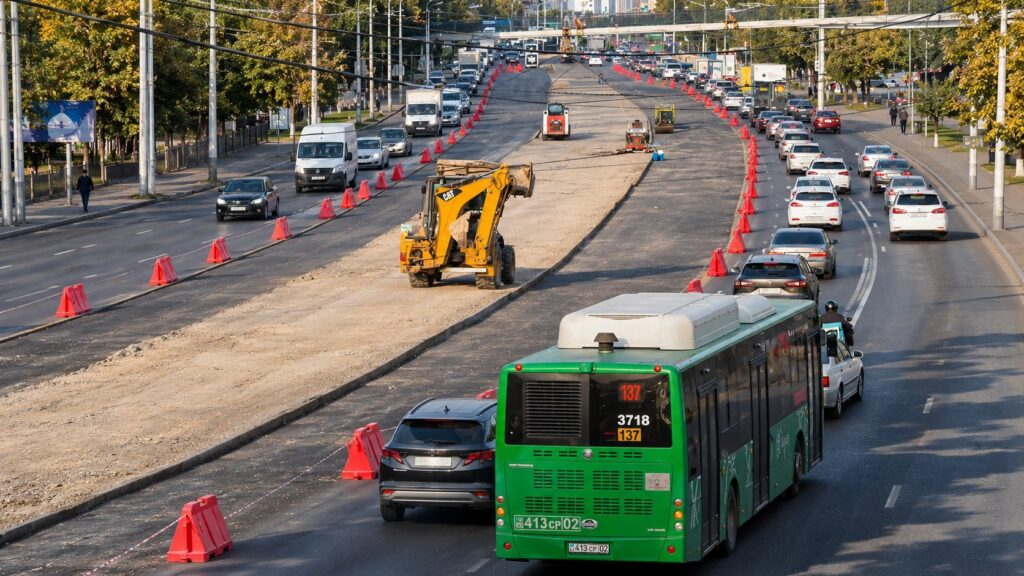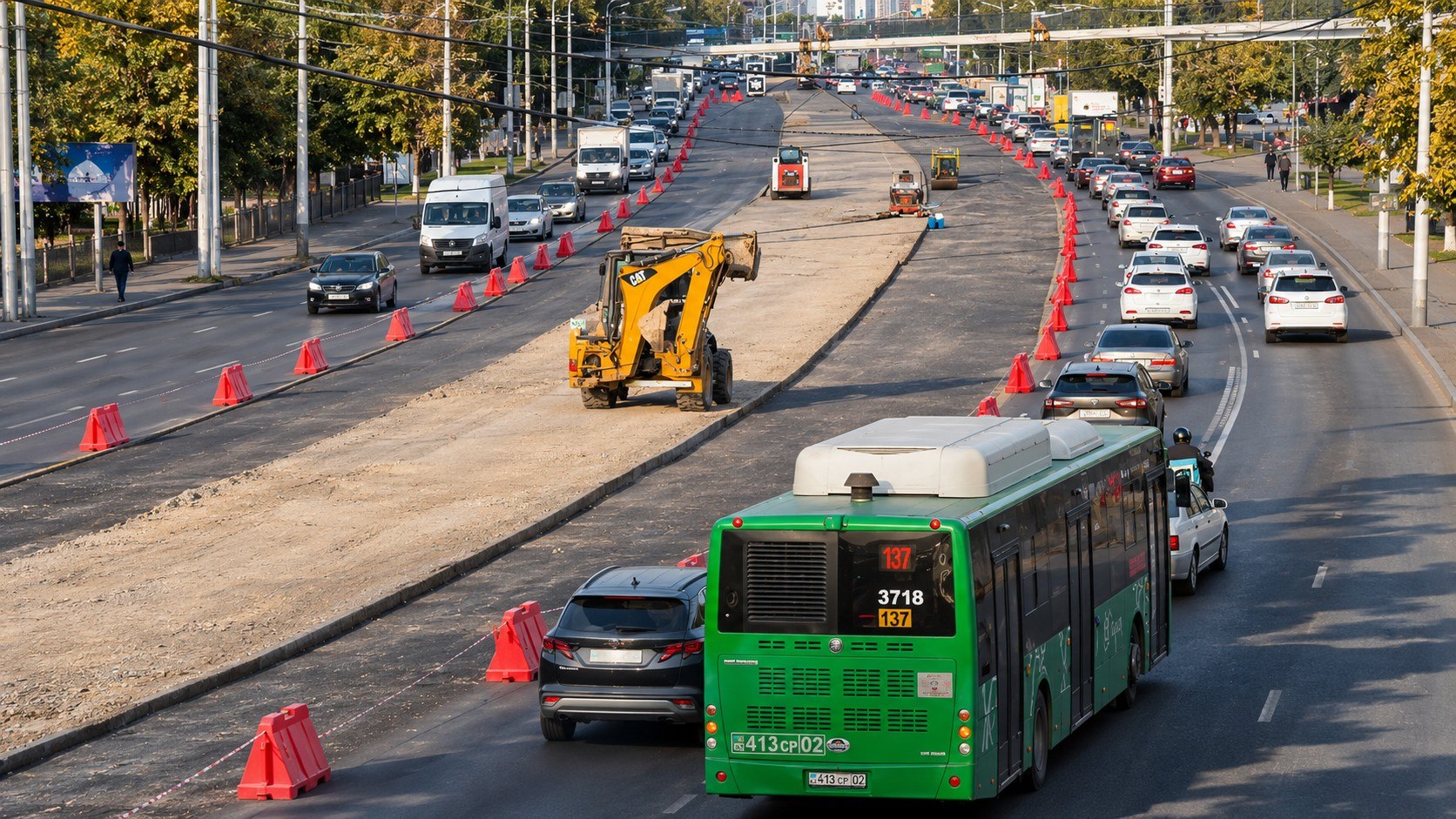
In early November, Almaty, Kazakhstan’s largest city and former capital, began dismantling a dedicated bus rapid transit (BRT) lane on Raiymbek Avenue. The city administration, known as the akimat, said the work was necessary to coordinate the bus route with the planned SkyTrain monorail system. According to Vlast, an earlier draft of the city’s master plan estimated construction costs at 567 billion tenge ($1.28 billion).
On November 12, the Urban Forum Kazakhstan public foundation appealed to President Kassym-Jomart Tokayev to reconsider the project before construction begins in 2027. Urban planning experts argue that the decision to build a monorail was made without properly assessing other forms of public transportation.
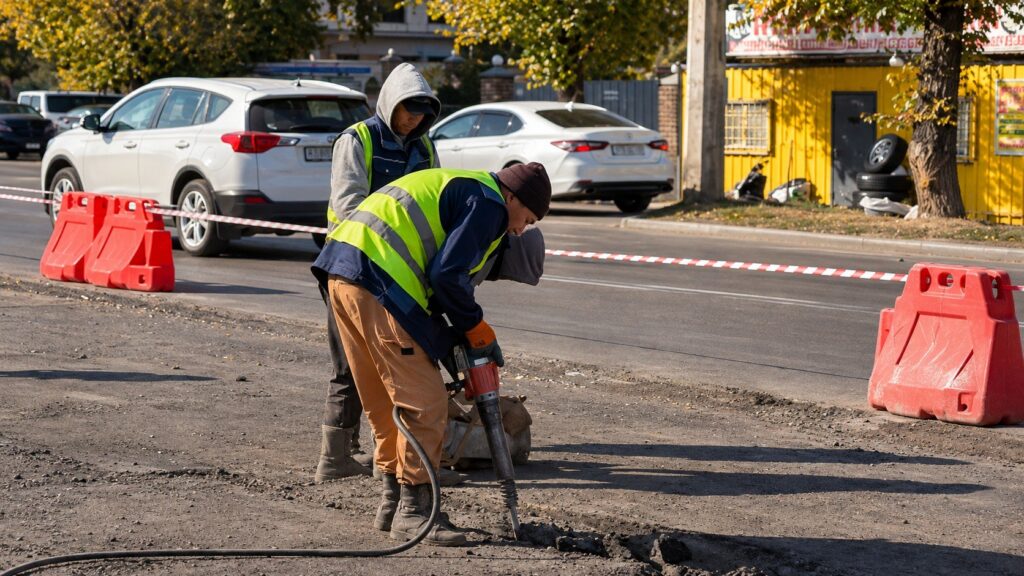
Image: TCA
The Dispute Over SkyTrain’s Routes
In June 2026, Tokayev instructed the administrations of Almaty and the surrounding Almaty region, together with Samruk-Kazyna, the national wealth fund that manages Kazakhstan’s largest state-owned companies, to explore the construction of high-speed lines beyond the city limits. These included connections to Alatau, a new satellite city being developed as an economic and investment hub. However, plans for routes within Almaty itself were already under discussion before this instruction.
Approximately 400,000 cars reportedly enter Almaty from the surrounding region every day. Suburban public transportation was intended to ease this burden, but both SkyTrain lines in the plans now being developed run within the city. Officials have said the network could eventually be extended into the surrounding region.
According to information released by Almaty’s Department of Road Infrastructure Development on November 17, the two SkyTrain lines will have a combined length of 46.4 kilometers. The project is scheduled for implementation between 2027 and 2030.
The first line will run along Raiymbek Avenue from the Barlyk transportation hub in western Almaty to the road connecting the city with Talgar to the east. The second will run from Sain Street along Al-Farabi Avenue and via the Eastern Bypass Road to the Halyk Arena complex. The tracks will be elevated 10–15 meters above ground, with trains traveling at an average speed of 35 kilometers per hour.
Earlier materials published by the Almaty Development Center indicated that the system would have 20 stations, while in September the Department of Road Infrastructure Development reported plans for 13 stations on the first line and 14 on the second, including two interchange stations. The official construction cost will be determined following a state review of the project.
According to preliminary estimates by the Almaty Development Center, each line could accommodate up to 40 million passenger trips annually.
Three Transportation Projects
Alongside preparations for SkyTrain, Almaty is building a light rail transit (LRT) line and reconstructing Raiymbek Avenue to accommodate bus rapid transit (BRT) services operating in dedicated lanes.
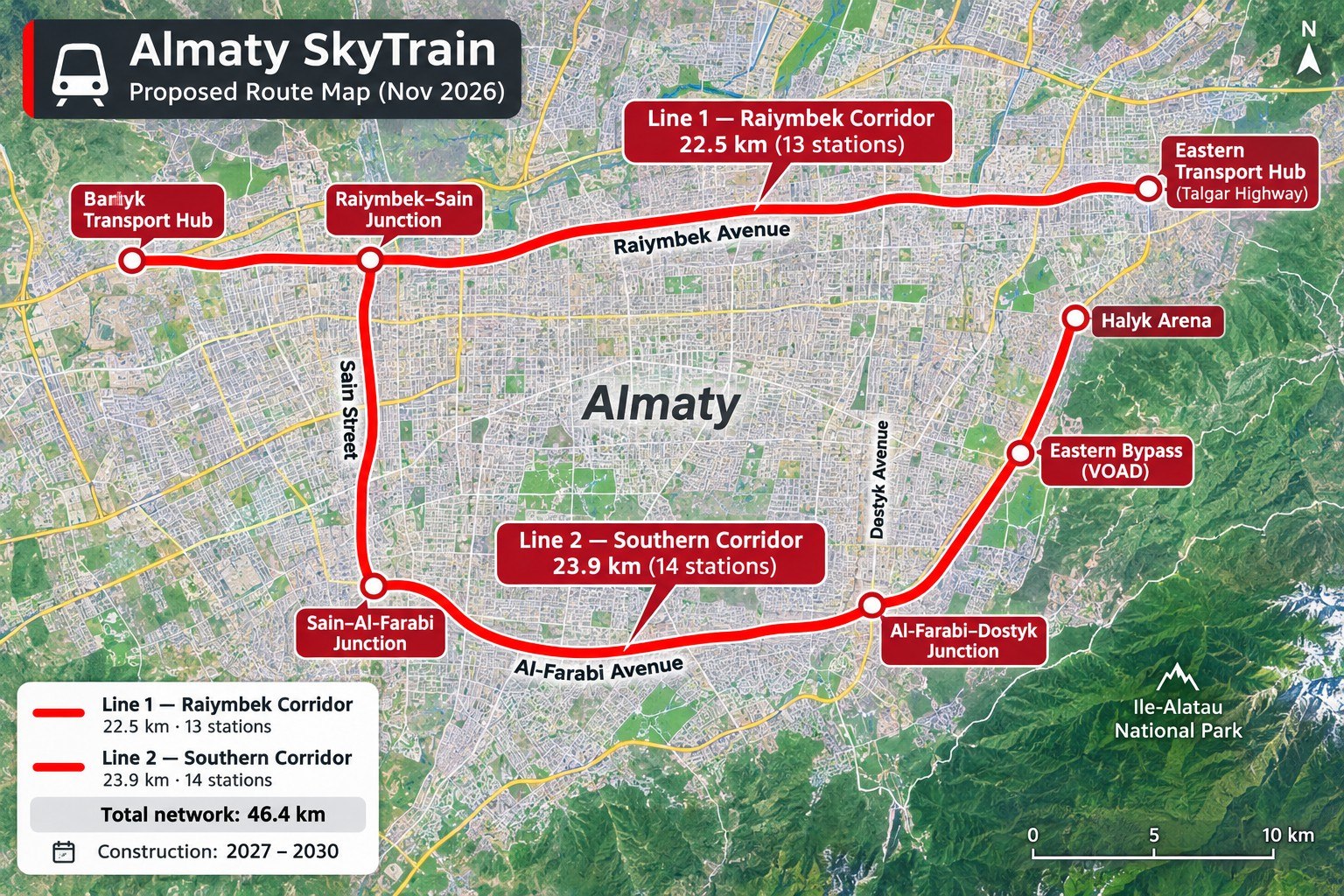
Image: TCA
Construction of the LRT system began in April 2026. The initial 18.3-kilometer section will include 34 stops. Some 61.4 billion tenge ($138 million) has been allocated for construction in 2026, with services scheduled to begin in late 2027. Almaty has been discussing the project since 2003, but its implementation has repeatedly been delayed.
Work on the 39.9 billion tenge ($90 million) BRT project along Raiymbek Avenue began in 2025. Construction was suspended by June 2026, when approximately 37% of the work had been completed, and in November workers began dismantling the dedicated lane already installed between Utegen Batyr and Yemtsov streets.
The city administration explained that the project was being revised to accommodate future SkyTrain construction and avoid having to reconstruct the avenue again. Officials are now considering moving the bus lanes from the center of the roadway closer to the sidewalks.
The general contractor is responsible for covering the dismantling costs. Officials say the construction work on the section being dismantled has not yet been paid for. The cost of BRT construction will be recalculated once the revised traffic layout is approved.
What Urban Planning Experts Propose
According to Urban Forum Kazakhstan, SkyTrain was not included in the existing master plan for the development of Almaty’s transportation network. The city authorities, however, say SkyTrain is now included in proposed revisions to Almaty’s general plan through 2040. A dedicated project directorate has already been established, and design work is underway.
The foundation questions the suitability of elevated tracks within the city. Long distances between stations could limit pedestrian access, while maintaining elevated infrastructure would entail additional costs.
Urban planning experts also point to the absence of published passenger demand studies, comparative assessments of the construction and operating costs of monorail, metro, LRT, and BRT systems, and information about the general contractor selection process. Vlast has identified Integra Construction KZ as the company selected to build SkyTrain, but reported that the authorities had not explained how it was chosen.
Urban Forum Kazakhstan proposes returning to the suburban transport concept: high-speed transportation connecting Almaty with its suburbs and the city of Alatau. Before construction begins, the foundation is calling for an independent review of the project, a comparison of alternative transportation options, and publication of the findings.
The Times of Central Asia previously reported on the construction of a new tram line in Almaty. The return of trams eleven years after the closure of the city’s former network has prompted debate among residents and urban planning experts over construction costs, project timelines, and transparency in contractor selection.