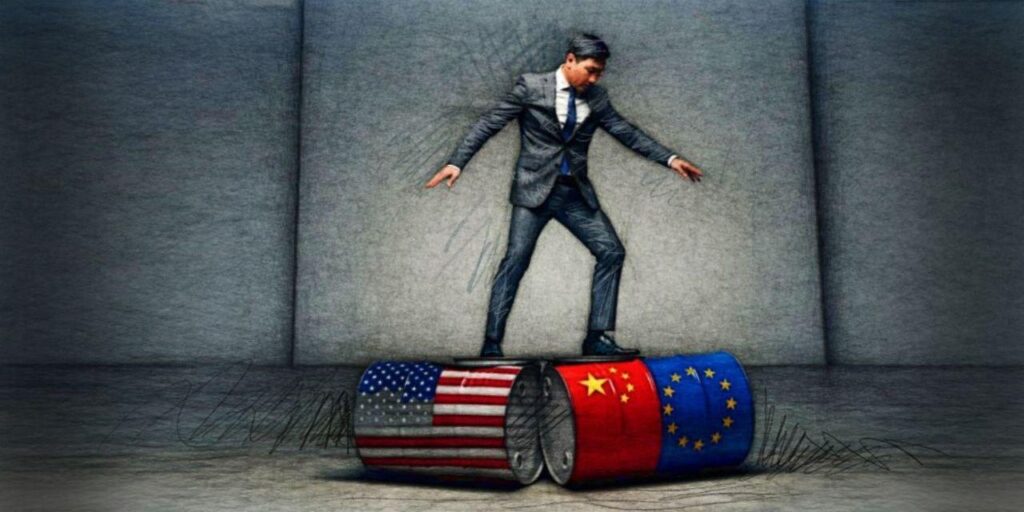
Kazakhstan will be hit with the largest U.S. tariffs among Central Asian states after President Donald Trump announced duties on goods from global trading partners, vowing to end what he calls unfair treatment of the United States even as concerns grow that a vast trade war carries grave risks for economies around the world.
According to a White House list released on Wednesday, Kazakhstan charges 54% tariffs on American goods and its own products will therefore be subject to duties of 27% when they arrive in the United States. A minimum baseline of 10% tariffs will also be applied to goods from Kyrgyzstan, Uzbekistan, Tajikistan, and Turkmenistan.
However, Kazakhstan has large reserves of minerals that could have applications in energy and other industries and might be exempted under terms of the Trump administration’s plan.
The measure against Kazakhstan reflects what the White House calls “an individualized reciprocal higher tariff” on countries with which the United States has its biggest trade deficits. The U.S. says its tariffs on nations around the world, which are to take effect in the coming days, can be increased if trading partners retaliate or can go down if those partners collaborate with Washington on economic and security matters.
The fallout from the Trump administration’s move remains to be seen, with many economists and other analysts warning that falling markets and the threat of higher prices, including in the United States, are a sign of the economic upheaval to come.
But a possible loophole for some Central Asian countries lies in the U.S. statement that some goods will not be subject to the tariffs. They include copper, pharmaceuticals, semiconductors, lumber, bullion, and “energy and other certain minerals that are not available in the United States.”
Kazakhstan said this week that it had discovered a huge rare earth metals deposit in the central region of Karaganda. By some estimates, the deposit could contain roughly 20 million tons of the coveted materials and is among the larger of more than a dozen similar deposits found in the country.
“The identified rare earth deposits and promising areas, if further confirmed, could position Kazakhstan as a global leader in rare earth element reserves and enable the rapid development of a high-tech rare earth metals industry,” the Ministry of Industry and Construction said, according to the Orda news organization.
Those natural resources are of interest to the United States. On March 12, U.S. Secretary of State Marco Rubio spoke with Kazakh Foreign Minister Murat Nurtleu and the U.S. “looks forward to working with Kazakhstan to deepen economic ties in the energy, telecommunications, and critical minerals sectors,” the U.S. State Department said.
U.S. tariffs and Central Asian resources are also likely to be discussed at a meeting of regional and European Union leaders in Samarkand, Uzbekistan, on Friday. The EU is seeking to expand trade ties with Central Asia as its longtime alliance with the United States unravels over trade and security matters.
More on this breaking story will follow.