CICA’s Next Chapter in Asian Cooperation
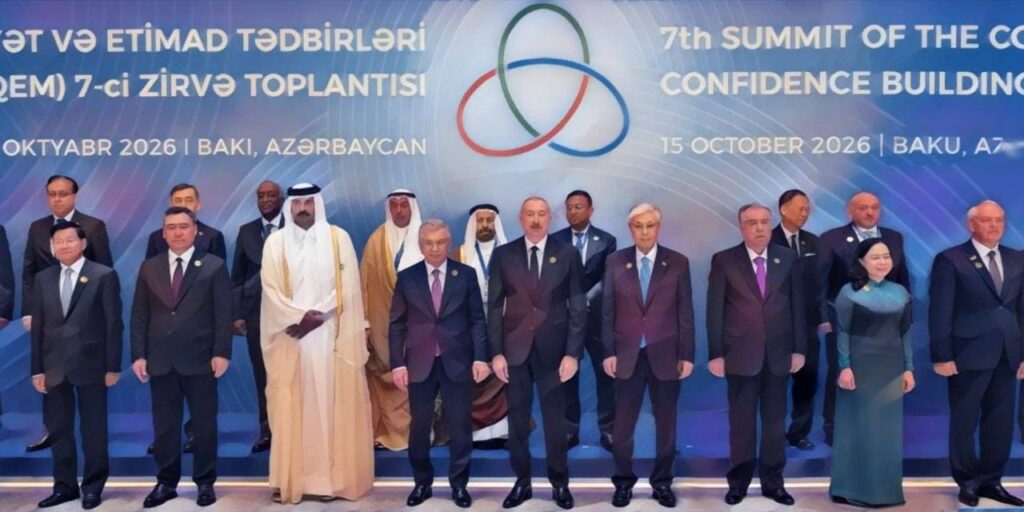
At the October 15 summit of the Conference on Interaction and Confidence Building Measures in Asia (CICA) in Baku, Kazakhstan proposed a mechanism for preventive diplomacy to address disputes before they escalate. President Kassym-Jomart Tokayev said the mechanism would give each member state a role in decision-making and help translate political commitments into coordinated action. If adopted, the proposal could increase Astana’s influence among Asia’s larger powers by making its founding initiative more enduring. Influence Through an Asian Agenda Kazakhstan already coordinates CICA’s military-political dimension, working with Türkiye on military exchanges, training-center visits, and seminars that include mediation. Kazakhstan could draw on these exchanges when seeking members’ agreement on a mandate for preventive diplomacy. They provide experience of organizing cooperation in a politically sensitive field, although a standing role in addressing emerging disputes would require a separate political agreement defining what members authorize the mechanism to do. The Think Tank Forum offers another example of Kazakhstan’s influence over CICA’s institutional development. China initiated the Forum in 2014; its transformation into a permanent CICA advisory body followed in October 2021, when member states acted on Tokayev’s initiative. Azerbaijan hosted the first meeting outside China in September 2025, at which the handover to the Indian Council of World Affairs was announced; the latter now chairs the Forum for 2026–2027. Kazakhstan thus helped turn a Chinese initiative into a permanent CICA advisory body that Azerbaijani and Indian institutions subsequently helped sustain. China also contributes funding and seconded personnel to the Secretariat; Kazakhstan can build influence by securing agreement on standing arrangements through which other members pursue their priorities. At the Baku summit, Tokayev also proposed establishing a CICA Water Partnership to promote joint research, technology exchange, and water-saving measures. He suggested that Central Asian countries and Azerbaijan could jointly advance a proposal for an International Water Organization under the United Nations. These proposals could give Kazakhstan a role in shaping cooperation on water security within CICA and, through a joint regional initiative, at the UN. Kazakhstan's Foundational Role in CICA's Development Kazakhstan conceived CICA in 1992 and has led its institutional development, including the effort to transform it into a full-fledged international organization. The initiative has a constituency extending well beyond Central Asia. Fifteen states adopted CICA’s first founding declaration in 1999. With Laos’s accession at Baku, CICA now has 29 members, ranging from China, India, Pakistan, and Russia to Iran, Israel, and South Korea. The 2022 Astana summit launched CICA’s transformation into a full-fledged international organization. The Road Map endorsed by member states in 2023 specified reforms through which to pursue that transformation. The reforms cover the Charter, implementation of confidence-building measures, procedural rules, and the Secretariat’s organization. These changes affect CICA’s capacity to carry agreements forward between high-level meetings. Within CICA, the consensus rule makes collective agreement a condition both of institutional change and of policy coordination. Kazakhstan thus has an interest in the procedures through which future cooperation will be organized. Cambodia’s pre-summit ratification of the convention on the Secretariat’s...
4 days ago