From October 1 to 3, Astana will host the AI & Digital Bridge conference, which is expected to draw more than 20,000 participants and over 100 technology companies. The wider AI Month begins on September 23 with HackAlem AI powered by OpenAI. Earlier editions of Digital Bridge have drawn a total of more than 127,000 participants from over 100 countries. Kazakhstan can bring such a gathering together because two decades of development have created the institutional and commercial base for its present AI strategy. Advanced computing capacity and large-scale technological investment now reinforce that base.
Building the Digital Base
Well before artificial intelligence became a central policy concern, Kazakhstan began building the digital-state capacity that underpins its current position. The e-government program dates from the mid-2000s. The 2017 Digital Kazakhstan program broadened that effort by linking the transition to a digital state with four other priorities: digitalization of economic sectors, development of the Digital Silk Road, human-capital development, and the creation of an innovation ecosystem.
Startup formation thereby entered policy not as a one-off technology initiative but as part of a wider program of institutional and economic digitization. Kazakhstan ranked 24th globally in the UN E-Government Development Index in 2024. By 2025, about 90% of public services were available online. By then, the eGov portal had more than 15 million registered users, while its mobile application had more than 11 million. Large-scale digital interaction between citizens and the state had thus become a daily fact of life before the present AI push began.
Public services inhabit the same digital environment as ordinary commercial transactions. Kaspi.kz reported 15.7 million average monthly active users in Kazakhstan at the end of 2025 and about 764,000 active merchants. Its Super App integrates payments with finance and commerce; it also carries government services. Digitalization has become part of everyday consumer behavior. In July 2026, internet and mobile banking accounted for 77.6% of non-cash transactions by number and 89.6% by value. Commercial adoption has accustomed much of the population to carrying out both routine transactions and more significant business transfers through digital systems. Infrastructure spending alone would not have produced the same result without the surrounding policy and commercial environment.
Almaty supplies the financial and corporate side of the ecosystem, complementing Astana’s policy and startup institutions. Together, the two cities anchor an economy accounting for more than half of Central Asia’s GDP. Kazakhstan also holds roughly two-thirds of the region’s inward foreign investment stock, according to TCA’s Central Asia Balance Sheet.
Institutional Concentration
These developments acquired an institutional center through Astana Hub, established in 2018. It brings firms and founders into the same network as investors. Participation brings concrete operating advantages, including tax preferences and simplified arrangements for hiring foreign specialists. Companies may hire such specialists without a numerical limit, with work visas available for up to five years. They can also enter incubation or acceleration programs and obtain access to financing mechanisms.
A 2026 World Bank appraisal described Kazakhstan as having built a credible technology-driven innovation foundation anchored by Astana Hub. It recorded 1,875 companies hosted by Astana Hub since its inception, of which 470 had received foreign private investment. The World Bank also noted partnerships with Plug and Play and Draper University’s Startup House. Other partnerships involved Alchemist and Google’s Silkway Accelerator. Training is organized through Astana Hub, while government support is channeled through the same network. External partnerships extend that network abroad.
The ecosystem now draws substantial demand and capital from outside the state sector. Kazakhstan’s IT-service exports rose from $33.5 million in 2020 to $1.142 billion in 2025. Astana Hub residents accounted for about $633 million of the latter figure, while the ecosystem supported more than 32,000 jobs. Some 537 companies were selling abroad, and Kazakhstani IT solutions had reached more than 110 countries. Kazakhstan attracted $209 million of the $320 million in venture investment across Central Asia in 2025, roughly 65% of the regional total. By then, funded Kazakhstani startups were valued collectively at $2.16 billion. Beyond venture funding, the Astana International Financial Centre operates under a legal framework based on principles of the laws of England and Wales. Kazakhstan’s established banking and securities markets add further financing capacity.
From AI Capacity to Regional Reach
Kazakhstan’s current AI drive adds new computing and research capacity for an already established digital economy. The country’s first AI Country Report identifies more than 100 AI startups and estimates that the Alem.Cloud and AI-Farabium clusters together provide around 3.6 exaflops of computing capacity. Together, the two clusters provide domestic capacity for AI training and inference, reducing reliance on infrastructure abroad.
The country is also developing its own AI models, trained for local languages and domestic data needs. Nazarbayev University’s Institute of Smart Systems and Artificial Intelligence released KAZ-LLM in December 2024. These developments build on existing institutional and commercial foundations. The expansion into AI and advanced computing is not a break with the earlier trajectory but a further layer of diversification.
President Kassym-Jomart Tokayev has moved AI and digitalization closer to the center of Kazakhstan’s economic strategy, linking technology infrastructure to higher-value industries and international investment. That strategy is backed by Central Asia’s largest electricity system. It generated 123.1 billion kWh in 2025, about 42% more than Uzbekistan’s 86.7 billion kWh. Although Kazakhstan still consumed more electricity than it generated, about 2.6 GW of new capacity is due online in 2026, with the government targeting an end to the deficit in early 2027. In Pavlodar Region, Data Center Valley’s first 50 MW facility is under construction, with a longer-term target of up to 1 GW.
Kazakhstan currently has about 11.1 Tbps of international internet capacity, compared with Uzbekistan’s 10.2 Tbps. Its Trans-Caspian fiber link, expected online in 2026, will add up to 6 Tbps, raising total capacity by roughly 54% to about 17.1 Tbps, potentially more than the rest of Central Asia combined. Kazakhstan has the region’s strongest route redundancy, an important component of connection stability. The new 12+ Tbps West–East backbone will further strengthen connectivity across Kazakhstan and toward Europe. For data centers, that combination of capacity and resilience is a material advantage.
Kazakhstan has also connected its domestic IT ecosystem more closely with outside capital and markets. Innovation hubs in Palo Alto, Shanghai, and Dubai give the ecosystem a presence abroad, while international accelerators and technology companies widen its external network. NVIDIA’s participation in the current conference cycle adds another such connection.
For Kazakhstani firms, such relationships create practical routes to investors and technical expertise while opening overseas markets. The overseas hubs give those connections a permanent institutional presence in major technology and financial centers, complementing domestic capital and expertise. Kazakhstan’s own AI Country Report nevertheless identifies shortages of experienced specialists and limited late-stage venture capital as continuing constraints. The pattern resembles Kazakhstan’s broader multi-vector strategy: technology and capital are drawn from several international centers, while training and access to markets are likewise diversified.
Kazakhstan’s Regional Position
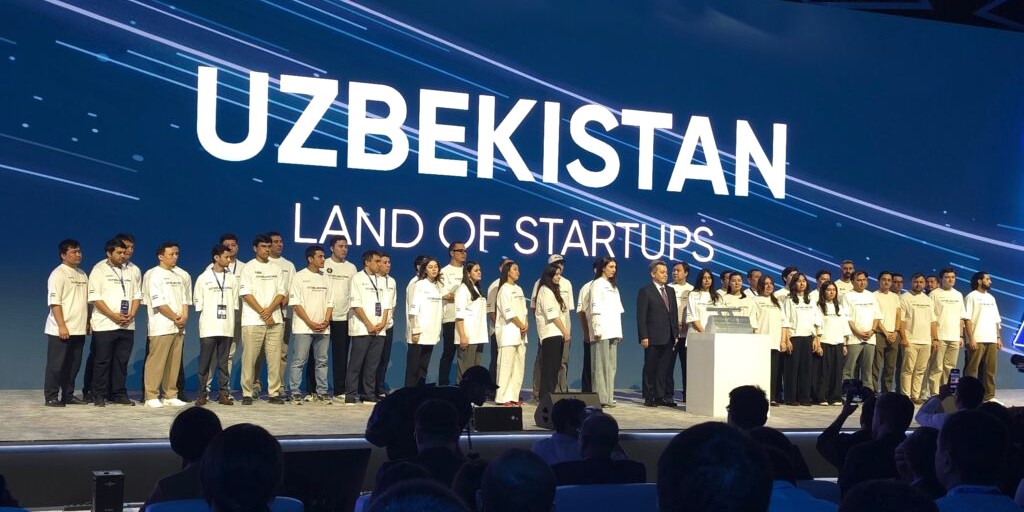
Kazakhstan’s regional position is better understood through the breadth of the digital ecosystem it has built than through any single measure of scale. Across Central Asia, technology sectors are expanding at different speeds and in different areas. Uzbekistan has recorded particularly rapid growth in IT exports and company formation: its IT exports approached $1 billion in 2025, while IT Park Uzbekistan reported more than 2,990 resident companies and over 44,000 jobs by mid-year. These figures demonstrate substantial scale, but they do not by themselves measure productivity, technical growth, or economic value.
The comparison shows why ecosystem integration cannot be reduced to isolated measures of scale. Digital government was established early in Kazakhstan, followed by mass commercial adoption. Startup institutions then concentrated firms and finance, while export capacity and advanced computing were added to that base. This development took place within Central Asia’s largest economy, with deeper capital markets, greater power generation, and stronger international connectivity than elsewhere in the region. Kazakhstan’s digital state has also had longer to develop.
The AI & Digital Bridge conference is not what makes Kazakhstan a regional digital hub. It reflects the accumulation of state capacity and market development over two decades, now reinforced by advanced computing and wider international reach. Astana can bring technology companies and investors together with specialists and policymakers because the underlying institutions, market, and infrastructure are already in place.