In the second installment of our exclusive two-part interview, The Times of Central Asia continues its deep dive into Kyrgyzstan’s evolving tech landscape with Elena Nechaeva, Head of Communications at the High Technology Park of the Kyrgyz Republic (HTP).
Last week, we explored the startups and entrepreneurs who are currently building and scaling global businesses.
If you missed it, you can read the first part of the interview here.
This week, we focus on policy reform, cross-border cooperation, investor outreach, and the path ahead for Kyrgyz entrepreneurs in an increasingly globally competitive market.

Image: The High Technology Park, Kyrgyz Republic
TCA: In terms of regulation and policy, what improvements or reforms would you like to see to better support innovation?
Elena Nechaeva: There are several policy improvements that could really accelerate innovation in Kyrgyzstan, and many tech leaders have been very open about them.
One of the biggest needs is a clearer national strategy for startups. Now, it’s not fully defined who exactly drives startup development and what the government’s long-term role should be. A coordinated approach with clear ownership would help the ecosystem grow much faster.
Another important area is venture legislation and a stronger legal framework. Founders and investors often mention the need for a proper venture law, elements of English common law, and better protection of intellectual property. These changes would make it far easier to attract long-term capital and for investors to feel confident working with local companies.
There’s also a lot of focus on the importance of modernizing higher education and expanding international partnerships. Strong engineering programs and links between academia and industry are essential for deep-tech development.
And finally, Kyrgyzstan needs policies that help retain and attract talent. The digital nomad visa is already showing positive results, but it can be expanded.
TCA: How does the Kyrgyz Republic’s tech ecosystem compare to others in Central Asia or the wider region?
Nechaeva: If you look at the region by population size, Kyrgyzstan is much smaller – about 7 million people, compared to nearly 20 million in Kazakhstan and over 36 million in Uzbekistan. And yet, with a far smaller talent pool and fewer resources, the country already exports more than $130 million in IT services, almost entirely to global markets.
Whilst Kyrgyzstan’s tech ecosystem is smaller than some of our neighbors, it is one of the fastest-growing. What makes it different is that it is being developed from the bottom up – driven by founders, engineers, and communities rather than large state programs. That’s why the ecosystem is very agile, open, with a real-world focus on exports.
Another difference is the mindset: Kyrgyz startups grow with a “global from day one” approach. They don’t build for a domestic market – they build for the U.S., Europe, and the wider world from day one. That creates a very different culture and pushes teams to compete internationally right from the start.
So, while our ecosystem is smaller in size, it’s fast, flexible, and globally focused, and that’s exactly why it’s gaining attention in the region.
TCA: Is HTP actively working to attract foreign investors or international companies? If so, how?
Nechaeva: Yes, the HTP is highly active in attracting foreign investors and international companies. We participate in major global tech events, GITEX Dubai, Gamescom, CES, Digital Bridge, ICT Week, Web Summit, and others, where we showcase Kyrgyz companies and IT solutions, meet with investors, and build long-term partnerships.
A central part of our strategy is the KIT Forum, our flagship annual event held at the end of May each year.
Last year, we welcomed participants from over 20 countries, hosted 60-plus speakers, drew more than 3,000 attendees, and featured over 40 companies at the expo.
HTP also operates a dedicated Global Development Department, which builds relationships with foreign companies, facilitates international communication, and works to attract both investors and tech firms to Kyrgyzstan.
Our approach is clear: maintain global presence, build trust, and demonstrate that Kyrgyzstan is an emerging tech hub with fantastic talent, competitive operating costs, and an open, business-friendly environment.
TCA: Are there partnerships or joint ventures with other tech parks or innovation hubs across the EAEU, CIS, or globally?
Nechaeva: Yes, Kyrgyzstan is actively engaged in several regional and international tech initiatives.
The country participates in regional forums and exchanges, such as the Digital Startup Awards (DSA), which held its semi-finals in Kyrgyzstan and brought together innovation hubs from across Central Asia, including Uzbekistan’s IT Park, demonstrating strong regional collaboration.
The Ministry of Digital Development and Innovative Technologies signed an MoU with Central Asia Capital Investment Fund to create a new technology hub in Tokmok, combining manufacturing, high-tech infrastructure, and startup support.
Another strong example is our cooperation with the Organization of Turkic States (OTS), which co-organized the KIT Forum, now a shared platform for innovation across the Turkic world.
We also partner with organizations like Accelerate Prosperity, which operates throughout Central Asia and supports cross-border startup programs, joint pitch sessions, and investor engagement.
TCA: What is the USP for launching a tech company in Kyrgyzstan right now?
Nechaeva: Kyrgyzstan’s unique advantage lies in its speed, affordability, and global accessibility. It’s one of the few places where you can register a company in just three business days, maintain 100% foreign ownership, and operate fully remotely without a physical office.
The regulatory environment is streamlined, government-backed, and legally protected, giving founders vital certainty.
HTP’s regulatory and fiscal framework has also been tailored for export-oriented tech businesses. The generous tax incentives ensure that more capital goes toward growth rather than taxation.
Operational costs are extremely competitive; Kyrgyzstan ranks among the most affordable countries globally, allowing startups to extend their runway and reinvest in product and talent. The banking infrastructure is also robust, with 21 banks and over 1,000 service points, making it easy for international founders to operate.
The country also boasts a growing, export-driven tech workforce supported by modern tech hubs, co-working spaces, and the HTP community of over 500 companies exporting to 63 countries. While the domestic market is small, the ecosystem is globally focused from the outset.
Finally, lifestyle is a major draw. Kyrgyzstan offers pristine natural beauty, rivers, forests, alpine lakes, and world-class mountains. You can finish a work call and be hiking or skiing within 20 minutes. For many in tech, the balance between global work and active outdoor living is a major incentive – think Boulder, Colorado, but without the price tag.
TCA: What new initiatives or developments can we expect from the High Technology Park in the next year or two?
Nechaeva: In the next 12-24 months, the HTP will evolve from being primarily a virtual tax regime into a more physical, innovation-driven ecosystem. One of our most exciting developments is the creation of a new High-Tech Laboratory, a space to bring together founders, researchers, deep-tech teams, and innovators from across the country.
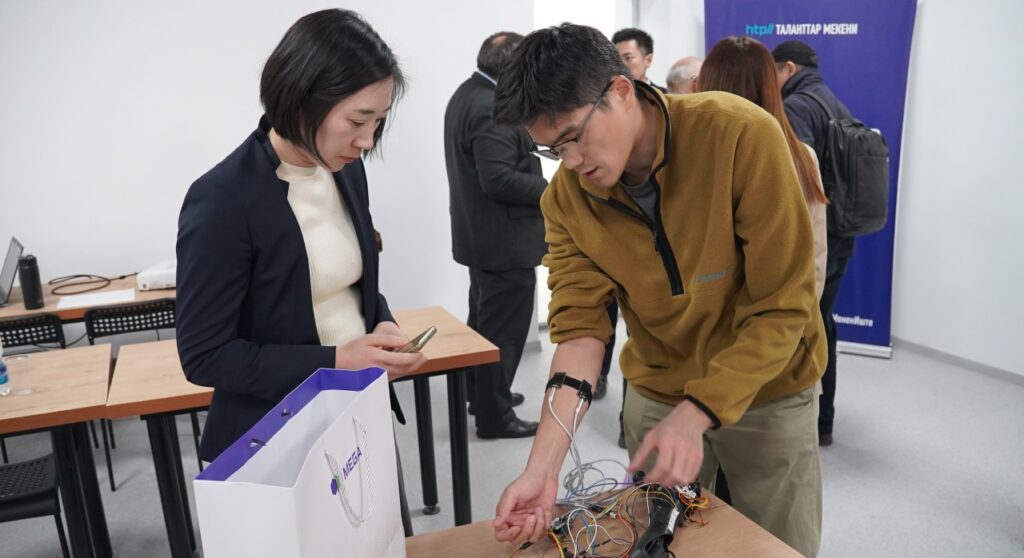
This initiative supports teams like ArtSkin, whose advanced work in prosthetic technology demands specialized infrastructure. The lab will enable experimentation, prototyping, and cross-disciplinary collaboration in AI, deep tech, engineering, and hardware at a level previously unavailable in Kyrgyzstan.
HTP will continue to be the region’s easiest place to launch a tech company, but soon, it will also be where breakthrough technologies are built.
TCA: How do you envision the HTP shaping Kyrgyzstan’s digital economy by 2030?
Nechaeva: By 2030, HTP aims to be a central driver for Kyrgyzstan’s digital economy. President Sadyr Japarov has already identified tech as a national priority.
Our goals include significantly increasing IT exports, scaling globally competitive product companies, and nurturing a deeper talent pool of engineers, researchers, and founders. HTP will be more than a launchpad; it will be the innovation core for deep-tech, AI, and engineering.
In 2024, HTP resident revenue reached $131 million, a more than sixfold growth since 2018. Under conservative projections, we expect revenues to hit $600-750 million by 2030, and under an accelerated strategy, to surpass $1 billion.
With a GDP of roughly $16-17 billion, this means IT already comprises around 1% of the national economy, nearly all from exports. If HTP maintains its trajectory, tech could account for 3-5% of GDP and 10-20% of exports, creating thousands of high-paying jobs in the country.
In short, if we meet our targets, IT will become one of the key pillars of the economy by 2030.
TCA: Are there emerging technologies or trends that the park is particularly focused on (e.g., blockchain, green tech, quantum computing)?
Nechaeva: AI is the leading area of focus for HTP. Teams are already working on speech tech, automation, analytics, and applied AI, with strong momentum continuing to build.
We are also increasingly focusing on blockchain and Web3. Kyrgyzstan recently hosted a major Web3 conference, and government interest in developing this sector is growing. HTP plans to support blockchain ventures through regulation, education, and global partnerships.
TCA: Finally, Elena, what message would you like to send to young Kyrgyz entrepreneurs or worldwide tech talent considering starting a technology business in Kyrgyzstan?
Nechaeva: In tech, the winners are those who spot opportunities before they go mainstream. They notice momentum in places others overlook.
Kyrgyzstan is one of those places: a small country with no coastline, no oil, and no vast population, but with something far more valuable: great Wi-Fi, a fantastic talent pool, low costs, a builder’s mindset, and a community that knows how to grow from the ground up; and did I mention how stunningly beautiful it is?
In the coming years, I hope that Kyrgyzstan will become a story of how a small nation used technology, creativity, and global reach to outperform expectations.
And right now is the perfect time to become part of that story, before it becomes the headline. The door is open. Jump in while the momentum is just beginning.
Thank you to Elena Nechaeva and the High Technology Park for providing The Times of Central Asia with such a detailed insight into Kyrgyzstan’s digital innovation ecosystem.
If you’re a seasoned entrepreneur, international investor, or aspiring entrepreneur, then you can find out more about the High Technology Park at: https://htp.kg/