• KGS/USD = 0.01144 0%
  • KZT/USD = 0.00192 -0%
  • TJS/USD = 0.10849 0%
  • UZS/USD = 0.00008 0%
  • TMT/USD = 0.28571 0%
  • KGS/USD = 0.01144 0%
  • KZT/USD = 0.00192 -0%
  • TJS/USD = 0.10849 0%
  • UZS/USD = 0.00008 0%
  • TMT/USD = 0.28571 0%
  • KGS/USD = 0.01144 0%
  • KZT/USD = 0.00192 -0%
  • TJS/USD = 0.10849 0%
  • UZS/USD = 0.00008 0%
  • TMT/USD = 0.28571 0%
  • KGS/USD = 0.01144 0%
  • KZT/USD = 0.00192 -0%
  • TJS/USD = 0.10849 0%
  • UZS/USD = 0.00008 0%
  • TMT/USD = 0.28571 0%
  • KGS/USD = 0.01144 0%
  • KZT/USD = 0.00192 -0%
  • TJS/USD = 0.10849 0%
  • UZS/USD = 0.00008 0%
  • TMT/USD = 0.28571 0%
  • KGS/USD = 0.01144 0%
  • KZT/USD = 0.00192 -0%
  • TJS/USD = 0.10849 0%
  • UZS/USD = 0.00008 0%
  • TMT/USD = 0.28571 0%
  • KGS/USD = 0.01144 0%
  • KZT/USD = 0.00192 -0%
  • TJS/USD = 0.10849 0%
  • UZS/USD = 0.00008 0%
  • TMT/USD = 0.28571 0%
  • KGS/USD = 0.01144 0%
  • KZT/USD = 0.00192 -0%
  • TJS/USD = 0.10849 0%
  • UZS/USD = 0.00008 0%
  • TMT/USD = 0.28571 0%
12 December 2025

Turkish Holding to Invest $10 Billion in Kyrgyz Hydropower Projects

Turkish conglomerate Ihlas Holding plans to invest $10 billion in the construction of two major hydroelectric power plants in Kyrgyzstan, the 912 MW Kazarmanskaya plant and the 1,305 MW Kokomeren plant, according to the Kyrgyz Ministry of Energy.

In Bishkek, Energy Minister Taalaibek Ibraev signed a final investment agreement with Central Asian Investment Holding, a subsidiary of Ihlas Holding, for a cascade of hydropower facilities on the Naryn and Kokomeren rivers. The total planned capacity is 2,217 MW.

In addition to building the plants and associated infrastructure, the project will include training engineers to operate the new facilities and supplying the Ministry of Energy with specialized equipment.

Under the agreement, the investor will provide $5 million in sponsorship funding annually from 2025 to 2030. The funds will support orphaned children and social programs in the regions where the hydropower plants will be built.

According to Turkish media, the deal grants Ihlas Holding a 20-year operational right over the stations, with the Kyrgyz government guaranteeing to purchase the electricity produced in foreign currency.

Ahmet Mujahid Eren, Chairman of Ihlas Holding’s Board of Directors, said Turkey faced similar energy challenges in the 1990s.

“At that time, losses exceeded 50 percent. After privatizing distribution networks and modernizing infrastructure, we reduced this figure to a minimum. We want to apply this experience to create not only new energy capacity, but also modern, exemplary infrastructure,” he said.

Tokayev Awarded Ninth-Degree Black Belt in Taekwondo

On Tuesday, President Kassym-Jomart Tokayev was awarded a ninth-degree black belt, the highest distinction in taekwondo, by Chungwon Choue, president of World Taekwondo (WT), during his visit to Astana.

The WT president arrived in Kazakhstan to attend the Kazakhstan Open 2025, an international G-1 ranking tournament taking place from August 14-16. More than 750 athletes from 22 countries will compete in three age categories: cadets, juniors, and adults.

On the eve of the tournament, Tokayev presented Choue with the Order of Dostyk, Second Class, in recognition of his contribution to the global development of taekwondo. In return, Choue awarded the Kazakh leader the ninth-degree black belt, symbolizing the highest level of skill and knowledge in the sport.

Tokayev said Choue’s visit was a significant event for Kazakhstan’s sporting community and reaffirmed World Taekwondo’s readiness to support the discipline’s growth in the country. Hosting major international competitions in Astana, he noted, will create new opportunities for Kazakhstani athletes and strengthen the national federation’s position.

Earlier, Choue met with Gennady Golovkin, President of the National Olympic Committee of Kazakhstan, to discuss the future of taekwondo in the country. The WT president announced that e-Taekwondo will be added to the Youth Olympic Games and continental championships from 2026. Kazakhstan has already secured the right to host the Grand Prix Final in 2026 and is preparing a bid for the 2027 World Championships.

As previously reported by The Times of Central Asia, Taekwondo has been part of the Asian Indoor and Martial Arts Games program and has featured in both the Olympic and Paralympic Games since 2000.

How Could the Armenia-Azerbaijan Peace Accord Benefit Central Asia?

On August 8, Armenia and Azerbaijan signed a peace accord in Washington and committed to the construction of the Trump Route for Peace and Prosperity, a trade route that bisects Armenia, connecting the two parts of Azerbaijan.

The deal may have far-reaching repercussions on the other side of the Caspian, potentially diversifying the Trans-Caspian Middle Corridor by allowing travel from Azerbaijan, through Armenia, and onwards to Turkey.

The upbeat mood music may be premature, however. There remain numerous political hurdles to be jumped before any construction can commence, and the entry of the United States into a region where Russia, Iran, and Turkey all have interests could have unintended consequences.

“It’s certainly an opportunity, but there are risks,” said Azerbaijani political analyst and non-resident fellow at the China-Global South Project, Yunis Sharifli. “The United States can be a stabilizing force, but it could go in the opposite direction. It can also create a spoiler.”
The Problem

Armenia and Azerbaijan have maintained ice-cold relations for almost their entire existence as independent states. For over three decades, they tussled over the status of Nagorno-Karabakh, a land which lies in the internationally recognized territory of Azerbaijan, but was, upon independence, populated mainly by Armenians.

As well as costing thousands of lives and leading to hundreds of thousands of displaced persons, the enmity has also led to shuttered frontiers, which have choked trade across the South Caucasus. Armenia’s borders with both Azerbaijan and Turkey have been closed since 1993.

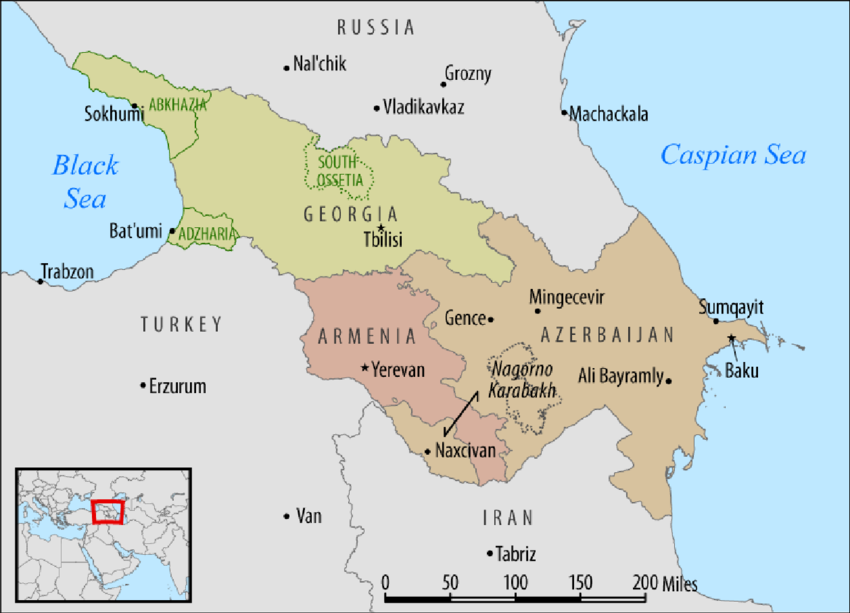
While Armenia has been cut off from two of its four neighbors, Azerbaijan has also been severed in two, with the exclave of Nakhchivan, which borders Turkey, separated from the rest of the country by a sliver of Armenian territory, just 20 miles wide at its narrowest point.

Conflicts in 2016, 2020, and 2023 saw Azerbaijan push Armenian troops from the region, with hundreds of thousands of Armenians fleeing Nagorno-Karabakh in fear of Azerbaijani reprisals. Since then, Baku has used its vast military superiority and geopolitical advantage to try to strongarm Armenia into accepting the construction of a corridor across its territory, threatening to use force on numerous occasions if Yerevan did not agree to its demands.

The Solution

Starting early this year, the United States began facilitating secretive negotiations between the pair, stepping into the vacuum left by Russia. The Kremlin has been sidelined from the process amid its deteriorating relations with both sides – many Armenians view Moscow as having betrayed them in the conflicts of 2020 and 2023, while Azeri-Russian relations have frayed significantly since the shooting down of Azerbaijan Airways Flight 8243 to Grozny earlier this year.

The timing of the signing ceremony, on the anniversary of the Russian invasion of Georgia in 2008, was perhaps designed to reflect this shift in geopolitical alignment in the South Caucasus.

Baku and Yerevan have signed up to a project which will see the construction of the corridor run by a U.S. private company, but under the laws of the Republic of Armenia. The Financial Times reported that in the long term, it is set to include a rail link, oil and gas pipelines, and fiber-optic cables.

Pitfalls

Nevertheless, distrust and bitter enmity remain high on both sides, and there is still a long way to go before a full restoration of relations and the widespread opening of borders.

According to Benyamin Poghosian, Senior Research Fellow at the think tank, APRI Armenia, two key issues need to be overcome. The first is that both sides can interpret the peace declaration in different ways: both sides have agreed to form a corridor which should be operated under Armenian jurisdiction, but give unimpeded access to Azerbaijan.

“Azerbaijan will say, ‘in the declaration, we have unimpeded access, so I demand no passport and customs control.’ Armenia will say, in the same declaration, in the same article, it says the route should be operated under Armenian jurisdiction. So, we need territorial integrity, which means passport and customs control,’” Poghosian explained.

He notes that a similar declaration in November 2020, in which both countries committed to building a corridor that would be protected by troops from the Russian Federation Security Service (FSB), failed to come to fruition.

Baku also wants to see Yerevan change the language of its constitution to remove a reference that, in its view, enshrines a claim to Nagorno-Karabakh.
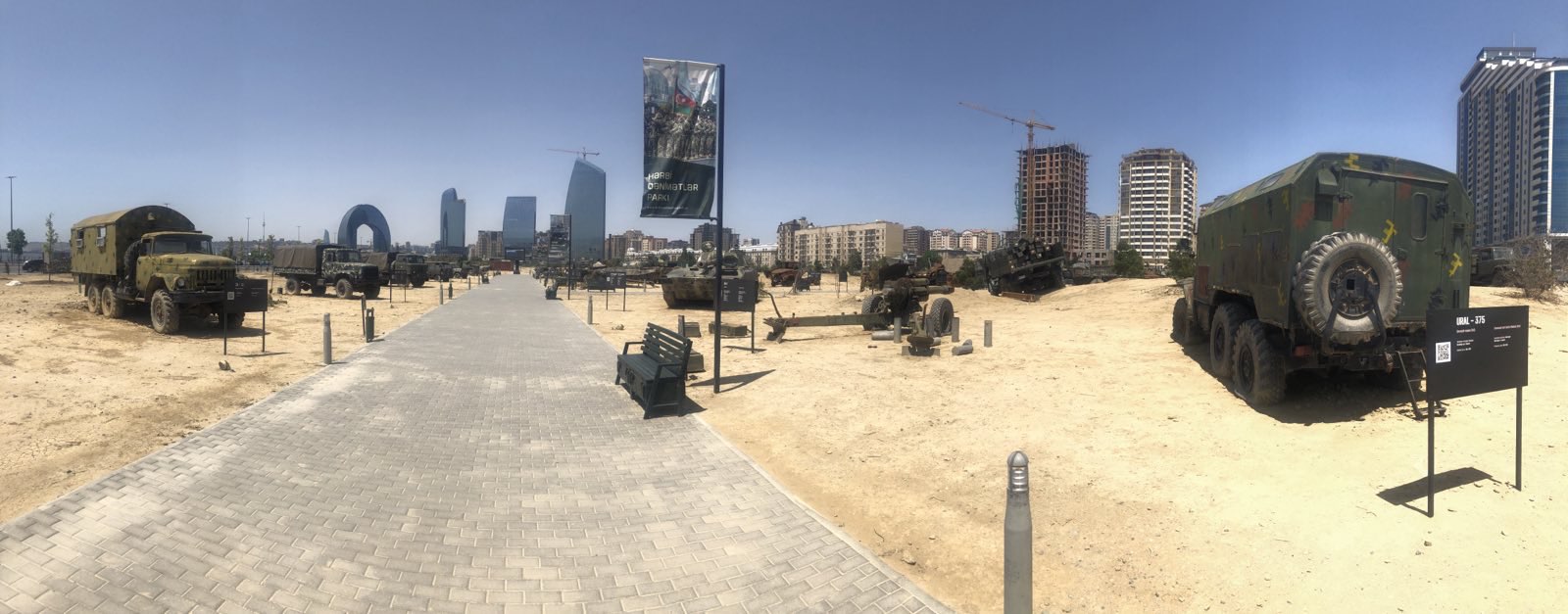
Captured military equipment from the 2020 Karabakh conflict on display in Baku, 2022; image: Joe Luc Barnes

“There are some articles in the constitution that can be changed by parliament, but the part that, in the view of Baku, makes territorial claims on Azerbaijan is in the preamble, and can only be changed via a referendum.”

Poghosian speculates that this is most likely to take place next year, potentially as part of the Armenian Parliamentary Elections in June 2026.

Consequences for Central Asia

The potential unfreezing of this route, under the auspices of the United States, could present a boon to countries beyond the Caucasus.

“It’s not only about the Nobel Prize for Trump, it’s also about the United States’ interest in creating new routes that are independent from Russia and China,” said Sharifli.

There is now a prospect that the Middle Corridor route could be simplified to involve just three countries: Kazakhstan, Azerbaijan (via the Armenian transit route), and Turkey.

This has the potential to loosen the leverage of Georgia, whose government has rapidly become Russia’s main ally in the region, while also providing an alternative route for Turkey.

Sharifli notes that while there are not necessarily any problems with the Georgian route, it runs very close to Russian troops stationed in South Ossetia, while key Georgian infrastructure projects, such as a new deep-sea port at Anaklia, will be built and operated by Chinese firms.
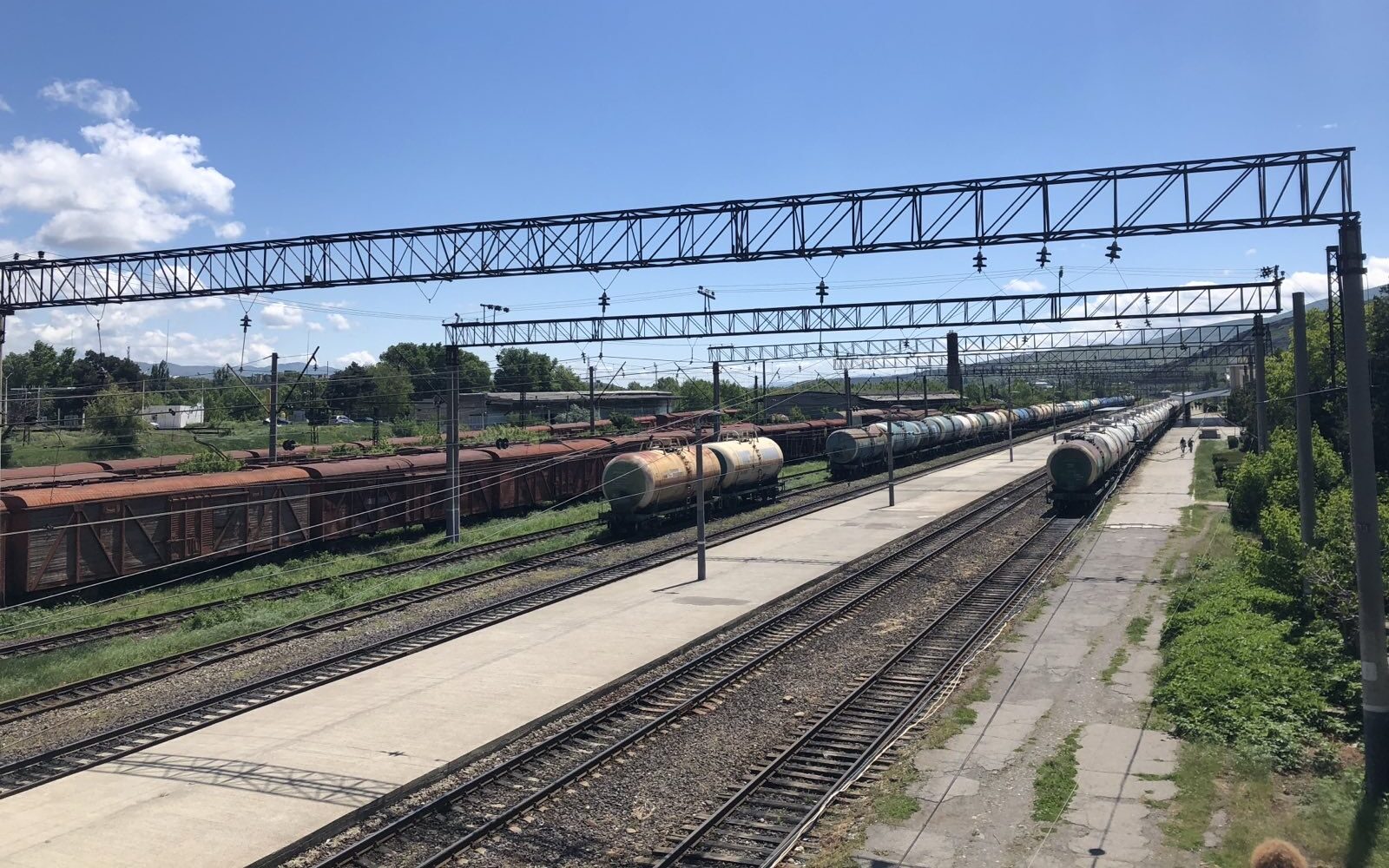
The Tbilisi-Poti railway in Gori, Georgia; image: Joe Luc Barnes

“The United States is engaging with Central Asian countries, particularly on critical minerals,” Sharifli told The Times of Central Asia. “They already signed an agreement with Uzbekistan on uranium, Kazakhstan will also likely see more engagement because Central Asia is an untapped market in terms of critical minerals. To import these resources, the United States also needs to secure the route.”

Others, such as Poghosian, believe that such a pitch is less based on economics than on Turkish-Azerbaijani geopolitics, and the real aim is to secure international funding and support to facilitate trade between the two countries.

Using the Trump Route as part of the trans-Caspian Middle Corridor is, he says, “mostly a geopolitical way to connect Turkey with Azerbaijan, to increase Turkish influence, and also to create problems for Iran. While many in Armenia would be happy to be part of big global transit routes, but there are serious concerns from objective experts about how much such a route would be used,” Poghosian adds, noting that the current railroad between Baku, Tbilisi, and Kars is running at “less than 20% capacity”.

Assylbek Nurgabdeshov, Assistant Professor of International Business at Edinburgh Business School, Heriot-Watt University, also puts the small scale of the planned route into perspective. “The Turkish government is building a railway from Kars to the border of Nakhchivan, but the capacity of that railway will only be 2 million tons per year. The capacity of Baku-Tiflis- Kars is now around 5 million, and they are planning to increase that to 17 million.”

Addressing Other Flaws

All this points to the fact that, despite the welcome signs from the Oval Office, the Middle Corridor has more pressing problems. The biggest bottleneck on the route remains the Caspian Sea, whose inclement weather, receding shorelines, and lack of ships can stop cargo for days on end.

“One of the main barriers is the number of vessels that are transporting those goods,” said Nurgabdeshov. This is exacerbated by the lack of a fixed schedule for crossings. He notes that while both Azerbaijan and Kazakhstan are working to grow the number of crossings, as well as improving the digital and physical infrastructure in their respective ports, the lack of reliability can end up costing businesses.

The Caspian Sea has noticeably retreated over recent years. Aktau, May 2025; image: Joe Luc Barnes

“Someone who is sitting in Amsterdam wants to know in how many days the cargo will be delivered from China to Amsterdam. And they don’t care if the ferry crossing the Caspian will be full or not. They just want to know exactly what time their goods will be there.”

Nurgabdeshov notes that in the future, competition from the Northern Corridor – a route running through Kazakhstan, Russia, and Belarus – will remain strong despite tensions between the EU and Russia, and this is partly a reflection of reliability and corporate habits. Whether the Middle Corridor can survive in a future where sanctions on Russia may one day be lifted will partly hinge on whether it can prove to be equally reliable.

“If the Middle Corridor can prove that it is a reliable, less risky route, it has a chance to continue with the same amount of goods transportation when the Russian road is opened,” he stated.

Armenia’s PM to Visit Kazakhstan Amid Historic Peace Breakthrough and Economic Opportunities

Astana is preparing to host Armenian Prime Minister Nikol Pashinyan on an official visit scheduled for late 2025. On August 12, President Kassym-Jomart Tokayev had a call with Pashinyan, during which, according to an official statement, he praised the “outstanding qualities” of the Armenian Prime Minister, “as a politician with strong political will and a strategic vision of the national interests of his state.” The forthcoming trip follows what U.S. Secretary of State Marco Rubio described as “the beginning of a peace deal” between Armenia and Azerbaijan, which was signed in Washington, D.C. on August 8, 2025, marking a pivotal moment in the South Caucasus after decades of conflict.

At the White House, Pashinyan and Azerbaijani President Ilham Aliyev signed a framework pledging to respect each other’s territorial integrity, renounce the use of force, and dissolve the long-standing OSCE Minsk Group mediation format. The agreement also approved the creation of a major transit corridor — dubbed the Trump Route for International Peace and Prosperity (TRIPP) — linking Azerbaijan’s mainland to its exclave of Nakhchivan via Armenian territory.

Kazakh President Kassym-Jomart Tokayev welcomed the accord as a “historic achievement” that not only ends a decades-long military standoff but also creates space for a deeper regional economic and diplomatic reset. In recent talks, Pashinyan briefed Tokayev on the details of the framework, the decision to dissolve the Minsk Group, and the TRIPP initiative. Both leaders emphasized the potential for new investment opportunities emerging from the stability the deal promises to bring and agreed to maintain an active political dialogue.

For Kazakhstan, the visit reinforces its positioning as a neutral mediator between Eurasian powers, willing to offer diplomatic platforms for peace talks. In May 2024, Astana hosted ministerial-level Armenia–Azerbaijan negotiations in Almaty. With the TRIPP corridor set to enhance connectivity across the South Caucasus, Kazakhstan’s role in facilitating regional integration could expand beyond mediation into infrastructure, trade, and energy cooperation.

Economically, the corridor offers Armenia new opportunities to become a transit hub between Central Asia and Europe, while Kazakhstan could benefit from more direct westward routes for its exports. Previous bilateral meetings have already laid the groundwork for business forums and joint initiatives in transport, technology, and investment, and the visit could provide the political momentum needed to bring these plans to fruition.

Challenges remain, however. In Armenia, nationalist factions have criticized the peace deal, with border demarcation and the fallout from the Second Nagorno-Karabakh War remaining sensitive issues. Iran has also expressed opposition to the TRIPP corridor, citing concerns over shifting regional influence. Yet both Yerevan and Astana appear determined to use the current diplomatic window to solidify long-term cooperation.

As the South Caucasus recalibrates, Pashinyan’s upcoming visit to Astana will test whether the political optimism generated in Washington can translate into tangible projects. For Kazakhstan, this presents an opportunity to deepen bilateral ties, demonstrate its growing influence as a stabilizing force, and secure a stake in the region’s new economic and geopolitical landscape.

Ending the War: Tokayev and Zelenskyy Talk Ahead of Trump-Putin Meeting in Alaska

“A bad peace is better than a good war.”

That was the advice from Kazakh President Kassym-Jomart Tokayev to Ukrainian President Volodymyr Zelenskyy in a phone call on Sunday in which the two leaders discussed prospects for a resolution to the war between Russia and Ukraine. 

Whether Zelenskyy agreed with Tokayev’s comment is open to question. In a readout of the conversation from the Ukrainian presidency, he used other adjectives to describe the kind of peace that Ukraine wants –“reliable” and “real.” 

The talk happened ahead of a meeting in Alaska on Friday between U.S. President Donald Trump and Russian President Vladimir Putin that Ukraine fears could leave it left out of deliberations and provide momentum for an end to the conflict on Russia’s terms. 

Tokayev told Zelenskyy that Kazakhstan has advocated for a solution that adheres to the United Nations Charter and respects “the inviolability of the borders of sovereign states, and the territorial integrity of sovereign states.”

While that statement implies criticism of the current state of affairs, in which Russia occupies an estimated 20 percent of Ukrainian territory, Tokayev also appeared to suggest that Ukraine should be prepared to make difficult compromises over territory because its independence as a nation was on the line.   

“In his view, given the current highly complex situation, it is essential to approach the resolution of the conflict with balance and reason, ensuring the preservation and protection of Ukraine’s statehood,” Kazakhstan’s presidential office said. “He stressed that all parties should be guided by the wisdom that ´a bad peace is better than a good war.´”

Tokayev stirred some debate last year when he said that Russia was too strong to be defeated on the battlefield. Critics interpreted the remark as defeatism in the face of Russian aggression, while others thought it was a blunt assessment of the war. Kazakhstan and other Central Asian countries have tried to be neutral in the conflict, not endorsing the Russian invasion but maintaining traditional ties with Moscow.

The Ukrainian presidency said Zelenskyy, in remarks to Tokayev, “noted that attempts to partition any independent state are extremely dangerous for every nation. History has repeatedly shown that if such injustice is allowed against one state, it does not end there.”

While Zelenskyy has ruled out territorial concessions to Russia, a poll conducted by the Kyiv International Institute of Sociology in May and June explored the nuance of the topic in a population that is both defiant and weary after years of war. The results show that “the only option where there is at least room for discussion is de facto recognition of Russian control without de jure recognition,” according to the institute.  

Zelenskyy invited Tokayev to visit Ukraine, according to the Ukrainian presidency. The Kazakh statement didn’t mention the invitation. 

Kazakhstan’s Vast Coal Reserves Could Fuel Energy Needs for Centuries

Kazakhstan’s coal reserves are expected to last between 200 and 300 years, depending on the rate of extraction, according to an analytical study by the Caspian Commodity Exchange.

The study notes that Kazakhstan ranks among the world’s top ten countries for proven coal reserves, estimated at 25 to 33 billion tons, and eighth in terms of production. In 2023, the country produced 112.7 million tons of coal, followed by 109.8 million tons in 2024. Exports for those years totaled 31.9 million tons and 29.5 million tons, respectively. At current production rates, reserves could last for 300 years; if output increases, they would last at least 200 years.

About 25 companies operate in Kazakhstan’s coal sector, with 75% of production concentrated among four major players: Bogatyr Komir LLP (about 40% of the market), Euro-Asian Energy Corporation (EEC), Shubarkol Komir JSC, and Qarmet (formerly ArcelorMittal Temirtau JSC). Domestic consumption accounts for 72% of coal use, with the remainder exported, mainly to Russia, which takes about two-thirds of supplies. In 2023, Kazakhstan ranked among the top five coal suppliers to the EU, holding an 8.7% market share, according to the European Commission.

The power sector is the largest domestic consumer, using 59% of coal, followed by households (8%) and industry (5%). Coal makes up roughly 50% of the country’s primary energy consumption. In 2023, thermal power plants generated 77.4% of Kazakhstan’s electricity, with coal-fired plants providing 66% of that output. Coal is also the primary source of heat, covering 80% of demand. In Astana, coal-fired combined heat and power plants (CHPs) account for 97% of heat generation, while in Almaty the figure is 56%.

Coal combustion is responsible for about 70% of Kazakhstan’s greenhouse gas emissions, creating a challenge for the government’s target of achieving carbon neutrality by 2060. Nonetheless, analysts forecast that coal will remain a key energy source in the medium term, accounting for 46% of the energy balance in 2035, down from 66% in 2023. Coal-based power generation is expected to decline by just 9% over that period.

Long-term projections point to a more significant decline in coal’s share, driven by the expansion of renewable energy, which is forecast to account for 24.4% of electricity generation by 2035 and 50% by 2050.

Another factor will be the commissioning of Kazakhstan’s first nuclear power plant, construction of which began last week, which will partially replace coal generation in the domestic market.