• KGS/USD = 0.01144 0%
  • KZT/USD = 0.00193 -0%
  • TJS/USD = 0.10876 0.55%
  • UZS/USD = 0.00008 0%
  • TMT/USD = 0.28490 0%
  • KGS/USD = 0.01144 0%
  • KZT/USD = 0.00193 -0%
  • TJS/USD = 0.10876 0.55%
  • UZS/USD = 0.00008 0%
  • TMT/USD = 0.28490 0%
  • KGS/USD = 0.01144 0%
  • KZT/USD = 0.00193 -0%
  • TJS/USD = 0.10876 0.55%
  • UZS/USD = 0.00008 0%
  • TMT/USD = 0.28490 0%
  • KGS/USD = 0.01144 0%
  • KZT/USD = 0.00193 -0%
  • TJS/USD = 0.10876 0.55%
  • UZS/USD = 0.00008 0%
  • TMT/USD = 0.28490 0%
  • KGS/USD = 0.01144 0%
  • KZT/USD = 0.00193 -0%
  • TJS/USD = 0.10876 0.55%
  • UZS/USD = 0.00008 0%
  • TMT/USD = 0.28490 0%
  • KGS/USD = 0.01144 0%
  • KZT/USD = 0.00193 -0%
  • TJS/USD = 0.10876 0.55%
  • UZS/USD = 0.00008 0%
  • TMT/USD = 0.28490 0%
  • KGS/USD = 0.01144 0%
  • KZT/USD = 0.00193 -0%
  • TJS/USD = 0.10876 0.55%
  • UZS/USD = 0.00008 0%
  • TMT/USD = 0.28490 0%
  • KGS/USD = 0.01144 0%
  • KZT/USD = 0.00193 -0%
  • TJS/USD = 0.10876 0.55%
  • UZS/USD = 0.00008 0%
  • TMT/USD = 0.28490 0%
11 December 2025

Video: Meet Marziya Aitzhanova, the Woman Helping To Bring Purified Water to Shymkent

The Times of Central Asia spoke to Marziya Aitzhanova, who is helping to bring purified water to Shymkent as part of the growing number of women in management positions in New Kazakhstan. “We purify two kinds of water,” she told TCA, “one desalinated and the other chemically purified. The first goes to the boiler and turbine, and the second goes to the city for heating.”


Kazakhstan Attracts British Agricultural Technologies

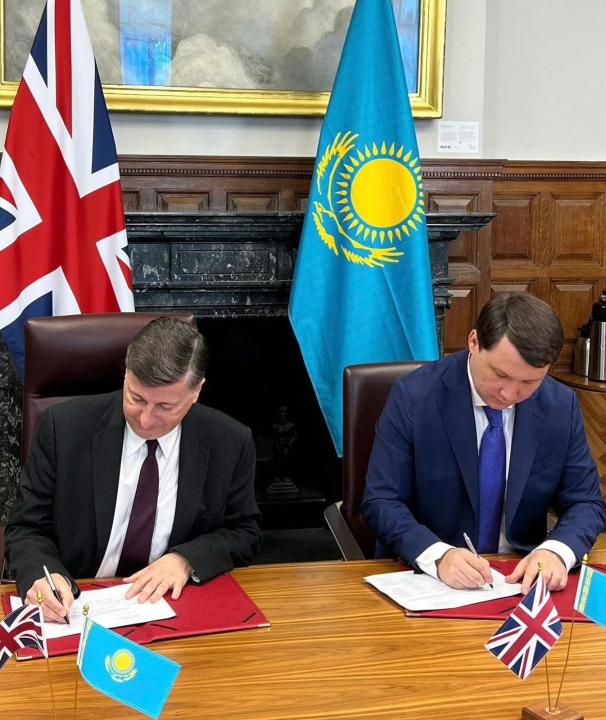
Kazakhstan and the United Kingdom have signed a roadmap for cooperation in agriculture, paving the way for partnerships in agricultural science, the export and processing of agricultural products, and the transfer of British agricultural technologies.

According to the Kazakh Ministry of Agriculture, the two countries also signed memorandums of understanding on collaboration in water resource management and the production of biopharmaceuticals in Kazakhstan in partnership with AstraZeneca.

These agreements were concluded during the 11th meeting of the Kazakhstan-UK Intergovernmental Commission on Trade and Economic Cooperation, held in London last week.

Deputy Minister of Agriculture Ermek Kenzhekhanuly stated that the introduction of British technologies and investment would enhance the competitiveness of Kazakhstan’s agro-industrial sector and improve its resilience to climate change. “In 2024, agricultural trade between Kazakhstan and the UK totaled $50 million. We intend to significantly increase this figure,” he said.

At the meeting, Deputy Minister of Foreign Affairs Alibek Kuantyrov, who headed the Kazakh delegation, emphasized the UK’s strategic role: “The UK is one of Kazakhstan’s key trading partners and top investors, with total FDI (Foreign Direct Investment) exceeding $22 billion. We greatly value the UK’s contribution to the development of Kazakhstan’s key industries and are committed to building a next-level partnership, focused on investment, technology, and knowledge transfer.”

The Strategic Partnership and Cooperation Agreement signed between the two countries last year has opened new avenues for collaboration in critical minerals, green energy and climate initiatives, transport and logistics, pharmaceuticals and healthcare, education, and financial services.

Kazakh Partisans Honored for Role in French Resistance

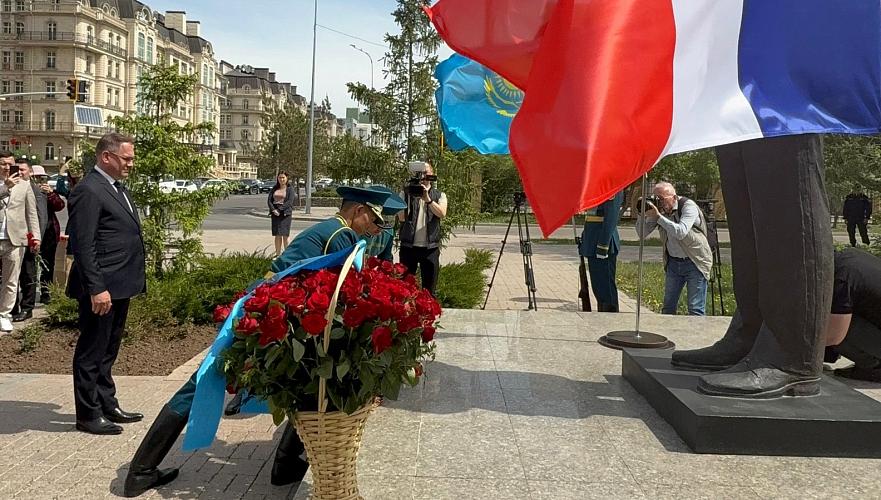
On May 8, 2025, a solemn ceremony commemorating the 80th anniversary of the Liberation of France was held in Astana at the monument to General Charles de Gaulle. During the event, French diplomats posthumously awarded medals to three Kazakh partisans, Kadem Dzhumaniyazov, Kabysh Omarov, and Ashimbek Istybayev, for their contributions to the French Resistance during World War II.

The awards were presented by Sylvain Guillemot, Ambassador Extraordinary and Plenipotentiary of France to Kazakhstan. According to the French Embassy’s press service, the medals were signed personally by Sébastien Lecornu, France’s Minister of the Armed Forces, who also took part in the ceremony.

“The memory of May 8, 1945, unites us, for this day marks the end of hostilities against a common enemy. However, today, in addition to celebrating the 80th anniversary of the Liberation of France, we are particularly keen to pay tribute to the Kazakh partisans who fought side by side with French soldiers on our soil,” Guillemot stated during the ceremony. “All of France stands behind us.”

Guillemot emphasized that Dzhumaniyazov, Omarov, and Istybayev were not just names but “faces and destinies” among the hundreds of Kazakh fighters who demonstrated heroism in France. “I am deeply proud and moved to have the honor of presenting the awards that rightfully belong to them and that should adorn their chests upon their return to their homeland. These are not commemorative medals, but real combat decorations,” he said.

The ambassador added that the recognition represents a powerful symbol of the enduring friendship between France and Kazakhstan, a bond, he noted, “forged in blood.”

Historical records indicate that approximately 300 ethnic Kazakhs participated in the French Resistance during World War II.

As China Cuts Gas Demand, Uzbekistan Eyes Renewables Opportunity

China’s rapid transition to clean energy is beginning to reshape global energy markets, with significant implications for Central Asia. While the shift poses challenges for major natural gas exporters such as Russia, Turkmenistan, and Kazakhstan, it may create new opportunities for Uzbekistan, according to a recent analysis by Eurasianet.

A report by BloombergNEF, titled Energy Transition Supply Chains 2025, highlights China’s dominant position in clean energy manufacturing. The country controls over 70% of global production in sectors such as solar panels, wind turbines, and batteries, falling short only in the area of hydrogen electrolyzers.

China is also leading in investment. In 2024, mainland China accounted for 76% of global spending on clean-tech manufacturing facilities. This robust industrial base aligns with the country’s surging domestic clean energy usage. Currently, renewables meet approximately 80% of the nation’s growing electricity demand.

Think tank Ember projects that China will have over 2,460 gigawatts of renewable electricity capacity by 2030, twice the 2022 figure, with the bulk coming from solar power.

Although fossil fuels still supply about 62% of China’s energy mix, this proportion is expected to decline as economic growth slows, renewable capacity expands, and the country pursues its goal of carbon neutrality by 2060.

These trends are already affecting regional energy dynamics. China’s softening demand for natural gas may explain the lack of progress on a Russian proposal to increase gas deliveries via Kazakhstan, as well as ongoing delays in the Power of Siberia 2 pipeline project.

Turkmenistan appears to be recalibrating its strategy, recently agreeing to export gas to Turkey, possibly reflecting a reassessment of future Chinese demand.

Meanwhile, trade tensions between China and the West have led to a surplus of Chinese-manufactured solar panels and other clean energy technologies. As developed nations impose tariffs, Chinese firms are increasingly targeting developing markets.

This could benefit Uzbekistan, which is actively expanding its renewable energy infrastructure. With surplus Chinese equipment likely becoming more affordable, Uzbekistan may gain access to low-cost clean energy technologies in the near future.

Vietnam’s Sovico Group Tapped to Manage Airport in Kazakhstan’s Kyzylorda Region

Vietnam’s Sovico Group, owner of Kazakh airline Qazaq Air, soon to be rebranded as VietJet Kazakhstan, has been offered the opportunity to manage one of the airports in Kazakhstan’s Kyzylorda region.

This week, Kazakhstan’s Deputy Prime Minister and Minister of National Economy, Serik Zhumangarin, confirmed Sovico’s interest in acquiring or taking over the management of an airport in the country, though he did not specify which facility was under consideration.

On Thursday, during a session of the Senate (the upper house of Kazakhstan’s parliament), Deputy Foreign Minister Alibek Bakaev clarified that the proposal concerned an airport in the Kyzylorda region. “The point is that the Vietnamese side would manage the airport temporarily to improve its operations. This is not about a buyout, we do not sell strategic assets. We are attracting advanced technologies and companies to enhance the functioning and services of our airports from both technological and administrative perspectives,” Bakaev told reporters.

The Kyzylorda region, located in southern Kazakhstan, hosts five airports: in the regional capital Kyzylorda, the district center of Aralsk, the village of Zhosaly, and two airports serving the Baikonur Cosmodrome, Krayniy and Yubileiny. The largest among them is Korkyt Ata International Airport, located in Kyzylorda city. Its 2,700-meter-long, 45-meter-wide asphalt runway, which can accommodate all categories of helicopters and first-class aircraft with a maximum take-off weight of 75 tons or more, includes the Tu-204, Boeing 757 and 747, and Airbus A320, as well as lighter aircraft.

In November 2023, a new passenger terminal was inaugurated at Korkyt Ata, boosting the airport’s annual capacity from 300,000 to 2 million passengers.

Korkyt Ata International Airport is currently managed by Airport Management Group and owned by the regional akimat (governor’s office).

As previously reported by The Times of Central Asia, last autumn, Sovico Group announced plans to modernize and develop airport infrastructure in both the Kyzylorda and Turkestan regions of Kazakhstan.

Kazakhstan’s Tourism Revival Attracts International Visitors and $1.8 Billion in Investment

Kazakhstan’s tourism sector is undergoing a notable resurgence, with a growing number of both international visitors and domestic travelers exploring the country. According to analysts at Ranking.kz, this revival is not merely inflation-driven; it reflects substantial structural changes and targeted investment in tourism infrastructure.

Data from the National Statistics Bureau (NSB) shows that in 2024, the total volume of services provided by hotels, motels, and other accommodation facilities reached KZT 299.8 billion (approximately $580 million), marking a 30.8% increase from the previous year. Tax revenues from tourism-related businesses rose by 25.1% year-on-year to KZT 254 billion (about $492 million), underscoring the sector’s expanding fiscal footprint.

Tourism continues to attract both domestic and international investors. In 2024, capital investment in the sector totaled KZT 947.5 billion ($1.8 billion), encompassing both private funding for resort and hotel construction and public subsidies aimed at developing tourism infrastructure.

Throughout 2024, investment in fixed capital across the hospitality, arts, entertainment, and recreation sectors reached KZT 321.1 billion ($622 million). Of that, KZT 163.8 billion ($317 million) was directed toward accommodation and food services. In the first quarter of 2025, investment in these areas rose by a further 6.5%.

The Almaty agglomeration, home to the Zailiyskiy Alatau ski resorts and scenic natural areas, remains a top destination for investment. In 2024, it accounted for 17.4% of total capital investments in the HoReCa (Hotels, Restaurants, and Catering) and entertainment sectors.

Currently, approximately 55 large-scale investment projects are in development across Kazakhstan’s tourism sector. Notable among them are the creation of a multifunctional tourist quarter in Astana, the Aqbura Resort in the Akmola region, and the expansion of the Oi-Qaragai ski resort, one of the largest in Central Asia.

The Oi-Qaragai development includes the construction of a new four-star hotel and significant upgrades to tourism infrastructure. With an estimated total investment of $150 million, the project is expected to generate over 1,200 new jobs. So far, $44.5 million has been invested, with an additional $57.4 million projected by the end of 2025.