• KGS/USD = 0.01144 0%
  • KZT/USD = 0.00193 -0%
  • TJS/USD = 0.10811 -0.28%
  • UZS/USD = 0.00008 0%
  • TMT/USD = 0.28490 0%
  • KGS/USD = 0.01144 0%
  • KZT/USD = 0.00193 -0%
  • TJS/USD = 0.10811 -0.28%
  • UZS/USD = 0.00008 0%
  • TMT/USD = 0.28490 0%
  • KGS/USD = 0.01144 0%
  • KZT/USD = 0.00193 -0%
  • TJS/USD = 0.10811 -0.28%
  • UZS/USD = 0.00008 0%
  • TMT/USD = 0.28490 0%
  • KGS/USD = 0.01144 0%
  • KZT/USD = 0.00193 -0%
  • TJS/USD = 0.10811 -0.28%
  • UZS/USD = 0.00008 0%
  • TMT/USD = 0.28490 0%
  • KGS/USD = 0.01144 0%
  • KZT/USD = 0.00193 -0%
  • TJS/USD = 0.10811 -0.28%
  • UZS/USD = 0.00008 0%
  • TMT/USD = 0.28490 0%
  • KGS/USD = 0.01144 0%
  • KZT/USD = 0.00193 -0%
  • TJS/USD = 0.10811 -0.28%
  • UZS/USD = 0.00008 0%
  • TMT/USD = 0.28490 0%
  • KGS/USD = 0.01144 0%
  • KZT/USD = 0.00193 -0%
  • TJS/USD = 0.10811 -0.28%
  • UZS/USD = 0.00008 0%
  • TMT/USD = 0.28490 0%
  • KGS/USD = 0.01144 0%
  • KZT/USD = 0.00193 -0%
  • TJS/USD = 0.10811 -0.28%
  • UZS/USD = 0.00008 0%
  • TMT/USD = 0.28490 0%
10 December 2025

China to Transport Lithium-Ion Batteries Along TITR via Kazakhstan

This month marks a significant milestone in Kazakhstan-China transport cooperation with the test shipment of lithium-ion batteries from China via the Trans-Caspian International Transport Route (TITR). This major trade corridor links China to Europe through Kazakhstan and the Caucasus. The decision was announced following a meeting between Kazakhstan’s Minister of Transport Marat Karabayev and China’s Transport Minister Liu Wei in Beijing on December 5.

Strengthening TITR Cooperation

The two ministers agreed on initiatives to further develop the TITR, including the creation of a permanent working group to facilitate the seamless flow of goods. They also highlighted advancements in the digitization of transport operations. Truckers can now receive permit forms within an hour through a newly implemented digital platform, streamlining international road transportation.

The TITR is seeing rapidly growing freight traffic. According to Kazakhstan’s Ministry of Transport, road freight volumes with China have more than doubled annually. Before 2023, Kazakh truckers made approximately 50,000 trips per year. In 2024, this figure is projected to reach 230,000 trips.

Expanding Multimodal Transport

The meeting also explored the potential for developing cargo transportation via transboundary rivers between the two nations. Both ministers noted a surge in rail and road freight volumes, as well as transit transportation through the Middle Corridor (another name for the TITR).

From January to October 2024, rail freight between Kazakhstan and China increased by 13%, reaching 26.6 million tons. Road freight volumes soared by 60% in the third quarter alone, amounting to 1.9 million tons.

Meanwhile, cargo transportation from China to Europe via the TITR has experienced explosive growth. In 2024, the volume surpassed 27,000 twenty-foot containers, a 25-fold increase compared to the same period in 2023.


Kazakhstan’s Middle Power Strategy Captures U.S. Focus in Trump-Tokayev Talks

On December 5, a telephone conversation took place between Kazakhstan’s President Kassym-Jomart Tokayev and U.S. President-elect Donald Trump. According to Akorda, the official residence of the Kazakh president, Tokayev congratulated Trump on his election and both leaders expressed a commitment to strengthening their strategic partnership in trade, investment, and nuclear non-proliferation. They also agreed to maintain regular contact to sustain the momentum of bilateral cooperation.

Kazakhstan as a Mediator

This brief but significant interaction has fueled speculation that Trump may view Kazakhstan as a potential mediator in negotiations between Russia and Ukraine. International expert Arkady Dubnov has suggested that Astana could become a platform for dialogue involving Trump, Vladimir Putin, and Volodymyr Zelensky, or other high level representatives. This aligns with Kazakhstan’s diplomatic efforts to promote mediation and its firm belief that the ongoing conflict can only be resolved at the negotiating table.

Tokayev and the Role of Middle Powers

Under Tokayev’s leadership, Kazakhstan has consolidated its status as a “Middle Power.” The term gained prominence in May during Tokayev’s Singapore Lecture, part of a prestigious series organized by the Yusof Ishak Institute (ISEAS). In his speech, “Kazakhstan and the Role of Middle Powers: Promoting Security, Stability, and Sustainable Development,” Tokayev emphasized the risks of global polarization and the need for middle powers to act against a new Cold War.

Tokayev revisited this concept in an article for the French newspaper Figaro, highlighting the growing influence of middle powers amidst the deadlock faced by global superpowers, such as the United States and China. Tokayev wrote, “The economic and political importance of these countries is growing, and their balanced and constructive position is becoming an advantage in the face of global uncertainty.”

At the Astana Think Tank Forum in October, Tokayev reiterated this idea, calling for the reform of the UN Security Council to amplify the voices of regional and middle powers. “The Security Council is in a deadlock, and we need to find a way out,” Tokayev stated.

Trump’s Strategy

Trump’s outreach to Tokayev appears to validate these concepts. Following his election, Trump has engaged with the leaders of regional and middle powers, including India, Israel, Canada, and South Korea, signaling a possible strategy to build a coalition of such nations for his proposed reforms to the global security architecture.

Kazakhstan’s balanced and constructive foreign policy, combined with its emphasis on multilateralism, positions it as an effective interlocutor in global conflicts. Tokayev’s vision of middle powers as mediators may prove instrumental in shaping a more inclusive and cooperative international order.

Tracing Ties: Donald Trump’s Diplomatic Legacy with Kazakhstan

Away from his business dealings, the official relationship between U.S. President-elect Donald Trump and the Central Asian republic began under the first president of Kazakhstan, Nursultan Nazarbayev. On January 17, 2018, Trump received Nazarbayev at the White House on an official visit, praising the existing relations between the two nations.

“I’m thrilled that you’re here. Everyone deeply respects you. We have a wonderful relationship between our countries. Now, Kazakhstan is in a perfect situation. It is a great honor for us to receive you. What you have done for your country is truly remarkable,” Trump stated.

It is widely-believed that during this visit, Nazarbayev warned Trump of the upcoming transition of power in Kazakhstan, naming Kassym-Jomart Tokayev as his successor.

On June 25, 2019, following Kazakhstan’s presidential election, Trump sent a congratulatory telegram to Tokayev. “We have made great progress in our bilateral relations over the years, and I am confident that the spirit of our cooperation will continue to strengthen. It is gratifying that American businesses continue to open new opportunities to expand economic cooperation with Kazakhstan,” Trump wrote.

According to the Akorda press service, the White House head noted that the U.S. intended to continue collaborating to promote an expanded strategic partnership with Kazakhstan.

“I look forward to working with you to advance our deepened strategic partnership to counter common challenges; the United States values a strong partnership with Kazakhstan. It will continue to work with you and the people of Kazakhstan to advance our shared interests in Central Asia and globally. I wish you every success in your work,” Trump said in his message.

Summarizing the Trump presidency’s impact on Central Asia in February 2021, renowned Kazakh economist, Zhandos Temirgali, emphasized his opinion that the “Trump administration has been prudent enough to maintain and develop the C5+1 format for cooperation with Central Asia, initiated in 2015 by the Obama administration, which was established in response to China’s One Belt, One Road initiative, and soon proposed a more global alternative: the Blue Dot Network. Over the years of Trump’s presidency, the C5+1 format has established itself as a reliable platform that unites the region’s states at the highest level in their pursuit of strategic cooperation with the leader of the [United States.].”

EDB Supports Construction of Strategic Highway in Kyrgyzstan

The Eurasian Development Bank (EDB) has pledged up to $200,000 for a preliminary feasibility study for the Bishkek – Kuntuu – Belogorka – Suusamyr highway. This alternative route aims to connect Kyrgyzstan’s capital, Bishkek, with the southern and western regions of the country. An agreement for technical assistance was signed on December 5 between the EDB and Kyrgyzstan’s Cabinet of Ministers.

Strategic Importance

The proposed highway is expected to have significant strategic, economic, and social benefits for Kyrgyzstan. Beyond improving transport infrastructure, it will facilitate access to mineral deposits and create new employment opportunities both during construction and operation.

Nikolai Podguzov, Chairman of the EDB Management Board, emphasized the project’s importance:

“This initiative is part of the Eurasian Transport Framework, a key investment mega-project. It aims to strengthen transport connectivity among Kyrgyzstan’s economic centers while increasing the transit potential of Kyrgyz highways and attracting greater interest in road transportation through Kyrgyzstan from neighboring countries.”

Alleviating Traffic and Economic Growth

Deputy Minister of Transport and Communications Bekzhan Rysmendeev highlighted the project’s role in addressing existing infrastructure challenges. “The Bishkek—Osh highway, Kyrgyzstan’s main arterial road, currently handles 5,000 to 18,000 vehicles per day and is struggling to accommodate the growing traffic flow,” he explained.

The new highway is set to reduce the travel distance by 164 kilometers compared to the existing route, providing an alternative pathway to southern regions and improving access to mining areas. “This public-private partnership project will ease congestion on the Bishkek—Osh route, contribute to economic and social development, and foster international and domestic tourism and trade,” Rysmendeev added.

Regional Connectivity

As part of the EDB’s broader mission to invest in Eurasia, this project aligns with the bank’s goals of enhancing regional connectivity and economic development. The EDB, a multilateral development institution, includes Armenia, Belarus, Kazakhstan, Kyrgyzstan, Russia, and Tajikistan as its member countries.

Kazakhstan Tops Central Asia in Global E-Governance Rankings

Kazakhstan has risen to 24th place out of 193 countries in the 2024 UN E-Government Development Index, up from 28th in 2022. This achievement reaffirms Kazakhstan’s position as the regional leader in e-governance, surpassing its Central Asian neighbors. Globally, Denmark, Estonia, and Singapore secured the top three spots.

Legislative Advances in Digital Transformation

To further bolster its digital transformation, President Kassym-Jomart Tokayev signed a landmark law on July 5, focusing on digitizing statistics and improving data management systems. This legislation is set to reduce statistical reporting requirements by 40-50% through amendments to various laws concerning state control, statistics, and data management.

Regional Comparisons

Other Central Asian countries also demonstrated progress in e-governance, albeit at different rates:
• Uzbekistan rose to 63rd place from 69th, exceeding the 2025 targets outlined in its “Digital Uzbekistan 2030” strategy, according to Minister of Digital Technologies Sherzod Shermatov.
• Kyrgyzstan improved to 78th place from 81st.
• Tajikistan made significant strides, climbing from 141st to 123rd place.
• Turkmenistan, however, experienced a decline, dropping to 145th place from 137th in 2022.

Kazakh Rituals Included in UNESCO’s Intangible Cultural Heritage List

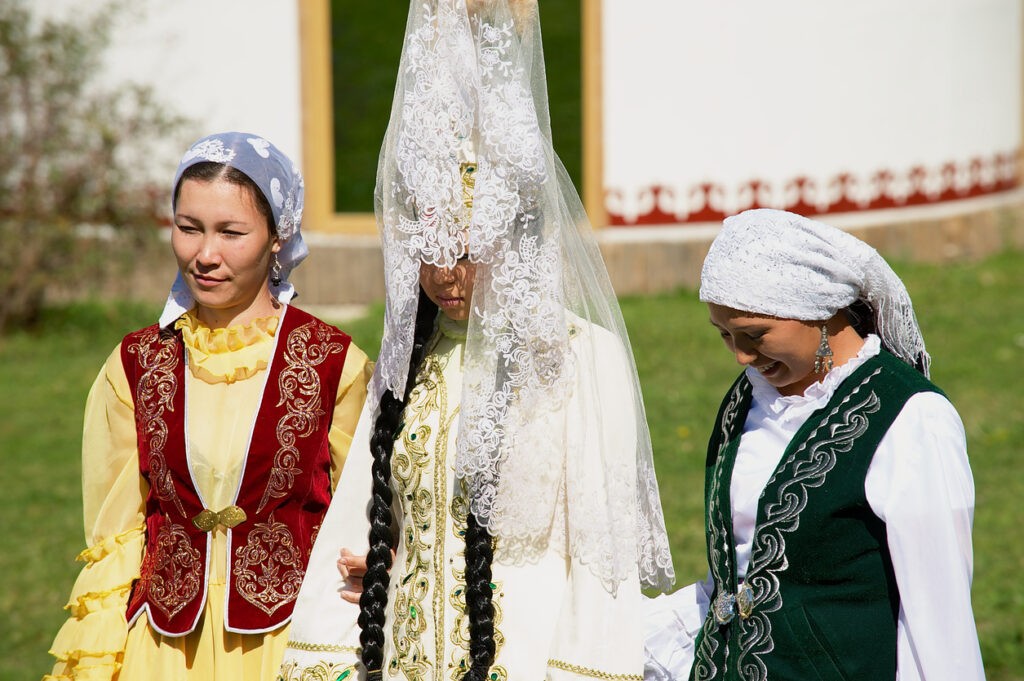
The Kazakh wedding ritual of Betashar has been officially recognized by UNESCO as part of the Representative List of the Intangible Cultural Heritage of Humanity. This inclusion highlights the enduring beauty and cultural significance of Kazakhstan’s ancient traditions. In this article, we explore the Betashar ritual, other celebrated customs, and the challenges posed by certain archaic practices in modern times.

Betashar: Revealing the Bride’s Face

During the UNESCO Committee for the Safeguarding of the Intangible Cultural Heritage meeting in Asunción, Paraguay, Betashar was officially added to the list of intangible cultural heritage. State Counselor Yerlan Karin announced the decision, which underscores Kazakhstan’s commitment to preserving its rich cultural legacy.

Kazakhstan ratified UNESCO’s Convention for the Safeguarding of the Intangible Cultural Heritage in 2011, pledging to protect and promote cultural traditions. Today, 13 Kazakh practices are on UNESCO’s list, including kiiz үi (yurt), kүi (instrumental music), aitys (improvised poetry duels), Nauryz (spring festival), kүres (wrestling), and togyzkymalak (a traditional board game).

Betashar—literally “revealing the face”—is a wedding rite introducing the bride to her husband’s family. Historically, the bride spent three days secluded with the women of her community before being ceremonially presented to her new family. Her face, hidden under a large cloth, was uncovered in front of the gathered relatives while a zhirshy (singer-improviser) performed the betashar zhyry, a song introducing the family members. In return, they pledged gifts to the couple. The ritual concluded with the bride serving tea to her in-laws. While modern weddings often simplify Betashar, its symbolic meaning remains deeply cherished.

Preserving Other Traditions

Another ritual presented to UNESCO is Salburyn, an ancient hunting custom. Hunters once gathered on horseback for multi-day expeditions, accompanied by falcons and hounds. These hunts began with feasts and competitions, emphasizing camaraderie and skill. Today, while hunting is less necessary, Salburyn is celebrated as part of cultural events, such as during the Nauryz festivities in Kyzylorda region.

The custom of Tusau Kesu—cutting a child’s “fetters”—is a joyous milestone in Kazakh culture. When a child begins to walk, their legs are symbolically tied with a colorful string, which is then cut by a respected relative. The ceremony includes laying out a symbolic “white path” (ak zhol), representing a prosperous future. Items such as money, a whip, a dombra, or a book are placed along the path to hint at the child’s potential destiny.

Addressing Harmful Practices

Not all traditions are compatible with contemporary values or legal norms. Bride kidnapping, an archaic practice still occurring in some regions, has drawn criticism and calls for stricter legal measures.

Mazhilis deputy Murat Abenov recently urged tougher penalties for bride abduction, highlighting gaps in the Criminal Code that leave many cases unresolved. “Many victims are coerced into claiming they went voluntarily,” Abenov explained, citing examples where cultural products like songs and videos romanticize the practice. Despite its criminalization after the October Revolution, the issue persists.

In 2023, there were 13 officially recorded cases of bride abduction, though Abenov believes the real figure is higher due to underreporting. He called for a dedicated Criminal Code article addressing the issue, a proposal supported by Mazhilis Speaker Yerlan Koshanov.