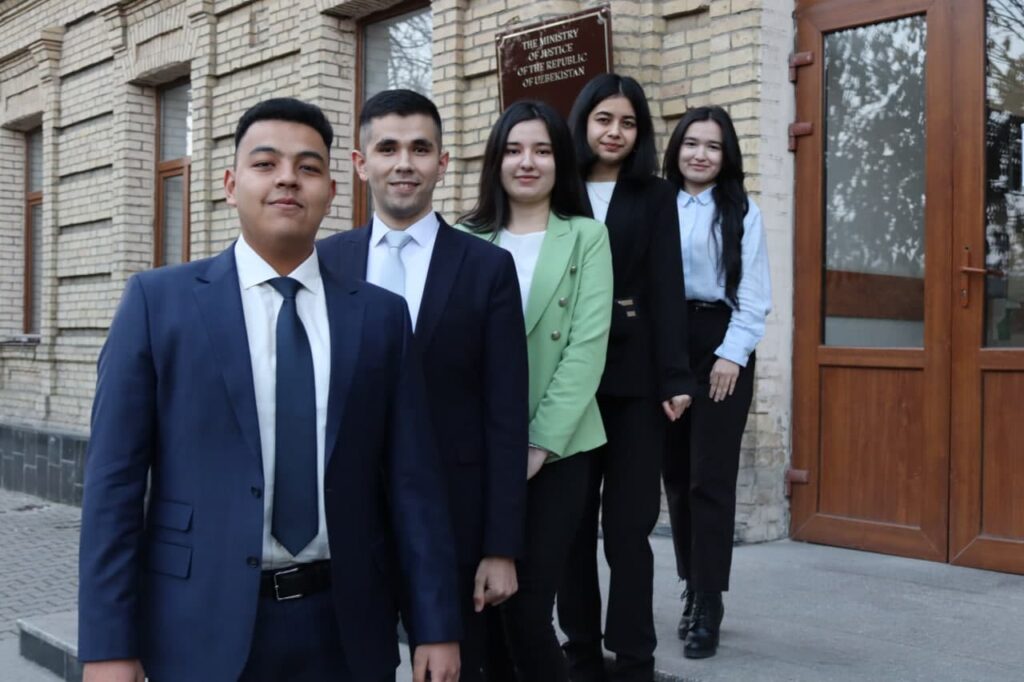
Like many Uzbek students, Nigina Poziljonova left Uzbekistan to study at a university abroad. She doesn’t regret her decision.
“Unlike the teachers I personally saw in Uzbekistan, professors are happy when students say, ‘I don’t understand, please explain again,’” said Poziljonova, who is studying for a bachelor’s degree in business economics with data science at the University of Cassino in Italy.
“If necessary, they are willing to spend two hours after class for that student. If I fail one exam, I can take it 5 times a year for 3 years for free,” said the Uzbek student, who nevertheless describes her Italian experience as “more challenging than I anticipated.”
—
The perceived shortcomings of higher education have long been a preoccupation in Uzbekistan, which has a large population of young people and is the most populous country – with about 35 million citizens – in Central Asia. Authorities are trying to fix the problem.
Last month, Minister of Higher Education Kongratbay Sharipov said 20 underperforming universities will be closed because only 5-10% of their graduates are employed. Uzbekistan has more than 200 universities – 114 are state-run, 65 are private and 30 are foreign university branches, according to 2023 data.
Uzbekistan had the fifth largest number of “tertiary” students (students who have completed secondary school) studying abroad – 109,945 – among countries around the world that were surveyed, according to UNESCO data in 2021. Around that time, more than 570,000 students were studying in higher education institutions in Uzbekistan.
As in many countries, a lot of Uzbek students believe a quality education lies abroad and their increasing command of English and openness to the world can bring that goal within reach. Additionally, Uzbekistan’s El-Yurt Umidi foundation, a state agency launched in 2018, covers tuition fees and living expenses of talented people who want to study abroad. The foundation signs a contract with scholarship holders that requires them to return to Uzbekistan and work for three years.
Many students study at universities in neighboring countries such as Kazakhstan, Kyrgyzstan, and Tajikistan, and then, after one or two years, transfer to universities in Uzbekistan. According to Kyrgyz data, some 38,857 Uzbek students studied in higher education institutions in Kyrgyzstan in 2022 and the figure reached 40,282 in 2023.
Uzbek President Shavkat Mirziyoyev chaired a meeting in May at which officials discussed the 306 majors available at the bachelor’s level in Uzbekistan, and the 625 specialties at the master’s level. They acknowledged that some don’t meet international standards and labor market requirements and explored ways to revise them. Opening new courses in areas of high demand was also discussed.
Another problem in Uzbek universities is an excessive focus on specializations. At one journalism university, specialists taught multiple sub-topics, including TV, international news, public relations, the internet, as well as military, travel, art, economic and sports journalism.
Progress has been made. More people have access to higher education. Starting this year, state grants are given for one year, and in the remaining years of study, the high grades of students throughout the year are taken into account when awarding further grants. The state is also promoting women’s education, helping to pay for master’s degree students and providing seven-year, interest-free loans for bachelor’s degree students.
—
In an interview, Mashhura Rakhmonova reflected on her experience as a university student in Uzbekistan. She attended the Journalism and Mass Communications University of Uzbekistan and recently completed a master’s degree in media law at Tashkent State University of Law, or TSUL.
“The university’s academic staff, including well-experienced teachers and professors, stand out for their teaching skills and professional experience,” Rakhmonova said of TSUL. “Honestly, punctuality has always been challenging for me, such as being on time for lessons, adhering to the dress code, and consistently attending classes. The dean of our department is very punctual and responsible in his position. He always keeps a close eye on everything in our department.”
She wrote in a Telegram message that the university evaluation system is transparent: “The credibility of TSUL’s exams, conducted in a large hall with disabled internet access, ensures a fair assessment of students’ knowledge. The case-study method employed in seminars, where students collaboratively resolve legal scenarios, further enhances the learning experience.”
However, Rakhmonova also pointed out drawbacks. Non-specialist applicants, like herself, face significant challenges when applying for specialized programs without prior foundational knowledge. Also, the short term of one year for the master’s program can be a significant challenge for both non-specialist students and teachers.
“It leaves little time for in-depth research and dissertation preparation,” she said. “In many foreign countries, a master’s degree takes two years, with at least one semester dedicated to writing and preparing the master’s dissertation. It would be beneficial to have an additional semester allocated for the master’s dissertation.”
—
Mohizarkhon Mamadaliyeva, a PhD student at Ferghana State University, also commented about higher education in Uzbekistan. Mohizarkhon says that a website has been created for doctoral students to help with administrative work. Also, the university supervises the cooperation of PhD students with professors and provides “motivation to participate in various scholarship programs and international conferences.”
She considers it a great opportunity to receive free education at the PhD level in Uzbekistan and to receive a monthly scholarship of 5,650,000 som (approximately $450). She also pointed out that they also have the requirement of a strict uniform, an issue which other students emphasized.
—
In another TCA story, Dilorom Mamadjanova talked about bureaucratic problems faced by PhD students.
Poziljonova, the student who went to study in Italy, said she found that exams there were strictly monitored in contrast to what she described as a relatively lax environment in Uzbekistan, where plagiarism is a big problem.
“That’s why I didn’t even know which subject I didn’t know well in Uzbekistan,” she said. “Currently studying in Italy, I can say 100% that I don’t know math, but I can learn.”