• KGS/USD = 0.01144 0%
  • KZT/USD = 0.00196 -0%
  • TJS/USD = 0.10899 -0%
  • UZS/USD = 0.00008 -0%
  • TMT/USD = 0.28490 0%
  • KGS/USD = 0.01144 0%
  • KZT/USD = 0.00196 -0%
  • TJS/USD = 0.10899 -0%
  • UZS/USD = 0.00008 -0%
  • TMT/USD = 0.28490 0%
  • KGS/USD = 0.01144 0%
  • KZT/USD = 0.00196 -0%
  • TJS/USD = 0.10899 -0%
  • UZS/USD = 0.00008 -0%
  • TMT/USD = 0.28490 0%
  • KGS/USD = 0.01144 0%
  • KZT/USD = 0.00196 -0%
  • TJS/USD = 0.10899 -0%
  • UZS/USD = 0.00008 -0%
  • TMT/USD = 0.28490 0%
  • KGS/USD = 0.01144 0%
  • KZT/USD = 0.00196 -0%
  • TJS/USD = 0.10899 -0%
  • UZS/USD = 0.00008 -0%
  • TMT/USD = 0.28490 0%
  • KGS/USD = 0.01144 0%
  • KZT/USD = 0.00196 -0%
  • TJS/USD = 0.10899 -0%
  • UZS/USD = 0.00008 -0%
  • TMT/USD = 0.28490 0%
  • KGS/USD = 0.01144 0%
  • KZT/USD = 0.00196 -0%
  • TJS/USD = 0.10899 -0%
  • UZS/USD = 0.00008 -0%
  • TMT/USD = 0.28490 0%
  • KGS/USD = 0.01144 0%
  • KZT/USD = 0.00196 -0%
  • TJS/USD = 0.10899 -0%
  • UZS/USD = 0.00008 -0%
  • TMT/USD = 0.28490 0%
08 December 2025

Health Specialists Visit Almaty Reference Laboratory

In a statement released by the Kazakhstan Ministry of Foreign Affairs, public health representatives from Central Asian countries and Azerbaijan, attending the regional Workshop on the Biological and Toxin Weapons Convention (BTWC), paid a visit to the Almaty Central Reference Laboratory.

The seminar held at the UN Hub in Almaty, was organized by the United Nations Office for Disarmament Affairs (UNODA) and the Ministry of Foreign Affairs of Kazakhstan, with the support of the European Union (EU). During the event, issues were raised concerning the implementation and strengthening of BTWC protocols. The seminar also offered opportunities to share knowledge and experience on improving legislation, discuss plans of national importance and implement confidence-building measures among members of the BTWC.

Whilst gathered in Almaty, representatives of Central Asian countries and Azerbaijan visited the Central Reference Laboratory, built with aid from US investments. The Ministry of Foreign Affairs noted that experts in the field of biosafety gave a high assessment of Kazakhstan’s flagship institution’s biotechnological complex and the laboratory’s activities and development of Kazakhstani scientists.

Kazakhstan conducts research in two bio-laboratories, both of which have third-level safety regulations in place. The first is the Central Reference Laboratory in Almaty. In operation since 2016, the facility was built with funded assistance of around $130 million from the U.S. Defense Threat Reduction Agency (DTRA) and the Nunn-Lugar Cooperative Threat Reduction (CTR) Program.

A similar laboratory, located in Otar, is run by the Research Institute of Biosafety Problems.

According to Kazakh President Kassym-Jomart Tokayev, Kazakhstan cooperates with the U.S. in the field of biological security under the former anti-plague institute in Almaty, but due to the expiration of the contract, the Americans are no longer involved in the reference laboratory which funded by the federal budget, now only employs Kazakh specialists.

Montana Farmer Pleads Guilty to Cloning Endangered Kyrgyz Argali Sheep

As reported by the Daily Montanan an 80-year-old farmer from Montana, Arthur “Jack” Schubarth, has pleaded guilty to federal charges for violating the Lacey Act, which prohibits the sale, transportation and purchase of wild animals between American states.

In 2013, Schubarth illegally brought part of an argali sheep which had been killed in the Kyrgyz mountains into the U.S. and paid a laboratory to create cloned embryos from the animal’s DNA. The embryos were then implanted into sheep on his farm and in time, he succeeded in raising a genetically pure argali, which he named Montana’s Mountain King. Used to impregnate other sheep, the ram’s sperm produced fairly large hybrids.

In a statement to the paper, assistant U.S. Attorney General Todd Kim said, “It was a bold plan to create large hybrids of sheep for sale and hunting as trophies… By implementing this scheme, Schubarth violated international law and the Lacey Act, which protect the viability and health of local animal populations,”

According to investigators, Schubarth conspired with five individuals to sell hybrid offspring to Texas and Minnesota under the guise of domestic sheep from New Mexico. The sheep hybrids led to healthy profits in the field of hunting. In 2020, a farmer sold one of Mountain King’s sons and 11 sheep containing a quarter of his genetics for $23,000 after obtaining a fake export license. The plea agreement states that the market value of all such sheep sold by Schubarth reached half a million dollars.

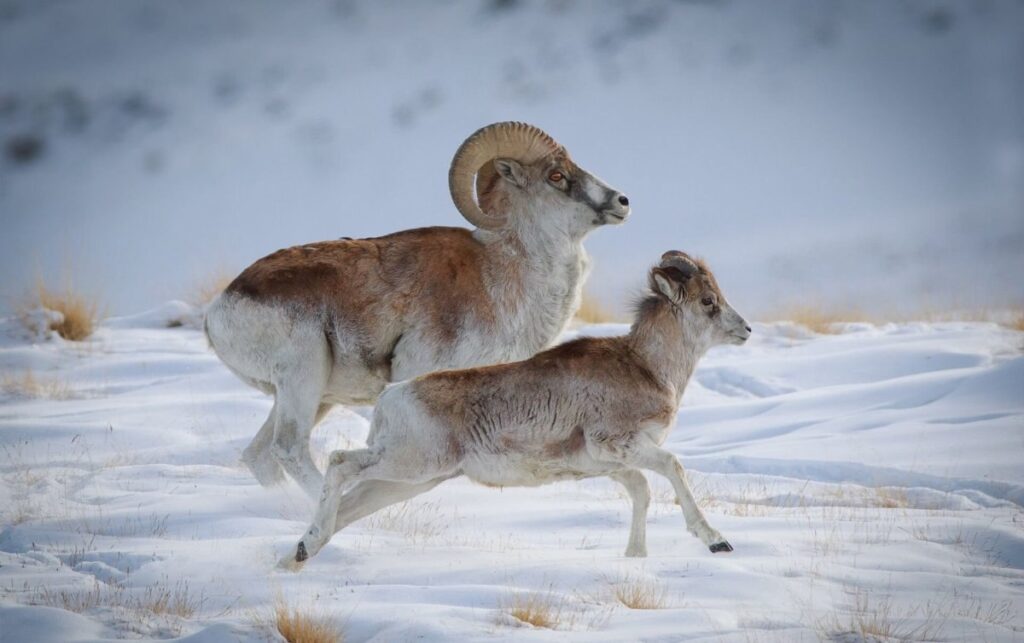
The Argali, also known as a Marco Polo, is the largest ram on earth. Reaching up to two meters in length, with a height at the withers of 120 centimetres, an adult can weigh 180 kilograms. The breed is also valued for its large, curled horns and in Kyrgyzstan, is protected as an endangered species. However, once a year, authorities issue about 70-80 licenses to cull the population; an activity popular with foreign hunters and a lucrative source of income for the state. Whilst the fine for illegal killing of an argali is around $15,000, the official rate charged to licenced hunters is around $10,000.

Speaking to the Times of Central Asia, Askar Davletbayev, an ecologist with the Kyrgyz National Academy of Sciences, stated, “According to the law, one percent of the total argali population can be shot but we try to shoot no more than 0.5 percent. According to the data, there are now about 19,000 of these animals in the country. Since the situation isn’t critical, the current level of hunting can be maintained.”

During the autumn hunting season, many argali living on the Sarychat-Ertash Nature Reserve in the Issyk-Kul region migrate to areas around the nearby Kumtor gold mine. Scientists explain this as a way in which the animals try to protect themselves from both hunters and predators. Because the gold mine’s territory cannot be accessed without approval, hunting is forbidden. Furthermore, since the local dump provides ample food for predators, the argali are left in peace.

On more than one occasion, deputies in parliament have raised the issue of banning hunting of the red-listed animal, but the practice of heavily regulated hunting remains in place.

Uzbekistan Reforms Punishments for Importation of Drones

From June 15, 2024, an Uzbek law will come into force to reduce punishment for the illegal import, sale, purchase, storage or use of drones in Uzbekistan.

Under the current law, the unauthorised importation of drones carries a fine of $270-$540 and confiscation of the device. Punishment for repeated violations is harsh with fines reaching $670-$1,300, or up to three years’ corrective labour, restriction of freedom or imprisonment.

However, in case of voluntary surrender, the perpetrator is exempt from liability.

Uzbekistan’s Customs Committee stated, “The changes should lead to a reduction in the number of offenses related to the use of drones, as well as an increase in foreign tourists to Uzbekistan. In the past, foreign citizens have been detained more than once for importing UAVs, including through ignorance.” .

Earlier this year, the country’s amended administrative liability replaced criminal liability for violating these rules for the first time.

The import of drones has been prohibited since 2015, with the exception of cases specified by law, such as the use of drones for agricultural purposes.

Sixty-two percent of the drones imported by Uzbekistan come from Sudan, 12% from Venezuela and 9% from Russia.

In early 2022, Uzbekistan announced the launch of locally assembled Lochin (Falcon) drones at the Scientific and Production Centre for Unmanned Aerial Complexes, established under Uzbekistan’s State Committee for Oboronprom. Equipped with specialized equipment and a test laboratory, the centre produces drones for surveillance and military strikes and information gathering as well as for work in agriculture and surveillance in nature reserves, geology and cartography.

Starting Over: Central Asian Countries Celebrate the Arrival of Spring

It’s time for renewal in Central Asia.

Spring is arriving and it’s time to tidy up the home. Time for traditional music, cuisine, and brightly colored costumes. An occasion to reflect and renew, give thanks for the past, and build toward the future.

Or set aside bad things that happened and start over.

One of the world’s oldest holidays happens on the spring equinox, which is March 20 (Central Asia time) this year. Known as Nowruz, Navruz, Nauryz, and other variations, it means “New Day” in Farsi and traces its roots to the ancient Persian religion of Zoroastrianism. This year, it coincides with the Muslim holy fasting month of Ramadan. The holiday is also celebrated in the Caucasus, the Middle East, and other regions.

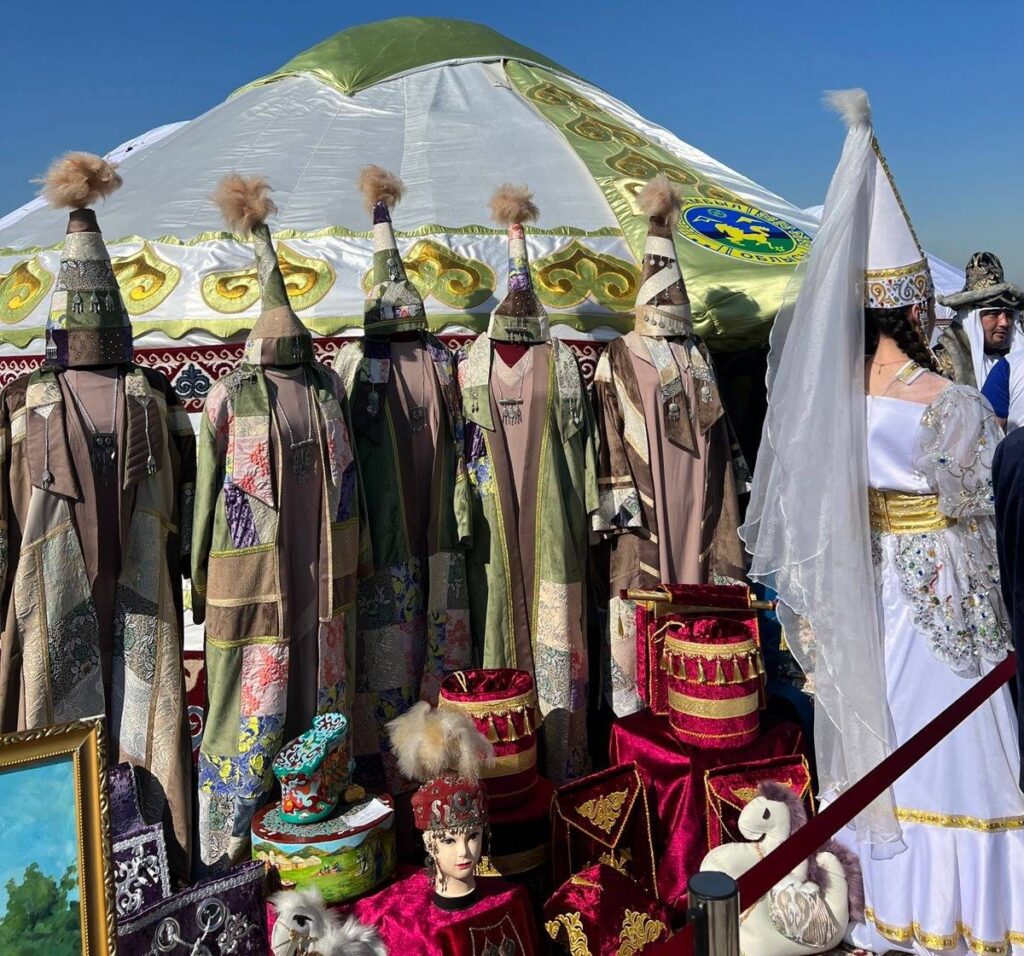
A view of the shanyrak, the central part of the upper dome of the yurt is shown to guests as an art object during Nauryz festivities. A shanyrak design, containing blue that represents the sky, is the national emblem of Kazakhstan. Photo: TCA

Celebrations are already in full swing. This year, Kazakhstan introduced a new format for Nauryz, with events running from March 14-23. In 2009, UNESCO included the day on its list of “intangible cultural heritage of humanity.”

In many parts of Central Asia, people decorate houses with branches of fruit trees to ensure a prosperous year. On the night before the spring equinox, people fill vessels with water from springs, milk, and grain. It is believed that such a ritual will bring abundant rains and a successful harvest in the coming year.

Holiday concerts feature traditional instruments. There are the karnai and surnai (wind instruments) and dutar (strung) in Tajikistan and Uzbekistan, or the dombra and kobyz (both strung) in Kazakhstan and Kyrgyzstan.

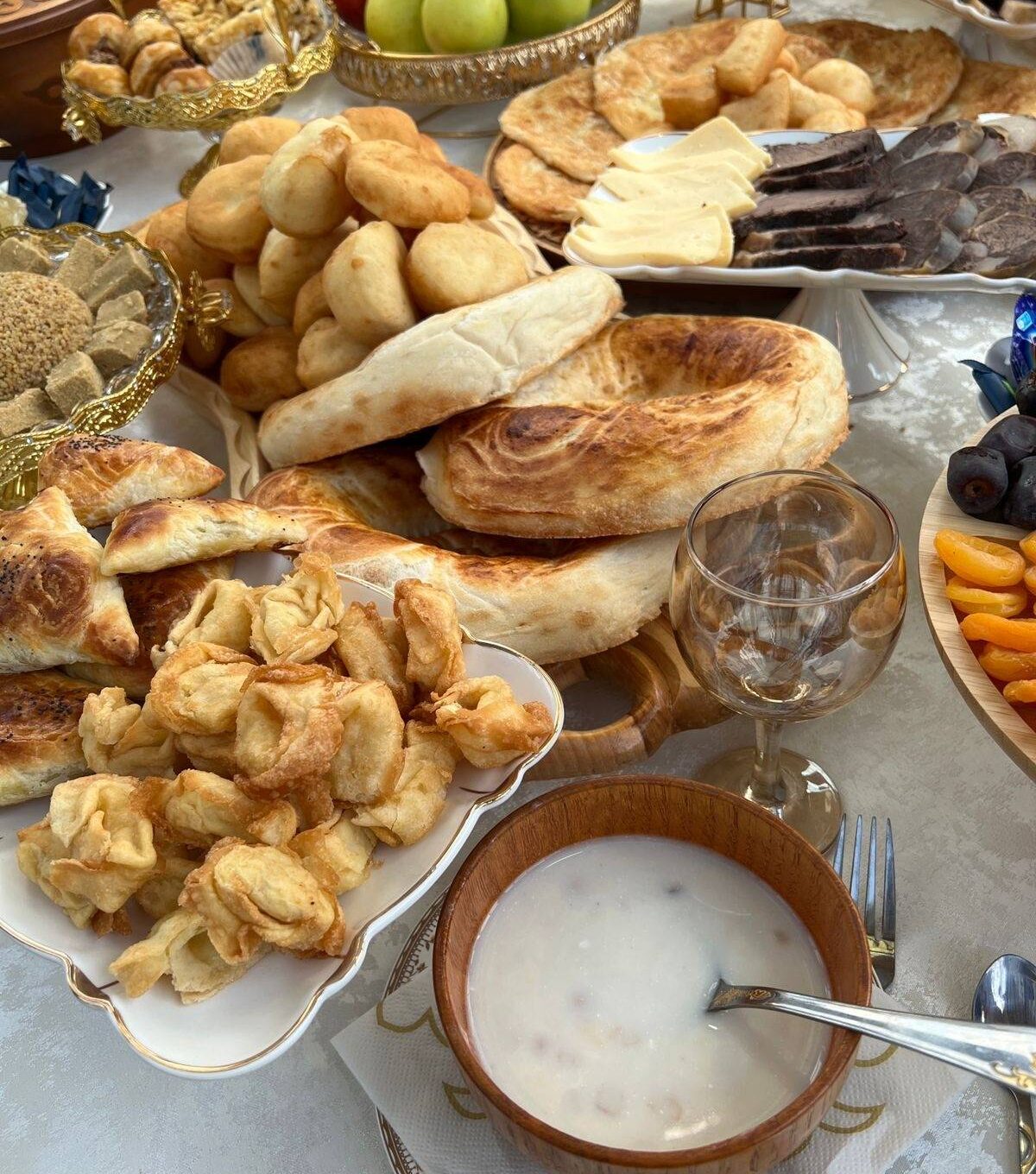
Baursak, a fried bread, and Nauryz kozhe, a cool, hearty drink that symbolizes good luck, are shown during Nauryz celebrations in Almaty, Kazakhstan in 2023. Ingredients of Nauryz kozhe can include water, meat, salt, milk or yogurt, and grain. Photo: TCA

A beautifully set table is another Nauryz tradition. The central place on the table in Tajikistan, Uzbekistan, Kyrgyzstan, and Turkmenistan is occupied by sumanak, a dessert. It is made of germinated wheat and cooked in a metal pot for about 12 hours. According to legend, you should make a wish while stirring the sumanak. It is said that if you make a wish from a pure heart, it will definitely come true.

In Kazakhstan, a special place on the table is occupied by Nauryz kozhe, a hearty soup of milk, meat, butter, two kinds of millet, rice, and corn, symbolizing the seven principles of life: growth, luck, happiness, wealth, health, wisdom, and heavenly protection. At home, it is poured into seven bowls and placed before seven wise elders, known as aksakals.

The number has a special meaning in many aspects of the celebration. Traditionally, everyone should invite seven guests to their home and visit seven houses themselves.

Nauryz is also a time of moral education and mutual understanding. People congratulate each other and share values and traditions with young people.

Boys born on March 21 are called Navruzbek or Navruzbay, and girls are named Navruzgul.

Some cities in Central Asia hold festivals and parades to celebrate the spring holiday. Streets are decorated with flowers, flags, and national symbols.

A game of buzkashi at the Hippodrome in Bishkek, Kyrgyzstan. Photo: TCA

Games and competitions are organized in squares and stadiums. In Tajikistan, it is the national wrestling, gushtingiri, where rivals try to throw each other to the ground, and the game called buzkashi, in which riders compete for a goat, trying to snatch it from the hands of rivals. In Kazakhstan, it is Kazaksha kures and arkan tartys tug-of-war. In Kyrgyzstan, there are large-scale horse games. During the holiday, guests can buy souvenirs and national delicacies at folk fairs.

Nauryz was especially important in Central Asia when populations were primarily nomadic and based their lives around the changing seasons. Today, it’s also an occasion for charitable donations.

Astana Projects Attract Qatari, Turkish, Russian Interest

This month foreign investment projects in Astana’s real estate sector have been high on the agenda at meetings at the Investment Headquarters in Kazakhstan’s capital.

One such project is a new medical center to be constructed in collaboration with a Qatari holding company, and with the participation of American cosmetic skin care provider Cynosure. The first stage is set to comprise a medical center for 50 patients with a planned investment of 88 billion tenge (~$196million), and in the second, the Qatari partners intend to invest around 160 billion tenge (~$360 million) in a larger extension.

According to reports, Qatari investors have also committed funds for the construction of branded international schools in Astana. The first, a Sabis school for almost 3,000 pupils and 530 children of preschool age, is scheduled to open in April this year. The second, to be constructed by International Community Schools Ltd, will accommodate 1,225 pupils and 100 pre-school children, involve private investment of 9 billion tenge (~$20 million), and create over 100 jobs.

The Turkish Tiryaki Company discussed investment of up to $200 million in the construction of a wheat processing plant with a capacity of 240,000 tons per year, and Russian e-commerce giants Wildberries and Ozon expressed their readiness to invest up to 90 billion tenge (~$200 million) in constructing large logistics centers in Astana. The Austrian Lasselsberger Group’s plans for investment of over 25 billion tenge (~$55 million) in a plant at Astana’s Industrial Park Number One will produce 100,000 tons of dry construction mixtures per year and create some 200 jobs.

Kazakhstan Bans LPG Export and Wheat Import

To prevent shortages in the domestic market, the government of Kazakhstan has extended the ban on export of liquefied petroleum gas (LPG) for six months.

The ban on import of wheat by road, rail, and water has also been extended for another six months in a move to prevent ‘gray schemes’ for the import of wheat into Kazakhstan from Russia and its further re-export. The sole exceptions are rail deliveries to Kazakh flour mills and to poultry enterprises for fodder. In both cases, imported wheat can neither be sold on the domestic market nor re-exported.

The Kazakh government has also announced a five-year extension of anti-dumping measures against manufacturers of bearings from China and electrodes from India to protect its country’s manufacture of similar goods.