• KGS/USD = 0.01144 0%
  • KZT/USD = 0.00212 0%
  • TJS/USD = 0.10456 0.19%
  • UZS/USD = 0.00008 0%
  • TMT/USD = 0.28490 0%
  • KGS/USD = 0.01144 0%
  • KZT/USD = 0.00212 0%
  • TJS/USD = 0.10456 0.19%
  • UZS/USD = 0.00008 0%
  • TMT/USD = 0.28490 0%
  • KGS/USD = 0.01144 0%
  • KZT/USD = 0.00212 0%
  • TJS/USD = 0.10456 0.19%
  • UZS/USD = 0.00008 0%
  • TMT/USD = 0.28490 0%
  • KGS/USD = 0.01144 0%
  • KZT/USD = 0.00212 0%
  • TJS/USD = 0.10456 0.19%
  • UZS/USD = 0.00008 0%
  • TMT/USD = 0.28490 0%
  • KGS/USD = 0.01144 0%
  • KZT/USD = 0.00212 0%
  • TJS/USD = 0.10456 0.19%
  • UZS/USD = 0.00008 0%
  • TMT/USD = 0.28490 0%
  • KGS/USD = 0.01144 0%
  • KZT/USD = 0.00212 0%
  • TJS/USD = 0.10456 0.19%
  • UZS/USD = 0.00008 0%
  • TMT/USD = 0.28490 0%
  • KGS/USD = 0.01144 0%
  • KZT/USD = 0.00212 0%
  • TJS/USD = 0.10456 0.19%
  • UZS/USD = 0.00008 0%
  • TMT/USD = 0.28490 0%
  • KGS/USD = 0.01144 0%
  • KZT/USD = 0.00212 0%
  • TJS/USD = 0.10456 0.19%
  • UZS/USD = 0.00008 0%
  • TMT/USD = 0.28490 0%

Assassination Plan by Criminal Group on Kyrgyz Leaders

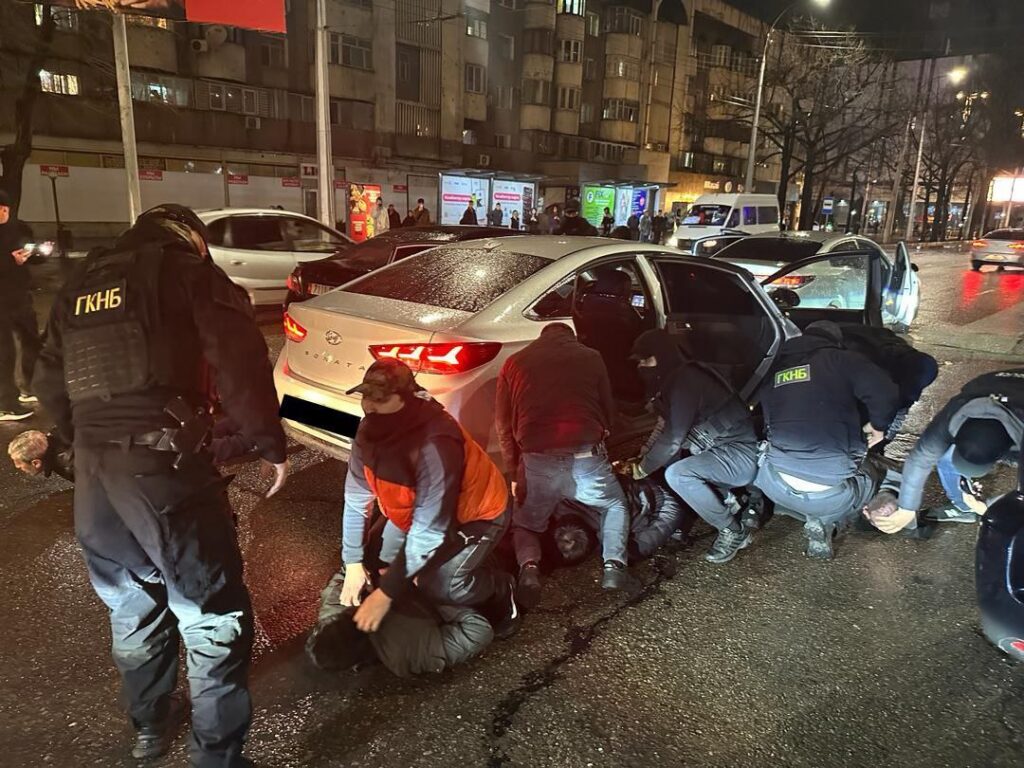
The State Committee for National Security of Kyrgyzstan (CNSK) has reported that members of a transnational organized criminal group, on the instruction of former Kyrgyz oligarch Rayimbek Matraimov, were preparing an assassination attempt on the country’s top officials.

The committee stated that the standard operating activities of Kyrgyz national-security organs led to the discovery of five citizens of Azerbaijan who under the leadership of a transnational organized criminal group, had arrived in Kyrgyzstan in order to strengthen their criminal enterprise and spread the group’s ideology. However, according to the CNSK, the leader’s main task was to organize an assassination attempt on the country’s leadership in connection with the government’s policy of fighting organised crime. Kyrgyz law enforcement claims that the leaders of the international criminal community are dissatisfied with the actions of the Kyrgyz authorities — which force people involved in crime in the Commonwealth of Independent States (CIS) to abandon criminal plans.

“In this regard, on March 22, employees of the CNSK carried out operational and investigative measures, as a result of which all the above-mentioned persons were detained. Currently, investigative measures are being carried out to bring them to justice, according to the laws of Kyrgyzstan,” the CNSK said.

Law enforcement claims that the assassination attempt on the Kyrgyz leaders was organized by Raimbek Matraimov, former deputy head of Kyrgyz customs, and a known corrupt oligarch. After being placed on the wanted list, Matraimov fled to Azerbaijan, where he remains at present. The CNSK sent a letter to Baku requesting the extradition of Matraimov to Bishkek in the belief that the former official is related to the currently detained Azerbaijanis.

After the change of power in October 2020, Matraimov was accused of corruption in the customs service. The court ordered the former official to pay 2 billion som ($22.3 million) in damages and restitution back to the state. Matraimov pleaded guilty and paid the fines and penalties, in both cash and in the form of property. But, as Kyrgyz President Sadyr Japarov later noted, Matraimov continued to engage in “dark deeds” and was also accused of holding hostages.

“Now Matraimov has been put on a wanted list. All his property in Osh and throughout Kyrgyzstan will be confiscated. We will not leave him even one hundredth [of a hectare] of land. Even if he returns, he will no longer be the former ‘Rayim-million’ (the oligarch’s nickname). From now on, if he wants to live normally and feed himself, he should take a trading [stall] at the market…” said Kamchibek Tashiev, head of the CNSK at a meeting with workers at one of the markets previously owned by Matraimov.

Last year, when the authorities engaged in a high-profile struggle with the leaders of organized crime groups, many so-called ‘thieves in law’ began, one after another, to publicly renounce criminal activity and promised to live by the law. Conversely, some leaders of Kyrgyzstan’s criminal underworld were arrested and had their assets seized. One criminal mastermind when searched, was found to have jewellery worth over $1 billion in his possession.


EBRD Adds Kazakh Companies to Blacklist

Over the past six months, the European Bank for Reconstruction and Development (EBRD) has added two Kazakh enterprises to its blacklist of entities that the bank will not do business with.

One of the companies is Astana’s KS-Group LLP, which produces railway machinery and equipment. The company has been barred until April 2025 due to alleged fraudulent activities. The other enterprise, whose ban runs until December 2026, is Agidel-As LLP, which is also suspected of fraud. The company’s website mentions its involvement in large water-supply projects, construction of heating networks and other engineering projects.

KS-Group and Agidel-As are also blacklisted by the World Bank and Asian Development Bank.

Several other entities and individuals from Kazakhstan have been added to another of EBRD’s blacklists, entitled ‘Sanctions Based on Third-Party Findings’. Among them are the companies A3 Commerce and AltocomAsia, to which in addition to fraud, theft is also alleged.

Kazakh companies that appear on EBRD’s blacklists reflect the negative side of the business environment in the country. However, it does also indicate that the country’s law enforcement agencies are actively fighting fraud.

Kazakhstan’s SMEs Borrowed Almost U$17 Billion from Banks

Kazakhstan’s banks are actively supporting small and medium-sized businesses, according to the Kazakh National Bank, and as of February 1, 2024, entrepreneurs and small-business owners have been granted loans totaling 7.6 trillion tenge ($16.9 billion). Furthermore, the growth in lending over the last year amounted to 18.75%, or more than 1.2 trillion tenge ($2.2 billion).

The greatest demand for loans is observed among enterprises in the industrial sector, which received loans worth 2.21 trillion tenge ($4.9 billion), an increase of 10.5% annually, as well as in trade, where the volume of lending doubled to 2 trillion tenge ($4.4 billion). At the same time, the smallest loan volume was allocated to representatives of the communications sector – only 52.3 billion tenge ($160 million), which means a 21% decrease over the past year.

When analyzing statistics by region, one can note that the largest amounts of lending is to small and medium-sized enterprises (SMEs) from Almaty, which were allocated 3.8 trillion tenge ($8.4 billion), while Astana-based borrowers received 1.25 trillion tenge ($2.8 billion) in loans, an increase of 1%.

Earlier, Elena Bakhmutova, head of the Association of Financial Companies (AFC), noted that over the past eight years, lending to legal entities has increased by only 15%, while lending to individuals registered as sole proprietors increased more than five-fold to 1.6 trillion tenge ($3.6 billion) from 300 billion tenge ($665 million).

Uzbekistan’s IT Sector Sets Sights on United States

Uzbekistan’s revenues from IT outsourcing tripled last year to more than $300 million, after doubling every year for the previous four years. The Uzbek government believes that this rate of growth could soon bring Uzbekistan into the ranks of major IT outsourcing centers such as India, Belarus, Ukraine and Romania.

Recent reforms and investment in Uzbekistan have made the country a more attractive place to work not only for local IT professionals, but foreign workers as well. The number of companies in Uzbekistan established using foreign capital has grown seven and a half times in the last two years.

Uzbekistan is developing an IT ecosystem centered around the Tashkent IT Park. In addition to the Ministry of Digital Technologies, which is located there, 1,652 companies had become residents of the park by the end of 2023, almost half of them (767 companies) setting up over the past year. Residents of the IT park have significant tax benefits: Uzbekistan’s corporate tax ranges from four to 15%, but companies at the park are exempt from it. The IT sector now employs about 6,000 people.

The main technology export market for Uzbekistan today is the United States, which accounts for half of all IT exports. By the end of 2022, the U.S. had moved to 15th place from 20th for importing outsourcing services from Uzbekistan. Uzbek authorities aim to increase IT outsourcing to $5 billion, with the involvement of 300,000 people, as part of the country’s 2030 development strategy.

Extremists See Some Central Asian Communities as Fertile Recruiting Ground

The deadly attack on the Moscow concert hall has focused attention on the large number of Central Asian migrants living – often in grim conditions – in Russia, as well as the possible vulnerability of some of them to recruitment by extremist groups.

A Russian court on Sunday charged four migrant laborers from Taijikistan with terrorism in the attack at the Crocus City complex that killed about 140 people on Friday night, according to various media reports. The men appeared to have been badly beaten prior to their court appearances.

The Islamic State group claimed responsibility for the attack. While Tajikistan has expressed concern that “fake information” about who was behind Moscow could scapegoat its citizens, terrorism experts have noted in recent years that extremists see some Central Asian communities as fertile ground for recruitment.

A U.N. Security Council report last year highlighted the activities of the Islamic State branch in the historical Khorasan region, which includes Afghanistan and parts of Iran and southern Central Asia. The branch is known as ISIL-K.

“Regional Member States estimated current ISIL-K strength at between 1,000 and 3,000 fighters, of whom approximately 200 were of Central Asian origin, but other Member States believed that number could be as much as 6,000,” the U.N. report said.

It said the group’s propaganda magazine publishes in Pashto, Iranian, Tajik, Uzbek and Russian, and that outreach in the Tajik and Uzbek languages was “noteworthy” after an Uzbek national named Rashidov joined its media wing. Rashidov was recruited online while working as a migrant in Finland and he then moved to Afghanistan, the report said.

The Islamic State branch is “bolstering its campaign to appeal to Central Asians in their home countries and in diasporas abroad,” Lucas Webber and Riccardo Valle wrote in a Hudson Institute analysis last year. It seeks to take advantage of “the deep-seated grievances that are present across Central Asia, Afghanistan, and Pakistan,” they wrote.

Russia’s military intervention in Syria’s civil war as well as past campaigns in Chechnya and Afghanistan have made it a potential target for Muslim extremists, according to terrorism analysts.

By some estimates, 10% of Tajikistan’s workforce of more than five million people have migrated to Russia. The vast majority are men. Most leave Tajikistan legally, though some end up in violation of the law because of administrative problems or more serious offenses.

Workers’ remittances accounted for about one-third of Tajikistan’s annual GDP in 2019, according to the bank report. Tajik officials have been trying to generate job growth to reduce the economy’s dependency on money sent by its citizens abroad.

In Russia, many migrants live in hostels and overcrowded apartments, enduring poor hygiene and health.

“The majority of migrants, low skilled and economically desperate, are willing to accept any working conditions. Most migrants also have nearly zero legal literacy,”  the Asian Development Bank said in a 2020 report on labor migration in Tajikistan.

“These conditions can lead to labor exploitation by employers and police abuse and extortion by criminal gangs,” the report said. “In addition, xenophobic attitudes in the Russian Federation, cited in interviews of returned migrants, are a major difficulty of working there.”

Many details about the Moscow attack remain unclear. But there are heightened concerns about whether such migrants are being exploited – not just by employers or police, but by extremists as well.

Container Trains from China to Europe through Kazakhstan reaches 80%

On March 25th, Marat Karabaev, Kazakhstan’s Minister of Transport visited Urumqi in China’s western Xinjiang Uyghur Autonomous Region, home to the International Dry Port, the Express Delivery Center (Jitu Express), the China-Europe Railway Express Hub, and the office of the Xinjiang Trade and Logistics Corporation.

The occasion marked the anniversary of the departure of the 150th container train, Tian Shan, along the China-EU route. During the ceremony, it was stated that over the 10-year period since the launch of China’s Belt and Road initiative in 2013, about 85 thousand container trains were sent from China to Europe; 80% of which had passed through Kazakhstan.

Earlier this month, the Kazakh government announced plans to increase the volume of cargo transported by rail to 450 million tons and by road to 316 million tons. The proposed increase in transit transportation to 30 million tons will include that of cargo along the Trans-Caspian International Transport Route to at 4.2 million tons.