According to domestic sector-specific sources, more than nine million tonnes of municipal solid waste (MSW) are generated annually in Tajikistan, of which around 322,000 tonnes is plastic. The key feature of plastic waste is its extreme resistance to decomposition; it can persist in natural environments for decades or even centuries, accumulating in soil and water bodies.
However, estimates of total waste generation vary widely depending on the source, with international organizations offering more conservative figures. The United Nations Environment Programme (UNEP), for instance, reports approximately two million tonnes of formally collected municipal waste generated annually in Tajikistan.
This discrepancy is likely due to differing accounting methodologies. National statistics typically include waste from unauthorized dumps and the informal sector, while international estimates often rely on formally collected and officially documented waste. Still, even the most conservative figures highlight the significant environmental burden posed by Tajikistan’s waste-management system.
Tajikistan’s Position in International Waste Rankings
Waste accumulation and limited recycling capacity are reflected in global assessments. According to domestic reporting citing the 2024 Mismanaged Waste Index (MWI), 87.1% of Tajikistan’s waste is either not collected through organized systems or is disposed of in violation of environmental standards. This would place the country among those with the most vulnerable waste-management systems.
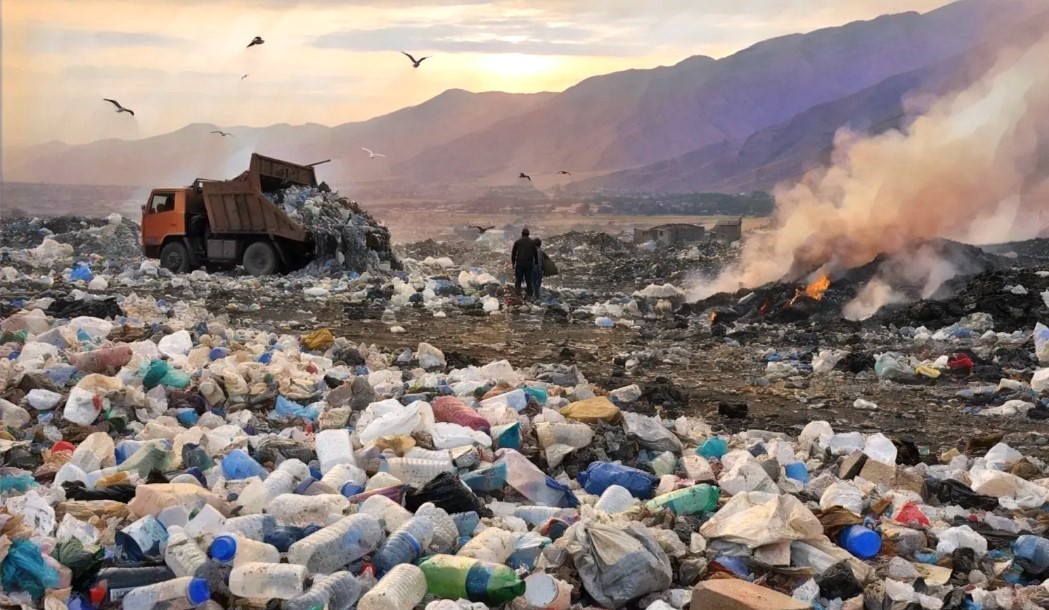
In practice, this means waste is often dumped at unauthorized sites, openly burned, or dispersed into the environment. These practices place pressure on soil, water resources, and air quality, while also posing long-term risks to public health.
This crisis is unfolding amid a global plastic-waste emergency. Even in countries with advanced recycling systems, the proportion of recycled plastic remains low. UNEP estimates that only around 9% of all plastic ever produced has been recycled; the rest remains in the environment.
Regional Disparities: Cities vs. Rural Areas
Tajikistan’s domestic statistics divide the country into three groups based on waste generation. The “Mega” group includes the largest cities and adjacent areas (e.g., Dushanbe, Khujand), home to roughly 4.2 million people. Average daily waste generation here is 1.013 kg per person, resulting in up to an estimated 148,000 tonnes of plastic waste annually.
The “Medium” group comprises 10 mid-sized cities (e.g., Bokhtar, Kulob, Kanibadam), with a combined population of 1.99 million. Daily per capita waste generation in this group averages 0.902 kg, leading to an estimated 62,000 tonnes of plastic annually.
In rural areas and smaller districts, with over 4 million residents, waste generation averages 0.79 kg per person per day. While the plastic share here is less precise, these regions still generate an estimated 100,000 tonnes of plastic waste per year.
It is in these smaller settlements that waste-management infrastructure is most deficient. While cities have basic municipal services and landfills, many rural areas lack even waste-collection containers. As a result, waste is often dumped in ravines, rivers, or burned in backyards, meaning much of it goes unrecorded in official statistics and may significantly exceed documented levels.
Where the Plastic Goes: Disposal, Loss, and Recycling
Most plastic waste in Tajikistan is either buried or left in landfills. Estimates suggest that only about 2.6%, roughly 8,500 tonnes per year, is recycled. Around an estimated 267,000 tonnes (83% of the total) is transported to landfills, where it remains unprocessed. Around another 46,000 tonnes is lost during transit, blown from containers, dropped by collection trucks, or left at informal dumps.
This means that of more than 320,000 tonnes of plastic discarded annually, only a fraction re-enters the economic cycle. The rest contributes to growing environmental degradation.
Environmental experts warn that urgent action is required. Proposals include banning the production and import of single-use plastics such as tableware and packaging under 15 microns, products nearly impossible to recycle. Similar bans in other countries have successfully reduced hard-to-recycle waste.
The State of Recycling and Infrastructure
Despite formal commitments to green principles, Tajikistan still lacks a robust recycling industry. Currently, only 42 small enterprises handle waste processing for plastic, paper, and metal. As of 2024, just 19 firms were dedicated to plastic recycling, insufficient to handle the national volume.
There is no systematic separation of waste; plastics are typically discarded with organic and other refuse, making sorting difficult. Large-scale recycling facilities have yet to be developed. Recycling is fragmented and driven primarily by individual initiatives.
Signs of Progress
Recent data, however, show encouraging trends. Between 2020 and 2023, production of goods from recycled plastic increased significantly. Plastic profile materials for construction rose by 250%, reaching 19,300 tonnes in 2023. Metal-plastic construction output (e.g., windows and doors) rose by 200%, producing 596,000 square meters. Plastic pipe production grew by 132%, reaching 10,600 linear metres. The manufacture of smaller products such as bottle caps rose by 439%, exceeding 193,000 units annually.
Waste management has also begun to attract political attention. In November 2024, Dushanbe hosted an international seminar on plastic waste in mountainous regions. Tajik officials presented strategies to reduce plastic use and proposed investment initiatives for recycling.
Despite these positive developments, the challenge remains severe. Plastic waste is fueled not only by domestic consumption but also by imports, exacerbating pressure on the waste system. This underscores the urgent need for a circular plastic economy, one that expands recycling, promotes reuse, and curtails unnecessary single-use items.
Without such systemic reforms, Tajikistan’s plastic footprint will continue to grow, deepening its waste crisis.