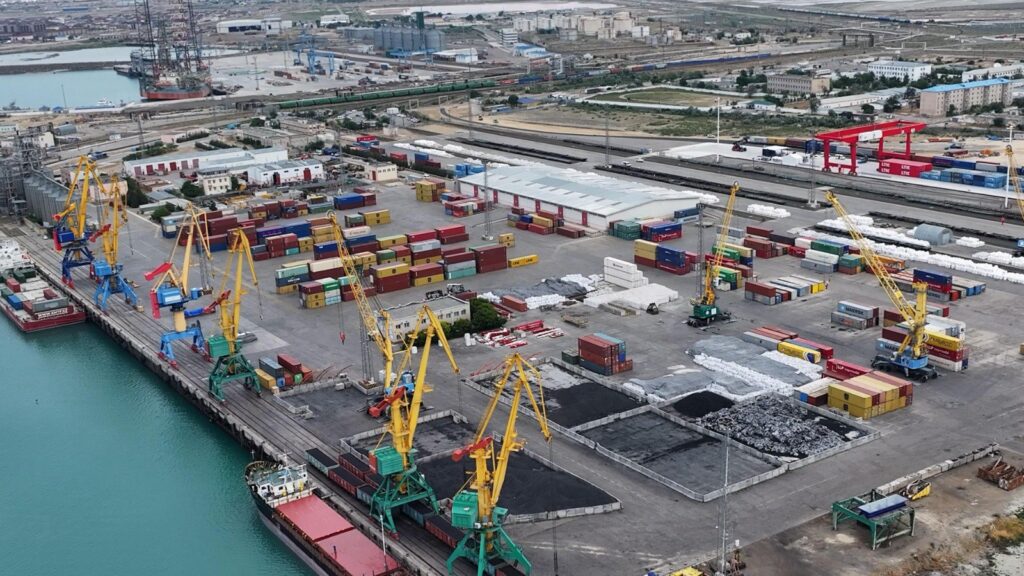
In June of this year, the first phase of a new container hub at the seaport of Aktau on the Caspian Sea was launched. This hub is one of Kazakhstan’s largest transportation projects in recent years.
But will it truly become a strategic anchor point for the transport corridors passing through the port, or will it instead become a “bottleneck,” reducing overall throughput? And will the port’s own capacity decline during the hub’s construction? Let’s explore these questions.
A step towards transit growth
A container hub is a specialized complex offering a full range of services for container handling, railcars, storage, and more. The project involves constructing a container terminal, establishing a container yard at the seaport, expanding container transport, and acquiring modern transshipment equipment.
Scheduled for completion in 2025, it carries an estimated cost of 20.7 billion tenge (about $38 million). Once completed, the hub will increase the port’s container handling capacity from 140,000 twenty-foot equivalent units (TEU) to 240,000 TEU.
The project is expected to become a key link in the supply chain along the Trans-Caspian International Transport Route, as well as other transport corridors passing through the port.
@”KTZ Express”
From terminal to logistics hub
Asem Mukhamedieva, Managing Director for New Projects and Marketing at KTZ Express JSC, told TСA that the container hub project based at the port of Aktau is part of Kazakhstan’s strategy to develop its transport and logistics sector and is being implemented as part of China’s Belt and Road Initiative.
“Given that the project falls within the scope of this initiative, we attracted a Chinese investor in the form of the port of Lianyungang, which is one of the largest players in the Chinese market, not only in terminal operations but also in maritime infrastructure and seaport management,” said Mukhamedieva.
According to her, the Port of Lianyungang has been a longtime partner of Kazakhstan. The national railway company, Kazakhstan Temir Zholy (KTZ), has been cooperating with Lianyungang for 10 years. Their first joint project was the Kazakhstan-China terminal at the Port of Lianyungang, launched in 2014.
In 2017, they opened the largest dry port in Central Asia, KTZE-Khorgos Gateway, at Kazakhstan’s border with China. The third joint venture, constructing the Caspian’s largest container hub at Aktau Port, began in late 2024.
Construction is being carried out by a consortium consisting of Integra Construction KZ LLP and China Harbor Engineering Company, a subsidiary of China Communications Construction Company, which ranks 63rd on the Fortune Global 500 list.
The container hub is also part of a larger project to develop alternative routes to traditional maritime trade lanes. According to Mukhamedieva, the Port of Lianyungang, with its vast experience in shipping and port operations, not only shares its expertise with Kazakh partners but also ensures cargo flow toward Kazakhstan and further westward.
This integrated model will connect the three joint terminals into a “hub-to-hub” transport system, unified by a shared digital platform for data exchange and improved cargo management efficiency.
“KTZ Express”
A flagship project
The implementation of the container hub project will create a freight distribution center in the Caspian region, handling cargo flows not only from East to West but also from North to South. For example, the rapidly growing importance of the Trans-Caspian International Transport Route (TITR) is underscored by a 33-fold increase in freight volumes along this corridor last year, according to analysts.
For 2025, a plan has been approved to transport 600 transit container trains along this route (compared to 358 in 2024). In the long term, under agreements with Chinese partners, container transit from China along the route is expected to grow to as many as 3,000 trains.
According to KTZ Express, container transit volumes on the TITR for the first six months of this year reached 20,544 TEU, which is nearly double the volume for the same period last year. This demonstrates strong positive dynamics and growth.
To support this increasing freight flow, Kazakhstan is not only constructing the container hub at Aktau but also expanding the capacity of its two Caspian ports, Aktau and Kuryk, and modernizing key railway sections along the route within the country.
Regarding the hub’s construction and its impact on Aktau Port’s throughput, Mukhamedieva explained that the hub is being built on a 19-hectare section of the Aktau Seaport Special Economic Zone.
“The seaport continues to perform all operations, including those related to container handling. There are no overlaps or disruptions. After the project is completed and commissioned, it will expand the seaport’s container processing capacity. For now, construction does not cause any inconvenience or operational issues for Aktau Port,” Mukhamedieva said.
Moreover, the completion of the first phase of the hub, together with Aktau Port’s existing capacity, has already increased container handling capacity at the port by an additional 100,000 TEU. The second phase will further raise capacity to 240,000 TEU. This will make it possible to handle not only current cargo flows but also the future volumes anticipated along the TITR and the North-South transport corridor.
Aktau Port’s ambitious development and modernization program includes upgrading port equipment, dredging operations, and reclaiming land south of the harbor using dredged material. These efforts will expand the port’s territory from 60 to 100 hectares. According to KTZ Express, this comprehensive approach will prevent the infrastructure from becoming a “bottleneck.”
Thus, as an integral part of Kazakhstan’s key transit corridors, the container hub is also a significant element of the country’s broader strategy for expanding its global trade, a footprint strengthening not only its transit potential but also its export capacity.