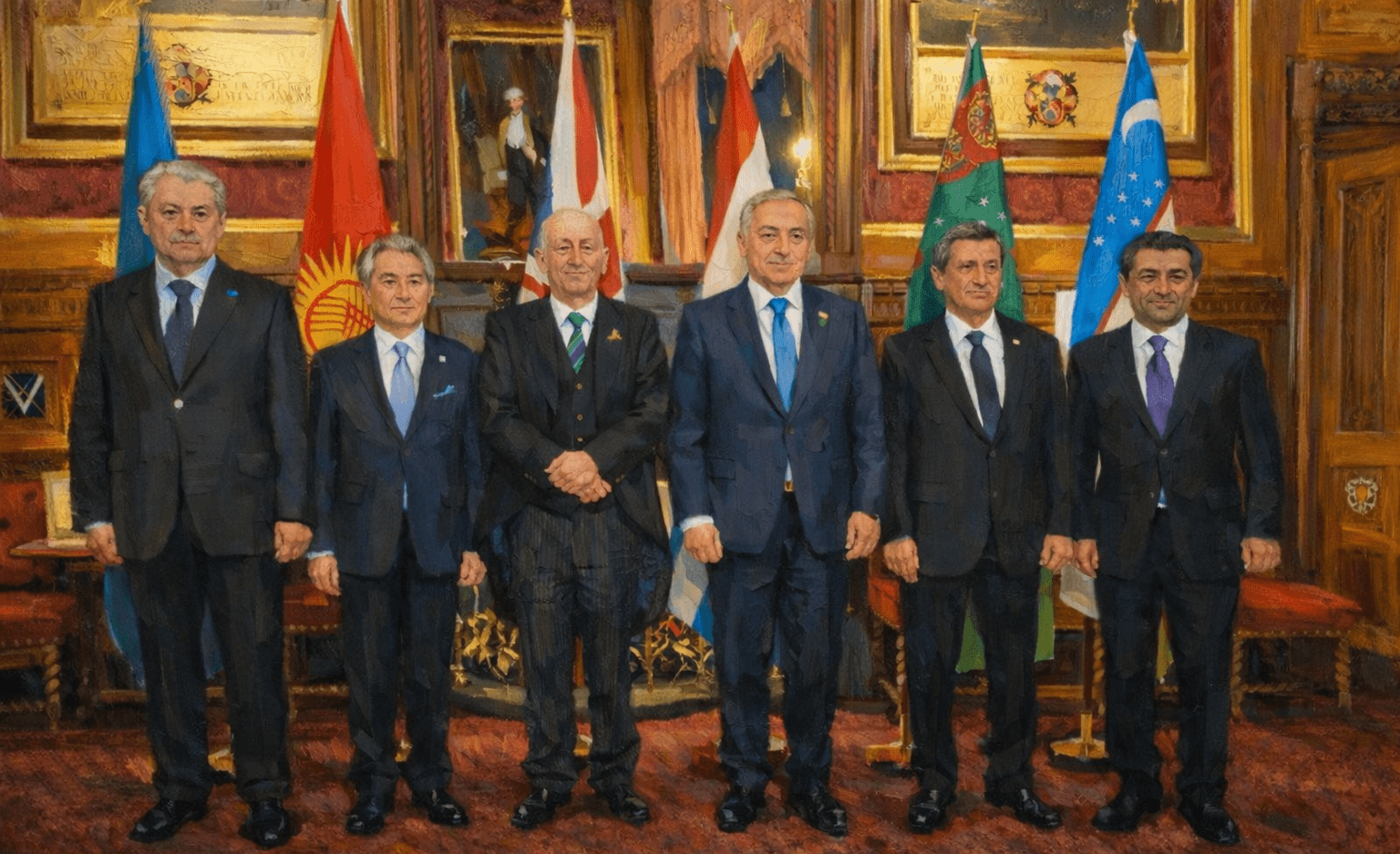
London is hosting the first formal meeting of Central Asian foreign ministers with the United Kingdom on February 26, opening a new “Central Asia–UK” ministerial track after a broader parliamentary program in London earlier in the week. Foreign ministers from Kazakhstan, Kyrgyzstan, Tajikistan, Turkmenistan, and Uzbekistan are attending. Kyrgyzstan’s Foreign Minister Jeenbek Kulubayev is expected to hold bilateral talks with UK Foreign Secretary Yvette Cooper, while Kazakhstan’s Foreign Minister Yermek Kosherbayev has also been holding meetings in London focused on trade, investment, and critical minerals cooperation. With delegations from all five Central Asian countries present, the format provides scope for further bilateral engagements on the margins.
On the eve of the ministerial meeting, Central Asian foreign ministers, led by Kazakhstan’s Yermek Kosherbayev, held a session with the UK’s All-Party Parliamentary Group on Cooperation with Central Asia, with British MPs emphasizing political dialogue, legislative exchange, and deeper interparliamentary ties as foundations for advancing economic and regional cooperation.
For Tashkent, the London meeting comes after a burst of bilateral engagement that has put finance and infrastructure at the center of the relationship. On February 17, President Shavkat Mirziyoyev received the UK Prime Minister’s Trade Envoy to Central Asia and Azerbaijan, Lord John Alderdice, and highlighted how heavily Uzbekistan has leaned on London’s markets: Uzbek sovereign and corporate bonds worth more than $15 billion have been placed on the London Stock Exchange, while trade turnover has doubled over the past five years, according to the presidential press service. Mirziyoyev also flagged potential projects spanning energy, finance, geology, and transport, and the sides agreed to prepare a joint roadmap.
That roadmap is already acquiring project language. Uzbekistan’s Deputy Prime Minister and Minister of Economy and Finance, Jamshid Kuchkarov, met Alderdice in Tashkent with representatives of the London Stock Exchange Group, Arup, and UK Export Finance (UKEF), as well as the UK ambassador, Timothy Smart. According to the Uzbek government, talks focused on transport and logistics infrastructure—rail and road projects, airport modernization—alongside green energy and public–private partnerships. The same meeting produced a memorandum of understanding between Arup and the Ministry of Economy and Finance aimed at engineering and transport infrastructure planning and capacity-building for regions.
Alderdice has also put a number on the UK’s offer. Speaking at a UK–Uzbekistan infrastructure conference, he said the UK has “about £4 billion available for export guarantees in Uzbekistan specifically,” linking the figure to potential backing for projects ranging from rail and airports to urban development. He pointed to London as a venue for Uzbek IPOs and bond issuance and said he was exploring potential collaboration with Uzbekistan’s mining sector, noting that the city also hosts the London Metal Exchange.
The data suggests why Uzbekistan is pushing: the UK reported total trade in goods and services with Uzbekistan of £2.2 billion in the four quarters to the end of Q3 2025, including £545 million in UK exports and £1.6 billion in imports.
Uzbek borrowers have already treated London as more than a diplomatic stop. In 2024, Uzbekistan’s National Bank for Foreign Economic Activity (Uznatsbank) placed two tranches on the London Stock Exchange totaling $411 million, after Uzbekistan’s own sovereign bond placement of $1.5 billion in three currencies earlier that year, as reported by The Times of Central Asia. For a reforming economy that still relies on state-linked finance, repeated access to that market lowers funding costs, widens the investor base, and pressures issuers to improve disclosure and governance.
Regionally, London is seeking to build a coherent Central Asia “offer” around critical minerals and connectivity. Astana and London signed a strategic partnership on critical minerals in 2024, and in February 2026, extended that cooperation by signing a roadmap on strategic partnership in critical minerals that runs through 2027. Kazakhstan — the world’s largest uranium producer and a significant source of copper and other strategic metals — is well positioned to expand its role as an exporter of additional essential metals and materials.
In late 2025, Kyrgyzstan and the United Kingdom followed with a memorandum of understanding focused on exploration, ESG standards, and investment promotion. Uzbekistan represents an additional layer within this evolving framework, increasingly positioning itself as an aspiring participant in diversified mineral supply chains. Taken together, these initiatives illustrate what British policymakers appear to be scaling across the region: structured, project-based cooperation linked to supply-chain resilience and long-term investment.
Transport connectivity is the other pillar. Central Asian governments increasingly pitch the Trans-Caspian “Middle Corridor” as an alternative to routes through Russia and as an economic hedge against disruption in maritime chokepoints. Yet UK engagement has often lagged its rhetoric. Times of Central Asia analysis previously noted British support “in principle.” While London has since signaled up to £4 billion in UKEF export guarantees, the test now is whether those guarantees translate into identifiable, financed projects comparable in scale to the EU’s €10 billion Global Gateway pledge. The London ministerial now serves as a test of whether Britain can shift from endorsement to delivery.
For Uzbekistan, delivery is likely to mean three things. First, converting PPP talk into a bankable project pipeline—roads, rail, airports, power transmission, and the planning capacity to execute them. Second, using London’s financial infrastructure to advance privatization and to bring more Uzbek issuers to international markets on terms that satisfy global investors. Third, defining a minerals agenda that goes beyond extraction and includes processing, logistics, and ESG compliance—precisely the kind of package necessary to attract long-term capital rather than one-off traders.
Politically, Tashkent will want the new format to fit Central Asia’s multi-vector diplomacy. During his 2024 tour of the region, UK Foreign Secretary David Cameron said Britain was not asking Central Asian states to “make a choice” between partners, but was offering cooperation tied to shared security and prosperity. Uzbekistan has been adept at using that space to widen options without signing up to blocs.
If the new C5–UK meeting produces only generalized communiqués, it will be filed away as another well-meaning initiative. If London can align export finance, capital-markets access, and a small number of “nameable” projects—airport upgrades, rail links, power grids, or logistics hubs—the format could become a practical channel through which Uzbekistan and its neighbors finance modernization. Watch for UKEF-backed pipelines, education links, and a timetable for the next ministerial—ideally in Central Asia—to show the format is built to last.