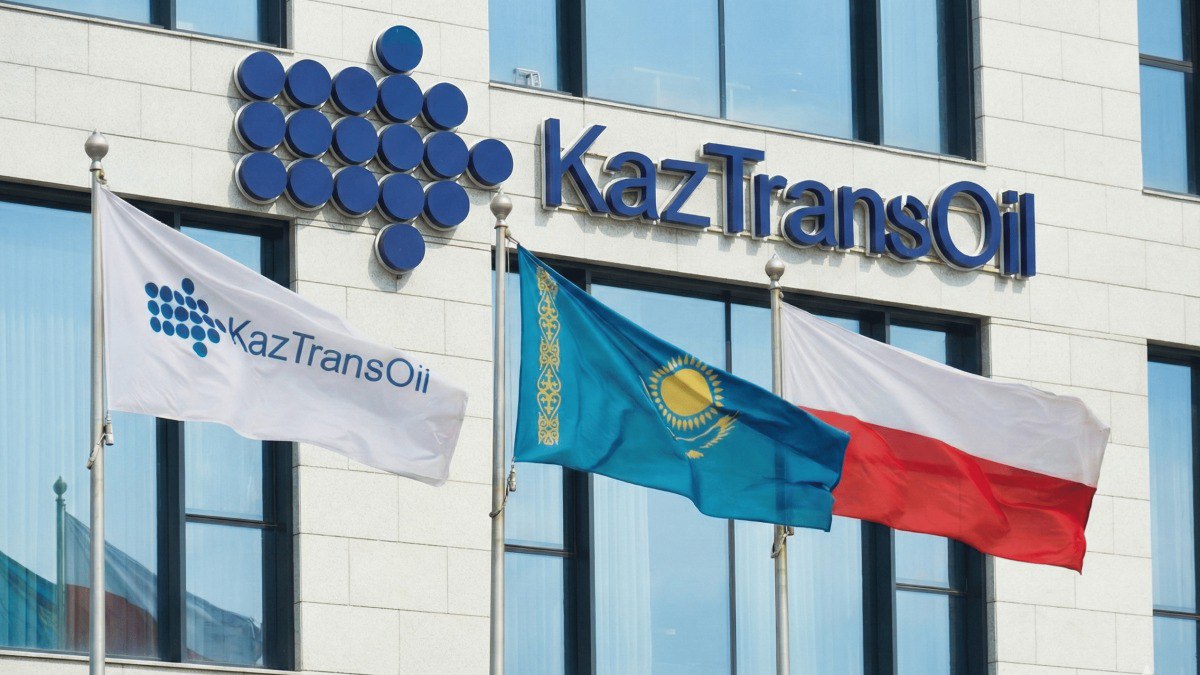
Kazakhstan’s national oil pipeline operator KazTransOil has announced the opening of its first representative office in the European Union, selecting Poland as the location. The decision, approved by the company’s board of directors, aims to strengthen Kazakhstan’s presence in European energy markets, the company said in a statement.
The new office will focus on protecting KazTransOil’s commercial interests in Poland and facilitating the transit of Kazakh crude oil through Belarus and Poland. It will also oversee the handover of oil at the Adamova Zastava delivery point on the Belarusian-Polish border, from where it is transported to the Schwedt refinery in eastern Germany.
KazTransOil stated that the move is intended to expand alternative export routes, enhance supply reliability, and reinforce Kazakhstan’s role as a strategic energy partner to Europe.
The expansion comes amid deepening oil cooperation between Kazakhstan and European countries. On December 18, KazTransOil and Russia’s state-owned pipeline operator Transneft signed a transit agreement for 2026, allowing Kazakh oil to continue flowing through Russian territory. While specific volumes were not disclosed, the agreement covers shipments to Russian ports such as Novorossiysk and Ust-Luga, and to the Russia-Belarus border for onward delivery to EU countries.
Germany, in particular, has ramped up imports of Kazakh oil as part of its broader effort to reduce reliance on Russian energy. Following the 2022 invasion of Ukraine and subsequent EU sanctions, Berlin halted Russian oil imports and began receiving regular shipments of Kazakh crude in 2023.
In 2024, Germany imported 1.5 million tons of Kazakh oil and plans to increase that to 1.7 million tons in 2025, with a long-term target of 2.5 million tons annually.
In October 2025, KazMunayGas, Kazakhstan’s national oil and gas company, signed an updated agreement with Rosneft Deutschland GmbH to extend oil supply arrangements through the end of 2026. The revised deal boosts monthly deliveries from 100,000 to 130,000 tons. Additional volumes are expected from the Karachaganak field, while supplies from the Kashagan and Tengiz fields are set to begin in 2024 and 2025, respectively.
According to KazMunayGas, approximately 1.5 million tons of Kazakh oil were delivered to the Schwedt refinery between January and September 2025. Rosneft Deutschland GmbH, which holds a stake in the refinery, remains under German government trusteeship as part of Berlin’s effort to minimize exposure to Russian energy assets.
Deliveries of Kazakh oil to Europe are conducted via the Druzhba pipeline. Originating in Samara, Russia, the pipeline splits near Bryansk and Mozyr into two branches: the northern route through Belarus and Poland to Germany, and the southern route through Ukraine to Hungary, Slovakia, and the Czech Republic.