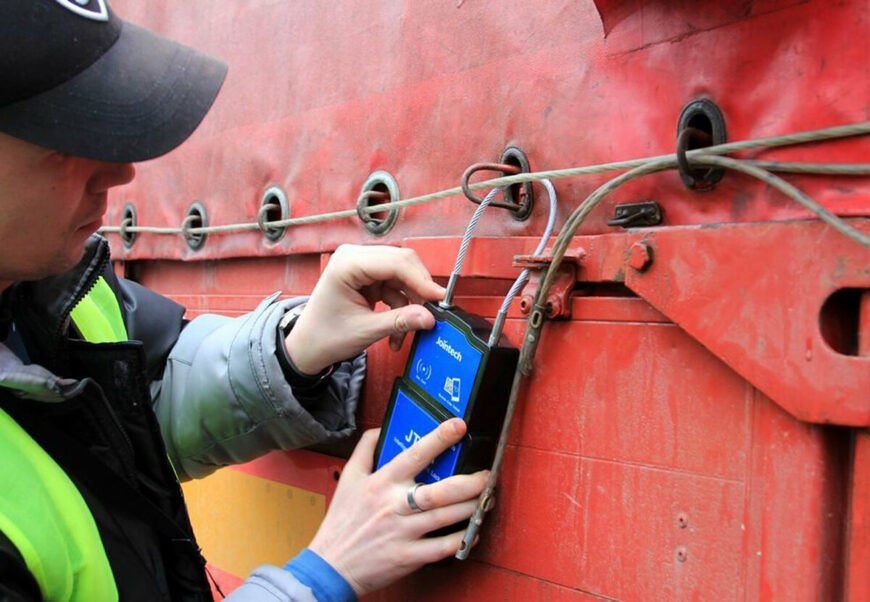
Since February 2026, the countries of the Eurasian Economic Union (EAEU), Kazakhstan, Kyrgyzstan, Tajikistan, Belarus, and Russia, have begun the phased introduction of a navigation seal system to track cargo shipments. The mechanism is designed to increase transit transparency, strengthen control over the movement of goods, and speed up logistics operations.
However, business representatives warn that the new system could lead to higher logistics costs and create additional administrative barriers for carriers. Against the backdrop of the launch of the project’s first phase in Kazakhstan, debate is growing over whether digitalization will deliver the expected benefits, or become another source of pressure on the market.
New Transport Control System
The agreement on the use of navigation seals in the EAEU was signed by the heads of state on April 19, 2021, and ratified by Kazakhstan in 2023. The document provides for the tracking of goods transported through the territories of two or more member states of the union.
In Kazakhstan, amendments were introduced to national legislation to implement the agreement, the information systems of controlling authorities were modernized, and pilot projects were conducted in both road and rail transport.
Under a resolution of the Government of Kazakhstan dated September 10, 2024, the national operator of the transport tracking system is the Institute of Space Technology and Technologies LLP, which operates under the Aerospace Committee of the Ministry of Digital Development.
By decision of the Eurasian Economic Commission’s Collegium dated September 23, 2025, phased transport tracking using navigation seals began on February 11, 2026, for goods transported between EAEU countries.
In 2025, the national operator, together with the State Revenue Committee of the Ministry of Finance of Kazakhstan, conducted a pilot project on the use of navigation seals in transit transportation.
Testing took place at road border crossings and along railway routes. The main objective was to test procedures for installing and removing seals, as well as to verify the interaction between government information systems and the Transit platform.
As a result of the pilot project, more than 890 shipments involving 1,757 vehicles were tracked, and a total of 1,637 navigation seals were installed.
The devices were used at key road checkpoints and along the railway route between Altynkol and Saryagash stations. Based on the results, authorities concluded that the system was technically and organizationally ready for large-scale implementation.
How “Digital Seals” Work
According to Osken Toishibekov, director of the Institute of Space Technology and Technologies, the system is based on the Transit information platform, which connects carriers, operators, and government agencies.
He explained to The Times of Central Asia that a navigation seal is a device equipped with an electronic module and a sealing element with satellite navigation capabilities. It enables the location of a vehicle to be tracked via GPS, with data transmitted to the system through mobile networks.
The device records attempts to open or damage the seal, break the sealing cable, interfere with the equipment, or trigger other abnormal events. All information is automatically transmitted to the monitoring system.
To manage the process, a mobile app called Transit has been developed. It allows users to activate and deactivate seals, scan QR codes, and record the installation of the device with photographs.
Transportation will be monitored by a 24-hour dispatch center that tracks vehicle movements, analyzes incoming data, and communicates with drivers in the event of abnormal situations.
Communication Problems and Technical Risks
One potential challenge remains unstable mobile coverage along certain sections of transport routes.
According to Toishibekov, the system allows for offline operation in such cases. When connectivity is unavailable, operations with the seal can be performed via Bluetooth, with the data transmitted to the system once the connection is restored.
In addition, satellite internet and other technical solutions are planned for use at certain checkpoints to improve system stability.
The cost of using navigation seals varies depending on the country and the mode of transport.
According to current estimates, the cost of services in Kazakhstan is approximately:
- about $83 for the start of transportation and tracking by road;
- about $140 for the start of transportation and tracking by rail;
- about $57 for transit through the country;
- about $76 for the completion of transportation tracking.
The national operator says that the cost of sealing represents only a relatively small share of overall transportation expenses.
Business representatives, however, take a different view.
According to Timur Zharkinov, deputy chairman of the board of the Atameken National Chamber of Entrepreneurs, calculations by businesses suggest that the system’s introduction could significantly increase logistics costs.
In some cases, the cost of rail transport could rise by tens of percent, particularly when transporting small consignments of goods.
Entrepreneurs argue that mandatory sealing could become an additional administrative burden, especially for small and medium-sized businesses.
Which Goods Will Be Subject to Control
The system will be implemented in stages. In the first phase, tracking will apply to:
- alcoholic beverages;
- tobacco and tobacco products;
- goods subject to special economic measures;
- certain categories of consumer goods transported by road.
In the future, the list may expand to include additional cargo categories and rail shipments.
The business community has proposed maintaining exemptions from mandatory sealing for several categories, including humanitarian aid, the transport of animals, hatching eggs, and international postal items.
Digitalization of Logistics or New Barriers?
By the end of 2026, Kazakh authorities plan to expand the use of navigation seals and increase the infrastructure operated by the national system provider. Plans also include further development of the information system and improvements to regulations governing the interaction among transport participants.
Authorities argue that the system will improve transit transparency, reduce cases of false transit declarations, and increase budget revenues.
Businesses, however, are calling for a careful assessment of the economic consequences of the technology’s introduction and, if necessary, a revision of tariffs.
Whether the project ultimately becomes a tool for modernizing logistics or a new barrier to trade will likely become clear in the first years of its implementation.