Reports surrounding the death of an employee at an anti-plague research institute in Russia’s Irkutsk region have prompted health authorities across Central Asia to tighten sanitary controls and review preparedness measures.
Russian officials have not confirmed that the employee contracted plague or that a laboratory accident occurred. Kazakhstan, Kyrgyzstan, Tajikistan, and Uzbekistan have nevertheless announced additional checks or heightened readiness in response.
Officials across the region say there is no cause for alarm, but the response reflects the sensitivity that remains around cross-border infectious disease threats after the COVID-19 pandemic.
What Is Known
Russian authorities have released few details, but reports say an employee at the anti-plague institute in Shelekhov, near Irkutsk, accidentally broke a test tube containing live bacteria.
That employee, a female aged 27 or 28, was hospitalized on September 29, but she died on October 2. The hospital where she was treated was reportedly placed under quarantine, and nearly 200 people who might have come into contact with her are under medical observation.
There are also reports that four more hospitals are under quarantine, with some 100 people hospitalized as a precaution.
Russian officials deny these reports and say health specialists are on the ground in the area investigating and have urged the public to wait for an official assessment of the situation and not spread rumors.
The Response in Central Asia
Kazakhstan shares a 7,800-kilometer border with Russia; the distance from far northeastern Kazakhstan to Irkutsk is more than 1,500 kilometers. While that is comforting, the distance from Kazakhstan to Wuhan, China, is some 3,600 kilometers, and the coronavirus that originated in Wuhan in 2019 eventually reached Kazakhstan and everywhere else in the world.
On October 5, Kazakhstan’s Health Ministry said it was aware of the reports from Irkutsk, was following the situation closely, and had ordered closer checks at border crossings and other entry points.
“Sanitary and quarantine controls are being conducted at state border crossing points,” a Health Ministry statement said, “No individuals with elevated temperatures, signs of illness, or suspected highly dangerous infections have been detected across any mode of transport.”
The Health Ministry said the chances of plague, or “pneumonia of undetermined etiology” crossing Kazakhstan’s borders were low.
Kyrgyzstan’s Health Ministry also said it had ordered close checks of people entering the country in response to reports about the situation in Irkutsk.
“Specialists monitor individuals, vehicles, and cargo crossing the border to prevent the importation and spread of infectious diseases, including highly dangerous infections,” the Health Ministry said.
The same measures are being implemented in Tajikistan.
Said Davlatzoda, the head of the Health Ministry’s Department of Sanitary-Epidemiological Safety, Emergency Situations and Emergency Medical Care, said orders went out that every person crossing into Tajikistan must have their body temperature measured.
Workers from the department have been instructed to ask people arriving whether they are experiencing symptoms such as nausea and vomiting, headache, weakness, and muscle and joint pain.
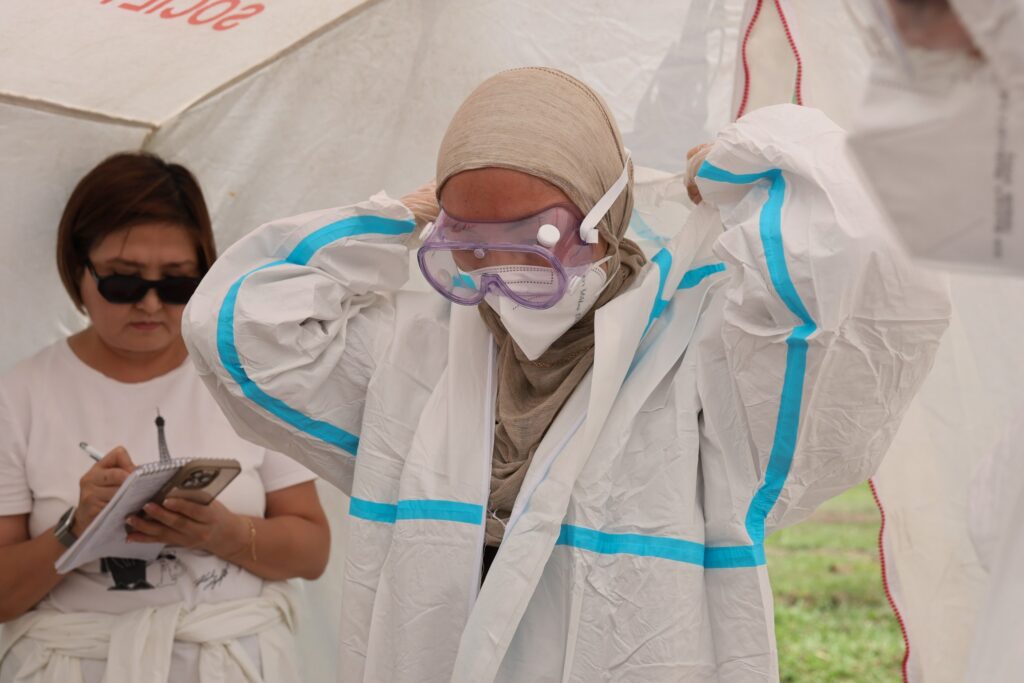
Personnel from the Sanitary-Epidemiological Safety Department have also been told to wear disposable hazmat clothing when manning border entry points.
Uzbekistan’s Committee for Sanitary and Epidemiological Welfare and Public Health said it had strengthened the readiness of relevant services “to prevent the introduction and spread of highly dangerous infectious diseases within the country.”
However, the committee also said there has been no confirmation of the possible contagion, and the exact suspected disease has not been named by any Russian health officials.
The committee also pointed out that the World Health Organization was monitoring the situation and called on Uzbekistan’s citizens not to rely on unverified reports.
Turkmenistan has not said anything about the reports of plague in the Irkutsk area or about the authorities introducing any special measures. This is to be expected from Turkmenistan, remembering that the authorities there continue to claim to this day that the country never had any cases of COVID.
A Looming Influx of Russians?
Reports of a possible problem with the plague in Irkutsk come just weeks after Russia held parliamentary elections.
There have been rumors for months that Russian President Vladimir Putin would announce another mobilization for the armed forces sometime after those elections to bolster forces invading Ukraine.
The last time the Russian authorities declared a general mobilization in 2022, more than one million Russian citizens crossed into Central Asia in less than a year. The vast majority continued on to a third country, but while many countries in the West have barred Russian citizens from entry due to the war in Ukraine, Central Asia remains accessible for Russians.
The announcement of another mass mobilization would likely send hundreds of thousands more Russians fleeing through Central Asia, and local health officials would have their hands full trying to check everyone crossing their borders.