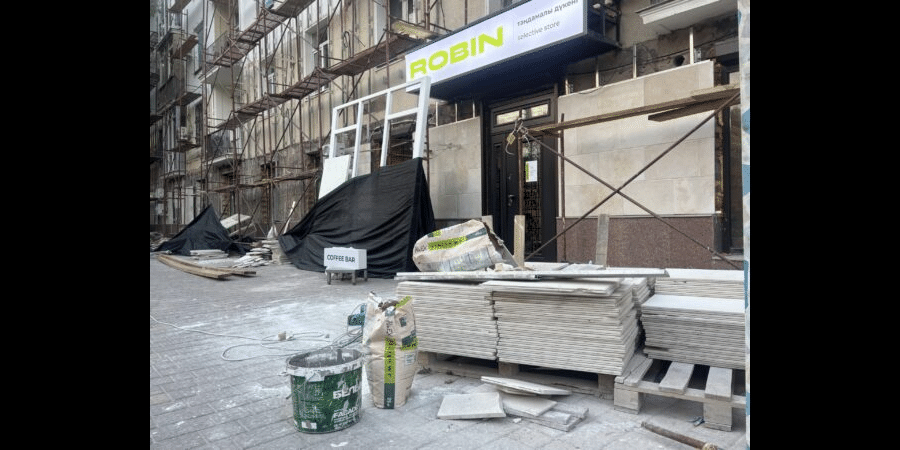
When Gaukhar Osmonalieva rented a space in central Almaty for a pet grooming salon and coffee shop, renovations to the building’s facade were already underway. She was assured the work would be finished soon. Her business opened in August, but instead of a busy street and an outdoor terrace, she found herself surrounded by scaffolding, a torn-up sidewalk, and constant dust. By mid-October, construction was still underway, and the customers she had hoped to attract by choosing the location were coming less frequently.
“At one point, the construction workers dug up the entire road, and foot traffic dropped noticeably. We chose this location because it was convenient and had heavy pedestrian traffic, but those are precisely the advantages we have now practically lost,” Osmonalieva told The Times of Central Asia.
Almaty is Kazakhstan’s largest city and commercial hub. In 2026, the city launched a large-scale renovation of residential building facades, many dating back to the Soviet era. The original program covered 176 buildings in three central districts – Almaly, Bostandyk, and Medeu. More than 25.8 billion tenge (approximately $57 million) was allocated for the work. Many of the buildings house cafes, shops, and small businesses on their ground floors.
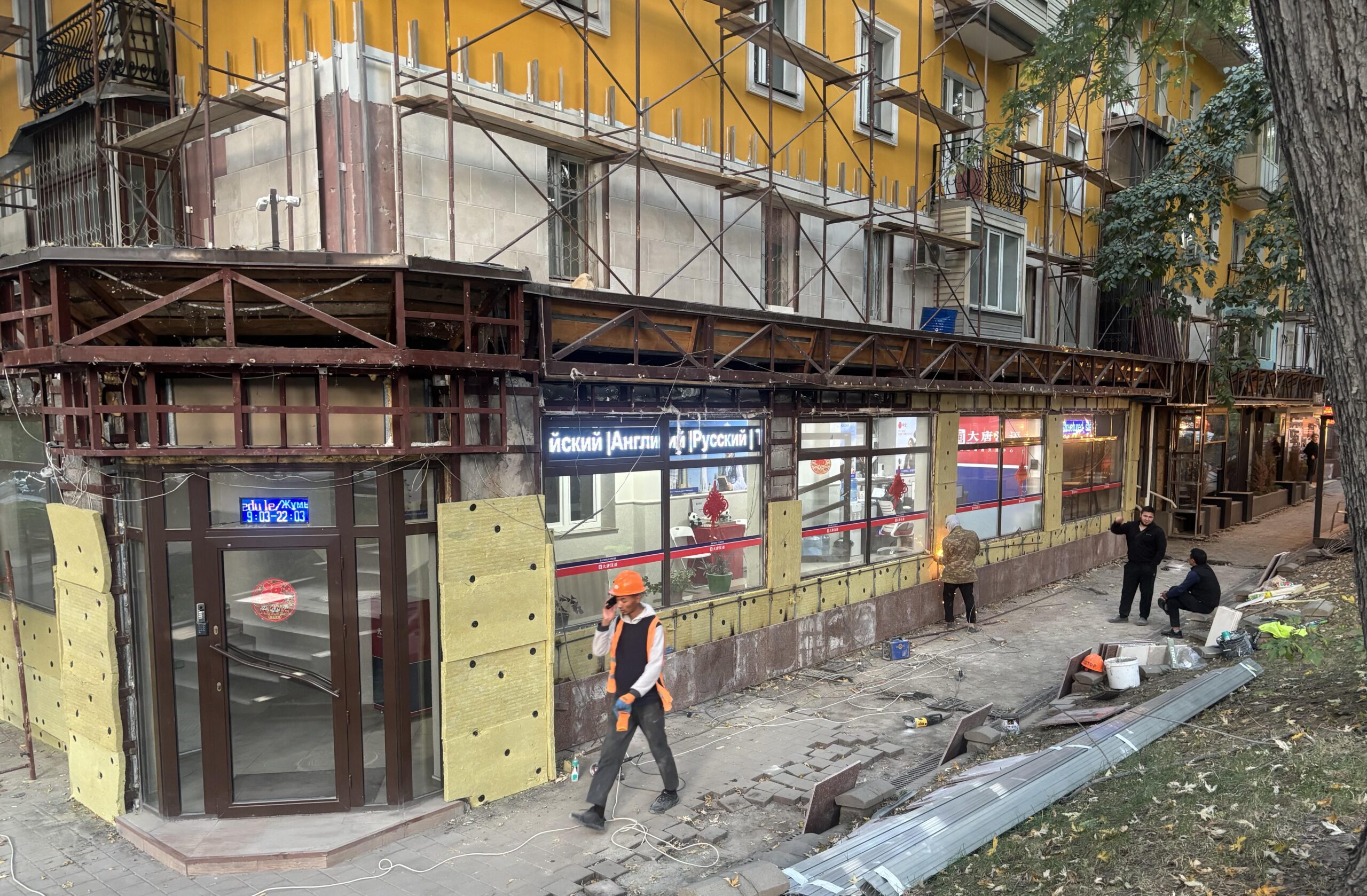
Classes continue as normal at a language school on Abay Avenue as restoration goes on outside.
City officials promised to update the facades while preserving the buildings’ architectural features. But questions about how the work was organized emerged as early as spring. Local news outlet Vlast found that construction had begun at some sites in March, before public tenders were announced and contracts signed. Under the tender terms, renovating a single building was supposed to take three to five months.
By August, only nine of the 178 buildings listed in updated district administration figures had been fully renovated. Authorities in Bostandyk expected to complete most of the work by September, while those in Almaty targeted October.
Osmonalieva was initially told the renovations would take three weeks, then that they would be completed by September. After complaining via e-Otinish, Kazakhstan’s government complaints platform, she was given a new deadline: October 15.
“But today is already October 12, and judging by the condition of the facade, I wouldn’t say even half the work has been done,” she said.
According to Osmonalieva, there are often only three or four construction workers on the building. Tools are left near the entrance, while workers cut cladding materials beside the salon, filling the area with dust.
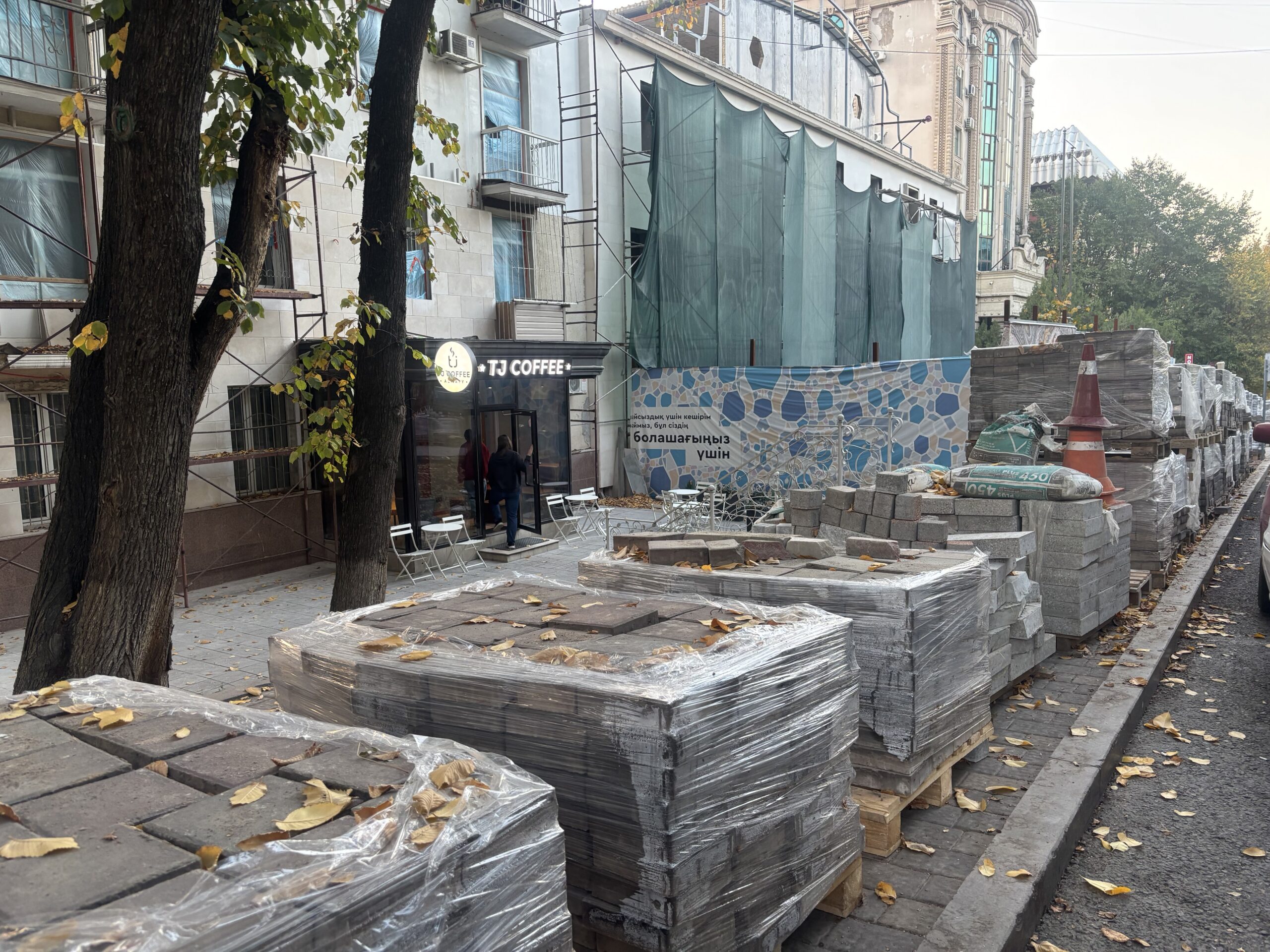
A coffee shop on Kunaev Street, with construction materials stacked outside.
The coffee shop has suffered most. Osmonalieva had planned to open an outdoor terrace, a popular feature in Almaty, where warm weather lasts for several months. But scaffolding made it impossible to set up tables outside.
“As a result, we missed the entire season. This had a significant impact on the coffee shop: demand was lower than expected, and we couldn’t reach our planned targets,” she said.
The construction has created additional difficulties for the grooming salon, too. Some dogs become frightened by the noise and machinery before they even reach the entrance. Because of the dust, employees have to wash the entrance area more frequently, using more water.
Sometimes construction workers ask permission to plug their tools into the salon’s electrical outlets.
“And we agree, because we also want them to finish the work as quickly as possible,” Osmonalieva explained, adding that her utility bills rose in October.
She has not been offered compensation or financial relief during the renovations. Nor has she asked her landlord to reduce the rent, believing he is not responsible for construction organized by the city.
Osmonalieva’s experience echoes the findings of a study by Urban Forum Kazakhstan, a nonprofit focused on urban development.
The study, titled “This Is for Your Future,” surveyed 340 people affected by street reconstruction in Almaty during the summer of 2026. It found that 90% of respondents learned about construction only after it had begun. The same proportion reported having no convenient, safe, clearly marked route around construction sites. Nearly 68% had been forced to walk in the roadway, while 51.5% had to pass directly through construction zones. Respondents also complained about dust, particularly when stone and paving tiles were being cut.
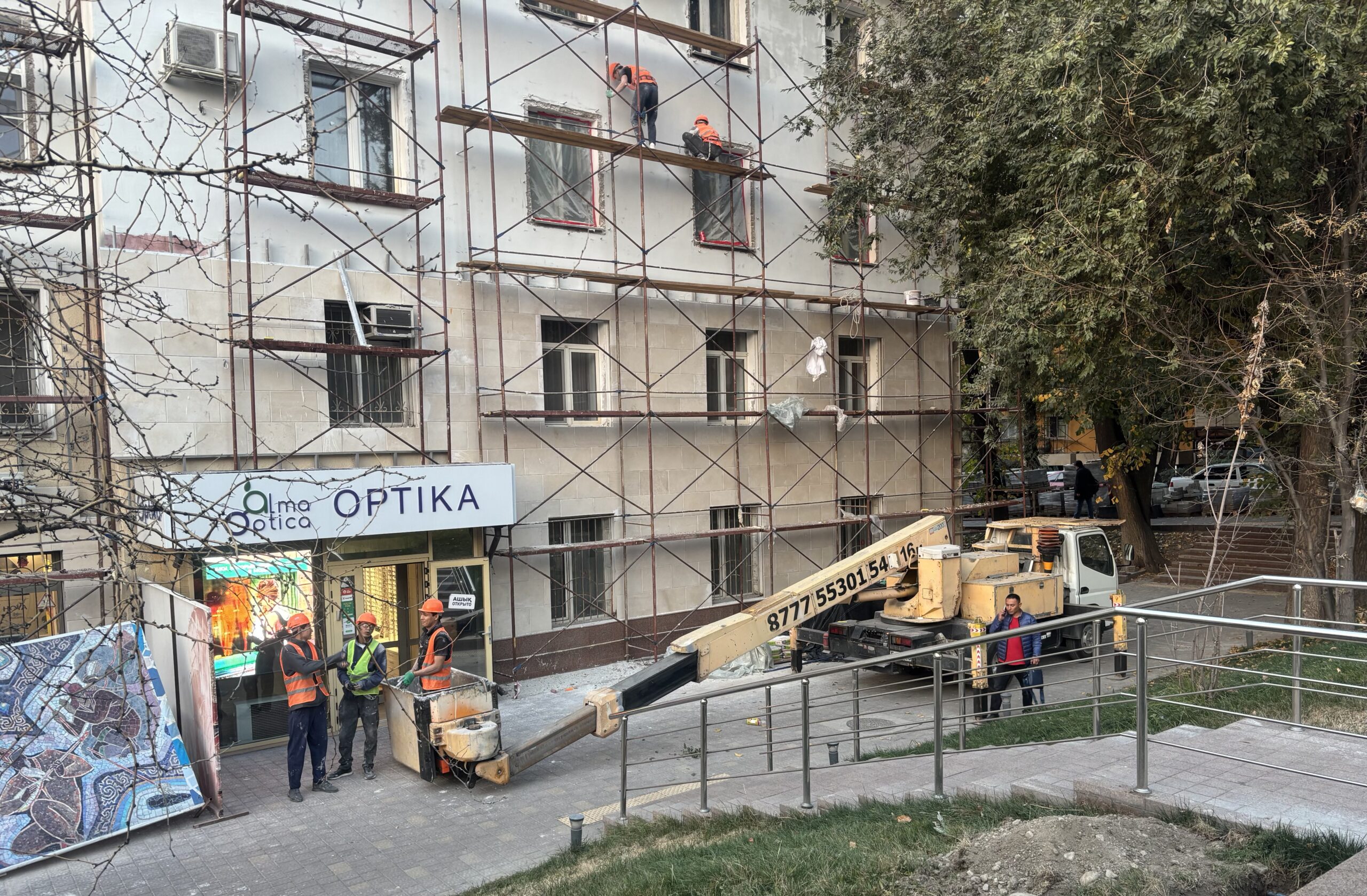
Construction workers take a break outside an opticians on Abay Avenue.
Urban Forum Kazakhstan concluded that requirements for pedestrian protection and construction dust control were not adequately incorporated into construction regulations and contractor agreements.
The survey was conducted from July 13 to August 14 and covered street and public-space reconstruction. Its sample is not representative of all Almaty residents, but it illustrates the difficulties people encounter in areas affected by construction.
Urban Forum Kazakhstan recommends requiring contractors to establish safe pedestrian routes in advance, install clear barriers and signs, and use dust suppression equipment. The organization wants these requirements written directly into municipal regulations and contracts.
Residents have also complained about the results of the renovations. In October, residents of a building on Nazarbayev Avenue, one of Almaty’s main streets, complained about selective renovation: neighboring buildings had been refurbished, while theirs was left untouched despite previously appearing on renovation lists. At another building, workers painted only the end wall facing the avenue. The akimat, or local administration, said the contractor had done so on its own initiative and that the building was not part of the approved program.
Osmonalieva does not oppose Almaty’s renovation program. She believes the work could make the city more attractive, particularly if the architectural features of older buildings are preserved. But she argues that business owners should receive advance notice of construction schedules and support during prolonged renovations.
“It’s one thing when business owners know the exact schedule in advance and can prepare for temporary inconvenience. It’s quite another when you’re constantly promised that the renovations will be finished soon, but weeks and months go by and nothing fundamentally changes,” she said.
Both her coffee shop and salon continue to serve customers amid scaffolding and dust, with the October 15 completion deadline just a day away. Judging by the condition of the facade, she doubts the workers will meet it.