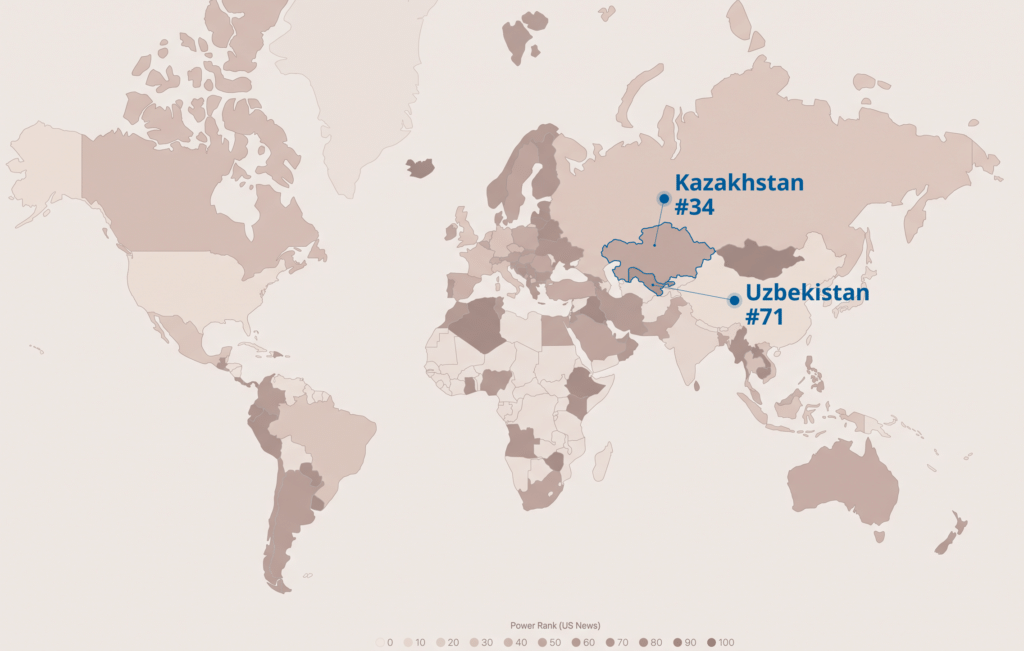
Kazakhstan will receive the maximum 8% country weight in JPMorgan’s new index for frontier market government bonds, creating an opportunity to attract new foreign buyers of tenge-denominated debt.
JPMorgan plans to launch the GBI-EM Edge by the end of September. The maximum weight for any single country is capped at 8%, and Kazakhstan will receive the full quota. Vietnam, Pakistan, and Bangladesh will have the same weight. Other major components will include Egypt, Morocco, Nigeria, and Sri Lanka. The index will cover 26 countries, with nearly $330 billion in bonds eligible for inclusion.
GBI-EM Edge is designed for frontier markets, relatively less accessible markets outside JPMorgan’s main emerging market benchmark. Inclusion is a separate development from Kazakhstan’s efforts to join that main index.
The index will serve as a benchmark for international asset managers. Some funds seek to replicate its composition, while others use it to compare the performance of their own portfolios. A country’s weight can therefore influence how much money investors allocate to its bonds.
However, the nearly $330 billion represents the value of bonds eligible for the GBI-EM Edge, not the amount of future investment. JPMorgan has not yet said how much capital will directly track the new index. That will largely determine how significant the additional demand for Kazakh debt may be.
Foreign Investors Have Already Increased Their Holdings
Foreign investors began actively buying Kazakhstan’s government debt even before JPMorgan’s decision.
According to the Analytical Center of the Association of Financiers of Kazakhstan (AFK), non-resident holdings of government securities reached KZT 2.5 trillion, or about $5.4 billion, by the end of June. During the first half of the year, their portfolio grew by 28.3%, while the share of non-residents in the government securities market increased from 6.2% to 6.9%. In June alone, foreign investors added KZT 185.1 billion, or about $400 million.
Just a year and a half earlier, non-resident holdings stood at around KZT 1.1 trillion, or about $2.4 billion.
Kazakhstan has maintained a high base rate to combat inflation. This has also kept yields on government bonds high. According to AFK, real yields on government securities – meaning returns above inflation – ranged from 5.7% to 7.4% in the first half of the year. The association’s analysts also linked strong demand to expectations of a gradual reduction in the base rate.
For a foreign fund, the trade can look attractive: raise money in a market with lower interest rates, buy tenge, and invest in Kazakh government bonds. If the tenge remains stable or strengthens, the investor benefits both from the high interest rate and from the currency movement. If the tenge falls, some of that return disappears when the investment is converted back into dollars.
The tenge’s appreciation has already helped foreign bondholders. It strengthened by 2.6% during August, ending the month at KZT 461.57 per dollar, according to the National Bank.
AFK points to another effect of foreign purchases. To buy the bonds, non-residents sell foreign currency and purchase tenge, increasing the supply of dollars and other currencies in the domestic market. Growth in their bond holdings therefore became one of the factors supporting the tenge in the first half of the year.
High Yields Come at a Cost to the Budget
For the government, a broader pool of buyers also matters. Greater demand for bonds can give the state more room to issue new debt on acceptable terms.
According to AFK calculations, Kazakhstan’s government debt reached KZT 40.9 trillion, or about $88.6 billion, by midyear, up 14.7% from a year earlier. Debt-servicing costs grew almost twice as fast, rising 26.3% to KZT 2.1 trillion, or roughly $4.5 billion, in the first half alone. Interest payments and other debt-related costs accounted for about 11% of budget expenditures, compared with 9.6% a year earlier.
AFK attributes the increase in costs to both the growth of the debt itself and the high cost of new borrowing. During the first half of the year, the government raised KZT 3.7 trillion, or about $8 billion, in the market, compared with KZT 3.4 trillion, or roughly $7.4 billion, a year earlier.
Kazakhstan Is Making Its Government Debt Easier for Foreigners to Buy
High interest rates alone are not enough for major international asset managers. They also need to be able to buy securities, receive payments, and exit investments without going through cumbersome local procedures.
Kazakhstan has spent several years rebuilding its debt-market infrastructure with this in mind.
Since May, five primary dealers have been operating in the government securities market: Bank CenterCredit, Eurasian Bank, Kaspi Bank, ForteBank, and Halyk Bank. They regularly participate in government bond placements and provide two-way quotes for selected securities in the secondary market.
For a foreign investor, a liquid secondary market means being able to sell a bond without waiting for it to mature.
When launching the system, the National Bank explicitly linked the reform to making tenge-denominated government debt more attractive internationally and creating conditions for its inclusion in global indices, including JPMorgan’s main GBI-EM index.
Kazakhstan is also working to connect its government bonds directly to Euroclear, one of the world’s largest international securities settlement and depository systems. This would allow foreign funds to work with tenge-denominated government debt through familiar global infrastructure.
The direct Euroclear link is planned for 2027. Access through Clearstream is already available. In May, Kazakhstan’s National Bank and other state institutions, together with the Asian Development Bank, published the country’s first comprehensive Bond Market Guide, explaining access to local securities, settlement procedures, regulation, and market infrastructure.
What Index Inclusion Could Change
The new index has a yield of about 10.4%, roughly 4.4 percentage points above JPMorgan’s main local currency emerging market government bond benchmark. JPMorgan’s back-testing showed that over the past nine years, the GBI-EM Edge would have delivered about 1.2 percentage points more per year than the main index.
Kazakhstan is continuing to prepare its market for possible inclusion in the main GBI-EM index, which is followed by a much larger pool of international capital. GBI-EM Edge gives tenge-denominated government debt an intermediate route to investors who use JPMorgan indices as benchmarks.
The growing foreign portfolio also has a currency dimension. As investors enter the market, they buy tenge, supporting demand for the national currency. During a sharp exit, the process works in reverse: funds sell their bonds, then sell tenge and move their capital back into dollars or other currencies. The larger the foreign portfolio becomes, the more noticeable such movements can become in the domestic market.
GBI-EM Edge could bring in new buyers. How large that flow becomes will be clearer after the index launches and more is known about the amount of capital using JPMorgan’s new benchmark.