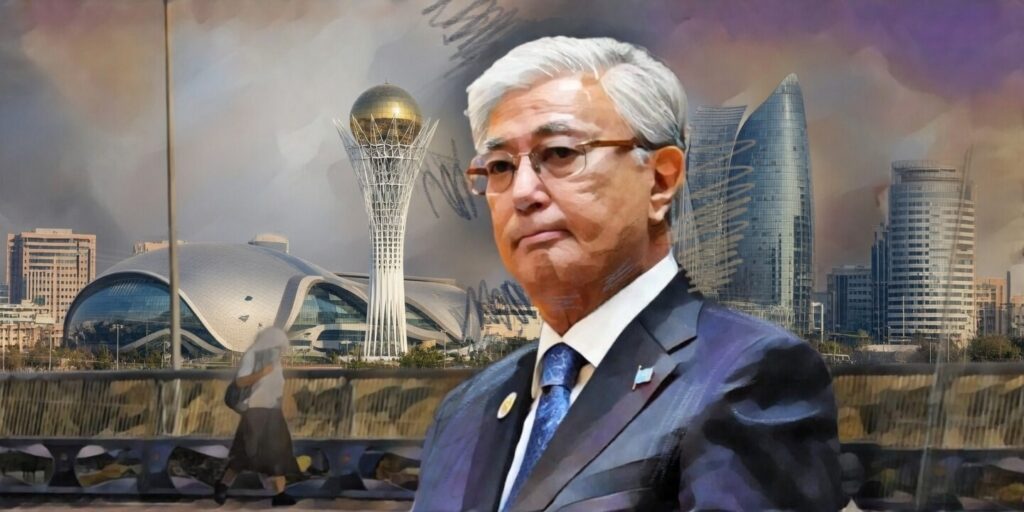
As The Times of Central Asia has noted throughout its special coverage, Kazakhstan’s new constitutional model is presented as modernization, not a rupture with the existing system. President Kassym-Jomart Tokayev has described the project as a response to a rapidly changing global landscape, arguing that the country’s basic law must be recalibrated to make governance more coherent, effective, accountable, and sustainable. That framing has included streamlining parliament, restoring the vice presidency, and redistributing authority across institutions as part of what Tokayev called a “complete reboot” of government, not a revolutionary break with existing institutions. Voters endorsed that vision in the 15 March referendum, with 87.15% backing the new constitution on 73.12% turnout. A report published the following day by the Kazakhstan Institute for Strategic Studies can be read as the most authoritative attempt to define and systematize that vision.
Why This Report Matters
Kazakhstan’s new constitutional report is presented as an analytical study while remaining closely aligned with official policy perspectives and institutional priorities. Published by the Kazakhstan Institute for Strategic Studies under the President of the Republic of Kazakhstan, it says its purpose is to examine constitutional reform as part of a broader process of institutional and socio-economic transformation. The timing is also significant. The report was recommended for publication on 16 March 2026, one day after the referendum it describes as a milestone in the country’s political development.
That makes the document best read as an authoritative explanatory text outlining the state’s interpretation of the reform. It is an effort to define the significance of the referendum for both domestic and foreign audiences. The report’s central argument is that Kazakhstan is not abandoning the presidential republic but renewing its constitutional architecture for a new stage of development. Throughout, it links constitutional change to stronger institutions, better governance, human capital, and long-term resilience.
The International Framing of Reform
For external audiences, the report presents this argument as a process of evolutionary reform, not revolutionary change. It traces the reform path back to political modernization launched in 2019 and accelerated by constitutional amendments in 2022. In the report’s own framing, the 2026 referendum is the next step in a longer sequence of institutional renewal.
The institutional changes highlighted for foreign audiences are significant. The report points to a transition to a unicameral parliament, the creation of a Vice President, the establishment of the Halyq Kenesi as a consultative body with legislative initiative, and an expanded role for the Constitutional Court. Together, these changes are framed as a way to improve policy coordination, ensure continuity in government, and broaden channels between the state and society.
The report also puts heavy emphasis on rights protection, especially in ways likely to resonate internationally. It says the reform strengthens guarantees of fair trial, the presumption of innocence, legal assistance, freedom of expression, and access to information. It also gives unusual weight to digital-era rights, including personal data, privacy, and the security of electronic communications. To reinforce that point, the report cites the Constitutional Court’s record between 2023 and 2025: 566 rulings, more than 190 hearings, 76 final decisions, legal amendments following those rulings, and 36 citizens whose rights were restored.
Just as importantly, the report addresses questions raised by international observers. A full chapter takes up common concerns, including questions about the inclusiveness of the drafting process, the length of the campaign period, and whether the media environment allowed for meaningful debate. The report emphasizes that such debates are a normal feature in constitutional reform processes and notes that formal campaign periods in countries such as France and Turkey were also short. It adds that Kazakhstan’s debate unfolded in a heavily digitalized environment, with more than 5,000 registered media outlets by 2025 and internet penetration above 93 percent.
The Domestic Dimension: Rights, Welfare, and Daily Life
Alongside its international framing, the report also emphasizes the everyday relevance of constitutional reform for citizens. The document says constitutional reform is not just about state design; it is meant to affect how citizens live, work, and interact with public institutions. It reaffirms that human life, dignity, rights, and freedoms are the highest values of the state, and ties that language to a stronger “social state” model. The report notes that 53.8 percent of respondents fully agreed that government is obliged to ensure a good standard of living for every citizen, while another 40 percent said they rather agreed.
That social-state emphasis runs throughout the report. It says the revised constitutional framework gives clearer weight to family, healthcare, social security, and access to essential public services. It also makes education, science, and innovation explicit constitutional priorities, signaling a shift away from a development model centered mainly on natural resources and toward one based on knowledge and technological capability.
The report’s own survey data suggest the public was most engaged when the debate moved away from elite institutional design and toward concrete social and rights-based issues. In February, the most frequently discussed topics were rights and freedoms, social guarantees, environmental protection, education and science. In March, the most-supported provisions included responsible treatment of nature, recognition of culture, education, science and innovation, and protection of personal data in the digital environment.
To support the human-capital argument, the report highlights rising investment in science. It says domestic R&D spending rose by 27.3 percent in 2024, reaching 219.7 billion tenge after a 42 percent jump in 2023, while young scientists are now leading 1,055 research projects. The implication is that the constitution is positioned not just as a legal text, but as a framework for economic upgrading.
The Legitimacy Case and Public Participation
The report places significant emphasis on participation and approval data to underscore the reform’s legitimacy. It says the Constitutional Commission included about 130 members, held 12 publicly broadcast sessions that drew close to one million views, and reviewed more than 12,000 citizen submissions through digital platforms. The larger point is that the reform should be understood as publicly consulted rather than purely elite-driven.
The same logic appears in the polling. The report cites survey support for the draft constitution ranging from 78.8 percent to 90.9 percent, depending on the research organization. It then pairs those findings with the official referendum result and the scale of the voting operation: 10,388 polling stations, including 71 abroad in 54 countries.
The document also highlights a noteworthy dynamic. Only 68.3 percent of respondents in one February survey said the Constitutional Commission had successfully fulfilled its task. In other words, support for the final document appears to exceed confidence in aspects of the process that produced it. The report itself notes this gap and suggests it may help guide future approaches to citizen engagement. That may be one of the report’s most consequential governance findings.
What Comes Next
Taken together, the report is trying to tell two stories at once. To foreign governments, investors, and international institutions, it says Kazakhstan is building a more modern, rules-based, rights-conscious state. To domestic audiences, it says constitutional reform should translate into better governance, stronger social guarantees, and more meaningful state-society interaction.
An important question going forward is how these commitments will be realized in practice. The referendum mandate is strong. The rights language is expansive. The modernization narrative is clearly articulated. The long-term credibility of Kazakhstan’s new constitutional model will rest on how effectively the new institutions improve accountability, protect rights, and deliver the social outcomes citizens were told to expect.