• KGS/USD = 0.01144 0%
  • KZT/USD = 0.00193 -0%
  • TJS/USD = 0.10811 -0.28%
  • UZS/USD = 0.00008 0%
  • TMT/USD = 0.28490 0%
  • KGS/USD = 0.01144 0%
  • KZT/USD = 0.00193 -0%
  • TJS/USD = 0.10811 -0.28%
  • UZS/USD = 0.00008 0%
  • TMT/USD = 0.28490 0%
  • KGS/USD = 0.01144 0%
  • KZT/USD = 0.00193 -0%
  • TJS/USD = 0.10811 -0.28%
  • UZS/USD = 0.00008 0%
  • TMT/USD = 0.28490 0%
  • KGS/USD = 0.01144 0%
  • KZT/USD = 0.00193 -0%
  • TJS/USD = 0.10811 -0.28%
  • UZS/USD = 0.00008 0%
  • TMT/USD = 0.28490 0%
  • KGS/USD = 0.01144 0%
  • KZT/USD = 0.00193 -0%
  • TJS/USD = 0.10811 -0.28%
  • UZS/USD = 0.00008 0%
  • TMT/USD = 0.28490 0%
  • KGS/USD = 0.01144 0%
  • KZT/USD = 0.00193 -0%
  • TJS/USD = 0.10811 -0.28%
  • UZS/USD = 0.00008 0%
  • TMT/USD = 0.28490 0%
  • KGS/USD = 0.01144 0%
  • KZT/USD = 0.00193 -0%
  • TJS/USD = 0.10811 -0.28%
  • UZS/USD = 0.00008 0%
  • TMT/USD = 0.28490 0%
  • KGS/USD = 0.01144 0%
  • KZT/USD = 0.00193 -0%
  • TJS/USD = 0.10811 -0.28%
  • UZS/USD = 0.00008 0%
  • TMT/USD = 0.28490 0%
10 December 2025

Kazakhstan Emphasizes Strategic Role of Trans-Caspian Route at Astana Forum

Kazakhstan is positioning the Trans-Caspian International Transport Route (TITR), also known as the Middle Corridor, as a cornerstone of sustainable logistics across Eurasia. Speaking at a panel session on May 29 during the Astana International Forum, Deputy Minister of Foreign Affairs, Alibek Kuantyrov outlined the country’s ambitions to transform the route into a vital artery for regional connectivity.

The session, co-organized with the Boao Forum for Asia, featured high-profile participants, including Boao Forum Chairman and former UN Secretary-General Ban Ki-moon.

Kuantyrov highlighted that Kazakhstan boasts over 3,500 kilometers of strategic railway infrastructure linking China to Caspian Sea ports. In the coming years, annual cargo volumes along the TITR are projected to reach 10 million tons.

“The TITR is not just a logistics route; it is an infrastructure of trust, efficiency, and growth,” Kuantyrov said. “Kazakhstan is committed to both physical and digital integration. We are already seeing tangible outcomes: in March 2024, a container train from Xi’an [China] reached Azerbaijan in just 11 days, including only three days traversing Kazakhstan.”

This efficiency, Kuantyrov explained, was enabled by key infrastructure improvements such as the upgrade of the Dostyk-Moiynty railway section, development of the Khorgos logistics hub on the Kazakh-Chinese border, and the implementation of digital customs technologies.

Kazakhstan is investing over $35 billion in infrastructure development, including new railways, the expansion of the Aktau and Kuryk ports, and the creation of a container hub in partnership with international investors. “Our objective is not merely transit,” Kuantyrov added. “Kazakhstan views the TITR as a foundation for industrial development and sustainable integration into global supply chains.”

To further enhance east-west cargo flow, the country is constructing second tracks along the 836-kilometer Dostyk-Moiynty section. According to Kazakhstan Temir Zholy, the national railway operator, the additional tracks are set to open in June. These upgrades are expected to increase the line’s capacity fivefold from 12 to 60 train pairs per day.

Baikonur Fallout: Russia’s Cosmic Legacy Leaves Scars on Kazakhstan

“Every time there’s a rocket launch at Baikonur, you can’t see for days. The sand comes up off the ground, and doesn’t shift for a good while,” a waiter in Aralsk, a one-time fishing town on what was once the shore of the shriveled Aral Sea told The Times of Central Asia.

Upon entering Baikonur, Russia’s gateway to outer space on the Kazakh steppe, the first thing you see is a billboard proudly displaying Vladimir Putin shaking hands with President Kassym-Jomart Tokayev.

Beneath the façade, however, Russia’s presence here has spurred major economic inequalities and environmental degradation.

Backwater to the Cosmos

“Here on January 12, 1955, the first group of military engineers arrived, who laid the foundation for the creation of Baikonur Cosmodrome;” image: Thomas Hodgson

Stepping off the train at Töretam, the closest town to Baikonur proper, there is very little sense of occasion to be found.

The only reference to the existence of rockets in the immediate vicinity is a tucked-away, red-starred plaque on the platform bearing the inscription: “Here on January 12, 1955, the first group of military engineers arrived, who laid the foundation for the creation of Baikonur Cosmodrome.”

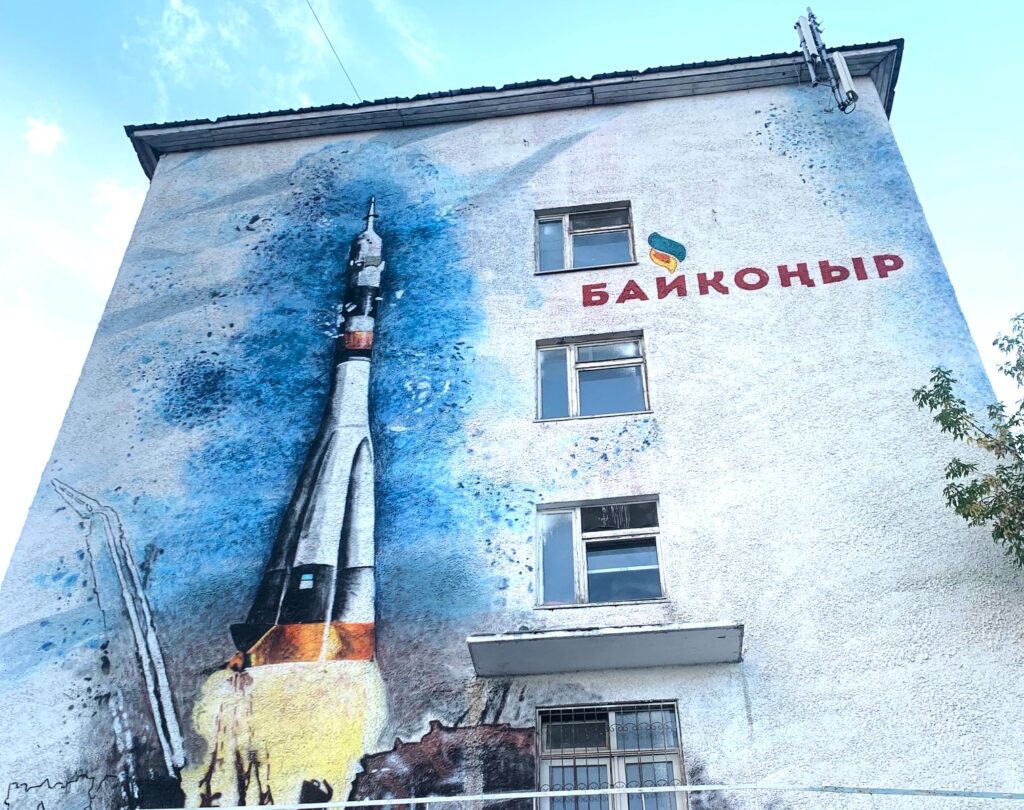
In 1961, Yuri Gagarin launched from Baikonur to become the first human being in outer space, propelling the complex’s status in history from an obscure backwater to a legendary, top-secret star city.

​In reality, “Baikonur” was a decoy name given by the Soviets to a town 300 kilometers away from the real launch site at Leninsk. Western newspapers reinforced the false story, and Baikonur entered the global popular consciousness. Kazakhstan’s government chose to sell the myth, finally renaming the actual cosmodrome settlement from Leninsk to Baikonur in 1995.

With the collapse of the Soviet Union in 1991, Russia found overnight that its primary spaceport was in a foreign power’s possession. By 1994, Moscow struck a deal with the nascent Kazakh Republic to lease Baikonur at a rate of 7 billion rubles per year ($110 million).

As of 2024, the Kazakh state has pulled in over $3 billion in revenue from the scheme.

Living in the Shadow of Russia

Image: Thomas Hodgson

The extent of Russia’s grip over the area, even outside of the “ring,” is clear in all aspects of daily life.

In nearly every shop in Töretam, the ruble is accepted alongside the Kazakh tenge. This poses problems for the local economy, with the circulation of rubles effectively pricing out anyone who doesn’t receive a ruble salary from jobs in Baikonur itself.

The Russian language is likewise used in tandem with Kazakh, even though the surrounding Kyzylorda region is less than 2% ethnically Russian and, by all appearances, overwhelmingly favors Kazakh.

Poverty is widespread here, juxtaposed markedly with the hordes of affluent “space tourists” from around the world who head through Töretam into the “ring” every day. Tour agencies charge upwards of $1,000 per day for access to Baikonur, yet reinvestment in communities surrounding the “ring” seems non-existent, with the average salary in this part of Kazakhstan being less than $330 per month.

For those living on the edge of Baikonur, the necessity of a permit to work inside the complex cannot be understated. This boils down to pure economics – a ruble wage massively outstrips that of a tenge one. There is, likewise, skilled work to be found within Baikonur. In Töretam, prospects are broadly limited to casual employment, with much of the town dependent upon remittances sent from family members working elsewhere – predominantly in Russia or the oilfields of the west.

This does not mean that said permits are easy to come across. One woman described the process of getting permission to work in the “ring” as “next to impossible.” It is “easier for foreign tourists to get in than locals,” she remarked bitterly.

Of all the Russian tourist and military convoys from Töretam to Baikonur that seemed to run on an almost constant basis, it was difficult to identify a single ethnic Kazakh employed in any capacity. Russians also appeared to be exclusively entrusted to check permits at checkpoints, even though approximately 70% of Baikonur’s permanent residents are ethnic Kazakhs.

Two Kazakh men TCA spoke to in a Töretam cafeteria described Kazakhs’ position in Baikonur as “second-class citizens” who are only afforded “menial,” “rough” work, while Russians enjoy better conditions and salaries. In their view, Moscow imports Russians here to take up positions of authority, while Kazakhs are seen as an expendable workforce.

Toxic Fallout
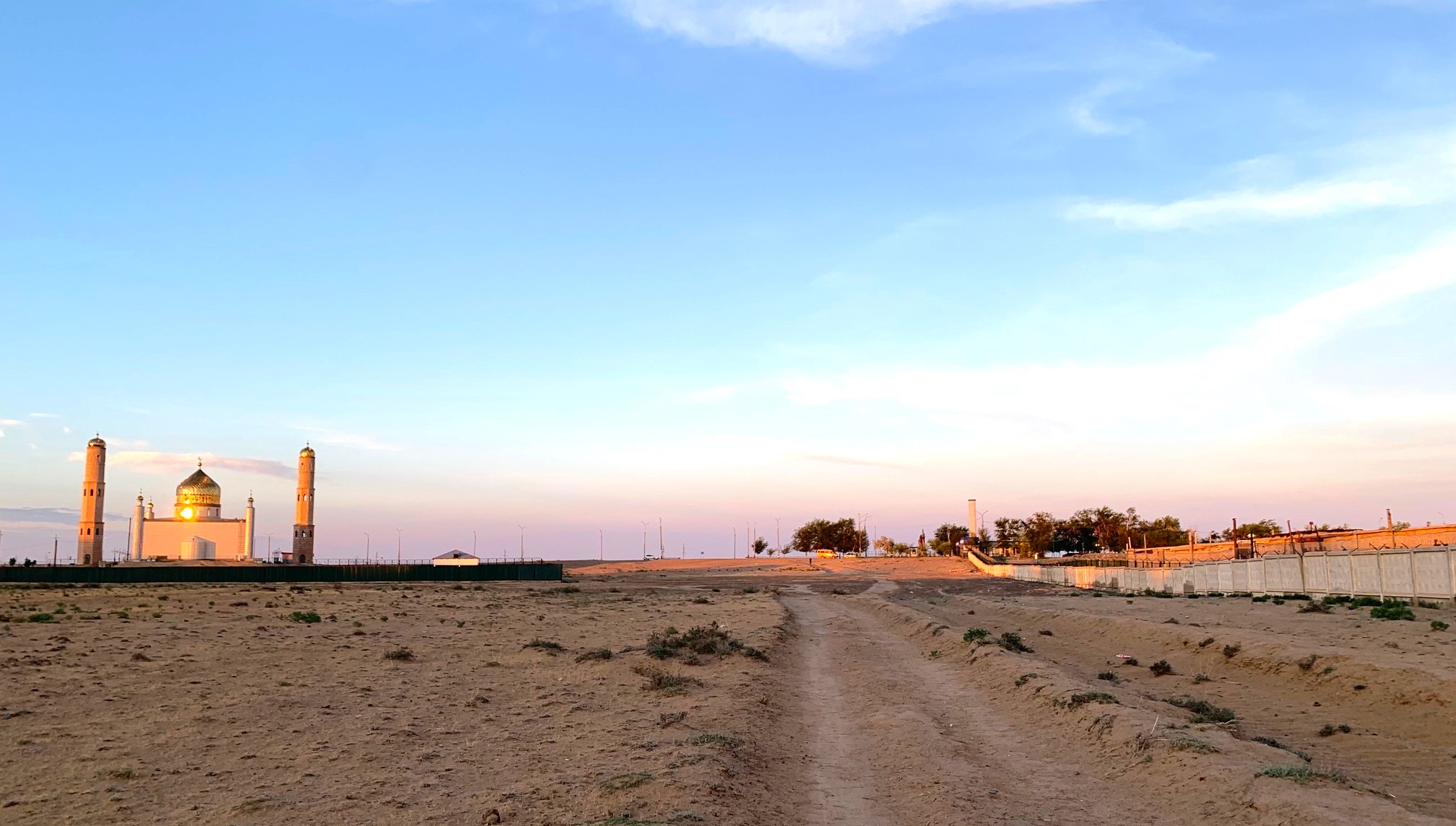
Separate Spheres – the Mosque on the Wall at Toretam; image: Thomas Hodgson

Beyond the economic strain on local Kazakhs, Russia’s cosmodrome wreaks environmental havoc on the steppe. Scientists often refer to UDMH — the fuel used to launch rockets — as “devil’s venom” on account of its toxicity. Locals claim that the soil beneath the flightpaths of Proton rockets has been permanently poisoned by fuel spills from their first and second stages.

Some critics say that these chemicals are carcinogenic and therefore play a part in the unusually high cancer rates in Kazakhstan’s Baikonur and Kyzylorda regions.

An elderly man in a train compartment between Aralsk and Töretam described his brother’s passing from cancer, which he ascribed in no uncertain terms to the “heavy metals” emitted by Baikonur rockets, which get kicked up into the air during the regular dust storms on the steppe.

Children in Baikonur are even warned against playing in the nearby Syr Darya River.

“In the days of the [Soviet] Union, when I was young, we used to play in the river all the time, but now it is full of rubbish and too dangerous,” an elderly local recalled.

Baikonur has also been linked to mass animal deaths. In 1999, a Russian veterinarian established that bird deaths in Russia’s Far Eastern Republic of Sakha were abnormally high due to the disposal of discarded Baikonur rocket parts there. As recently as 2015, Kazakh ecologist Musagali Duambekov suggested that the mass deaths of endangered saiga antelope on the steppe could be linked to toxic fuels used at Baikonur.

Some people are even forced to make a living by scavenging scrap metal from fallen rocket debris.

While Roscosmos claims that it provides 24 hours’ notice for people living in the flight paths to “get to safety” during a rocket launch, they do not accept liability for damage caused by debris within the flight path itself. Compensation is only awarded for damage caused outside of their designated fall zones.

TCA asked a few Töretam locals what they thought about individuals living in more isolated areas of the steppe under the flight paths, but all they offered in response was a vague indication of sympathy for their woes.

While the rocket “falloff” presents an economic opportunity for scrap dealers, their work is uniquely dangerous. Rocket debris, still burning when it hits the ground, emits toxic fumes harmful to both wildlife and humans. The traders typically have little more than a welding mask and a T-shirt to protect themselves against these harmful compounds.

Behind the Wall

The wall separating Baikonur and Toretam; image: Thomas Hodgson

The cosmodrome’s social license is further threatened by its emergent status as a “smuggling” hub to further Russia’s war effort in Ukraine. While Roscosmos is sanctioned by the West, it can continue to operate out of Baikonur relatively unscathed due to the facility’s special status on Kazakh soil.

This comes despite polling suggesting that 44% of Kazakhs view Russia’s full-scale invasion of Ukraine as either “somewhat or completely unjustified.

While this may point to the conclusion that life inside Baikonur is markedly better than outside, the closed city itself is beleaguered with social problems.

According to a barman in Töretam who was born and lives inside the “ring” but commutes daily from Baikonur into the satellite town due to a lack of opportunities, Baikonur’s days are numbered. He described the “constant propaganda,” “lack of work” and “invasive security” that plague the complex. The crumbling housing stock is “from the Soviet days” — dilapidated and not fit for purpose.

“Corruption is everywhere,” he told TCA, accusing everyone from Roscosmos higher-ups to checkpoint employees of taking backhanders to make ends meet.

This is not just barroom conjecture – in 2019, the first deputy head of the city administration was found guilty of embezzling over 7.5 million rubles ($80,900 at today’s exchange rate).

Distorted Histories
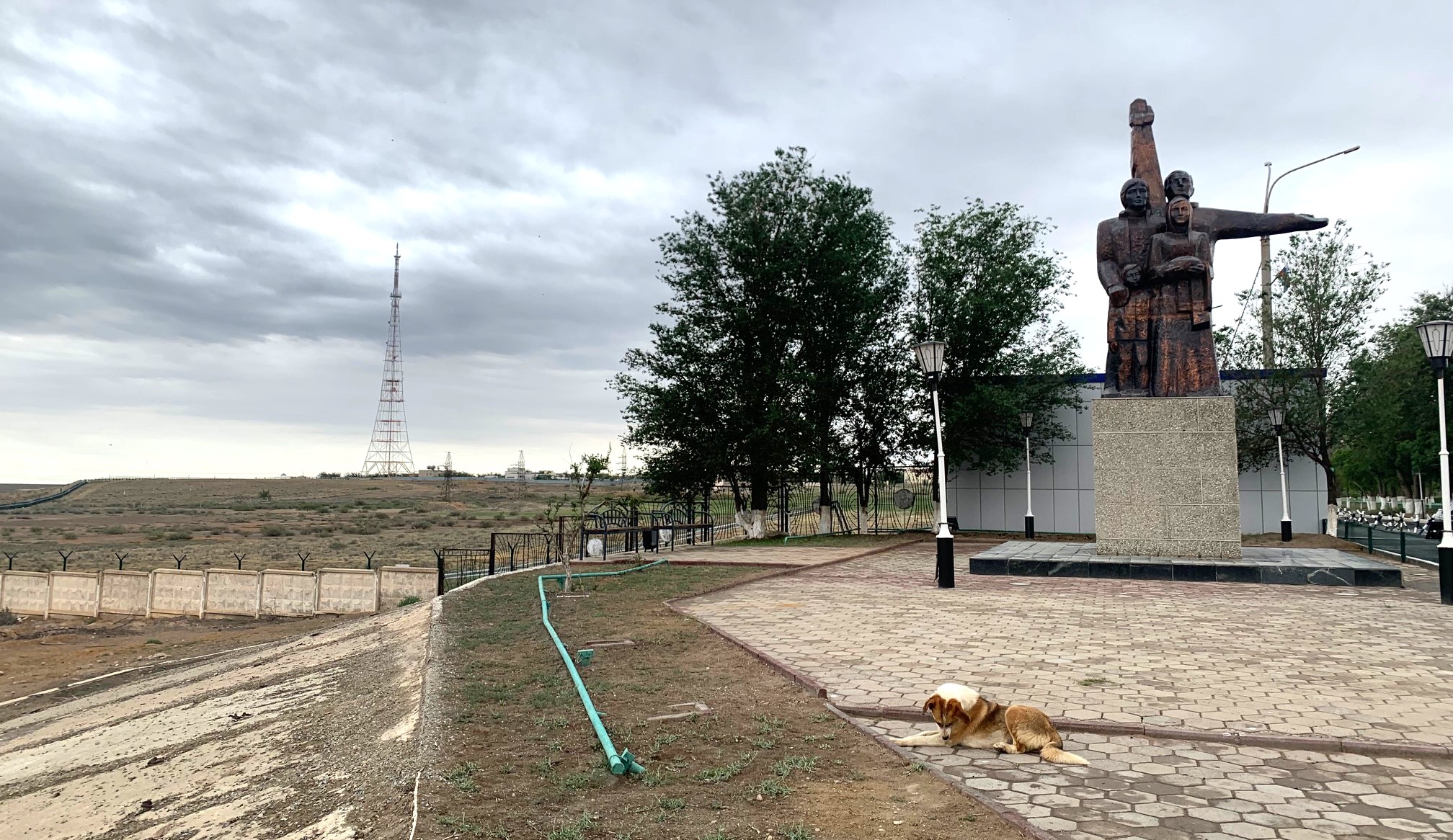
Monument to cosmonauts at the entrance to Baikonur; image: Thomas Hodgson

One can trace Russia’s use of Kazakhstan as a dumping ground for both human and scientific “waste” as far back as Fyodor Dostoevsky, who famously spent a period of exile in Semipalatinsk. This ‘tradition’ continued throughout the Soviet period, as Stalin deported over a million of the Union’s ethnic minority population to the Kazakh SSR.

In allowing Kazakhs to be exposed to potentially life-threatening toxins and keeping them poor through economic hegemony, modern Russia, by all appearances, continues to demonstrate a lack of concern for the local population.

Baikonur occupies a bipolar position in the Kazakh psyche. In Almaty and Astana, the country’s two largest cities, metro stations and suburbs are named after the cosmodrome. It is not uncommon to see Baikonur magnets adorning the fridges of Kazakh households. Bus stops across the country display posters reading “Baikonur — the unity of the nation — the umbilical cord of the earth” in the Kazakh language.

At the same time, memories of the trauma caused by the Russians and their rockets are still fresh. There is no better illustration of this than the memorials to Semipalatinsk, the Soviets’ testing site for nuclear weapons that exposed as many as 1.5 million people to fallout, present in every city in the country.

It is entirely natural that Baikonur is a source of pride for the Kazakh people. Their nation has played host to two earth-shaping developments in the launch of the first artificial Earth satellite and the first manned spacecraft. However, as Russia veers ever deeper into rogue state territory, Kazakhstan finds itself in the impossible position of toeing the line between its notional allyship with its former master, and existing as an independent, sovereign state with the right to shape its own future.

“Baikonur is a city out of time,” a student born in the “ring” who had since left to study in Astana told TCA. “Everything is crumbling. The buildings are all falling down. There is no money or work to be had. All of my friends want out.”

The Russian Federation is due to hand over the oldest and most famous launch pad in the Baikonur complex – Gagarin’s Start – on June 1. Decommissioned in 2019, Kazakhstan plans to turn the site of the world’s first crewed space launch into a museum, with the intention of acquiring UNESCO World Heritage recognition. Symbolically, the handover marks the closure of a historic chapter in space exploration and offers independent Kazakhstan an opportunity to renegotiate its uneasy relationship with the cosmodrome.

Video: “Connecting Minds, Shaping the Future,” – Astana International Forum 2025

The Astana International Forum 2025 aims to address global challenges, foster international cooperation, and strengthen Kazakhstan’s role as a bridge between regions and powers. The Times of Central Asia is in attendance, bringing you all the latest developments.

Follow our special coverage on the Astana International Forum here.

Can Kazakhstan Lead Small and Middle Powers in Reforming the UN?

ASTANA – The United Nations, envisioned as a pillar of global cooperation, has often struggled to rise to the challenges it was created to address. Its inability to bridge cultural divides hampers meaningful solutions to regional issues, while structural weaknesses and the exclusion of diverse regional voices from the Security Council deepen its shortcomings. Compounding these flaws is the frequent deadlock among permanent members, whose competing agendas stifle consensus and action. These inefficiencies cast doubt on the organization’s ability to hear and respond to regional voices, grievances, and expectations in a rapidly changing world.

Amid these persistent challenges within the United Nations, Kazakhstan’s proactive stance on global issues highlights its potential to lead efforts toward fostering peace and addressing critical gaps in international cooperation.

For example, although Kazakhstan prioritizes nuclear energy in its national strategy, it simultaneously remains committed to advocating for the non-proliferation of nuclear and biological weapons. Such an approach, combined with its balanced foreign policy, enables the largest Central Asian nation to seek to position itself as a leading advocate for global peace. But how realistic is that in the current geopolitical climate?

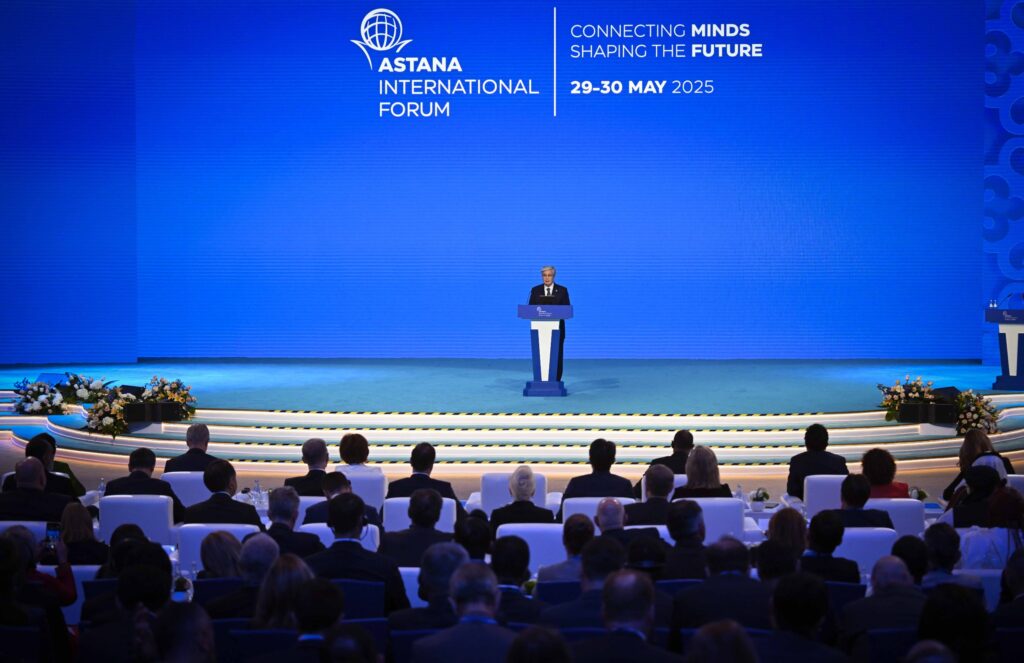
As conflicts and wars continue to rage around the world, leaders from several countries have gathered in Kazakhstan’s capital, Astana, for the Astana International Forum (AIF) to discuss key global challenges ranging from energy security and geopolitical cooperation to international trade and sustainable development. For Kazakhstan’s leadership, the event serves as an ideal opportunity to reaffirm its aspiration to position the country as a middle power. According to the Central Asian state’s President Kassym-Jomart Tokayev, it is middle powers that should be prepared to take on greater multilateral responsibilities.

“We all should strongly remain adherent to the United Nations Charter with no biased and selective approaches to its principles,” Tokayev said on May 29 in calling for the expansion of the United Nations Security Council that, in his view, should include broader regional representation.

This idea was firmly supported by President Gordana Siljanovska-Davkova of North Macedonia, who numbered among the major guests in Astana. She argues that small countries, along with middle powers, should be “the greatest advocates of effective multilateralism,” as they stand to gain the most from institutions like the United Nations.

“The Security Council should be expanded, reformed and democratized to make it more accountable and more responsible in maintaining international peace and security,” Siljanovska-Davkova stressed, adding that the international institution “should take its rightful place as a principal representative body, not only for debate and deliberative democracy but also for policymaking.”

The problem, however, is that major global powers, as permanent members of the UN Security Council, are unlikely to voluntarily relinquish their positions within the organization. Small and middle powers will, therefore, undoubtedly have to work hard to achieve their ambitious geopolitical goals. In the meantime, they are expected to continue developing bilateral relations.

“The task before us is clear – to preserve cooperation where it still exists and to restore it where it has broken down. We must widen this cycle of cooperation, the scale of cooperation,” Tokayev said, pointing out that Kazakhstan remains committed to a “stable, integrated and future-oriented Central Asia, one rooted in mutual respect and regional solidarity.”

The presence of leaders from countries such as North Macedonia and Rwanda as major guests at this year’s event in Astana, however, indicates that Kazakhstan’s aspirations extend well beyond Central Asia. Indeed, Rwandan President Paul Kagame underscored the critical role middle powers can play in reforming the UN, stating that “equitable global governance requires that all nations, regardless of size or power, have a meaningful voice in shaping our shared future.”

For Alain Berset, Secretary General of the Council of Europe, the need for regional partnerships in addressing global challenges is also very important. This principle resonates with Kazakhstan’s diplomatic position. Situated between Europe and Asia, the world’s ninth-largest country has spearheaded initiatives such as the Astana Process for Syrian peace talks and the establishment of the Central Asian Nuclear-Weapon-Free Zone. By promoting collaboration among regional powers, Astana demonstrates the potential to unite small and middle powers in advocating for meaningful reforms at the UN.

One of Kazakhstan’s major focuses, according to Tokayev, is the growing strain between nuclear-armed states which, in his view, can lead not only to immediate destruction but could trigger global climate disaster.

“We know what this means; we relinquished our inherited nuclear arsenal in the name of peace,” he emphasized.

Ban Ki-moon, the former UN Secretary-General, seems to share Tokayev’s concerns. In his view, the world today may be in a “worse position” than when he left office.

“What concerns me now is that today, leaders are more divided than ever,” the former UN Secretary-General noted, emphasizing that global problems require coordinated responses, and calling for a renewed tripartite partnership between governments, business, and civil society.

The Kazakh leader, on the other hand, sees reforming the core structures of the United Nations as a potential way to prevent global conflicts. Given that the UN is the Astana International Forum’s strategic partner, it is no coincidence that Kazakhstan is aiming to strengthen relations with the organization’s various bodies.

Next year, Kazakhstan plans to host an ecological summit in partnership with the UN, whose Director-General of the Food and Agriculture Organization, Qu Dongyu, was among the major speakers at the AIF. In his view, with its vast land area of 2.8 million square kilometers, Kazakhstan has the potential to feed a billion people worldwide “through proper management, investment, and the adoption of new technologies.”

Dongyu’s statement aligns with Tokayev’s goal of building a “more diversified, inclusive and future-ready economy where growth is not just sustained but shared.” Whether these ambitions can materialize remains to be seen, especially given that, as he emphasized, Kazakh economic reforms are taking place in a “highly fragile geopolitical environment.”

In spite of that, the Central Asian nation plans to create a pioneering pilot zone called “CryptoCity”, where cryptocurrencies might be used to purchase goods, services, and more. The coming months and years will show whether this project will help stimulate the Kazakh economy by attracting foreign investment, fostering innovation, and diversifying income sources beyond traditional sectors such as oil and gas.

One thing is certain – Kazakhstan is determined to play a more proactive role on the global stage. By championing multilateralism, sustainable development, and peace advocacy, it aims to position itself as a constructive force in a world marked by fragmentation and uncertainty. Thus, the Astana International Forum is not only a symbol of this ambition but a platform through which Kazakhstan is seeking to engage with diverse global actors and shape new paradigms in global diplomacy.

Kazakhstan has the potential to play a significant role in uniting small and middle powers to work towards meaningful reforms within the United Nations. A key player in Central Asia, it holds considerable regional influence supported by its strategic location along the Middle Corridor, which connects China to the West and fosters economic and political links. Kazakhstan’s experience in navigating the complexities of great power relations further enhances its capacity to unite diverse nations around shared goals. These strengths position it well to advocate for reforms that elevate the voices of smaller nations and contribute to a more inclusive and effective global system.


Follow our special coverage on the Astana International Forum here.

Dubai Hosts Talks on Major Central Asian Hydropower Project

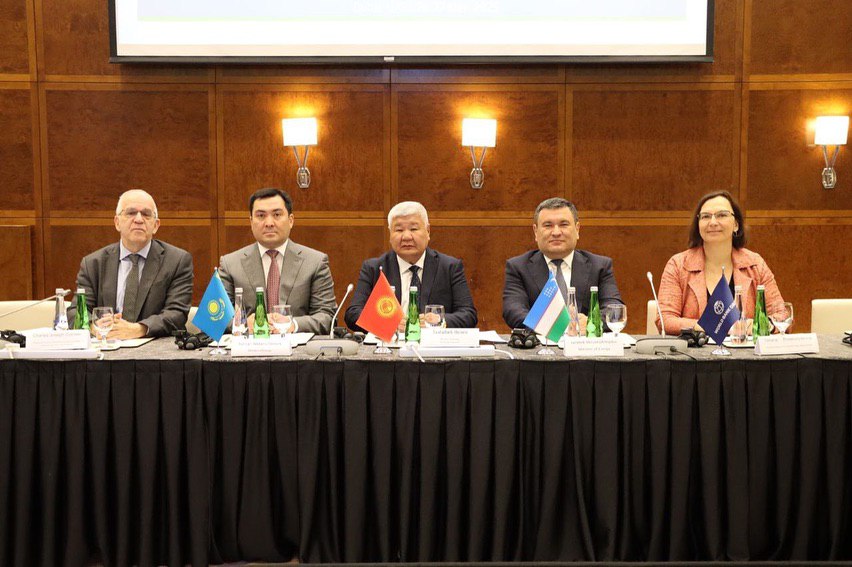
On May 26-27, 2025, energy ministers from Kazakhstan, Kyrgyzstan, and Uzbekistan met in Dubai, United Arab Emirates, for the second high-level meeting on the Kambarata-1 Hydropower Plant (HPP) project. The meeting was organized with the support of the World Bank, according to Kyrgyzstan’s Ministry of Energy.

Kambarata-1 is a flagship regional initiative designed to enhance energy security and water management across Central Asia. The planned hydropower facility, with a capacity of 1,860 megawatts, will be constructed on the Naryn River in Kyrgyzstan.

The delegations were led by Energy Ministers Yerlan Akkenzhenov (Kazakhstan), Taalaibek Ibraev (Kyrgyzstan), and Jurabek Mirzamakhmudov (Uzbekistan). High-level representatives from the finance and water ministries of the three countries also participated.

During the meeting, the ministers formally requested technical assistance from the World Bank. This includes an updated feasibility study, environmental and social impact assessments, and the development of a robust financial and commercial implementation model.

The World Bank delegation featured several senior officials, including Tatiana Proskuryakova, Regional Director for Central Asia; Carolina Sánchez-Páramo, Director for Strategy and Operations in Europe and Central Asia (ECA); Charles Joseph Cormier, Regional Infrastructure Director for ECA; and Stephanie Gil, Program Leader for Energy.

“We are pleased to support the governments of Kazakhstan, Kyrgyzstan, and Uzbekistan in advancing the Kambarata-1 project,” said Proskuryakova. “It will bring major economic and social benefits to the region.”

The ministers reiterated their commitment to the project, describing it as a cornerstone of regional energy integration.

Participants reviewed progress since the first roundtable in Tashkent in January 2025. Discussions focused on revised cost estimates, grid modernization needs, financing strategies, and the importance of strong environmental and social safeguards.

Kazakhstan’s Yerlan Akkenzhenov highlighted the collaborative nature of the initiative: “Kazakhstan fully supports this project and will continue working closely with its regional partners.”

Kyrgyzstan’s Taalaibek Ibraev underscored the national significance of the HPP: “This project is the foundation of Kyrgyzstan’s energy strategy. We are proud to implement it in partnership with Kazakhstan and Uzbekistan.”

Uzbekistan’s Jurabek Mirzamakhmudov referenced the tangible progress already made: “With joint efforts and international backing, we are confident in our ability to realize this project according to global standards.”

The ministers agreed on specific next steps and timelines for project preparation and pledged to hold regular meetings to ensure steady progress.

As previously reported by The Times of Central Asia, the Kambarata-1 HPP will be located in the upper reaches of the Naryn River in Kyrgyzstan. Once completed, it is expected to generate approximately 5.6 billion kilowatt-hours of electricity annually. The estimated construction cost exceeds $4 billion.

At AIF, Tokayev Proposes “CryptoCity” as Pilot Zone for Digital Innovation

Kazakhstan plans to establish a pilot zone named “CryptoCity” to facilitate the free circulation of cryptocurrencies, President Kassym-Jomart Tokayev announced at the Astana International Forum (AIF).

“We plan to create an innovative pilot zone called CryptoCity, where cryptocurrencies can be used to purchase goods, services, and for other purposes,” Tokayev stated.

The president highlighted Kazakhstan’s progress in digital transformation, positioning the country as a potential Eurasian IT hub. He also outlined ambitions for Kazakhstan to become an academic and innovation center through partnerships with foreign universities and increased research and development.

“Kazakhstan is launching the most powerful supercomputer, which has already been delivered to the country,” Tokayev said, referencing a recent agreement between the Ministry of Digital Development, Innovation and Aerospace Industry and Presight AI Ltd. The system, boasting a performance of about 2 exaflops, was developed under a strategic partnership with G42, an Abu Dhabi-based technology group.

Cryptocurrency regulation remains a divisive issue in Kazakhstan. While the National Bank supports liberalizing the sector, several members of parliament are advocating for increased state control.

Tokayev used the economic forum to reaffirm Kazakhstan’s commitment to innovation as a tool for societal development.

“Our primary task is to reduce regional disparities and strengthen the middle class. That is why we continue to bolster our capabilities in key sectors, from digital technologies and artificial intelligence to clean energy and high value-added manufacturing,” he said.

He also emphasized regional cooperation: “Kazakhstan is ready to share its emerging IT capabilities with its neighbors and collaborate with all countries interested in fostering economic ties.”

Reflecting on global trends, Tokayev warned of growing protectionism and weakening multilateralism. “There are different scenarios for the future, some offer opportunities, others harbor risks. Will we see inclusive progress or destructive fragmentation? This depends not on the declarations of a few, but on the cooperation of the majority,” he concluded.