• KGS/USD = 0.01144 0%
  • KZT/USD = 0.00213 0%
  • TJS/USD = 0.10607 0.57%
  • UZS/USD = 0.00008 0%
  • TMT/USD = 0.28530 0%
  • KGS/USD = 0.01144 0%
  • KZT/USD = 0.00213 0%
  • TJS/USD = 0.10607 0.57%
  • UZS/USD = 0.00008 0%
  • TMT/USD = 0.28530 0%
  • KGS/USD = 0.01144 0%
  • KZT/USD = 0.00213 0%
  • TJS/USD = 0.10607 0.57%
  • UZS/USD = 0.00008 0%
  • TMT/USD = 0.28530 0%
  • KGS/USD = 0.01144 0%
  • KZT/USD = 0.00213 0%
  • TJS/USD = 0.10607 0.57%
  • UZS/USD = 0.00008 0%
  • TMT/USD = 0.28530 0%
  • KGS/USD = 0.01144 0%
  • KZT/USD = 0.00213 0%
  • TJS/USD = 0.10607 0.57%
  • UZS/USD = 0.00008 0%
  • TMT/USD = 0.28530 0%
  • KGS/USD = 0.01144 0%
  • KZT/USD = 0.00213 0%
  • TJS/USD = 0.10607 0.57%
  • UZS/USD = 0.00008 0%
  • TMT/USD = 0.28530 0%
  • KGS/USD = 0.01144 0%
  • KZT/USD = 0.00213 0%
  • TJS/USD = 0.10607 0.57%
  • UZS/USD = 0.00008 0%
  • TMT/USD = 0.28530 0%
  • KGS/USD = 0.01144 0%
  • KZT/USD = 0.00213 0%
  • TJS/USD = 0.10607 0.57%
  • UZS/USD = 0.00008 0%
  • TMT/USD = 0.28530 0%

Kazakhstan Leads Central Asia in Latest Global Passport Rankings

Kazakhstan holds the most powerful passport in Central Asia, according to the latest update of the Henley Passport Index. The index ranks 199 passports by the number of destinations their holders can access without a prior visa. Kazakh citizens can now travel to 79 countries visa-free.

Following Kazakhstan in the regional ranking is Kyrgyzstan, whose passport ranks 73rd globally with access to 63 countries. Uzbekistan is close behind in 74th place, with 62 visa-free destinations. Tajikistan ranks 80th (56 countries), while Turkmenistan trails at 85th, with just 49 destinations accessible without a visa.

The Henley Passport Index calculates scores by awarding one point for each destination where no visa is required, or where travelers can obtain a visa on arrival, a visitor’s permit, or an electronic travel authorization. A score of zero is assigned if a visa is required prior to departure or if government pre-approval is needed for a visa on arrival.

On the global stage, Singapore retains the top spot for the second consecutive year, granting its passport holders visa-free access to 193 countries. Japan and South Korea share second place, each offering visa-free travel to 190 destinations. The top ten is dominated by European countries.

The Times of Central Asia previously reported on last year’s edition of the Henley Passport Index and its implications for mobility in the region.

Indian Regulator Flags Concerns About Uzbek University

India’s National Medical Commission (NMC) has issued a warning to Indian students regarding enrollment at the Chirchik branch of Tashkent State Medical University in Uzbekistan, as well as three medical schools in Belize.

As reported by The New Indian Express, the NMC cited multiple concerns, including alleged non-compliance with Indian medical education standards, subpar infrastructure, inadequate clinical training, high tuition fees, and instances of student harassment.

According to the NMC, all of the institutions in question “did not comply with Indian medical education standards, lacked adequate or functioning campus infrastructure, provided poor quality educational and clinical training, and had instances of harassment of Indian students.

Additionally, they reportedly charged excessive fees and refused refunds upon withdrawal from the course.”

In response, the Chirchik branch issued an official statement categorically denying the accusations, calling them “unfounded.” The university emphasized that it adheres strictly to academic and clinical guidelines established by Uzbekistan’s Ministry of Health and the World Federation for Medical Education (WFME).

Established by presidential decree in July 2023, the branch began full operations in December 2024. It currently enrolls 801 students, including five from India, alongside others from Jordan, Pakistan, and Egypt.

The university highlighted its modern facilities, which include fully equipped classrooms, laboratories, simulation centers, and student dormitories. “An open and transparent environment is created for students,” the statement read, underlining a commitment to academic freedom and equal treatment.

The Chirchik branch is listed in the World Directory of Medical Schools, jointly maintained by WFME and FAIMER. It offers English-language medical programs and maintains partnerships with several international universities and clinical institutions.

“We take the concerns raised by the NMC seriously,” the university stated. “However, we believe these claims are based on information that has not been verified locally and are unfounded.”

The university expressed openness to inspections and dialogue with Indian authorities and reassured students and families of its adherence to global academic standards. “We categorically reject attempts to damage our reputation,” the statement concluded.

German University Launches Bachelor’s Programs in Kazakhstan

Germany’s Anhalt University of Applied Sciences has opened a branch campus in Almaty, marking a new milestone in German-Kazakh educational cooperation. The new campus, based at Energo University, is now accepting applications for bachelor’s programs in Biomedical Engineering and Electrical Engineering and Information Technology.

The initiative is supported by Kazakhstan’s Ministry of Science and Higher Education and the German Consulate General in Almaty. According to the ministry, the programs were selected to align with current demands in Kazakhstan’s labor market. Graduates will receive dual diplomas, one from Anhalt University and one from a Kazakhstani institution.

A total of 100 state-funded scholarships will be awarded to students who qualify through a competitive selection process.

The Almaty campus features modern classrooms and laboratories equipped for practical and research-based instruction in electronics, biomedical science, and information technology.

“This is a large-scale initiative for young people in Kazakhstan who are eager to learn,” said Jörg Bagdahn, President of Anhalt University. “They now have the opportunity to obtain a German engineering degree without leaving their country.”

Courses will be taught by faculty from Germany, and German language instruction is included in the curriculum.

“Partnership with Anhalt University is a strategic step for Energo University,” said Rector Gani Cosmetology. “We are creating a platform to deliver top-tier European education locally.”

Bishkek Opens Poplar Nursery to Increase City Tree Cover

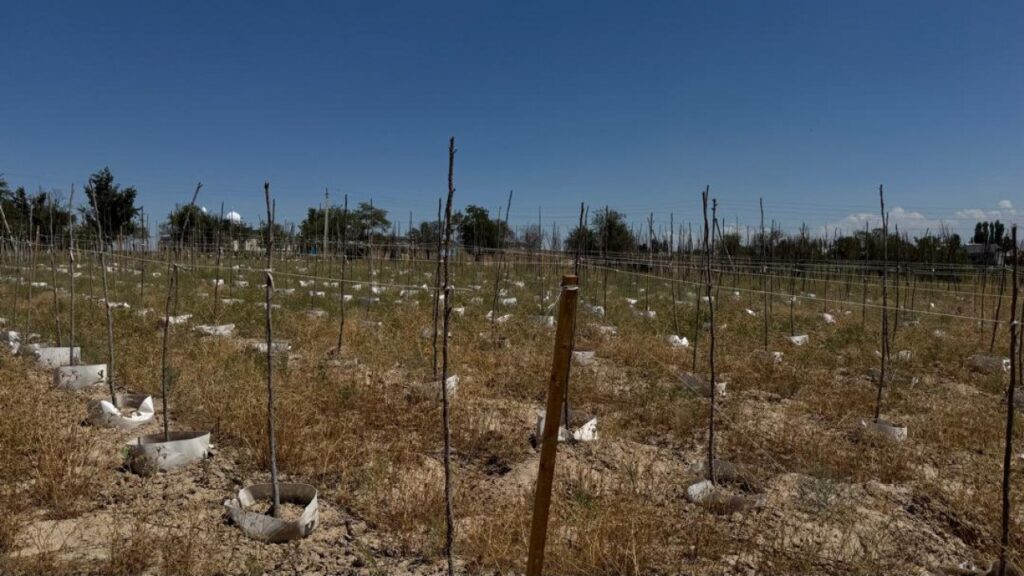
Bishkek has launched an experimental nursery dedicated to cultivating hybrid poplars as part of a broader initiative to restore the city’s declining green spaces. The project, spearheaded by Kyrgyzstan’s Ministry of Natural Resources, Ecology and Technical Supervision, aims to support long-term urban reforestation.

Located on 24 hectares of land, the nursery is expected to produce up to 200,000 saplings each year. In 2025 alone, 12,000 hybrid poplars have already been planted. The selected variety is suited for urban environments; it does not produce fluff, grows up to two meters annually, and develops straight trunks with high crowns. Tree cuttings are used for continued propagation.

Minister Meder Mashiev, who visited the site, stressed the strategic importance of the initiative. “If this business develops, all the problems of city greening can be solved,” he stated.

The nursery is expected to reduce dependence on imported saplings and play a key role in reversing urban deforestation while improving air quality in the capital.

As previously reported by The Times of Central Asia, Bishkek’s municipality is also collaborating with partners from Qingdao, China, to establish a large-scale tree and shrub nursery. This bilateral project forms part of a broader environmental restoration strategy aimed at strengthening the city’s ecological resilience.

Once regarded as one of the greenest cities in the former Soviet Union, Bishkek has experienced a steady decline in tree cover over the past three decades due to rapid urban development. Environmental experts have urged authorities to prioritize planting tall, broadleaf deciduous trees, valued for their shade and noise absorption, rather than the coniferous species currently favored in urban landscaping.

Kazakhstan Drug Seizure Tops Six Tons in First Half of 2025

Kazakh authorities seized 6.4 tons of narcotic substances in the first half of 2025, Interior Minister Yerzhan Sadenov announced at a recent meeting of the Interdepartmental Commission on Crime Prevention.

For comparison, the Ministry of Internal Affairs reported a total of 21 tons of drugs confiscated in 2024. That figure included 547 kilograms of synthetic substances, 2.5 kilograms of heroin, over 10 tons of marijuana, and 572 kilograms of hashish. Authorities also recorded more than 8,000 drug-related offenses, dismantled 63 drug laboratories, and identified 7,400 internet resources involved in the distribution of drug-related content.

Between January and June 2025, the volume of synthetic drugs seized nearly doubled compared to the same period last year, reaching 570 kilograms. In addition, law enforcement blocked over 17,000 drug-related websites and detained 474 individuals on drug charges, including 28 administrators of Telegram channels. Authorities shut down 103 underground drug labs and uncovered 63 drug smuggling cases.

Twenty-one criminal cases have been opened against organized drug trafficking groups, including three transnational networks.

Health Minister Akmaral Alnazarova reported that more than 17,000 individuals suffering from drug addiction are registered with medical facilities across Kazakhstan. While the number of opioid users has declined by 50 percent over the past five years, there has been a marked rise in addictions linked to synthetic stimulants and poly-drug use.

In response to these developments, Prime Minister Olzhas Bektenov has ordered the implementation of stricter mechanisms to identify and block online drug content and to restrict financial transactions associated with drug trafficking.

“The increase in drug use among young people is particularly concerning,” Bektenov stated. “Distribution occurs via the internet, postal services, hidden ‘stash’ drops, and anonymous electronic payments, removing direct contact between dealers and consumers.”

The Prime Minister also called for tighter control over the dispensation of addictive pharmaceuticals, the expansion of rehabilitation centers including those for minors, and stronger efforts for early detection and treatment of drug dependence.

As previously reported by The Times of Central Asia, Central Asia remains a significant transit corridor for narcotics smuggled from Afghanistan. However, the situation is becoming increasingly complex, as more drugs are now being consumed within the region itself.

Kazakhstan to Increase Penalties for Attacks on Medical Workers

Kazakhstan is preparing legislative amendments that will significantly increase criminal liability for violence against medical personnel, equating such offenses with attacks on law enforcement officers.

The initiative follows a directive from President Kassym-Jomart Tokayev, who urged the government to take stronger action to protect medical staff amid a growing number of violent incidents. At a recent meeting, Prime Minister Olzhas Bektenov reviewed proposals presented by Health Minister Akmaral Alnazarova.

The Ministry of Health is drafting legislation that would classify attacks on healthcare workers in the same legal category as assaults on police officers. Proposed measures also include equipping staff with smart video badges, installing comprehensive security systems in hospitals, and deploying permanent police posts in emergency departments.

Under the current Criminal Code, an attack on a law enforcement officer is punishable by up to 10 years in prison, while attempted murder carries a sentence of 10 to 15 years with property confiscation.

Speaking at a briefing, Minister Alnazarova announced the introduction of a new article in the Criminal Code addressing threats and violence against medical workers. Threats alone could result in up to two years’ restriction of liberty. Violence against a single medical worker may carry a sentence of 1 to 10 years, while attacks involving multiple perpetrators or targeting groups of workers could lead to up to 15 years of imprisonment.

“These are adequate and necessary measures to protect our medical workers,” Alnazarova said, adding that the bill would be submitted to the Mazhilis, the lower house of parliament, in September.

According to the Health Ministry, over 170 cases of violence against doctors, nurses, paramedics, and other healthcare staff have been recorded in Kazakhstan since 2019.

“Such incidents must be resolutely suppressed by legal means,” Bektenov emphasized. “I instruct the ministries of health, internal affairs, and justice to develop and submit the necessary legislative amendments to parliament within ten days.”

As previously reported by The Times of Central Asia, two recent assaults on medical personnel in Kazakhstan resulted in hospitalizations. In response, the health minister issued a public appeal urging an end to violence against medical staff.