• KGS/USD = 0.01144 0%
  • KZT/USD = 0.00209 0%
  • TJS/USD = 0.10523 0%
  • UZS/USD = 0.00008 0%
  • TMT/USD = 0.28530 0%
  • KGS/USD = 0.01144 0%
  • KZT/USD = 0.00209 0%
  • TJS/USD = 0.10523 0%
  • UZS/USD = 0.00008 0%
  • TMT/USD = 0.28530 0%
  • KGS/USD = 0.01144 0%
  • KZT/USD = 0.00209 0%
  • TJS/USD = 0.10523 0%
  • UZS/USD = 0.00008 0%
  • TMT/USD = 0.28530 0%
  • KGS/USD = 0.01144 0%
  • KZT/USD = 0.00209 0%
  • TJS/USD = 0.10523 0%
  • UZS/USD = 0.00008 0%
  • TMT/USD = 0.28530 0%
  • KGS/USD = 0.01144 0%
  • KZT/USD = 0.00209 0%
  • TJS/USD = 0.10523 0%
  • UZS/USD = 0.00008 0%
  • TMT/USD = 0.28530 0%
  • KGS/USD = 0.01144 0%
  • KZT/USD = 0.00209 0%
  • TJS/USD = 0.10523 0%
  • UZS/USD = 0.00008 0%
  • TMT/USD = 0.28530 0%
  • KGS/USD = 0.01144 0%
  • KZT/USD = 0.00209 0%
  • TJS/USD = 0.10523 0%
  • UZS/USD = 0.00008 0%
  • TMT/USD = 0.28530 0%
  • KGS/USD = 0.01144 0%
  • KZT/USD = 0.00209 0%
  • TJS/USD = 0.10523 0%
  • UZS/USD = 0.00008 0%
  • TMT/USD = 0.28530 0%

Intrigue Shadows a Rugged Motor Race with Central Asian Roots

Several vehicle crews from Turkmenistan are competing in the Silk Way Rally, a 5,243-kilometer race that started in Russia’s Siberian city of Tomsk on July 5 and will finish in Ulaanbaatar, Mongolia on July 15 after passing through mountain and desert terrain. The Russia-backed event has attracted scrutiny not just for the off-road adventure – its organizers face U.S. sanctions for allegedly helping Russian military intelligence.

The annual Silk Way Rally, which comes at a time of high tensions between Russia and the West over the war in Ukraine, has a history of Central Asian involvement since it was first held in 2009. The initial route started in Kazan, Russia, went through Kazakhstan and finished in Ashgabat, the capital of Turkmenistan. After a few more route variations, the 2016 edition began in Red Square in Moscow and passed through Kazakhstan on the way to the finish in Beijing after an epic 10,735 kilometers. The race was canceled in 2020 because of the pandemic.

The rally has had competitions for various categories, including trucks, cars, SSVs (Special Service Vehicles, of a type often used by police or firefighting units for difficult conditions at high speeds) and quad bikes, which are four-wheel, all-terrain vehicles.

silkwayrally.com

The rally, which purports to follow routes used by merchants on the so-called Silk Road network many centuries ago, is reminiscent of the renowned Dakar Rally in West Africa. It has recently come under suspicion as an alleged front for Russian operatives.

Past winners and competitors in the Silk Way Rally have included people from France, Spain and other Western European countries, as well as Ukraine, Israel, Qatar, Saudi Arabia and Argentina. At least two dozen countries were represented in several editions of the annual race in previous years. This year, nationals from about half a dozen countries signed up and the vast majority are Russian, illustrating the impact of sanctions and the deterioration in ties since Russia’s full-scale invasion of Ukraine in 2022.

Several two-member teams from Turkmenistan, including brothers Merdan and Shokhrat Toylyev, are competing in the T2 class of cross-country vehicles. A Kyrgyz citizen is listed with a Russian in a team in another vehicle category.

The 2024 Silk Way Rally is not recognized by the Fédération Internationale de l’Automobile, also known by its initials FIA. The Paris-based governing body of motorsport has taken action to isolate Russia and its ally, the government in Belarus, since the Russian invasion of Ukraine.

The race has caught the attention of the U.S. Department of the Treasury, which on June 12 said it was imposing sanctions on the organization and its directors for alleged ties to the Russian military intelligence agency GRU. The department said Silk Way head Bulat Akhatovich Yanborisov, a Russian citizen, had received awards from the GRU for his work and appears to use his properties in Europe as transit points for Russian military intelligence officers.

“Bulat, who is Silk Way’s CEO and general director, alongside his son Amir Bulatovich Yanborisov (Amir), use Silk Way’s logistical infrastructure to procure anti-UAV and radioelectronic warfare equipment for use on the battlefield in Ukraine,” the U.S. department said in a statement announcing a wider package of new sanctions.

Russian President Vladimir Putin has said the Russian economy is growing despite increasingly tough Western sanctions and has sought to expand trade with other countries to offset their impact. Prime Minister Narendra Modi of India, a big buyer of Russian oil during the Ukraine war, met Putin in Moscow on Monday.

The media guidelines for the Silk Way Rally appear to reflect the concerns of a wartime country that is anxious about expressions of opposition. Drones, a common media tool, can’t be used along the rally route. Journalists are advised against “committing public actions aimed at discrediting the use of the Armed Forces of the Russian Federation” and must not “intentionally destroy or damage or desecrate the flag and state symbols of the Russian Federation and Mongolia.”

Promoting or displaying “Nazi paraphernalia or symbols, or paraphernalia or symbols that are confusingly similar to Nazi paraphernalia or symbols,” is also out, according to the press regulations. Russia has often said that Nazi ideology pervades the Ukrainian leadership, which characterizes such allegations as absurd.

Against the backdrop of geopolitical intrigue, the Silk Way drivers crossed from Russia into Mongolia on Tuesday.

They encountered “fast, winding tracks between picturesque hills, then the competitors found rocky sections with holes and mounds, passing through rocky deposits past the mountain Achit Lake,” organizers reported. “The crews reached the finish line through a canyon with fast roads, where they had the opportunity to rev their engines to full power.”

Uzbekistan: Bukhara Administration Denies Relocation of “Eternal Bukhara”

Previously, The Times of Central Asia reported in an article titled “Land Cleared for Tourism next to Old Bukhara; UNESCO Urges Pause” that the construction of “Eternal Bukhara,” a tourist facility in the Bukhara region of Uzbekistan, had sparked protests from locals and UNESCO alike.

Recently, rumors spread on social media claiming that the “Eternal Bukhara” project is proceeding on the city’s outskirts despite public objections. However, the Bukhara city administration has now provided official information to clarify the situation.

According to the regional administration, these reports are false. They assert that the construction of the cultural ethnographic park “Eternal Bukhara” is progressing systematically. Most of the old and dilapidated buildings in the area have been dismantled, and the construction site is now 90% ready.

Additionally, the Bukhara regional administration have stated that previous dismantling work was completed without affecting the population or surrounding structures, whilst adhering to technical safety regulations. Nearly 70% of the work has reportedly already been completed.

The administration also noted that the project documents for “Eternal Bukhara” are being finalized in collaboration with renowned historians, scientists, cultural heritage experts, and international project organizations.

Over 200 UNDP Projects Implemented in Kazakhstan

During a meeting between Kazakhstan’s Vice Prime Minister, Nurlan Baibazarov and Katarzhina Vaviernia, permanent representative of the United Nations Development Program (UNDP) in Kazakhstan, discussions focused on UNDP projects aimed to promote the economic development of UN member states.

To date, over  200 projects worth over $200 million have been implemented in the country with support from the government of Kazakhstan, public organizations, the business sector, UN agencies, and other partners.  Broad ranging, the initiatives include the development of small and medium businesses, green energy, agriculture, and ecotourism.

Nurlan Baibazarov  noted that Kazakhstan is ready to present the third Voluntary National Review on implementing the Sustainable Development Goals at the High-Level Political Forum in New York in 2025 and stated: “Achieving the Sustainable Development Goals is a national priority for Kazakhstan. We pay great attention to discussing the implementation of the goals at different platforms to find optimal solutions for our state’s sustainable development. The voluntary review will objectively reflect the country’s main achievements, challenges, and emerging problems.”

In addition, it was noted that Kazakhstan is interested in strengthening cooperation with UNDP, and in particular,  the successful implementation of the UNDP Country Program for 2021-2025.

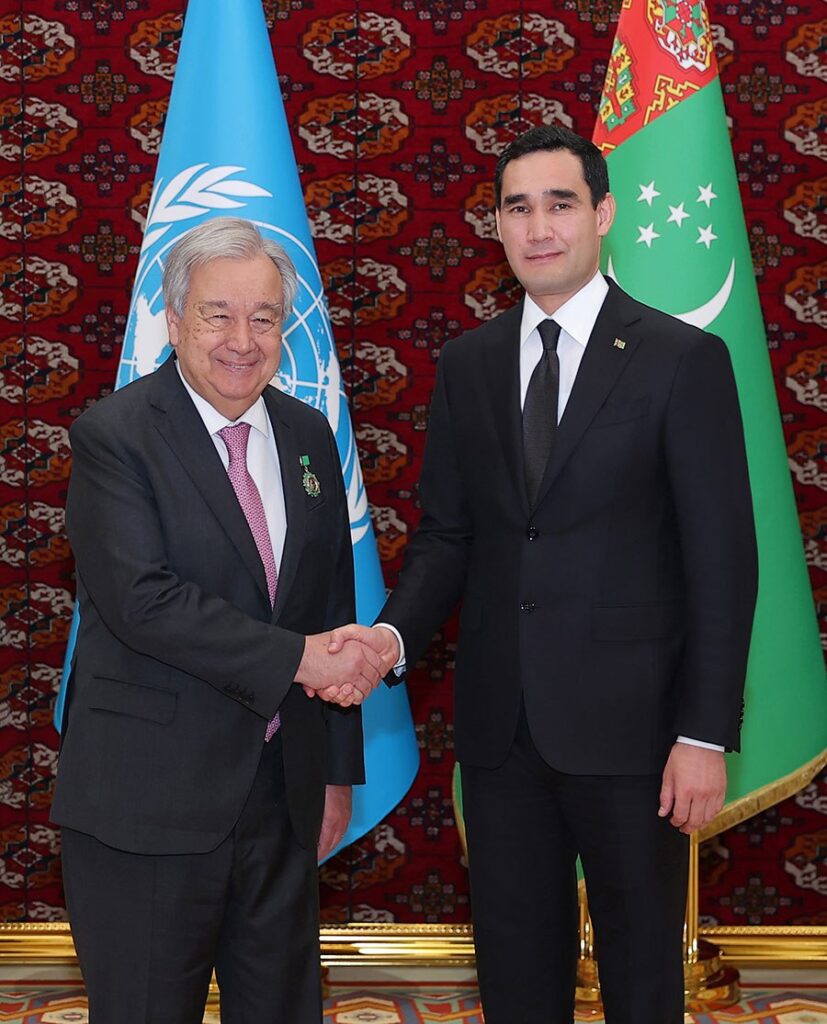
UN’s Guterres and Turkmen President Berdimuhamedov Discuss Development, Security

During his visit to Turkmenistan, the UN Secretary General António Guterres met President Serdar Berdimuhamedov to discuss strengthening cooperation in political, economic, environmental, cultural, and humanitarian spheres.

President Berdimuhamedov emphasized Turkmenistan’s aspiration to further develop relations with the UN. Noting the importance of the country’s permanent neutrality in strengthening peace and security in the region, he recalled that on Turkmenistan’s initiative, the UN General Assembly proclaimed 2025 the International Year of Peace and Trust.

Guterres praised Turkmenistan’s proactive approach to solving urgent problematic issues and remarked on the country’s important role in ensuring universal peace, security, and sustainable development. He also recognized Turkmenistan’s efforts to address the problem of statelessness, especially in Central Asia.

During the talks, both sides stressed the prolonged nature of the strategic dialogue between Turkmenistan and the UN, based on common ground regarding the organization’s goals and the country’s national interests.

Outlining the priorities of the Turkmenistan-UN strategic dialogue, the president highlighted ensuring  global security, resolving regional situations, sustainable development, and other humanitarian issues.

He also proposed to develop a Global Security Strategy based on preventive diplomacy for conflict prevention, expressing a readiness for close cooperation with all interested states and UN institutions.

In the context of regional cooperation, the parties noted the growing importance of Central Asia as a critical center of global energy, geopolitics, and transportation.

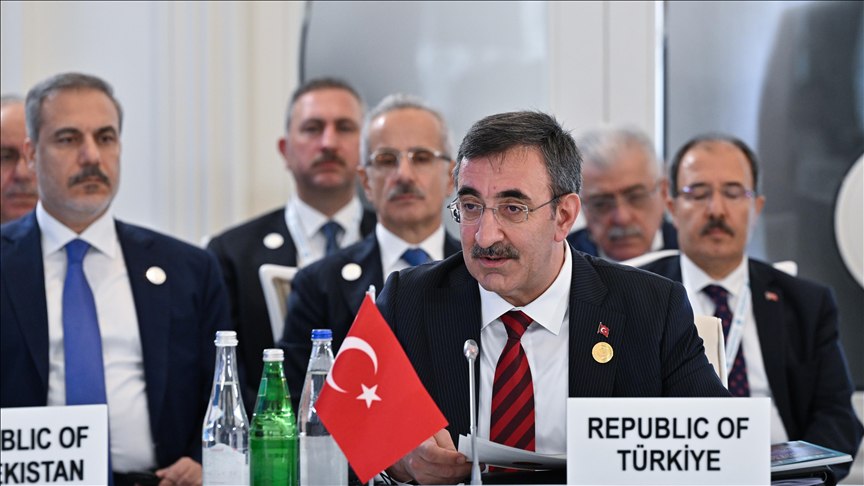
Turkish Vice President: Turkmen Gas Supplies Via Turkey Will Help Ensure Energy Security in Europe

Turkish Vice President Cevdet Yilmaz has said that Turkmen gas supplies through Turkey will contribute to the country’s national welfare and ensure Europe’s energy security. This was said during his speech at the informal summit of member states of the Organization of Turkic States (OTS) in Azerbaijan.

“The transportation of trans-Caspian resources, especially Turkmen natural gas, to Turkey and Europe will contribute to our national welfare and security. We are pleased with establishing an energy mechanism within the framework of the OTG and the publication of contact projects,” Yılmaz said.

According to him, the Organization will further strengthen ties between Turkic states as the world’s economic centers of gravity change and the importance of Turkic geography increases.

“The work that will be done in our countries to develop the Middle Corridor will both strengthen our cooperation and show the global role of the Turkic world,” the Vice President emphasized.

World Bank Establishes Permanent Office in Tajikistan

The World Bank has opened a permanent representative office in Tajikistan this month. ASIA-Plus reports that Ozan Sevimli, who had been the bank’s country manager for Tajikistan since 2021, has been appointed the head of the office.

In Tajikistan the World Bank Group works to ensure reliable electricity and water supply, improve roads and transportation infrastructure, improve education and health care systems, increase food security, and create conditions for private sector growth and institutions of good governance and public administration.

As part of his role, Sevimli will manage programs in Tajikistan being run by the International Bank for Reconstruction and Development, International Development Association, International Finance Corporation, and the Multilateral Investment Guarantee Agency in Tajikistan. This will provide a single point of contact for access to the full range of World Bank Group products and services.

Upon his appointment, Sevimli commented: “Tajikistan faces challenges ranging from institutional challenges and constraints in human capital development to the negative impact of climate change on the economy and people’s livelihoods. The combined leadership of the WB Group will enable a more holistic approach to projects.”