• KGS/USD = 0.01143 -0%
  • KZT/USD = 0.00192 -0%
  • TJS/USD = 0.10820 0.19%
  • UZS/USD = 0.00008 0%
  • TMT/USD = 0.28575 0%
  • KGS/USD = 0.01143 -0%
  • KZT/USD = 0.00192 -0%
  • TJS/USD = 0.10820 0.19%
  • UZS/USD = 0.00008 0%
  • TMT/USD = 0.28575 0%
  • KGS/USD = 0.01143 -0%
  • KZT/USD = 0.00192 -0%
  • TJS/USD = 0.10820 0.19%
  • UZS/USD = 0.00008 0%
  • TMT/USD = 0.28575 0%
  • KGS/USD = 0.01143 -0%
  • KZT/USD = 0.00192 -0%
  • TJS/USD = 0.10820 0.19%
  • UZS/USD = 0.00008 0%
  • TMT/USD = 0.28575 0%
  • KGS/USD = 0.01143 -0%
  • KZT/USD = 0.00192 -0%
  • TJS/USD = 0.10820 0.19%
  • UZS/USD = 0.00008 0%
  • TMT/USD = 0.28575 0%
  • KGS/USD = 0.01143 -0%
  • KZT/USD = 0.00192 -0%
  • TJS/USD = 0.10820 0.19%
  • UZS/USD = 0.00008 0%
  • TMT/USD = 0.28575 0%
  • KGS/USD = 0.01143 -0%
  • KZT/USD = 0.00192 -0%
  • TJS/USD = 0.10820 0.19%
  • UZS/USD = 0.00008 0%
  • TMT/USD = 0.28575 0%
  • KGS/USD = 0.01143 -0%
  • KZT/USD = 0.00192 -0%
  • TJS/USD = 0.10820 0.19%
  • UZS/USD = 0.00008 0%
  • TMT/USD = 0.28575 0%
13 December 2025

Kazakhstan Bank Deposits Decline by $1.1 Billion

Bank deposits by Kazakhstani citizens have declined by 2.5%, according to data from January of this year. Analysts from Ranking.kz say that the portfolio “lost weight” by $1.1 billion and amounted to $44 billion at the end of January 2024. Experts say that it’s a common seasonal occurrence, when after December inflows, there’s an outflow of money from second-tier banks, which is called a “calendar pit.”

Correspondingly, according to analysts’ data, there’s only one financial institution among the largest banks of Kazakhstan that had an inflow of deposits in January — Home Credit Bank’s $725 million (+1.2%). Experts say that was expected, considering the bank has kept rates on its retail deposit products above the average level on the market. Currently the bank’s offered rates on savings products range from 14.5% to 16.7% per annum.

All other large Kazakh banks showed reductions in their portfolios of individual deposits. However, at Bereke Bank, the volume of savings deposits barely changed (-0.02%) and remained at $951 million. By year-on-year measure, Bereke Bank’s portfolio of retail deposits has doubled.

Out of 21 Kazakhstani banks and four foreign financial institutions, Russia’s VTB Bank saw an increase of 36.6% to $128 million, and two Islamic banks — Al Hilal, whose deposits rose 1.5 times to $8.1 million, and Zaman Bank, up 8.5 times to $2.4 million — showed strong deposit growth.

In total, the volume of all bank deposits in Kazakhstan at the end of January 2024 amounted to $76.5 billion — which is 1.4% less than at the end of 2023.

Drug Dealing in Kazakhstan Continues to Gain Momentum

Over the past six years the volume of seized synthetic drugs in Kazakhstan has almost doubled, Finprom.kz reports. In 2023 law enforcement agencies in Kazakhstan interdicted and confiscated 41.1 tons of illicit substances, up from 20.3 tons in 2018.

In 2023 the number of drug laboratories destroyed increased to 75 from 68, and Kazakhstani officials called the increase in the distribution of banned substances an outbreak of drug trafficking. Because of the increase in drug usage, the Ministry of Internal Affairs has said that new types of synthetics will be included in the national list of narcotic drugs before they are brought into Kazakhstan. As soon as the drugs are on the national list, they’ll immediately be registered on Eurasian Economic Union (EAEU) and UN International Committee lists. Until 2019 in Kazakhstan, the procedure for inclusion of new drugs in the national list took about a year — now it takes no more than a month.

Over the past few years in Kazakhstan, the volume of seizures of all sorts of so-called “salts,” “ecstasy” and various synthetic cannabinoids has increased 143.4 times — rising to 1.1 tons from 7.7 kilograms. At the same time, the share of synthetics out of the total number of confiscated drugs in 2023 was insignificant, at 2.7 percent. It’s difficult to obtain accurate data on the market volume of modern illicit substances — often because new types of drugs are distributed mainly among young people through messenger apps and crypto-wallets, with the use of bots for publishing advertisements. According to the Interior Ministry, more than 3,000 different drug-dealing sites and 1,300 online stores on encrypted messaging app Telegram were blocked by Kazakhstan last year. Finprom.kz analysts report that they themselves managed to independently find several such channels operating in the country.

At the end of 2023, Kazakhstani Interior Minister Yerzhan Sadenov named some of the main barriers in the fight against the spread of synthetic drugs. He said the issue is complicated by the fact that the drugs are made in clandestine labs in the country from substances that are not considered illegal in Kazakhstan — and can only legally be brought to the attention of police after they are used to make a drug. Last year the Ministry of Internal Affairs seized more than 100 tons of these ingredients — which could have turned into eight tons of finished drugs. Therefore, the Ministry of Internal Affairs proposes increasing criminal liability for trafficking in precursor chemicals. Today the country punishes only the smuggling of these substances.

According to the Prosecutor General’s Office of Kazakhstan, last year drug crime in the country increased by 9%. In 2023, 7,500 drug crimes and criminal offenses were recorded. The police detained about 4,500 people, including minors, on suspicion of distribution, manufacture or sale of illegal substances.

Uzbek Environmentalists Propose Harnessing Rainwater to Combat Water Crisis

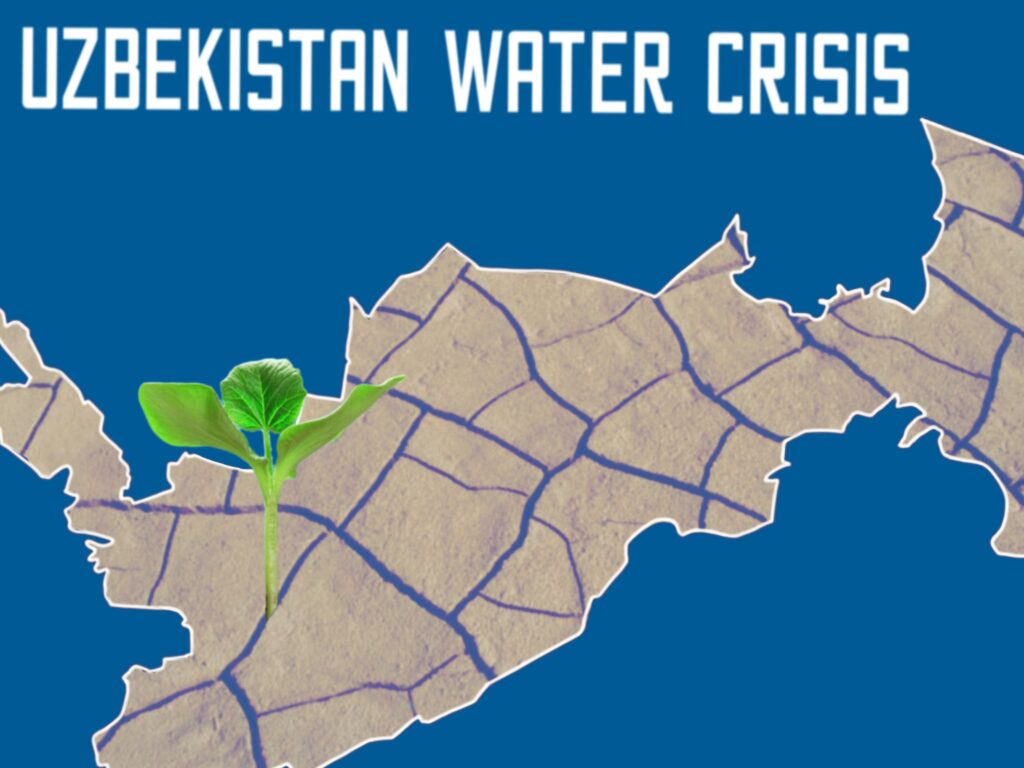
The Ecological Party of Uzbekistan has proposed using collected rainwater as a groundwater supply for the population. The activists plan to develop a corresponding program and submit it to the government for consideration.

Rainwater, after appropriate treatment, can be reused for certain purposes. The average person uses about 150 liters of water per day for drinking, bathing, and cleaning, and the party claims that each person can save up to 71 liters of clean drinking water per day by this method.

In the context of water scarcity in Central Asia, this sounds more than relevant. After all, over the past 50 years, glaciers in Central Asia have shrunk by about 30%, putting Uzbekistan in 25th place among the 164 countries suffering from “water stress.”

The population of the five countries in the Central Asian region totals more than 78 million, and by 2050 that number will have grown to 90-100 million people. Water shortages may rise to affect 25-30% of the population.

At a meeting of the Uzbek government at the end of 2023, officials said that the country’s economy loses $5 billion annually due to inefficient use of water resources. Climate change, shrinking water sources and growing water consumption could lead to a water deficit of 15 billion cubic meters by 2030.

South Korea to Supply Uzbekistan With High-Speed Trains

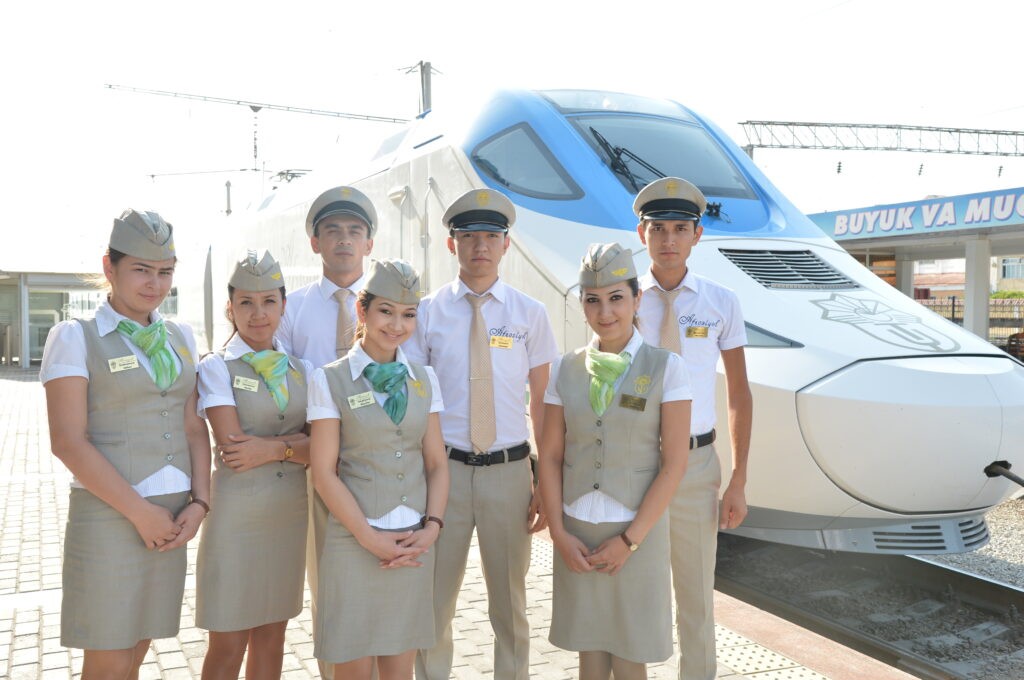
Six Hyundai Rotem high-speed trains made in South Korea will soon be launched between Tashkent and Khiva. The electric trains will have seven carriages, and will be able to carry 350 passengers at speeds of up to 250 kilometers per hour.

To purchase the trains, Uzbekistan will use a $200 million, 35-year loan from the Economic Development and Cooperation Fund (EDCF) of the Republic of Korea. A feasibility study for the project is currently being drawn up.

Uzbekistan had originally planned to purchase high-speed trains from Hyundai back in 2018, with the project estimated at $1 million. But the national rail company Uzbekistan Temir Yollari ended up instead signing a contract with the Spanish company Talgo, which manufactured the Afrosiyob trains currently in use in the country.

A $162 million loan for electrification of the 465km Bukhara-Miskin-Urgench-Khiva railway line was approved by the Asian Development Bank (ADB) back in 2021. High-speed trains that will connect these cities will shorten the journey by two hours. The project was planned as part of the Central Asia Regional Economic Cooperation (CAREC) Corridor 2 program. It will link China and Europe through Central Asia and aims to boost the countries’ cross-border trade.

Uzbekistan is actively developing its tourism potential. Because of this, Uzbekistan Temir Yollari and the Italian company Arsenale Group are planning a luxury tourism train project. The train will have all the accoutrements for comfortable, five-star travel along the Silk Road along the Tashkent-Samarkand-Bukhara-Khiva-Tashkent route.

London University Installs Bust of Persian-Tajik Cultural Force Rudaki

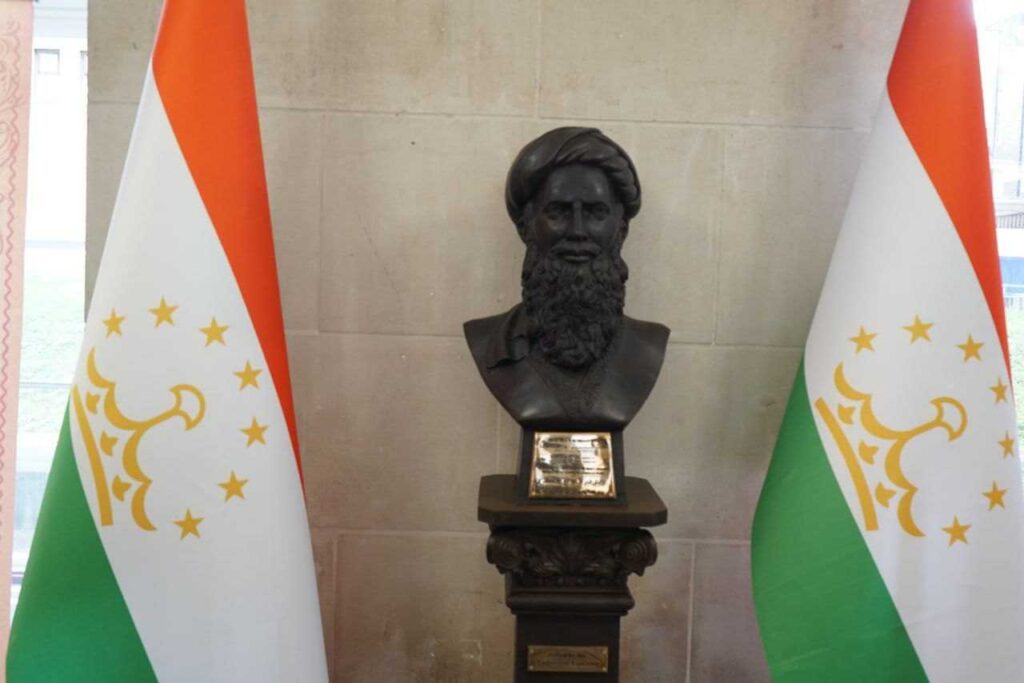
A bust of Abu Abdullah Rudaki, the founder of Tajik-Persian literature, was installed last week at the University of London School of Oriental & African Studies (SOAS).

The bust is the latest initiative of the Tajik embassy in Great Britain. Tajikistan’s ambassador Rukhshona Emomali was at SOAS for the presentation of the bust, and in a speech mentioned the contributions that Rudaki made to strengthening the Tajik-Persian language, and the foundations of Tajik literature and poetry. Thanks to him, in the centuries that followed, Central Asia, the Caucasus, Asia Minor, Pakistan, and India recognized the Tajik-Persian language as a language of science, literature, and statehood.

Following the presentation on 16 March, over 200 guests attended an event honoring Abu Abdullah Rudaki’s life. Staff from Tajikistan’s Ministry of Education and Science met with members of SOAS, as well as the University of Oxford’s Faculty of Persian Studies and the University of Portsmouth, to discuss forming educational partnerships in future.

Tears and Laughter: An Evening at an Uzbek Theater

Tashkent, Uzbekistan – The action unfolds in the Soviet Union in the 1960s.

An Uzbek man goes to Russia for compulsory military service and falls in love with a Russian woman. Back with her betrothed in his homeland, the Russian slowly wins over her recalcitrant mother-in-law and learns to love Uzbek culture.

So goes the plot of “Uzbek Dance,” a play being performed in the colonnaded Uzbek National Academic Drama Theater in Tashkent, the capital. The tragicomedy made its debut in Uzbekistan in 2009 and has been re-staged several times, immersing audiences in Uzbek history and culture and making them laugh and cry.

The Times of Central Asia attended a performance on March 9. So did hundreds of other people. Ticket prices in the Uzbek currency, the sum, cost the equivalent of about USD4 to USD5.60. Before the start, people in the atrium gazed at portraits of actors who helped to build the Uzbek theater scene over the last century.
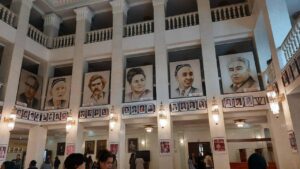
People mingle in the museum of the National Academic Drama Theater in Uzbekistan. Portraits of actors who contributed to the development of Uzbek theater in the past century are hung there. Photo: TCA


In the early days, the “Turon” troupe performed around Uzbekistan. The first performance of the theater group was held in 1913 in the garden of the 14th century Tashkent mausoleum of an Islamic leader, or sheikh. In 1918, the state took over the troupe.

Written by Nurillo Abbaskhan, “Uzbek Dance” explores tension and reconciliation between the Russian woman and her Uzbek mother-in-law, whose verbal and cultural missteps make for mutual suspicion and comedy.

The play invites reflection on the nuanced relationship between Russia and Uzbekistan today (at least 2% of Uzbekistan’s population are ethnic Russians, according to government data in 2021; the population is estimated today at nearly 37 million).

There’s a dark side to the drama. The family saga happens against the backdrop of a real-life 1980s corruption scandal surrounding a campaign to supply more Uzbek cotton for the Soviet Union.
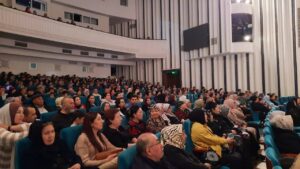
Spectators await the performance of “Uzbek Dance,” a play that has been staged in different productions several times since making its debut in 2009. Photo: TCA


The cotton campaign was marred by falsified production numbers and a backlash from Soviet officials who rounded up thousands of Uzbek people, prosecuting many on false charges. Additionally, pesticides took a devastating toll on the environment and workers’ health.

In the play, the Uzbek man, Tursunboy, drives a tractor in the cotton fields. Eventually, he gets falsely accused in the purge and imprisoned. He eventually gets out of jail, but the harsh conditions and years of exposure to toxic chemicals have left him fatally ill.

Then there is Panamaryova Maria Visilevna, who took the name Maryam after converting to Islam on the insistence of her Muslim mother-in-law, Kumri Aya.

The two women don’t get along at first. But they get closer. Maryam, who gives birth to six children before Tursunboy’s decline, learns the Uzbek language, dances, hat-making and other customs from Kumri Aya. They exchange hugs and sing lullabies together.

One day, Kumri Aya asks Maryam for forgiveness for hurting her in the past. The next day, she dies. The Russian daughter-in-law mourns.

The performance ends with the Russian woman teaching the national Uzbek dance “Tanovar” to the young Uzbek wife of one of her sons. The wife had lived in the city and barely knew her own heritage.