• KGS/USD = 0.01144 0%
  • KZT/USD = 0.00196 -0%
  • TJS/USD = 0.10899 -0%
  • UZS/USD = 0.00008 -0%
  • TMT/USD = 0.28490 0%
  • KGS/USD = 0.01144 0%
  • KZT/USD = 0.00196 -0%
  • TJS/USD = 0.10899 -0%
  • UZS/USD = 0.00008 -0%
  • TMT/USD = 0.28490 0%
  • KGS/USD = 0.01144 0%
  • KZT/USD = 0.00196 -0%
  • TJS/USD = 0.10899 -0%
  • UZS/USD = 0.00008 -0%
  • TMT/USD = 0.28490 0%
  • KGS/USD = 0.01144 0%
  • KZT/USD = 0.00196 -0%
  • TJS/USD = 0.10899 -0%
  • UZS/USD = 0.00008 -0%
  • TMT/USD = 0.28490 0%
  • KGS/USD = 0.01144 0%
  • KZT/USD = 0.00196 -0%
  • TJS/USD = 0.10899 -0%
  • UZS/USD = 0.00008 -0%
  • TMT/USD = 0.28490 0%
  • KGS/USD = 0.01144 0%
  • KZT/USD = 0.00196 -0%
  • TJS/USD = 0.10899 -0%
  • UZS/USD = 0.00008 -0%
  • TMT/USD = 0.28490 0%
  • KGS/USD = 0.01144 0%
  • KZT/USD = 0.00196 -0%
  • TJS/USD = 0.10899 -0%
  • UZS/USD = 0.00008 -0%
  • TMT/USD = 0.28490 0%
  • KGS/USD = 0.01144 0%
  • KZT/USD = 0.00196 -0%
  • TJS/USD = 0.10899 -0%
  • UZS/USD = 0.00008 -0%
  • TMT/USD = 0.28490 0%
08 December 2025

Smog in Bishkek Decreases by 10-15%

Kyrgyzstan’s Ministry of Natural Resources, Ecology and Technical Supervision has announced that smog in Bishkek has decreased by at least 10-15% resulting from the government’s efforts to improve the air quality in the capital city. Welcome news at a time when pollution had reached a critical level. In recent years, IQAIR has frequently ranked Bishkek among the worst cities in the world for the highest levels of air pollution.

The Asian Development Bank’s (ADB) brief, “Tackling Air Pollution in Bishkek: A Road Map to Cleaner Air,” released in November 2023, stated that air pollution in Bishkek exceeded the WHO air quality guidelines by up to 30 times in winter.

The brief referenced several studies on the main sources of air pollution. A UNICEF report showed PM2.5 concentrations are highest where households rely on coal for heating, in areas around the city’s coal-fired thermal power plant and where solid waste is burned. UNDP-UNEP similarly cited coal as the primary source of pollution, followed by road transport.

Transport was estimated by ADB to contribute around a third of annual emissions, particularly diesel trucks and minibuses.
In conclusion, the ADB report recommended that to arrest air pollution, top priority be given to phasing out coal and investing in clean public transport.

According to government reports, in 2023, nine residential neighborhoods comprising over 14 thousand households were supplied with natural gas. Today, 31 of the 47 residential suburbs, previously reliant on coal for heating, are connected to gas.

The ministry also stated that the Bishkek landfill, which had been burning for decades adding to the city’s air pollution woes, was completely extinguished last year. Its territory is currently being reclaimed, with 850 tree saplings planted so far on an area of 2.3 hectares. In addition, 850 new environmentally friendly buses running on liquefied gas have been purchased for Bishkek. Mild weather and heavy rainfall were contributory factors but the decrease in smog this winter bodes well for the city’s environment.

The Development and Drivers of Transport and Logistics in Kazakhstan

The challenging geopolitical situation in the region, combined with sanctions pressures, has ruptured traditional transport and logistics chains. Finding itself sandwiched, Kazakhstan has had to actively build new routes for transportation and freight, and to diversify its own suppliers. Measures previously taken to develop the transport and logistics industry has made it possible to solve these problems to some extent, though it still faces many challenges ahead.

Kazakhstan’s transport and logistics industry plays an important role in the country’s economy and attracts cargo flows. To transform the country into a transport and transit hub – one of the government’s declared strategic objectives – a number of large-scale measures are being taken today, with investments in the industry of about KZT1.8 trillion (U$4 billion), which are already bearing fruit.

Last year, about 29 million tons of freight passed through Kazakhstan, up 21% year-on-year, the lion’s share of which was transported by rail. Indeed, railways are slated to lead the country’s transit development. To further increase cargo flow, boost efficiency and, most importantly, expand the capacity of railroads, three large-scale projects were launched in Kazakhstan last year: the construction of a railway line bypassing the Almaty station, as well as two other lines – Darbaza-Maktaaral and Bakhty-Ayagoz. Over the next three years, more than 1,300 km of new rail lines will be laid. The projects aim not only at increasing transit traffic through Kazakhstan, but also expanding the country’s export potential and removing existing bottlenecks. Besides modernizing infrastructure, the industry faces many other tasks to spur transit traffic, including updating rolling stock, putting in place modern digital services, establishing competitive tariff rates for the transport of transit freight, etc.

To support cargo flows by road, the most used option, the construction and reconstruction of federal and local highways continues. In 2023, over 10,000 km of road was built or repaired. Such large projects as the BAKAD (Almaty ring road) and the Kandyagash-Makat and Usharal-Dostyk highways were completed. In the coming years, several road projects along federal and regional networks are planned, comprising a total length of about 9,000 km. More attention is to be paid to the quality of the roads under construction, which has been known to raise questions among motorists.

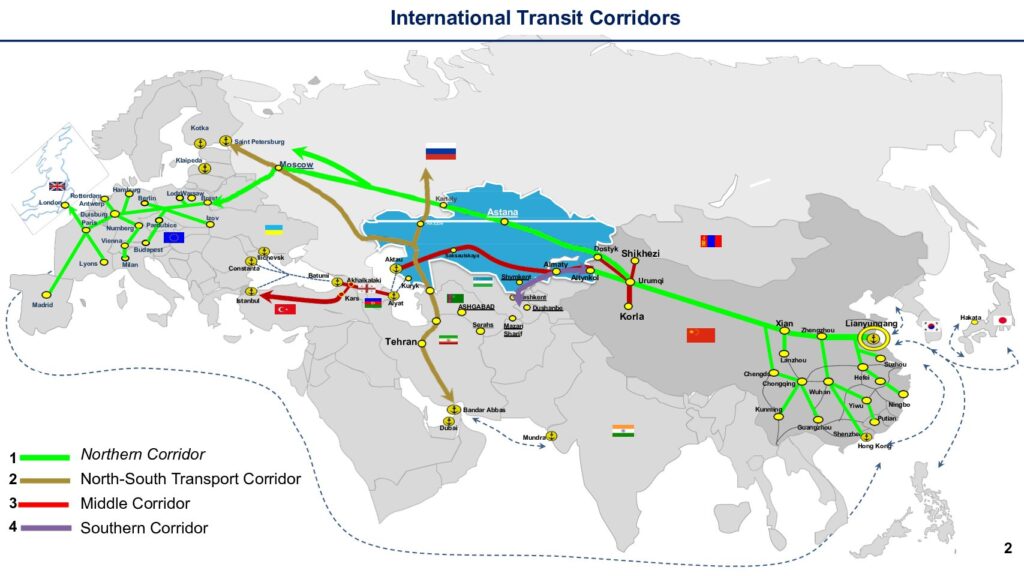
Kazakhstan’s maritime transport industry has also seen much development. In this regard, in the near future the creation of a container hub is planned at the Aktau seaport, along with the reconstruction of its docks and an upgrade of handling equipment. Dredging work is also to be done. The port of Kuryk is also being developed through the construction of a multi-functional terminal. Taken together, this will boost the throughput capacity of Kazakhstan’s seaports by 10 million tons, with container capacity rising to 300,000 TEUs per year. This is especially important in the context of the active development of alternative trade routes, in particular the Trans-Caspian International Transport Route (TITR) and the International North-South Transport Corridor (INSTC), for which both seaports will be used. The potential of these routes is evidenced by the interest of many foreign players. Note that the World Bank published a report in late November 2023 on the outlook for the TITR until 2030, exploring priority measures that could help countries participating in this multi-modal, rail-sea corridor to transform it into an important and reliable trade route.

The country’s airports are also a focus. Currently, the Astana, Almaty, Shymkent and Aktau airports are planning to attract $1.5 billion of foreign direct investment, which should raise the capacity of their cargo terminals from the current 200,000 to 1 million tons per year and create regional air hubs with a full range of services. A special economic zone for the airports is under consideration, a step that global experience shows will help attract cargo flows. In addition, as part of the Open Skies regime, airlines and low-cost carriers from 12 countries have agreed to fly to 13 international airports in Kazakhstan (Astana, Almaty, Taraz, Shymkent, Aktau, Semey, Karaganda, Ust-Kamenogorsk, Pavlodar, Petropavlovsk, Kokshetau, Turkestan and Aktobe), thus increasing competition among carriers, opening international routes, reducing the cost of tickets, developing tourism, and making cities in Kazakhstan more accessible.

Transport and logistics are reaching a new level of development in Kazakhstan and becoming one of the priority areas for the government. In the context of the unstable geopolitical situation in the former Soviet Union, as well as in the Middle East, which has affected global transport flows, Kazakhstan is well positioned to become an important transport and logistics hub between East and West and North and South, providing the shortest, safest routes, and convenient conditions for transporting goods.


Dauren Moldakhmetov 

Editor-in-Chief of industry transportation publications of Kazakhstan, railway magazine “Trans-Express Kazakhstan” and business magazine “Trans Logistics Kazakhstan”


Afghan Canal Will Divert Water from Uzbekistan

Afghanistan has begun construction of the second phase of the Qosh Tepa Canal, which will divert water from the Amu Darya River and may have an adverse effect on agriculture in downstream Uzbekistan.

The Taliban announced that construction work on the second phase, which stretches from Dawlat Abad District of Balkh Province to Andkhoi District of Faryab Province, began on February 20th, Afghan broadcaster TOLOnews reported, adding that the 198-km first phase of the canal is now complete and construction of the 177-km second phase will take 12 months.

The canal is expected to convert 550,000 hectares of desert into farmland in northern Afghanistan. The Taliban-led government of Afghanistan has made the Qosh Tepa Canal a priority project and its construction started in early 2022. However, neighboring Uzbekistan, the main downstream country in the Amu Darya basin, has expressed concerns that the canal will have an adverse effect on its agriculture.

In September 2023, Uzbekistan’s President Mirziyoyev stated that the canal could “radically change the water regime and balance in Central Asia.” Speaking at a meeting of the Council of Heads of the Founder States of the International Fund for Saving the Aral Sea, Mirziyoyev warned that a “new participant in the water use process has appeared in our region.” Mirziyoyev proposed the formation of a joint working group to study all aspects of the Qosh Tepa Canal and its impact on the water regime of the Amu Darya River with the involvement of research institutes of the Central Asian countries.

A Eurasian Development Bank’s (EDB) study, “Efficient Irrigation and Water Conservation in Central Asia,” released in November 2023, emphasized the need to mitigate the anticipated decrease in the flow of the Amu Darya River from Afghanistan. EDB analysts forecast that by 2028, the combined effects of climate change, low-water periods and the commissioning of Qosh Tepa Canal in Afghanistan will result in acute water shortages in Central Asia, estimated to be between 5 and 12 km3.

With the launch of the canal provisionally set for 2028, its expected water intake from the Amu Darya will be up to 10 cubic kilometers. A reduction in the Amu Darya flow will have an impact on the entire Aral Sea basin. As a result, from 2028, Central Asia will face a chronic water shortage, Evgeny Vinokurov, chief economist of the EDB warned.

Bishkek Cable Car Plan Gets Mixed Reaction

The Bishkek municipality’s plan to build a cable car line to solve transport problems in Kyrgyzstan’s capital has received a mixed response from the city residents. Many believe the proposed project is too expensive and will not achieve the declared goal of providing comfortable transport options.

In January, the Mayor of Bishkek, Aibek Junushaliev visited Switzerland to meet with Roland Bartholet, CEO of the engineering company, Bartholet Maschinenbau AG, with the parties signing an agreement and approving a plan to build a cable car line in Bishkek.

Bishkek’s Deputy Mayor, Maksatbek Sazykulov said this week that the project’s designer is expected to arrive from Switzerland late in February, that construction may begin in May or June, and the line could be in operation in the third quarter of 2025. According to the deputy mayor, the line is planned to stretch for six kilometers from north to south along a major central avenue, have five stations and 65 cars, and a daily capacity of up to 100,000 passengers. The approximate cost of the project is $50m-$60m.

Bishkek City Council member, Kadyrbek Atambayev, believes the project to build a cable car line leaves many unanswered questions. “Cable cars are usually used in areas with very rough terrain, where other modes of transport cannot function effectively. In our case, in the absence of significant natural obstacles or large water barriers inside the city, the use of a cable car line does not provide significant advantages over existing types of urban transport,” Atambayev wrote on Facebook.

Atambayev stated that the cost of construction and maintenance of the cable car line significantly exceeds the cost for city buses. “Six kilometers of cable line [would] cost of up to $60m… $100m allowed Bishkek to purchase 1,000 buses last year,” he stated.

The city of Bishkek’s press service earlier called the cable line project an important step in the modernization of urban infrastructure aimed at providing comfortable transport options for the people of the city.

Kazakhstan Seeks to Tap Huge Wind Power Potential

Kazakhstan may soon become one of the world leaders in wind power generation, the country’s Minister of Energy, Almasadam Satkaliev told a parliamentary commission on February 23rd. According to the minister, as the world’s ninth-largest country, Kazakhstan has significant potential for the development of the renewable energy sector, with its vast territory highly suited to wind and solar power generation.

Kazakhstan’s climate is favorable for the construction of wind power plants as the country has wind corridors with wind speeds of more than five meters per second, a requirement for the operation of turbines. Experts estimate the potential of wind energy in Kazakhstan at 920 billion kWh per year. The Caspian Region, south Kazakhstan, and the Shelek Corridor and Dzhungar Gate located in the southeast have the most potential.

The minister also noted the possibilities for the utilization of solar energy. The southern regions of the country see 2,200-3,000 hours of sun per year, among the most in the world. The best areas for solar generation are the Aral Sea region and south Kazakhstan.

In 2023, Kazakhstan consumed 115 billion kWh of electrical energy, compared with 112.9 billion kWh in 2022, and produced 112.8 billion kWh, the same amount as in 2022. Last year Kazakhstan imported 3.4 billion kWh, and exported 1.4 billion kWh. In 2024, the country plans to generate 115 billion kWh.

According to the minister, renewable energy has shown steady growth, and since 2014 its capacity has increased more than 16-fold — from 178 MW in 2014 to 2,868 MW in 2023.

In 2023, the volume of electricity generated by renewable energy facilities amounted to 6.675 billion kWh, including 3.8 billion kWh from wind power plants, 1.8 billion kWh from solar plants, and 993.8 million kWh from hydropower plants. That accounted for 5.9% of the total electricity generation in the country. Kazakhstan’s goal is to achieve a 15% share of renewable energy sources in power generation by 2030, and a 50% share by 2050.

U.S. Company to Process Medical Waste in Uzbekistan

Uzbekistan’s Ministry of Ecology, Environmental Protection and Climate Change announced on February 23rd that a U.S. company, SAYAR LLC, will begin the processing of medical waste in a test mode in the city of Tashkent and the Samarkand Region.

An agreement on the project was reached with the American company following its delegation’s visit to the Samarkand Region, where company representatives inspected local medical institutions and examined the storage conditions and quantity of medical waste.

The disposal of medical waste will produce thermal energy which will be used to heat hospitals; special filters will be installed to prevent harmful emissions into the atmosphere.