Bridging East and West: Kazakhstan’s Changing Foreign Policy in the 2020s

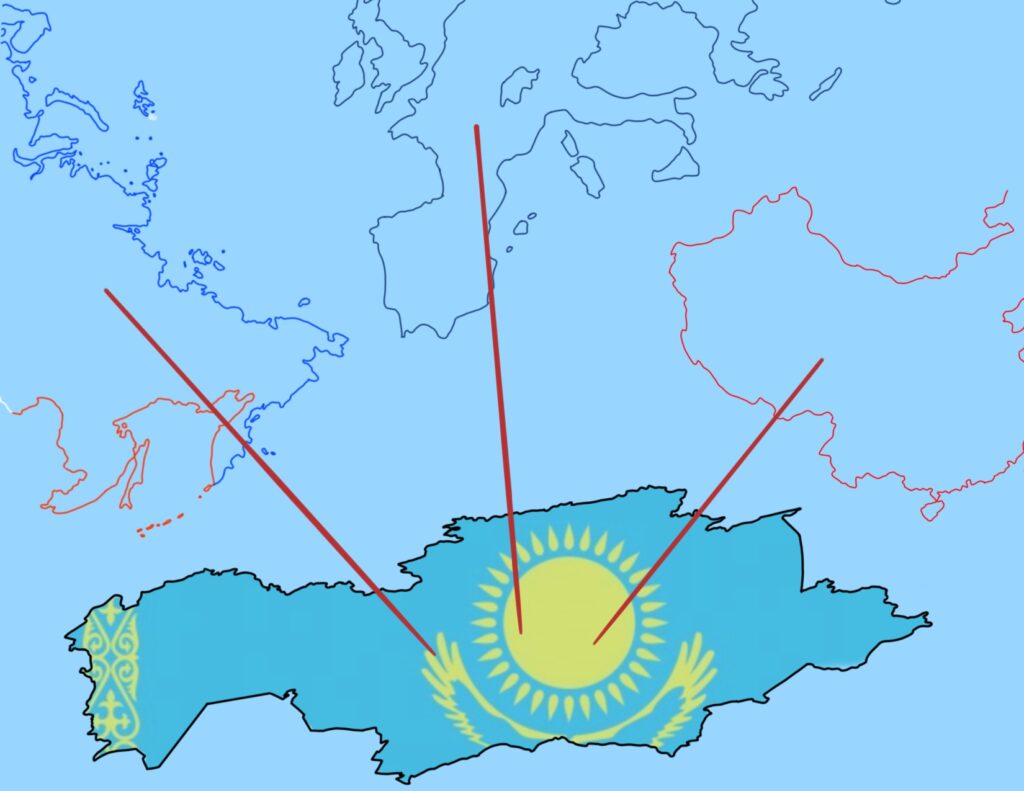
In the wake of significant geopolitical and social change, Kazakhstan has been noticeably reassessing its official and economic relations with foreign powers. Formerly a part of the USSR, Kazakhstan has positioned itself since the collapse of the bloc in 1991 as a country with a triangulated approach to foreign relations. This means that it attempts to maintain cordial relationships with both of its powerful neighbors, Russia and China, whilst also improving relations with countries in the West. Now, this multi-vector foreign policy appears to be shifting as Kazakhstan re-evaluates its priorities in a world that has seen both a global pandemic and Russia’s invasion of Ukraine.
Russia
Kazakhstan is allied with Russia in the Collective Security Treaty Organisation (CSTO), but this relationship was put under strain even prior to Russia’s war in Ukraine. In a memorable speech from September 2014, Russian President Vladimir Putin expressed his view that “Kazakhs never had any statehood,” and that their desire to align themselves more closely with Russia was “profound.” These statements caused Nursultan Nazarbayev, then President of Kazakhstan, to threaten to remove his country from the Eurasian Economic Union (EAEU), a bloc largely dominated by Russia. This threat was not acted upon, however, and Kazakhstan remains a member to this day. Nonetheless, it was an indication of cooling relations long before the current global state of affairs, and a precursor to a shift in how Astana sees Kazakhstan being positioned on the world stage in future.
Since Russia launched its full-scale invasion of Ukraine on 24th February 2022, Kazakhstan’s foreign relations have taken an ever more decisive turn. While Astana does not officially support international sanctions against Russia, citing the knock-on effects these sanctions create for Kazakhstani businesses – Russia remains a strong trade partner and a key part of Kazakhstan’s supply chain for land-based trade due to their long, shared border – it has nevertheless complied with them. This purely economic reasoning for not officially supporting international sanctions places Kazakhstan at odds with Belarus, which is an example of a former Soviet state that remains allied to Russia and whose leader, Aleksandr Lukashenko, derided by many as a dictator, has been vocal in his support of Russia’s political actions, allowing Belarusian territory to be used to further Russia’s strategic goals in the war against Ukraine. In sharp contrast, Astana has made it clear that it will not allow Russia to use Kazakh territory in an attempt to circumvent international sanctions.
In an effort to avoid incurring secondary international sanctions due to its ties with Russia, Kazakhstan has invested in an electronic monitoring system, launched in spring 2023, for goods purchased from Western countries passing through its territory for re-export to the EAEU. This system tracks goods until they reach their final destination, thus aiming to prevent foreign players who wish to help Russia evade international sanctions through this method, known as “parallel imports”. In October 2023, Kazakhstan also halted the export of over 100 products to Russia (including drones, military equipment, microchips and specialized electronics), in line with Western sanctions. The following month, President Kassym-Jomart Tokayev spoke in Kazakh at a press conference to which Russian officials had been invited in an obvious snub towards the status of the Russian language in Kazakhstan (Russian is an official language of the country alongside the state language of Kazakh), which left Russian officials flustered as they were not prepared for the need for interpreters. Despite these issues with translation, the message was clear: Kazakhstan is no longer prepared to play by Russia’s rules.
China
Kazakhstan’s relations with China are also a legacy of the country’s Communist past. Following the collapse of the Soviet Union, Kazakhstan and China have worked together to pursue stronger ties and cordial relations. Kazakhstan officially recognizes the One China principle, which includes China’s rightful ownership of Taiwan, and President Tokayev not only studied in China, but also served at the Soviet embassy in Beijing during the early days of his career. The two countries are involved in various cooperation agreements, such as the Shanghai Cooperation Organisation (a political, economic and defense organization in the region which also includes Russia), and the China-Central Asia Summit, a diplomatic summit composed of China and the five Central Asian countries which held its inaugural meetings in Xi’an in May 2023, with the second summit set to be held in Kazakhstan in 2025.
With Russia increasingly funneling its resources into its war in Ukraine, the importance of China to Kazakhstan’s economy has increased, and trade between the two countries has grown as a result. In 2022, total trade between China and Kazakhstan reached $31.17 billion, an increase of 23.6% on the previous year. China is Kazakhstan’s second-largest trading partner, and currently stands as the largest importer of Kazakh goods, while Kazakhstan imports a range of products from China, including clothing and electronics, and is a significant beneficiary of China’s Belt and Road Initiative, receiving 15% of investment pledges announced in 2023, totaling over $16 billion. This includes an agreement to develop the Trans-Caspian International Transport Route (TITR), a rail and sea transport corridor connecting China and Kazakhstan to Europe, Turkey, and the Caucasus.
The limitations of Kazakhstan’s strengthening relations with China are twofold – firstly, Chinese investment into countries via the Belt and Road Initiative provides leverage for Beijing to wield political influence over those countries, both in bilateral disputes and on the global stage. Kazakhstan may not be immune to such pressures if the threat of terminated investment is applied. A secondary consequence of this partnership lies in the balance Astana will need to find diplomatically between its negotiated obligations to China and its desire to cultivate a closer relationship with the EU, as competing interests are certain to arise along the way. In addition, China in 2024 is not in the same economic position as it was when it launched the Belt and Road Initiative back in 2013. Since then, the country’s market competitiveness has stagnated and its internal market is battling deflation, with the Financial Times reporting earlier this month that prices within the country have fallen at the fastest rate in 15 years. It is with this in mind that Astana seems eager not to rely solely on Beijing’s economic support, and is also looking to develop its relationships with countries in the West.
The West
On March 1st 2020, Kazakhstan’s Enhanced Partnership and Cooperation Agreement with the European Union came into effect. This agreement was significant for both parties, being the first such agreement to be signed by the EU and a Central Asian state. This agreement was a formal statement of intention from Astana to strengthen its relationship with the Western bloc, in the hope that this would lead to an upturn in its domestic economy. The agreement sets out a framework for bilateral relations, which includes Kazakhstan’s transition to a green, more diversified economy, and a simpler legal environment for businesses when operating in both territories.
The EU is Kazakhstan’s most significant trade partner, accounting for almost 30% of Kazakhstan’s foreign trade in 2021. Kazakhstan’s exports (to countries within the EU, but also to other Western nations such as the U.S. and the U.K.) are almost entirely made up of oil and gas, minerals and chemicals, with some food products, hence why a diversified economy is a key focus for its development. Kazakhstan’s imports from the EU and the U.K., meanwhile, include machinery, chemicals, beverages, tobacco, vehicles, scientific instruments, and agricultural products. From the U.S., in 2021 Kazakhstan mainly imported vehicles and spacecraft. These statistics paint a picture of Kazakhstan as a country rich in land and natural resources, capable of acting as a launching pad for space programs, but lacking in the investment and technical sophistication to domestically produce the spacecraft for these missions, or the machinery needed to farm and mine its own land. This is something that the government in Astana will be hoping to change.
There are signs that the international community is willing to provide some of the investment necessary to further develop Kazakhstan’s economy. In 2022, Kazakhstan entered the top five countries receiving the highest amounts of foreign direct investment (FDI) globally, with an increase of 83% to $6.1bn. In the same year, Russia reported a negative FDI result totaling -$18.7bn due to businesses and investors ceasing operations in Russia because of the war in Ukraine. The two figures are undoubtedly linked – as Russia poured money and resources into its battlefields on European territory, the international community largely sought to distance itself from any association with a warmongering state, and Kazakhstan’s perception as a regional investment opportunity became increasingly attractive, particularly for those looking for an alternative to Russian energy and natural resources. At the same time, FDI in Ukraine also plummeted, as investors found the risks of investing in a war-torn country unpalatably high. Kazakhstan continues to position itself as an alternative provider for global buyers boycotting Russian-produced energy.
In addition to the Enhanced Partnership and Cooperation Agreement, Astana has signaled that it wishes to discuss with Brussels the possibility of Kazakhstan’s eventual accession to the EU as a member state, despite its Central Asian location. While the EU is unlikely to seriously entertain such a proposal, the bloc is clearly committed to developing a closer relationship with Kazakhstan, and will naturally want to avoid this becoming a potential hinderance to future diplomatic relations as Kazakhstan’s star rises on the international stage. Instead, the EU may look to explore other options, such as an eventual special status for Kazakhstan which, while stopping short of granting full EU membership, could afford Kazakhstan and its citizens some privileges in trade and travel with EU countries. Or, the EU may seek to encourage Kazakhstan to build ever closer relationships with its neighbors in Central Asia, with the goal of one day forming something akin to a “Central Asian Union.” The diplomatic tightrope that Brussels will need to walk in future will consist of encouraging Kazakhstan to cooperate with Western countries from both an economic and political standpoint so they can be sure of its status as an ally in the region, without leading Astana to ultimately become disillusioned with what it receives from the relationship, or alienated by the lack of a European appetite for Kazakh membership of the EU.
Developing and diversifying the Kazakh economy will take time, and this is by no means a process that will be completed by the end of the decade. Astana’s increasing eagerness to cooperate with the West, and the EU in particular, is indicative of a long-term foreign policy plan that seeks to limit the influence of Russia on Kazakhstan’s future. In doing so, the intention is clear – by diversifying its foreign policy and strengthening relations with Western nations, Kazakhstan hopes to diversify and strengthen its own economy, and secure an independent future. The question remains as to how independent this future can be if it involves an increased reliance upon Chinese investment at a time when Beijing is facing its own economic crisis, and while many remain uncertain as to how Kazakhstan will fit in to a changing geopolitical order.

Emily Rowland holds a BA in Modern Languages and an MSt in Slavonic Studies from the University of Oxford. Her research interests include social and geopolitical issues affecting the Central and Eastern European region.