• KGS/USD = 0.01144 0%
  • KZT/USD = 0.00212 0%
  • TJS/USD = 0.10456 0.19%
  • UZS/USD = 0.00008 0%
  • TMT/USD = 0.28490 0%
  • KGS/USD = 0.01144 0%
  • KZT/USD = 0.00212 0%
  • TJS/USD = 0.10456 0.19%
  • UZS/USD = 0.00008 0%
  • TMT/USD = 0.28490 0%
  • KGS/USD = 0.01144 0%
  • KZT/USD = 0.00212 0%
  • TJS/USD = 0.10456 0.19%
  • UZS/USD = 0.00008 0%
  • TMT/USD = 0.28490 0%
  • KGS/USD = 0.01144 0%
  • KZT/USD = 0.00212 0%
  • TJS/USD = 0.10456 0.19%
  • UZS/USD = 0.00008 0%
  • TMT/USD = 0.28490 0%
  • KGS/USD = 0.01144 0%
  • KZT/USD = 0.00212 0%
  • TJS/USD = 0.10456 0.19%
  • UZS/USD = 0.00008 0%
  • TMT/USD = 0.28490 0%
  • KGS/USD = 0.01144 0%
  • KZT/USD = 0.00212 0%
  • TJS/USD = 0.10456 0.19%
  • UZS/USD = 0.00008 0%
  • TMT/USD = 0.28490 0%
  • KGS/USD = 0.01144 0%
  • KZT/USD = 0.00212 0%
  • TJS/USD = 0.10456 0.19%
  • UZS/USD = 0.00008 0%
  • TMT/USD = 0.28490 0%
  • KGS/USD = 0.01144 0%
  • KZT/USD = 0.00212 0%
  • TJS/USD = 0.10456 0.19%
  • UZS/USD = 0.00008 0%
  • TMT/USD = 0.28490 0%

Uzbekistan and Pakistan Strengthen Ties in Trade, Transportation

With bilateral trade between Uzbekistan and Pakistan rising sharply, Uzbekistan’s ambassador to its southern near-neighbor, Oybek Usmanov, believes that Pakistan’s Punjab province alone could potentially hold $1 billion in trade value with Uzbekistan.

Usmanov has commented that the two countries can each grow their exports of garments and textiles, chemicals and agricultural machinery. To this end, Uzbekistan has invited the Lahore Chamber of Commerce and Industry to participate in the Tashkent International Investment Forum on May 2 — as well as in exhibitions of agricultural equipment to be held in the Uzbek capital in June.

Transportation companies from both countries have played a key role in Uzbek-Pakistani relations. The Trans-Afghan railway line is currently being designed, to pass through Afghanistan between the Uzbek town of Termez and Peshawar in Pakistan.

The idea to build a railway line through Afghanistan was conceived in 2018. At that time, the cost of the project — which could potentially carry 20 million tons of cargo per year — was estimated at $5 billion. In July 2022 Uzbekistan estimated the cost of the project at $4.6 billion, with a construction period of five years. In December 2022 Pakistan announced a figure of $8.2 billion. A year later, the cost of the railroad was adjusted downward to $7 billion.

EU Project Grants to Empower Civil Society in Uzbekistan

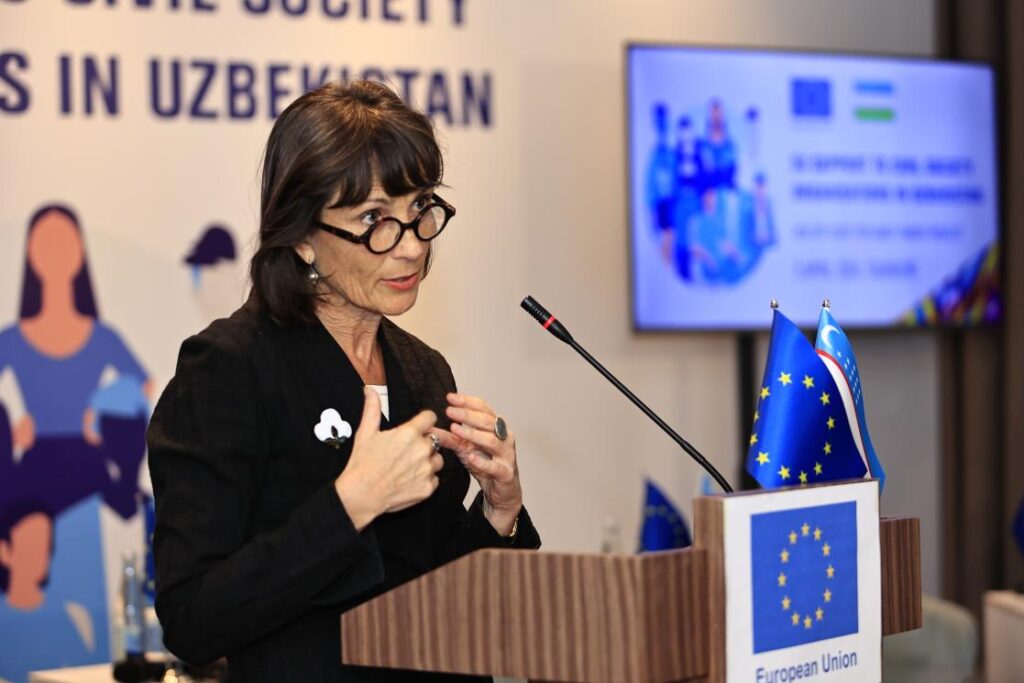
The European Union Delegation to Uzbekistan has announced a new wave of project grants. Aimed at empowering civil society in Uzbekistan, particularly women and marginalized groups, funds of over EUR 3.5 million will be allocated to the development of eight initiatives.

In her report on April 3rd, Charlotte Adriaen, EU Ambassador to Uzbekistan, stated: “Today’s EU-funded project launch is just a glimpse into our ongoing commitment to bolster civil society organizations in Uzbekistan. Our yearly efforts are dedicated to empowering these vital entities, fostering inclusivity, vibrancy, and democracy. Prioritizing projects for women, children, and marginalized groups, we amplify voices, promote inclusive development, and drive or support Uzbekistan’s reform agenda. Together with civil society and state partners, we contribute to the pluralism and inclusivity crucial for a thriving democracy and a peaceful society.”

Scheduled to operate from 2024 to 2026, the projects will focus on enhancing work undertaken by organizations concerning inclusion, gender equality and gender-responsiveness, and advances in the Green Agenda.

Tungsten Production in Almaty

Kazakhstan’s Minister of Industry and Construction Kanat Sharlapaev met representatives from Jiaxing International Resources Investment LTD on April 3rd to discuss progress on the extraction of tungsten at Bugutinskoe in the Almaty region.

The new mine and processing plant, scheduled for completion by the end of 2024, are expected to create 1,000 jobs.

The project involves the extraction and processing of 3.3 million tons of tungsten ores to produce a 65% tungsten concentrate. A feasibility study is also being conducted for the construction of a deep-processing complex, which will process a further 65% tungsten concentrate into 88.5% ammonium paratungstate and high-purity tungsten carbide.

Towards a New Tashkent

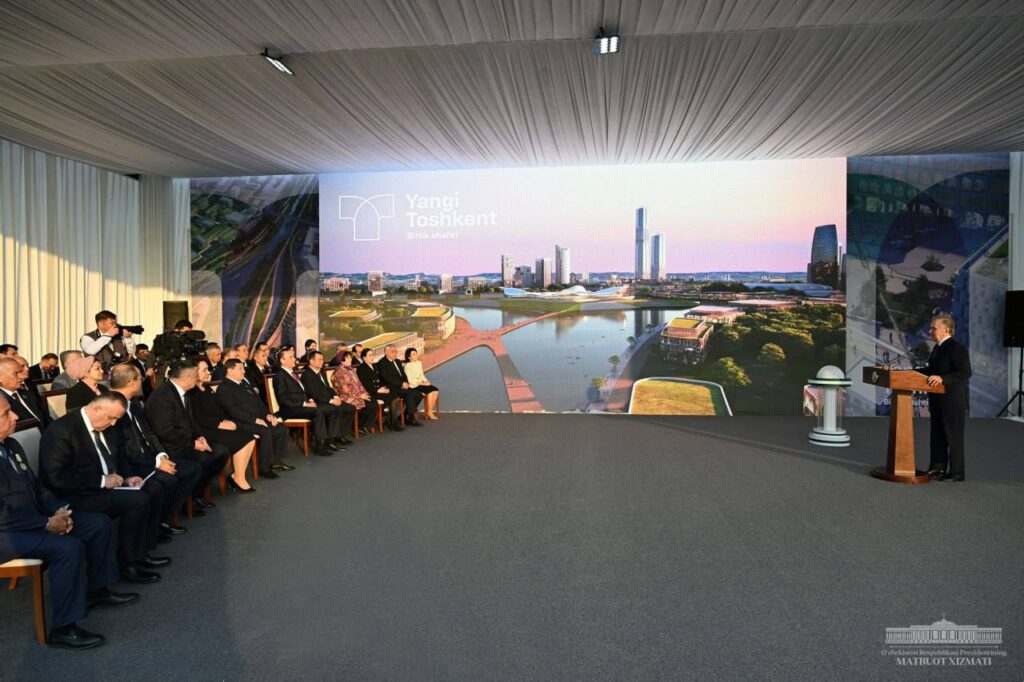
On April 3rd, Uzbekistan President Shavkat Mirziyoyev attended a ceremony to celebrate the start of construction of New Tashkent; a twin capital located on 20,000 hectares east of the existing city of Tashkent, between the Chirchiq and Karasu rivers.

Speaking at the launch, President Mirziyoyev emphasized the historical significance of the ground-breaking project and its far-reaching impact on the future of Uzbekistan: “Today we are laying the foundation for the campuses of Yangi Uzbekistan University and Tashkent State Pedagogical University, the National Library, the National Theater, the International Research Center, the Museum of Literature, and the Alisher Navoi School of Creativity. It is no coincidence that the construction of a new city begins with the abodes of knowledge and spirituality. They will become the basis and model in the formation of an enlightened society.”

The new city’s campus of Tashkent State Pedagogical University will provide teaching facilities for 20 thousand students, dormitories for 5 thousand, a kindergarten for 300 children, and a school for 616 pupils. It will also include a sports centre, a palace of culture, and an amphitheatre.

Yangi Uzbekistan University, rated as one of the most prestigious universities in the country for engineering, management, information technology, agricultural technology, humanities, and natural sciences, will be complemented by a second campus in New Tashkent. Once in operation, the new facilities will accommodate 10 thousand students, a library, sports complex, and an Olympic-sized swimming pool.

Ambitious plans for the second city also include a new National Library of Uzbekistan with the capacity to house over 10 million books and accommodate over 1,400 users at any given time.

Concluding his speech, the president underlined his belief that New Tashkent was set to become a centre for excellence in science, education, and culture not only for Uzbekistan but also for the entire region.

It was earlier reported that master plans for New Tashkent had been developed by the UK’s Cross Works design company.

Kazakhstan’s President Addresses Regional Threats

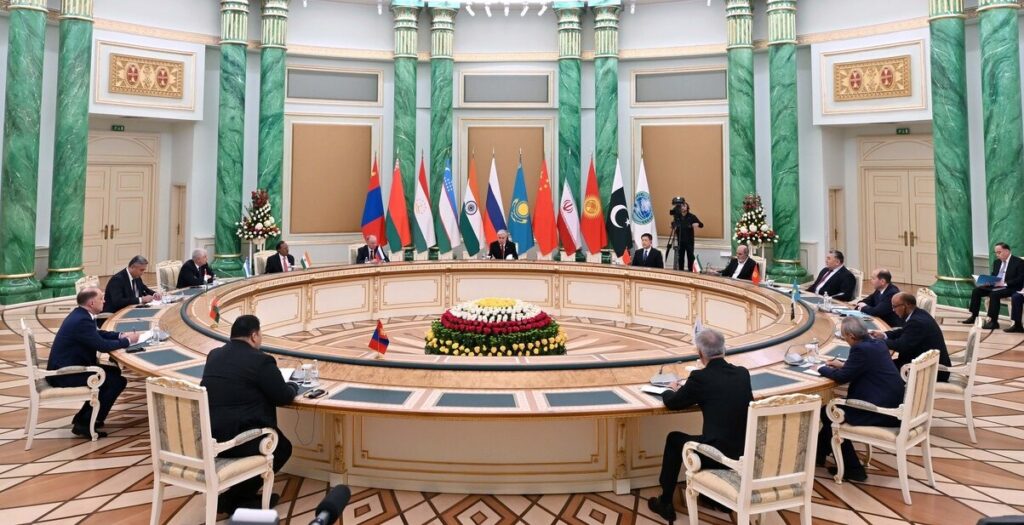
In preparation for the Shanghai Cooperation Organization (SCO) summit in Astana later this year, Kazakh President Kassym-Jomart Tokayev met with security council secretaries of SCO member states: China, Russia, India, Kyrgyzstan, Tajikistan, Pakistan, Iran, Uzbekistan, and Kazakhstan.

In his speech on April 3rd, the president began by reiterating the fact that the Shanghai Cooperation Organization had been created to ensure stability and security in the region by curbing the ‘three forces of evil’: terrorism, separatism, and extremism: “These threats – are being transformed, acquiring new severity. We, in turn, need more systematic and decisive responses. We must not allow manifestations of terrorism, extremism, and separatism to be used to undermine internal stability in our states. Countering the ‘three forces of evil,’ as well as transnational organized crime, drug trafficking and cybersecurity challenges, is one of the priorities of Kazakhstan’s chairmanship in the SCO.”

He continued by stating the need for an SCO Cooperation Program to counter terrorism, separatism, and extremism for 2025-2027, and the adoption of the SCO Anti-Drug Strategy for 2024-2029.

Turning to the situation in Afghanistan, the Kazakh president advised that SCO members paid due attention to developments to prevent the use of its territory by international terrorist groups. He also stressed the importance of continued efforts to alleviate the country’s humanitarian crisis and create conditions for its long-term stabilization.

Emphasis was also placed on conflict in the Middle East which remains a serious factor in undermining security: “Its tragic consequences were felt by civilians. Irreparable damage has been caused to regional stability. High-level diplomacy is needed to prevent further escalation. I firmly believe that our organization, representing half the world’s population, can offer a formula for a safe and just world.”

Marginalized But Indispensable – What the Crocus City Hall Attack Means for Central Asian Migrants

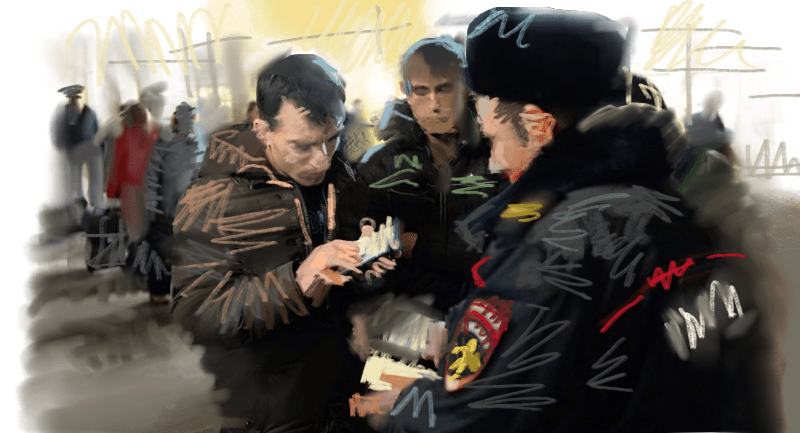
As previously reported by TCA, in the wake of the terrorist attack on the Crocus City Hall on the outskirts of Moscow which left 144 dead and 551 injured, Central Asian migrants in Russia have been living in a climate of fear. “There is panic, many people want to leave [Russia],” Shakhnoza Nodiri from the Ministry of Labor of Tajikistan said of the outflow of labor migrants. “We are now monitoring the situation; we have more people coming [to Tajikistan] than leaving.”

One of the most remittance-based economies in the world, in 2023 official figures released by the Ministry of Labor, Migration and Employment of Tajikistan – often underestimated – stated that 652,014 people left the country to work abroad, largely to Russia. According to the World Bank, in 2022 remittances made by migrants accounted for 51% of the country’s GDP.

As anticipated, despite the U.S specifically warning the Russian authorities that the Crocus City Hall was a potential target, whilst seeking to lay the blame for the attack on Ukraine, the Russian Government is intensifying its control over migrants. On April 1, a Ministry of Internal Affairs’ spokesperson announced that the regulations will include mandatory fingerprinting and photographing of all foreigners upon entry into Russia, a reduction in the legal duration of stay from 180 days to 90 days, and the registration of migrants and their employers. In addition, whereas in the past a migrant could only be deported following a court’s decision, this will no longer be the case.

Against this backdrop, on April 3, the Davis Center at Harvard University hosted a seminar entitled, “The Crocus City Hall Terror Attack and Its Repercussions for Central Asians and Central Asia.”

Opening the discussion, Yan Matusevich, a Ph.D. Candidate in Cultural Anthropology at the Graduate Center of the City University of New York, highlighted the fact that the “migration system has been in place for a very long time [and] the Central Asian migrant community in Russia has lived through crisis after crisis. But there are not a lot of alternatives out there,” he started, “so it’s really hard to disentangle oneself from that. It’s been difficult for migrants for a long time, but they also know how to navigate the system, as violent and oppressive as it is.

“Migrants are also under a lot of pressure to join the war effort, because a lot of Russians have left fleeing mobilization. Migrants are very resilient, though, and paradoxically, because there is such a major labor deficit in Russia, there are a lot of employment opportunities. Bringing in brigades of migrants in uniforms who are completely segregated and work in slave-like conditions would be the Russian ideal, but the problem is the reality doesn’t match up given the dependence on migratory labor.”

Malika Bahovadinova, a Post-Doctoral Fellow at the University of Amsterdam, addressed the “ambiguity” migrants face over whether their “status is legal or illegal.” Criminalization of migration laws has been a trend since 2013, she argued, with increased tracking of foreign citizens. “Tajiks are the most marginalized group in Russia; it’s hard to be documented in Russia,” she stated. “For migrants from Uzbekistan and Tajikistan, this involves a very complex procedure of trying to pay on time every month and tackling your registration… Stickers have appeared around Moscow which read ‘Bring our husbands home and kick the Tajiks out.’ [With] increased racial profiling, deportations and detentions, one of my respondents is thinking about dying his hair blonde in order to be able to blend a little bit in the crowd. Most migrants have a strategy of waiting it out, though, thinking everything will be okay in three months.”

Focusing on Russia’s “unreliable narrative,” Noah Tucker, a Senior Research Consultant at the Oxus Society and Program Associate of the Central Asia Program at George Washington University, noted that Russia has been pushing the idea that “ISIS was created by the CIA for over a decade and acts as a cut-out, especially to Central Asian audiences. ISIS K itself makes the same claim about the Taliban, who it says are a CIA cut-out and are controlled by the Americans. So, everybody is politicizing these things to fit their own preconceived narratives.

“The last major attack inside Russia was the 2017 metro bombing. [In a] strategy of authoritarian cooperation… that was also blamed on Central Asian migrants, and the security services arrested two Uzbek brothers and sent them to jail as the direct orchestrators of the attack – only the facts never added up… One of the brothers, who was charged as being the mastermind, was lying in a hospital in Osh during the attack, and was allegedly extradited to Russia only to be arrested in a made for TV event a few weeks later.

“ISIS K have not really made any particular effort to recruit Central Asians other than to come and join their civil war inside Afghanistan, [because none of their goals] has any relevance for Central Asians migrants.”

Noting that the atrocity spoke to “extreme negligence in not preventing this attack or willful neglect in allowing it to happen,” Edward Lemon, President and CEO of the Oxus Society, stated that Tajikistan and Russia have “very close cooperation [and] perhaps that cooperation will extend to drafting a narrative [of benefit to both regimes].” Lemon characterized the Russian account of the attack as an attempt to “drive a wedge between Central Asian States and further cooperation with NATO that also allows them to sidestep sanctions.”

“There’s a utility to pushing the narrative in this direction regardless of the facts,” Tucker concluded. “The narrative that emerges is going to make it much easier to squeeze Central Asian migrants into agreeing to be mobilized into the conflict in Ukraine, whether that’s as workers digging trenches and going out under artillery fire to retrieve bodies and dig fortifications, or as active fighters in the Russian military. Russia is going to become increasingly squeezed over the next year by a lack of human capital. There simply aren’t enough Russian citizens left to continue to staff the army.”