• KGS/USD = 0.01144 0%
  • KZT/USD = 0.00213 0%
  • TJS/USD = 0.10456 0.19%
  • UZS/USD = 0.00008 0%
  • TMT/USD = 0.28490 0%
  • KGS/USD = 0.01144 0%
  • KZT/USD = 0.00213 0%
  • TJS/USD = 0.10456 0.19%
  • UZS/USD = 0.00008 0%
  • TMT/USD = 0.28490 0%
  • KGS/USD = 0.01144 0%
  • KZT/USD = 0.00213 0%
  • TJS/USD = 0.10456 0.19%
  • UZS/USD = 0.00008 0%
  • TMT/USD = 0.28490 0%
  • KGS/USD = 0.01144 0%
  • KZT/USD = 0.00213 0%
  • TJS/USD = 0.10456 0.19%
  • UZS/USD = 0.00008 0%
  • TMT/USD = 0.28490 0%
  • KGS/USD = 0.01144 0%
  • KZT/USD = 0.00213 0%
  • TJS/USD = 0.10456 0.19%
  • UZS/USD = 0.00008 0%
  • TMT/USD = 0.28490 0%
  • KGS/USD = 0.01144 0%
  • KZT/USD = 0.00213 0%
  • TJS/USD = 0.10456 0.19%
  • UZS/USD = 0.00008 0%
  • TMT/USD = 0.28490 0%
  • KGS/USD = 0.01144 0%
  • KZT/USD = 0.00213 0%
  • TJS/USD = 0.10456 0.19%
  • UZS/USD = 0.00008 0%
  • TMT/USD = 0.28490 0%
  • KGS/USD = 0.01144 0%
  • KZT/USD = 0.00213 0%
  • TJS/USD = 0.10456 0.19%
  • UZS/USD = 0.00008 0%
  • TMT/USD = 0.28490 0%

Kazakhstan to Increase Use of Groundwater for Irrigation

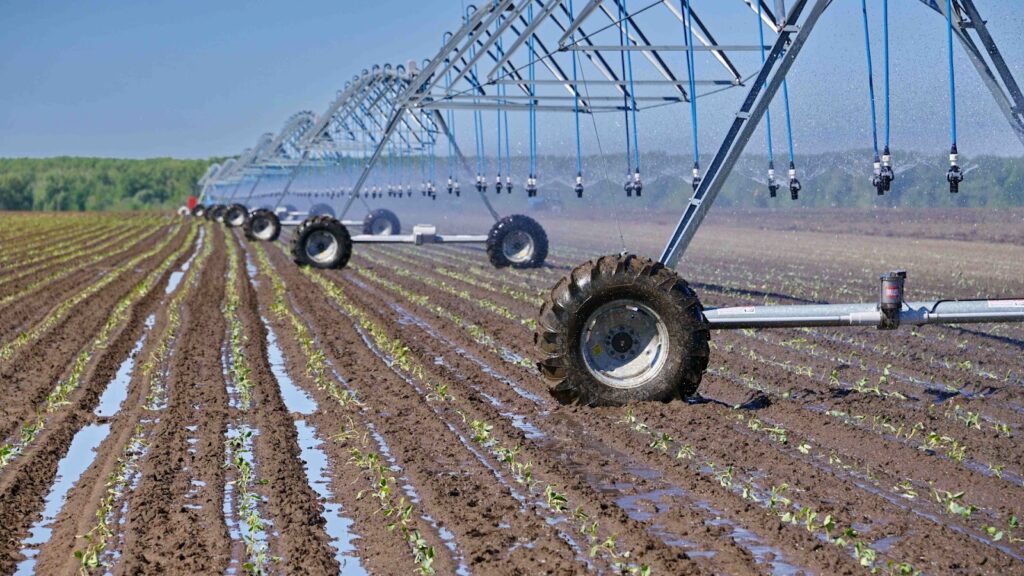
On 27th February, Kazakhstan’s Ministry of Water Resources and Irrigation announced plans to increase the volume of groundwater used for agricultural irrigation by tapping into local reserves.

The country and especially its dry southern and eastern regions, has long been dependent on water from its upstream neighbors, Kyrgyzstan and China.
Kazakhstan’s groundwater reserves exceed 43,000 tons per day, 19,000 tons of which could effectively be used in irrigation.

Agriculture currently uses more than 40 thousand tons, equivalent to 60%, of water collected per day. Of this, groundwater makes up just 1.2%. Under the first stage, this is due to increase to 10-15%, initially from reserves in Almaty, Pavlodar, East Kazakhstan, and Zhambyl.

In 2023, of the 1.8 million hectares of irrigated land in Kazakhstan, water-saving technologies were employed on as little as 17% (312,000 hectares), with drip irrigation used on only 84,000 hectares.

As an added incentive to implement the expansion of areas of irrigated land through a greater use of groundwater and water-saving technologies, the state will introduce subsidies and reduced tariffs for users.

Turkmenistan Hosts Business Delegation from Afghanistan

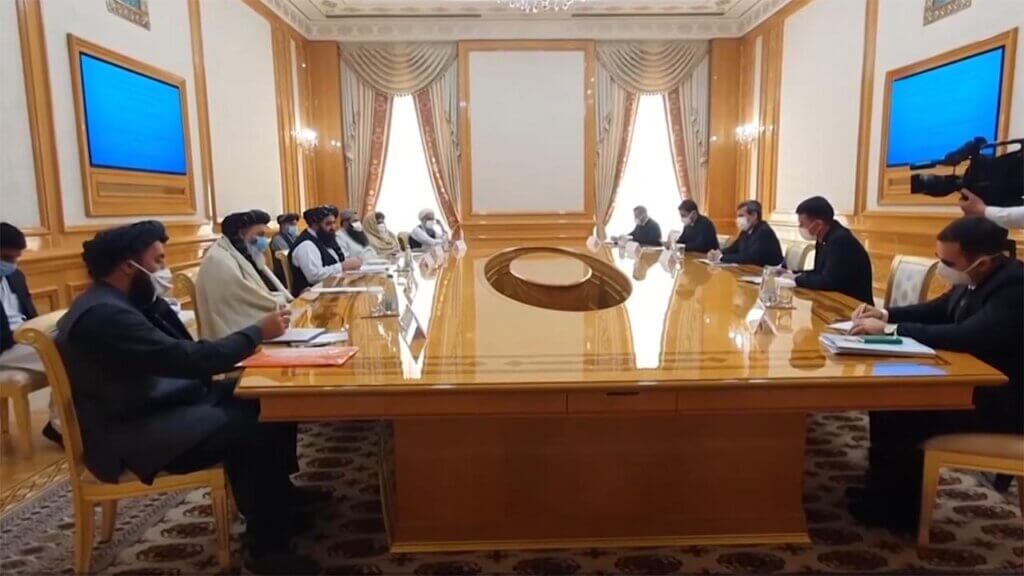
On February 25th a group of businessmen from Afghanistan arrived in Turkmenistan to discuss investment opportunities in Afghanistan, and to shore up the two countries’ commercial and diplomatic connections.

Led by the acting Afghan foreign minister Amirkhan Muttaki. the group included members of the Afghanistan Railways Authority, the acting minister of mines and petroleum, and representatives of the national energy company.

This visit was not publicized by Turkmenistan’s Ministry of Foreign Affairs. The ministry did however report on a February 23rd meeting between the deputy minister of foreign affairs of Turkmenistan, Ahmad Gurbanov, and the special representative of the Chinese foreign ministry for Afghanistan, Yue Xiaoyun, in Ashgabat.

Labor Migration – Making Money At Any Cost

The number of labor migrants from Tajikistan continues to grow steadily, officially reaching the highest figure seen in the last decade. According to the Ministry of Labor, Migration and Employment, in 2023, 652,014 people left the country to work abroad.

Despite the fact that the Government of Tajikistan claims the poverty level in the country has decreased (the poverty threshold is not specified), in reality a huge swathe of the male population is working abroad in an attempt to feed their families. Up to 40% of households in Tajikistan have at least one member working abroad.

Remittances from migrants therefore account for a significant part of the country’s GDP, but the authorities claim they cannot say exactly how much is sent by migrants because these remittances are funneled through different channels (accounts, banks, cards or through compatriots). However, various international organizations have stated that the figure stands in the realm of billions of dollars. Thus, according to the World Bank-KNOMAD, migrants’ remittances to Tajikistan in 2022 amounted to 5.346 billion dollars (39.6% of the country’s GDP). This makes Tajikistan one of the most remittance-based economies in the world, which serves as both a boon and a curse for the authorities, for whilst this mass migration removes those often viewed as unemployed malcontents, it’s also a source of embarrassment.

Against the background of military conflict, the number of Tajik workers in Russia has slightly decreased, from 775,000 in 2022 to just over 652,000 in 2023, according to the Minister of Labor, Migration and Employment, Gulnora Hasanzoda. However, official statistics from the Russian migration services, number citizens of Tajikistan who are labor migrants in Russia at 1.5 million, whilst several hundred thousand more have obtained Russian citizenship.

Renowned for being humiliated and extorted by border guards, these ex-pats are easy targets for the Russian police and are the subject of attacks by Neo-fascist groups. Often living in dormitory blocks overseen by gang-masters on the plains of Siberia, many die on the job, but they couldn’t survive back home. The poorest of the post-Soviet Republics, in September 2020, the World Food Program estimated that 47% of people in Tajikistan live on less than $1.33 a day, whilst an estimated 30% suffer from malnutrition.

A relatively new trend of leaving the country to work abroad has also been observed in Turkmenistan, where those serving in the police and in military units rank among the highest in terms of expats. Though salaries in these professions are considered quite high by Turkmen standards – police officers receive $142-157 and servicemen $160-185 a month, it is possible to earn several times more on a construction site, as a waiter or a cab driver in Russia. Thus, in April 2023 alone, around 200 officers from the Department of Internal Affairs of the Dashoguz Province of Turkmenistan submitted their resignations with the aim of going to work in Russia.
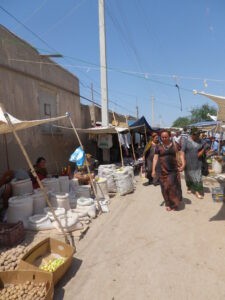
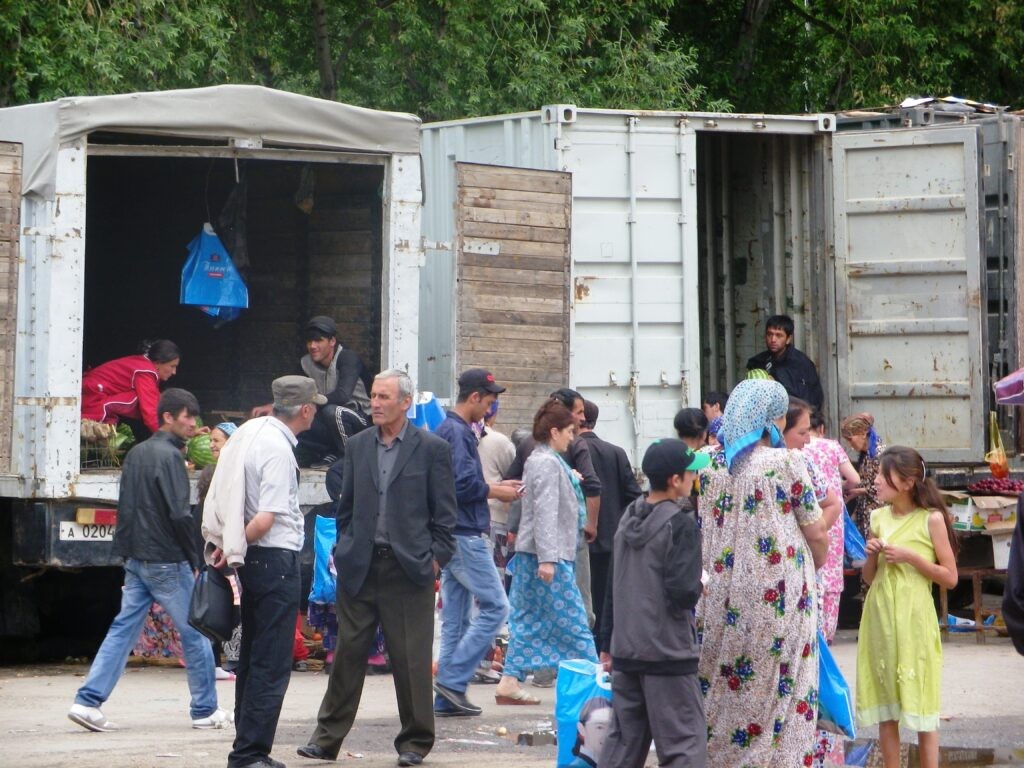
Konye-Urgench Bazaar, Dashoguz Province, Turkmenistan. Photo: TCA.

Against the background of aggravated labor migration, the authorities of Turkmenistan continue to do everything possible to hinder it: the issuance of foreign passports is a deliberately laborious process and a stringent visa regime is actively maintained. In 2022, the authorities requested that Turkey cancel a visa-free regime for its citizens, with the visa now costing a princely $250. In addition, those wishing to travel abroad have to pass an interview with the Ministry of National Security, who, since March 2023, oblige citizens to have a letter of guarantee they will return home signed by a close relative.  The final stage – buying a ticket – also involves a number of hurdles, including massive queues at ticket offices, corruption, and inflated ticket prices. Even after boarding the plane, a traveler cannot be sure that he or she will not be ejected from the flight without explanation.

Those who do manage to leave Turkmenistan in search of earnings often end up doing hard physical labor and living in unsatisfactory conditions. Most migrants are forced to work illegally, meaning they have no medical insurance and no rights in cases of accidents or disputes with employers.

Kazakhstan Exported a Million Tons of Goods to China Last Month

In January 2024 Kazakhstan sent over a million tons of cargo to China by rail, Kazakhstan’s nation rail company Kazakhstan Temir Zholy has reported. This is an increase of 43% compared to the volume recorded for January last year.

The supply of iron ore to its eastern neighbor has increased by 19%, grain supplies have gone up by 37%, and export of ferrous and non-ferrous metals has more than doubled.

Demand for passenger transport by rail is also growing in Kazakhstan. Last month 1.8m train journeys were made in Kazakhstan, a growth of 6.6% compared to January 2023.

Uzbekistan: Disabled Citizens Still Face Host of Challenges

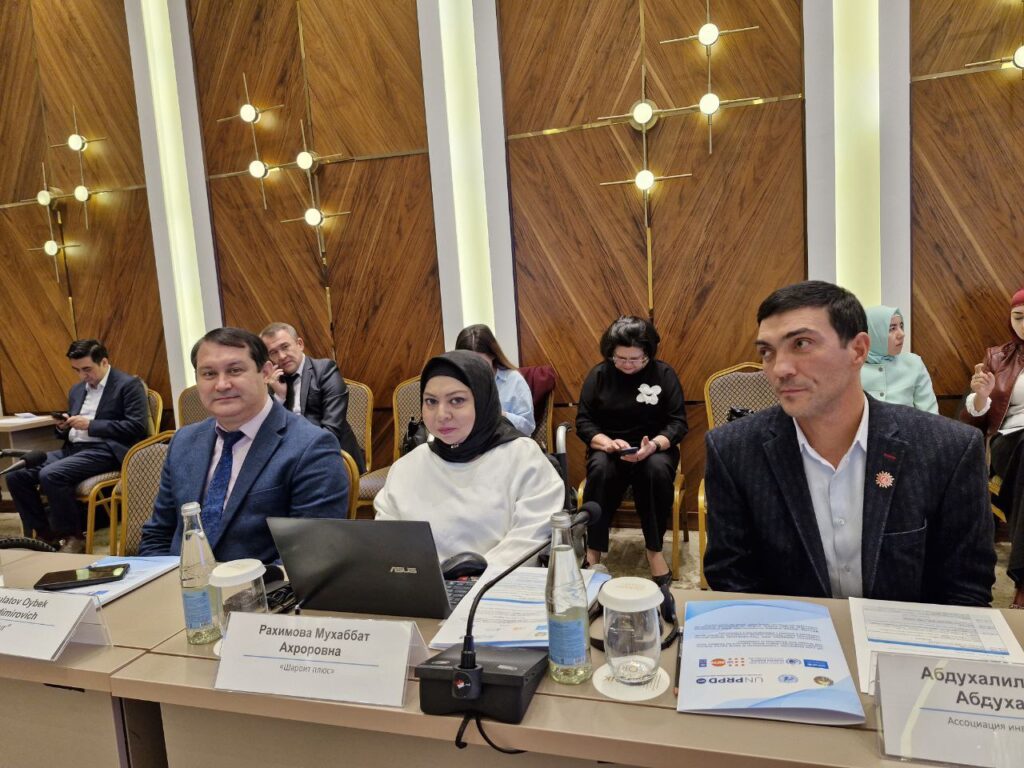
The Times of Central Asia spoke with Muhabbat Rakhimova, head of the Uzbek public association for disabled people, Sharoit Plus. We discussed the current situation with disability rights in Uzbekistan, and the country’s entry to the international arena of advocates.

TCA: In your opinion, what is the state of the educational system for people with disabilities in Uzbekistan, today?

MR: In order to develop inclusive education, it is first necessary to make the infrastructure of buildings and educational equipment comfortable, to develop sufficient textbooks, and to provide educational materials that account for the possibility of persons with disabilities. Also, most of our schools were built a long time ago, the buildings have three to four floors, and they do not have elevators. In this case, not all people with disabilities have the opportunity to go and study.

TCA: This month in Tashkent, USAID launched its five-year project called All Children Succeed. The project will be implemented as a pilot program in the regions of Namangan and Syr Darya, and hopes to make school education, teaching materials and teacher qualifications inclusive. Do you think schools in Uzbekistan are accessible for everyone?

MR: According to the next reforms, construction of structures will be allowed only if the buildings are wheelchair accessible, but in many cases, we notice that ramps are inconveniently located. For example, on ramps near the wall, it is not possible to turn backwards or forwards in a wheelchair. In ordinary stores and pharmacies, it is difficult to climb due to the steepness of the ramp; even with the help of two or three people, it’s impossible to climb them. But the presence of a ramp does not mean the infrastructure of the building fully meets the requirements of disabled people. The interior of buildings, rooms, toilets should also be adjusted. In order for persons with disabilities to study and work effectively, it’s necessary to adapt the infrastructure of the buildings.

TCA: What joint projects are currently being implemented in Central Asia to support disabled people?

MR: Central Asian countries don’t have joint projects on persons with disabilities. The Eurasia Foundation of Central Asia organizes educational seminars on this [topic] and invites organizations of the countries of the region dealing with disability issues to them. I think that this is actually a form of cooperation.

In your opinion, are there any advanced international practices that can be implemented in Uzbekistan to help disabled people?

MR: There is a system of independent living centers in the Philippines and Thailand, where a person with a disability learns independent living skills for five to six months. As a result, after returning home this person can live without the support of family members, can live separately from them is they so choose. In order for Uzbekistan to have the opportunity to create this, first of all, we need the desire. For this to happen, the active participation of people with disabilities is a necessity.

Global Firepower Index: Kazakhstan is Central Asia’s Strongest Army; Tajikistan its Weakest

The military index Global Firepower has announced its Military Strength Ranking for 2024. The annual ranking evaluates 145 countries according to 60 criteria, including resources, financial stability, and logistics capabilities.

Kazakhstan has once again been revealed as the strongest army in Central Asia, in 58th place overall. Uzbekistan has fallen by three places since last year’s rankings — the only country in the region not to show an improvement — and is now in 65th position. In the bottom half of the table, Turkmenistan lies in 83rd place, while Kyrgyzstan is in 100th. Global Firepower puts Tajikistan in 107th place, making it the region’s weakest army.

The difference between Kazakhstan and Tajikistan’s military strength is apparent in the countries’ respective defense budgets. The Kazakh army has $7.5bn at its disposal, while Tajikistan’s defense budget is only $96.2m.

The world’s three strongest armies according to the Military Strength Rankings are the United States, Russia and China, with no change from their positions in 2023.