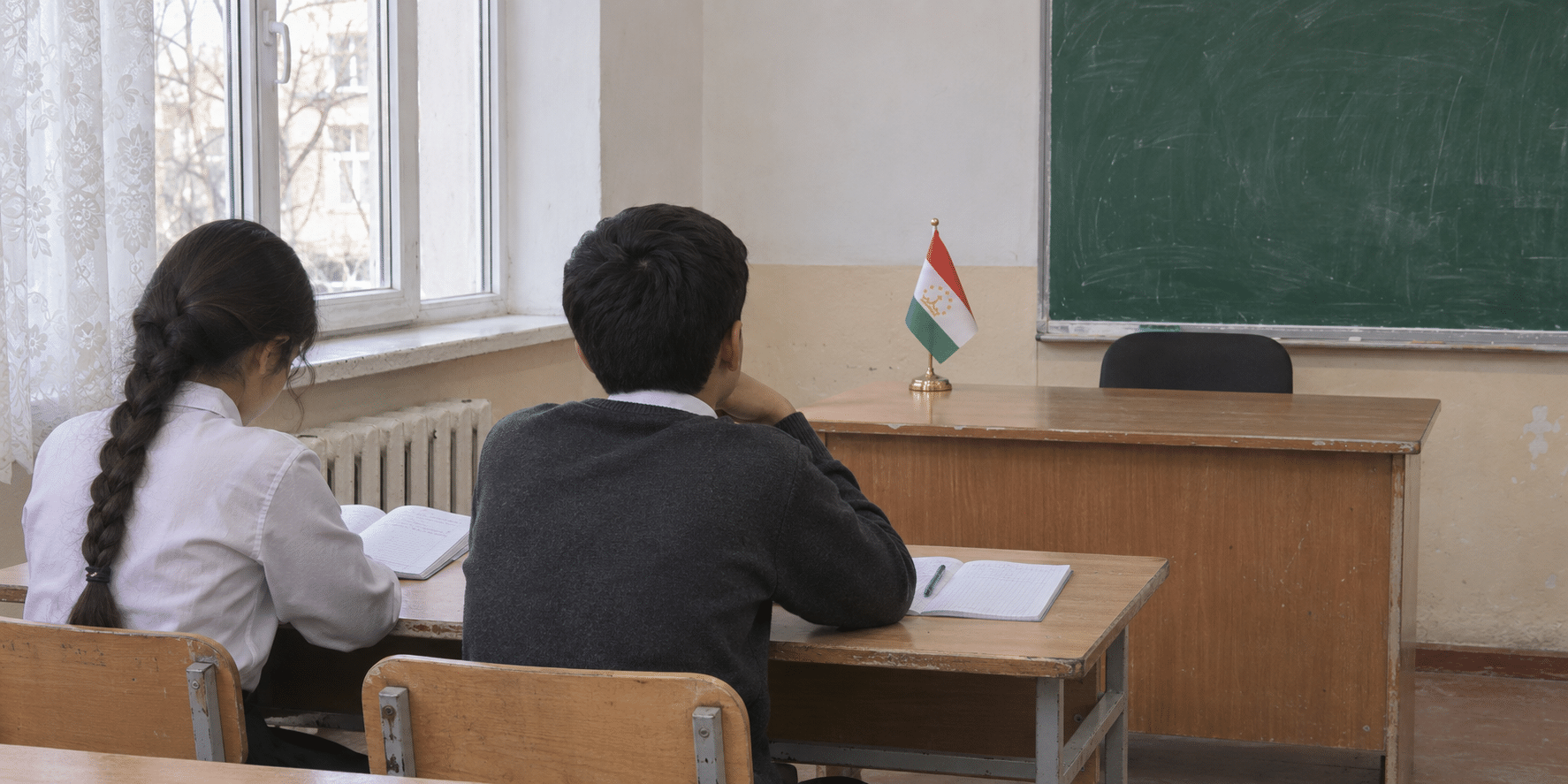
In February 2026, parents at School No. 54 in Dushanbe told Asia-Plus that upper-grade classes taught in Russian had no mathematics teacher. One parent described a day when only two of five scheduled lessons took place. Less than two weeks earlier, Deputy Education Minister Ravshan Karimzoda had declared Tajikistan’s teacher shortage over.
Between September 2025 and September 2026, the authorities raised teachers’ base salaries by a combined 62.5%. Despite a national recruitment drive, schools still reported shortages in key subjects. Dushanbe took part in the Programme for International Student Assessment (PISA) for the first time in 2025. In each subject tested, most of the capital’s 15-year-olds fell short of basic proficiency.
More Teachers, but Shortages Remain in Key Subjects
School and kindergarten employees received a 30% increase in base pay in September 2025. President Emomali Rahmon had announced the raise in December 2024 and formalized it by decree the following February. In December 2025, he announced a further 25% increase for the following September and signed the presidential decree in January 2026.
Before the first increase, teachers earned approximately $130 to $185 a month. Under the new pay scale, base salaries for upper-grade teachers ranged from $135 to $210 a month, excluding additional payments. In July 2026, the average monthly salary across the education sector was about $406, compared with a national average of $381.
The authorities hoped higher pay would help retain qualified teachers. In July 2025, Tajikistan’s Ministry of Education and Science said local education authorities had requested 3,848 teachers for the coming school year, before teaching hours had been assigned. At a briefing on January 30, 2026, the ministry said schools had hired 9,178 teachers during the 2025–26 school year. About 1,900 university students training as teachers had begun teaching before graduation.
Official figures put the number of teachers employed in the country’s schools at 136,116. About 700 taught outside their specialties. Colleagues covered the classes of 16,000 teachers on maternity or parental leave. Schools still report shortages of teachers of mathematics, physics, chemistry, and foreign languages. In rural areas, teachers of Russian and English are particularly hard to recruit.
PISA Reveals Weak Student Performance
In September 2026, the Organisation for Economic Co-operation and Development (OECD) published Dushanbe’s PISA results. The assessment covered 5,771 students from 160 schools in the capital. It did not measure student performance in Tajikistan’s rural areas.
Dushanbe ranked 89th among the 90 education systems with comparable science scores. Its average science score was 334 points, compared with 482 across OECD countries. In reading, students scored 368 points against an OECD average of 461, while in mathematics they scored 382 against 463.
Only 12% of students reached baseline proficiency in science, compared with an OECD average of 74%. The remaining 88% struggled with tasks requiring basic scientific understanding. In reading, 19% reached the minimum level, against 69% across OECD countries. In mathematics, 24% met the benchmark, compared with 65%. Almost none of the capital’s students reached the highest proficiency levels.
About 40% of students said they had skipped at least one day of school in the two weeks before the assessment. Principals at schools attended by 32% of the students surveyed said a shortage of teachers had hindered instruction to some extent.
Why Teaching Struggles to Compete on Pay
An October labor market report by the Eurasian Fund for Stabilization and Development found that more than one-third of Tajikistan’s wage earners work in the public sector, where salaries are substantially lower than in industry. The fund said the pay gap made careers in teaching and healthcare less attractive.
Russia’s labor market presents another challenge for Tajik schools. World Bank estimates indicate that even relatively low-skilled jobs in Russia can pay at least three times as much as comparable work in Tajikistan. For young professionals choosing between teaching at home and working abroad, the difference in pay can be decisive.
Neighboring Kyrgyzstan raised base pay for education workers by 60% in April 2026. Officials projected that monthly pay in the sector would average about $580.
Pay is only one challenge facing Tajikistan’s schools. During unannounced inspections in 2025, Education Minister Rahim Saidzoda found that some schools had failed to follow their timetables or had combined classes in violation of regulations. Attendance was poor, and some students struggled to answer basic questions in Russian and English. Several school administrators were dismissed after the inspections.