Five years of Taliban rule have shown that international relations with an unrecognized government can go much further than many imagined after the fall of Kabul in August 2021. Russia remains the only country to have formally recognized Afghanistan’s current authorities, yet the complete isolation some expected has not materialized.
Afghanistan receives foreign diplomats and participates in regional talks, while neighboring states pursue trade and infrastructure projects with Kabul. Over the past five years, the Taliban have signed mining agreements worth billions of dollars, including projects involving Chinese and Iranian capital.
This diplomatic arrangement has become possible because international approaches toward Afghanistan have diverged. Restrictions on the rights of women and girls continue to block broader international legitimization of the Taliban. In August, the UN described the situation facing Afghan women as the world’s most severe women’s rights crisis. At the same time, neighboring states have practical issues to address involving trade, security, water, energy, and transportation.
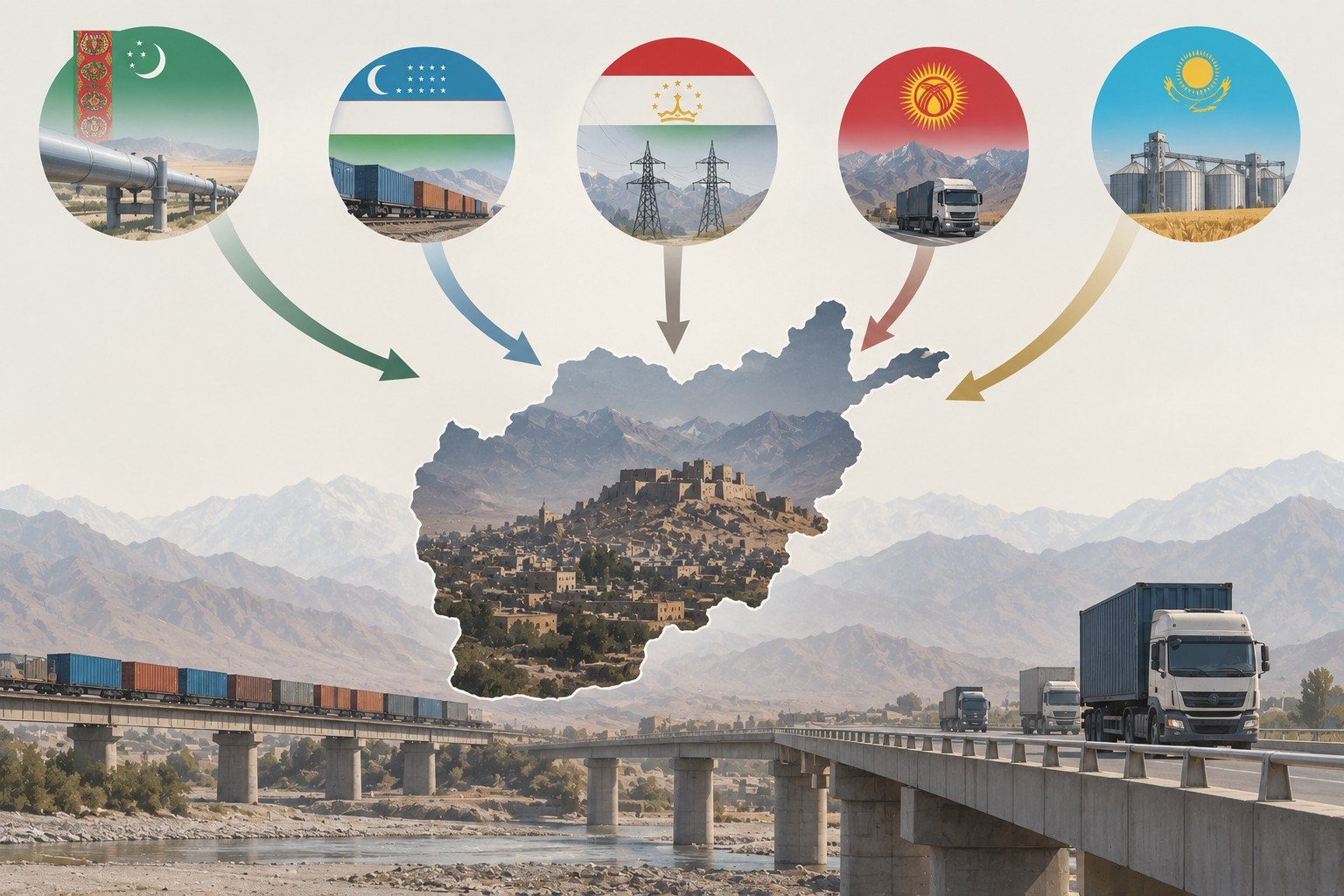
Central Asia has gone particularly far in developing practical engagement. Afghanistan is gradually being integrated into regional economic ties without any formal change in its international status.
Engagement Without Recognition
On April 5, 2026, Kabul hosted the first dedicated Central Asia-Afghanistan Consultative Dialogue, attended by representatives of all five Central Asian states. The participants discussed economic ties and regional connectivity. The format itself was presented as a multilateral political mechanism for regular engagement between Afghanistan and Central Asia.
This is already more than a collection of separate contacts with Kabul. The region is gradually developing its own model for dealing with the Taliban, driven by issues that cannot simply be left unresolved.
Trade and transportation continue regardless of diplomatic status. In the first quarter of 2026 alone, rail freight between Kazakhstan and Afghanistan reached 1 million tons, up 77% year over year. Tajikistan, which long maintained the toughest stance toward the Taliban among Afghanistan’s Central Asian neighbors, has also expanded working contacts with Kabul, although border security remains a serious concern. Tajik officials say five Chinese citizens were killed in two attacks launched from Afghan territory in late 2025, while Dushanbe has long warned about militant groups operating in Afghanistan, including Islamic State Khorasan Province (ISKP).
So far, this model has allowed political recognition to remain separate from practical cooperation. But the region is gradually moving beyond trade and diplomatic contacts toward proposed infrastructure projects with multibillion-dollar price tags.
From Trade to Long-Term Bets
Afghanistan’s economy is growing, but it remains too weak to finance major infrastructure projects on its own. The World Bank estimated real GDP growth at 4.8% in 2025, but the return of around 3.7 million Afghans and rapid population growth contributed to a 5.6% decline in GDP per capita. Investment remains weak, while businesses have limited access to financing.
The financial system also maintains connections with the outside world through narrow channels. The World Bank has noted limited correspondent banking relationships, a lack of direct access to accounts in the United States, and the significant role of the informal hawala payment system.
Against this backdrop, the scale of proposed projects is growing.
Uzbekistan, Afghanistan, and Pakistan are preparing the Trans-Afghan Railway, which would provide access to Pakistani ports. In February 2026, Tashkent completed its internal procedures for an agreement on preparing the project’s feasibility study. By June, its preliminary cost estimate had risen to more than $7 billion, with talks on potential participation also involving investors from the United Arab Emirates and Qatar. The project nevertheless remains at the feasibility-study stage, with financing yet to be secured. The route would also have to cross difficult Afghan terrain, while strained relations between Kabul and Islamabad could further complicate the project.
Meanwhile Kazakhstan has agreed with Kabul to explore construction of the separate Torghundi-Herat railway, with a potential extension through Afghanistan toward the Pakistani border. The project is intended to give Kazakhstan a shorter route to ports on the Indian Ocean. The creation of a joint venture involving the railway companies of Kazakhstan, Afghanistan, and Turkmenistan is also under discussion.
In August, the first Afghan leg of the Turkmenistan-Afghanistan-Pakistan-India gas pipeline, known as TAPI, received fresh momentum as construction advanced from Turkmenistan toward Herat. State-owned Afghan Gas and Türkmengaz signed a memorandum on gas purchases under the project, with the price, required volumes, and distribution arrangements still to be determined. In parallel, the two sides agreed to develop infrastructure in Herat Province to supply Turkmen gas to industrial enterprises, power plants, and households. That is a much narrower advance than progress on the full TAPI route: construction has yet to move beyond western Afghanistan, and no timetable has been announced for extending the pipeline to Pakistan and India.
Even at this limited stage, the project illustrates how infrastructure cooperation can create longer-term obligations than ordinary trade. Grain or electricity can be sold to Afghanistan under relatively short-term contracts. A multibillion-dollar railway has to operate for decades.
For an international bank or investor, the issue is no longer simply diplomatic protocol but whether commitments made by Afghanistan’s authorities can be enforced and invested capital protected over decades.
Formal recognition does not in itself resolve these problems. Nor does the absence of recognition make investment impossible. But the larger and longer-term a project becomes, the more important legal certainty becomes.
Functional Recognition
This is where one of the most interesting features of the current relationship with Afghanistan emerges.
Central Asian states do not legally recognize the Islamic Emirate, yet practical cooperation increasingly requires them to treat its institutions as counterparties capable of making and carrying out long-term commitments.
This process can provisionally be described as functional recognition. It does not amount to a diplomatic act or a legal change in the status of the Taliban government. Instead, states are recognizing in practice specific powers exercised by Afghan institutions in areas where cooperation would otherwise be impossible.
The first years after the Taliban’s return demonstrated the resilience of this model in routine trade and official contacts. Now it faces a more demanding test.
All of these projects are designed to operate for years or decades. To implement them, foreign governments, banks, and companies will have to find ways to structure legal relationships with Afghan institutions without waiting for more countries to formally recognize the Islamic Emirate. Afghanistan’s diplomatic uncertainty is therefore becoming a practical constraint on how large projects are structured.