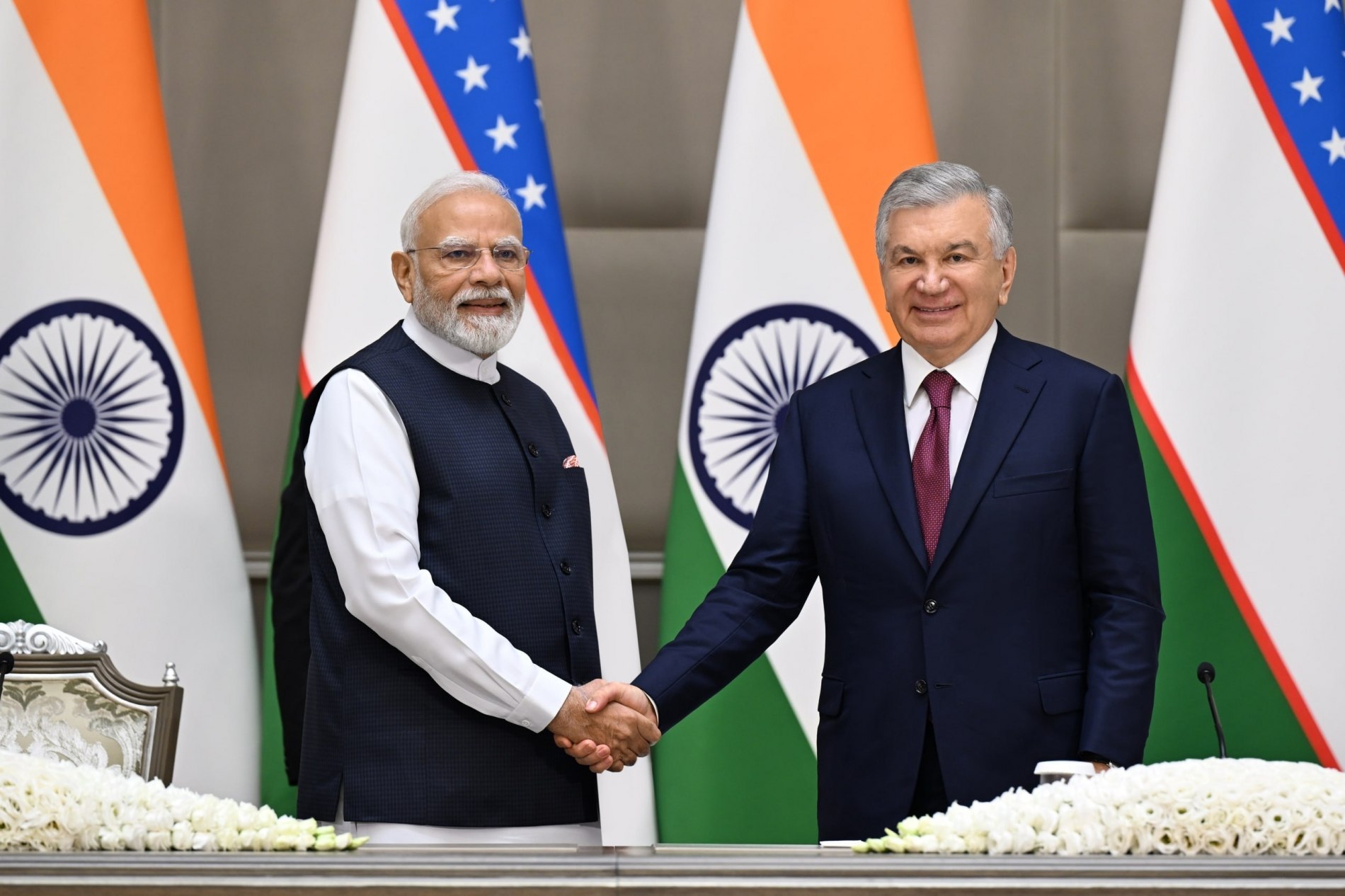
Uzbekistan and India want to increase bilateral trade to $5 billion by 2030 – nearly four times the 2025 level. During talks between Uzbekistan’s president, Shavkat Mirziyoyev, and India’s prime minister, Narendra Modi, in Tashkent, uranium, critical minerals, and industrial cooperation were among the key economic issues. However, trade growth continues to run up against a longstanding problem: there is no direct overland route between India and Central Asia, prompting Tashkent and New Delhi to again look toward transport corridors through Iran.
Modi visited Uzbekistan on August 29-30, his fourth trip to the country. Following the talks, bilateral relations were elevated to a Comprehensive Strategic Partnership. The sides signed a package of documents covering areas including geology and mineral resources, finance, education, tourism, and environmental protection.
A separate outcome was the new bilateral trade target of $5 billion by 2030. In 2025, trade turnover between the two countries reached $1.3 billion for the first time, an increase of 33.3%. Uzbekistan exported $164.6 million worth of goods to India and imported $1.15 billion. To meet the new target, bilateral trade would have to grow almost fourfold.
The imbalance has continued in 2026. In the first half of the year, bilateral trade totaled $598.1 million. Uzbekistan imported $514 million worth of goods from India while exporting $84.2 million. As of the beginning of August, 439 companies involving Indian investors were operating in Uzbekistan.
Mutual Interest in Expanding Ties
Tashkent and New Delhi have already completed a joint study on a possible preferential trade agreement. The two governments now say they have instructed their ministries to consider the next steps toward an agreement.
A significant part of the new agreements concerns natural resources. The memorandum on geology and mineral resources provides for cooperation in the exploration and development of deposits, while critical minerals were specifically included in the leaders’ talks.
India is particularly interested in uranium. Under a contract signed in 2019, Uzbekistan agreed to supply India with 1,100 tons of uranium concentrate.
Following the latest talks, Modi said progress had been made toward a long-term arrangement for uranium supplies from Uzbekistan. No new contract or quantities have yet been announced.
For India, the issue is becoming increasingly important as it expands nuclear power generation. New Delhi has set a target of increasing the country’s nuclear power capacity to 100 GW by 2047, from 8.78 GW today, substantially increasing its demand for nuclear fuel.
Uzbekistan is also interested in Indian investment in critical minerals. Tashkent wants foreign partners to help process raw materials domestically, while India is seeking to diversify supplies of resources needed for electronics, energy, and industry.
Transport Remains the Obstacle
Reaching $5 billion in trade, however, will also require addressing the transport problem. India has no direct overland access to Central Asia, while Uzbekistan is double landlocked. The shortest overland route would run through Pakistan and Afghanistan, but India-Pakistan tensions have long prevented it from becoming a dependable trade corridor. That has pushed the two countries toward alternatives through Iran.
One option runs through Iran’s Chabahar port, where India operates the Shahid Beheshti terminal. From there, cargo can travel across Iran and Turkmenistan to Uzbekistan. New Delhi has long viewed Chabahar as a way to reach Afghanistan and Central Asia while bypassing Pakistan.
Dilorom Mamatkulova, a leading researcher at Uzbekistan’s Institute for Strategic and Regional Studies, told the Dunyo news agency on August 29 that the India-Chabahar-Iran-Turkmenistan-Uzbekistan route could provide a practical foundation for developing transport links. In her assessment, a regular container service with a fixed schedule and a single transport document would make the route more predictable for businesses. She also argued that it could connect with the International North-South Transport Corridor, which links India and Iran with markets further north.
Transport remains the weak point of the new trade target. Uzbekistan and India already have direct air links, commercial ties are growing, and preferential trade is under discussion. But for bulk cargo, the cost and time involved in shipping through several transit countries are likely to matter more than tariffs.