Kyrgyzstan is trying to reduce its dependence on imported gasoline and diesel by refining more fuel at home. The country still relies overwhelmingly on Russia for its motor fuels, but in August it received 35,000 tons of crude through a newly opened transit route across Kazakhstan – more crude in one month than Kyrgyzstan imported during the whole of 2025, when trade data recorded about 26,400 tons.
The oil is believed to be Russian, meaning the shift does not reduce Kyrgyzstan’s dependence on Russian energy itself. Instead, it gives Bishkek another option: importing crude rather than finished fuel and using its own refineries to turn it into gasoline and diesel. That reduces its exposure to disruptions at Russian refineries and could eventually make it easier to bring in crude from other countries.
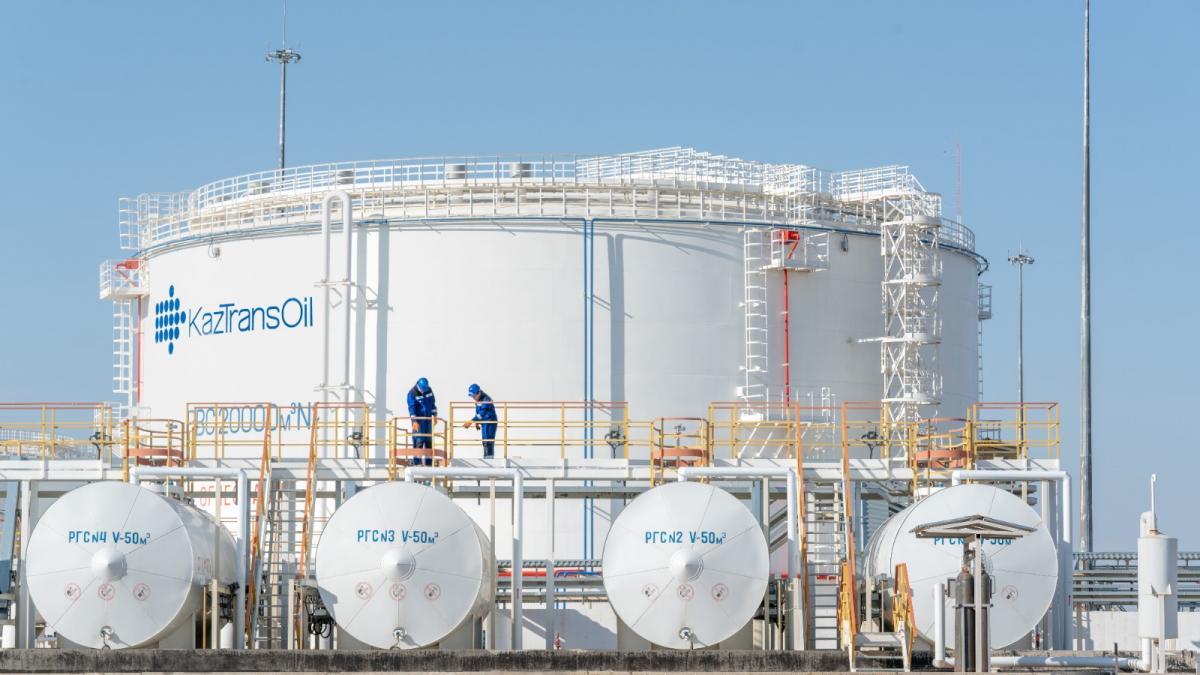
KazTransOil, Kazakhstan’s trunk oil pipeline operator, launched the new route on August 15. The crude is carried by pipeline to the Shagyr loading point in Kazakhstan, then transferred to railway tank cars for the final leg to Kyrgyzstan.
KazTransOil has not disclosed the oil’s origin, but industry publication InfoTEK and Kazakh media identify it as Russian. That would fit with an earlier KazTransOil tariff arrangement for moving Russian crude from the border through Shagyr to Kyrgyzstan, which remained in force until 2023.
Timely Diversification
For Kyrgyzstan, the new route has emerged at a particularly sensitive time. Kyrgyzstan has traditionally sourced around 90-95% of its fuel and lubricants from Russia. For years, this arrangement allowed Bishkek to buy Russian petroleum products without export duties within annually agreed volumes, but it also left the domestic market heavily dependent on conditions at Russian refineries.
In 2026, Ukrainian drone attacks and other disruptions to Russian refineries constrained available supplies of gasoline and diesel. Fuel prices in Kyrgyzstan were rising at the same time.
One way to reduce that risk is to process more crude domestically. Kyrgyzstan produces too little oil to do this on its own: output was around 262,400 tons in 2025, while the country’s largest refinery, Junda, alone has annual processing capacity of 800,000 tons.
Junda is located in Kara-Balta, around 60 kilometers from Bishkek, and is controlled by a Chinese investor. The refinery is undergoing a modernization program under an investment agreement worth nearly $194 million. Once completed, the upgrade is expected to increase production and allow the plant to produce Euro 5-standard fuels, with lower sulfur content and stricter vehicle-emissions requirements.
Kazakhstan has also agreed to supply Kyrgyzstan with fuel oil for processing at its refineries. The two countries agreed on monthly shipments of 15,000-20,000 tons of fuel oil, a heavy petroleum product that can undergo further processing. Kyrgyz authorities expect to use it to produce gasoline and diesel.
The country’s second major refinery, Kyrgyz Petroleum Company in the city of Manas, formerly known as Jalal-Abad, can process up to 500,000 tons of crude a year. The plant currently produces mainly AI-80, a low-octane gasoline for which domestic demand has largely disappeared. Following modernization, the refinery plans to shift toward the more widely used AI-92 and AI-95 grades. AI-92 is roughly comparable to regular gasoline in the United States, while AI-95 is close to standard European unleaded gasoline.
Even modernizing the two existing refineries will not fully solve the problem. The country’s president, Sadyr Japarov, has said that, even after reconstruction, the two plants together would meet only around half of the country’s fuel needs. He says Kyrgyzstan will therefore need two additional refineries, one in the north and another in the south.
Japarov has proposed locating the southern refinery near the China-Kyrgyzstan-Uzbekistan railway now under construction. The new line could make it possible to bring in feedstock from several directions. Japarov has named Iran, Azerbaijan, and Turkmenistan among possible future suppliers if domestic crude production is insufficient.
As long as domestic refineries can meet only part of demand, Russian gasoline and diesel will remain the backbone of Kyrgyzstan’s fuel market. But the newly launched crude oil transit route through Kazakhstan gives Bishkek a way to import fuel on a much larger scale and keep more of the refining process inside the country. If the new crude is Russian, that changes where the fuel is processed rather than where the oil comes from. But it reduces Kyrgyzstan’s exposure to problems at Russian refineries and could provide the basis for a more diversified supply system later.