The United States and Iran have exchanged their heaviest barrage since July, ending several weeks in which both sides had largely held their fire. Washington struck military targets along Iran’s southern coast, while Tehran responded with missile and drone attacks on U.S. assets in Kuwait, Jordan, Bahrain, and Iraq.
For Central Asia, the renewed escalation creates risks on several fronts, from oil prices to transport corridors through the Persian Gulf. All five countries in the region are likely to feel the economic effects in one way or another, although for some, those effects may initially come wrapped in gift paper.
Kazakhstan: Expensive Oil That Is Hard to Sell
Brent crude was trading at about $97 a barrel on September 3. The oil market remains highly volatile, with further price movements likely to depend heavily on developments surrounding Iran and shipping through the Strait of Hormuz.
In theory, Kazakhstan could benefit from higher oil prices. In practice, existing logistical constraints substantially limit that opportunity. Ukrainian attacks affecting the Caspian Pipeline Consortium (CPC) have contributed to production cuts, while Kazakhstan’s shipments through the Baku-Tbilisi-Ceyhan pipeline remain far too small to compensate for a major disruption to the CPC. In other words, Kazakhstan risks missing out on another oil price surge.
At the same time, Iran is important to Kazakhstan’s transport strategy. On June 16, while a ceasefire between Washington and Tehran was still in effect, Kazakhstan moved to advance its transport and trade plans through Iran. Deputy Prime Minister and Minister of National Economy Serik Zhumangarin met an Iranian delegation headed by Minister of Roads and Urban Development Farzaneh Sadegh.
Kazakhstan-Iran trade increased by 26.4% in 2025 to $430.2 million, with the two countries aiming eventually to raise bilateral trade to $3 billion. A central topic in the talks was the International North-South Transport Corridor (INSTC), where freight volumes increased by 12% in 2025 to 3.5 million tons. Rail freight between the two countries rose by 69%. The two sides agreed to modernize transport infrastructure with the goal of increasing the corridor’s capacity to 20 million tons annually.
Iran also completed arrangements to allocate Kazakhstan a land plot at Shahid Rajaee Port in Bandar Abbas and confirmed its readiness to provide access to Chabahar Port, offering connections to markets in South and Southeast Asia.
On June 28, Iran’s Ports and Maritime Organization hosted a ceremony to sign a Build-Operate-Transfer (BOT) agreement allocating land at Shahid Rajaee Port in Bandar Abbas for the construction of a Kazakh transport and logistics terminal.
Kazakhstan, in other words, tried to use the lull in the U.S.-Iran conflict to advance a route of its own that does not depend on Russia, China, or Turkey. Much of that effort, however, depends on an end to hostilities in the region.
Tajikistan: Fuel That Is Hard to Buy
On August 15, Tajikistan turned to Iran for assistance. At talks in Tehran with Farzaneh Sadegh, Iran’s minister of roads and urban development, Tajik Transport Minister Azim Ibrohim said more than 80% of the country’s fuel had been coming from Russia. With Ukrainian attacks targeting Russian refineries, Tajikistan began experiencing shortages.
Dushanbe asked Iran for more than 2.5 million tons of crude oil and fuel, including 2 million tons of crude, 300,000 tons of diesel, 150,000 tons of gasoline, and 100,000 tons of jet fuel. Tajik officials estimated that transporting the requested volumes would require around 51,000 railway tank cars.
Tajikistan proposed that Iran help organize dedicated trains of tank cars and establish a “green corridor” for fuel shipments moving across the Iranian rail network.
Renewed escalation and fighting, however, could make that logistics chain substantially more difficult and expensive. There is also a growing risk of secondary sanctions as the Trump administration intensifies economic pressure on Iran and its trading partners.
Could it ultimately prove cheaper to shelve the request indefinitely, particularly since no binding supply commitments have been signed?
Uzbekistan: Nine Percent of Imports at Risk
Uzbekistan’s dependence on Iran lies primarily in logistics. According to Uzbekistan’s Ministry of Economy and Finance, $3.9 billion worth of imports reached the country in transit through Iran in 2025, accounting for about 9% of Uzbekistan’s total imports.
Uzbekistan’s direct trade with the seven Middle Eastern countries included in the ministry’s assessment – Iran, Israel, Qatar, the United Arab Emirates, Bahrain, Kuwait, and Saudi Arabia – remained comparatively small in 2025 at $2.1 billion, or 2.6% of the country’s total foreign trade.
The ministry notes, however, that the region is far more important to Uzbekistan from a logistics perspective. Iranian ports serve as transport hubs connecting the country to other markets. Because direct trade is relatively limited, the ministry expects Middle East tensions to affect Uzbekistan primarily through disruptions to transit corridors running through Iran, higher transportation costs, and longer delivery times.
The impact through foreign trade and logistics channels is estimated in the government’s assessment at $1 billion-$1.5 billion, equivalent to roughly 0.7%-1% of GDP.
On August 17 in Tehran, Uzbekistan’s First Deputy Foreign Minister Bakhromjon Aloyev met Hamid Ghanbari, Iran’s deputy foreign minister for economic diplomacy.
The diplomats discussed increasing trade volumes and expanding the range of goods exchanged, as well as transport and transit cooperation. Plans included improving the efficiency of existing transport routes and creating conditions for increased freight traffic between Uzbekistan and Iran. The latest escalation could delay those plans again.
Kyrgyzstan: A Refinery in Limbo
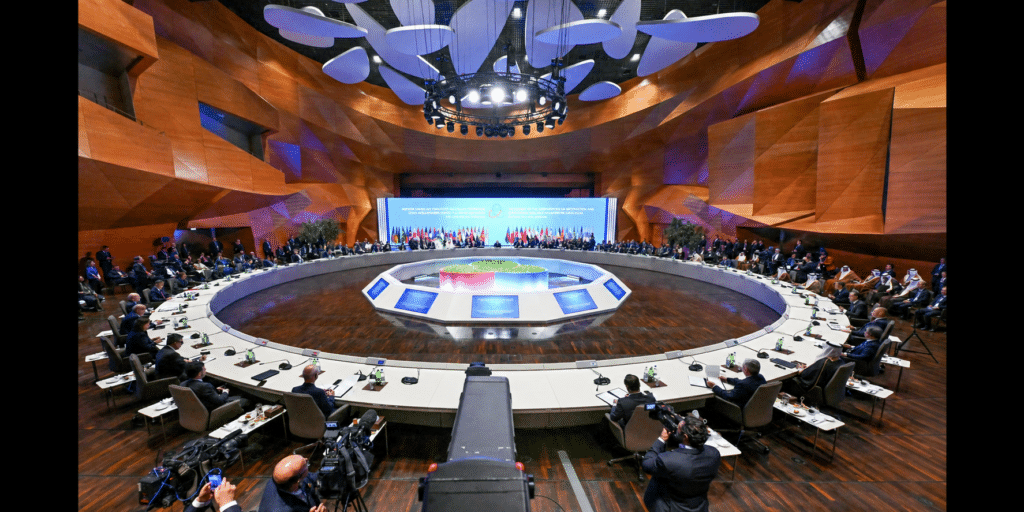
Kyrgyzstan and Iran are currently discussing the possibility of building an oil refinery. The proposal emerged during talks on August 31 around this week’s Shanghai Cooperation Organization (SCO) summit in Bishkek. Iranian President Masoud Pezeshkian, who met Kyrgyz President Sadyr Japarov in Bishkek, said Tehran viewed the proposal positively and was prepared to consider cooperation on the project.
Under the proposal, Iran would supply crude oil to the refinery, with the resulting petroleum products to be distributed between the two countries.
Pezeshkian also proposed establishing a Kyrgyz logistics center at Iran’s Bandar Abbas port, while Japarov invited Iranian oil exploration companies to work in Kyrgyzstan.
Turkmenistan: A Logistics Gamble
Turkmenistan, the only Central Asian country that shares a land border with Iran, also finds itself at a crossroads. In mid-August, Turkmenistan highlighted recent and ongoing transport infrastructure projects aimed at increasing freight flows toward Iran and India.
This infrastructure includes the recently completed 600-kilometer Ashgabat-Turkmenabat expressway, connecting the capital with the country’s eastern regions and the Uzbek border.
To strengthen the connection with Kazakhstan, Turkmenistan has built a road bridge across Garabogaz Bay. The structure can accommodate trucks weighing up to 50 tons. The project is expected to increase capacity along the route almost sevenfold and cut travel time in half. The route is intended in part to carry freight from Kazakhstan and Russia south toward Iran and India.
Turkmenistan is also modernizing its rail network and locomotive fleet to support the North-South and East-West corridors, while introducing electronic documentation to speed up border crossings.
Much of this effort is intended to strengthen routes running south through Iran toward India, making renewed instability in Iran a direct concern for Ashgabat. If these southbound routes ultimately prove reliable, Turkmenistan’s investment could pay off. For now, however, relying on Iran as a gateway to India looks increasingly risky.
Central Asia has spent years trying to use Iran as an alternative to Russian and Caspian routes. The latest escalation exposes the other side of that diversification strategy: an alternative corridor can itself become a source of geopolitical risk.