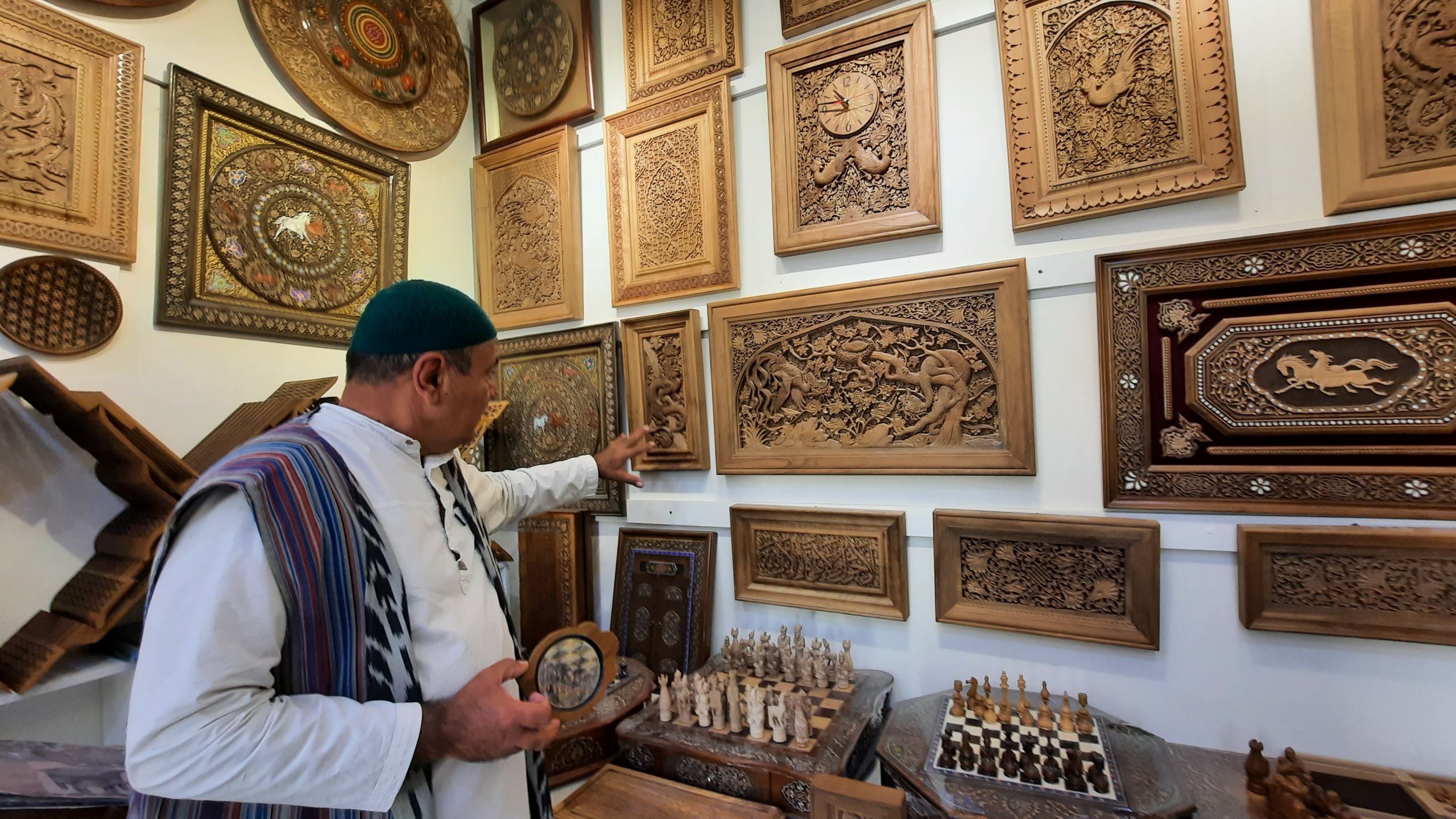
In the heart of Bukhara, one of Uzbekistan’s most historic cities, the sound of chisels meeting wood still resonates through the workshop of Shavkat Ashurov. At 57, he has dedicated more than two decades to the art of woodcarving, a tradition that has endured through centuries of upheaval and modernization in Central Asia.
Ashurov’s workshop feels like a living museum. The patterns he carves are not modern inventions but trace their lineage back to the fifth and sixth centuries, long before the spread of Islam in the region. “There is only one similar piece left in Shahrisabz,” Ashurov explains, “on the museum door connected to Amir Temur, and another in Turkistan. What we do here is to keep these traditions alive.”

Ashurov’s workshop. @Sadokat Jalolova
For Ashurov, woodcarving is more than a profession, it is a family legacy. “We are the fourth generation,” he said. “I only try to pass on what I know. I don’t add more than I can. What I learned from my forefathers, I hand over to my students.”
He began carving more than 35 years ago, but for the past two decades has devoted himself almost entirely to the craft. Over the years, he has trained nearly 100 apprentices, though today he works with just four. The reason, he admits, is the patience the art requires. “This work takes time and patience, and not everyone can manage that,” he said. “Some of my students chose other professions. But with the ones I have, I continue.”
The work itself is painstaking. A simple carved bowl may take about 40 minutes if the wood is well-prepared, but larger projects can span months. “One of our biggest works took nine months to complete,” he recalled. “It depends on inspiration too. Sometimes you work every day; sometimes you pause, waiting for the right moment to continue.”

Chess pieces from an 83-year-old apprentice working with his teacher Ashurov. @Sadokat Jalolova
Ashurov’s designs are rich with symbolism. Many incorporate chessboard-like patterns, interlocking stars, or subtle references to family and genealogy. Over centuries, foreign influences have entered Uzbek woodcarving, but artisans like Ashurov have absorbed them into a distinctly local tradition. “Miniature lacquer work came from Europe and Russia, and we placed it into our art,” he said. “The use of mother-of-pearl came through Iran and Turkey. But we reworked them into our own tradition.”
Equally important to him is honesty. “I tell customers about product defects before selling them, and I teach my students to be honest too. Honesty is as important as the design itself.”
Woodcarving is both an art and a livelihood. His workshop supports not only his own household but four other families. Income is unpredictable from modest sums to as much as 100 million soums (around $8,000) depending on commissions. “It is 50 percent local buyers, 50 percent foreigners,” he said. “Our people also value this work, but foreigners are often very interested.”
Social media has become an unexpected ally. On Instagram (@bukharawoodcarving), he shares photos of his work, attracting attention from within Uzbekistan and abroad. “People write to me on Instagram, sometimes even from overseas. I put many of my works there, and I leave my phone number so anyone can contact me directly.”

Ashurov’s workshop. @Sadokat Jalolova
Teaching remains central to his mission. His oldest student, now in his 80s, still collaborates in the workshop. While men typically handle the more complex carving, women in his family contribute a lot. “Our women do not do the difficult carving,” he said. “But they help with the lighter tasks, like lacquering and finishing.”
In a city famed for its domes, madrassas, and tiled minarets, Ashurov’s quiet workshop offers another dimension of Bukhara’s cultural heritage. Each carved panel, bowl, or bookstand is a bridge between the distant past and the present day, carrying forward the voice of generations who shaped wood with patience and devotion.
As Ashurov put it: “I only try to pass on what I know. What came to me from my fathers, I pass to my students. That is enough. That is how this craft survives.”