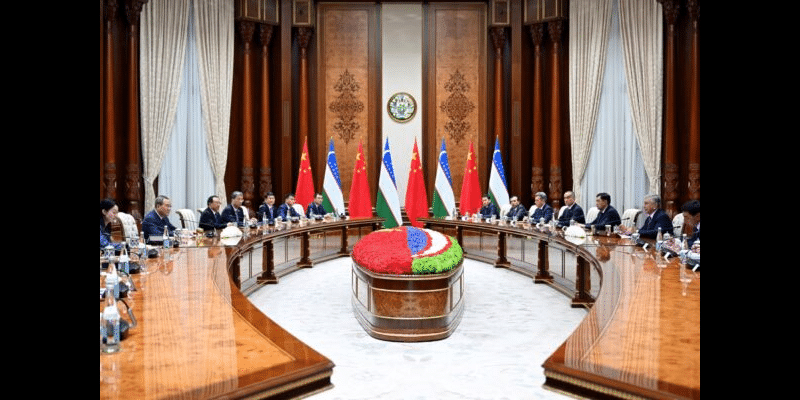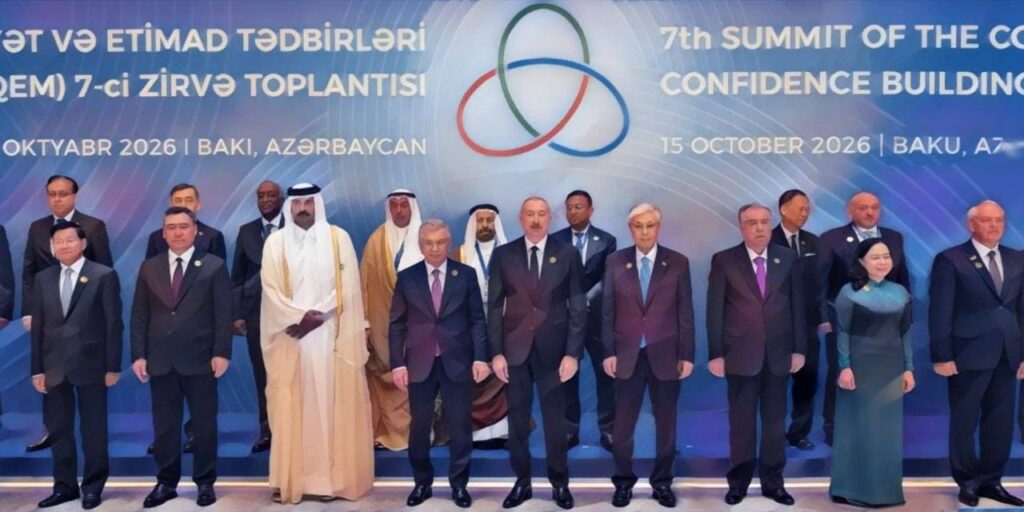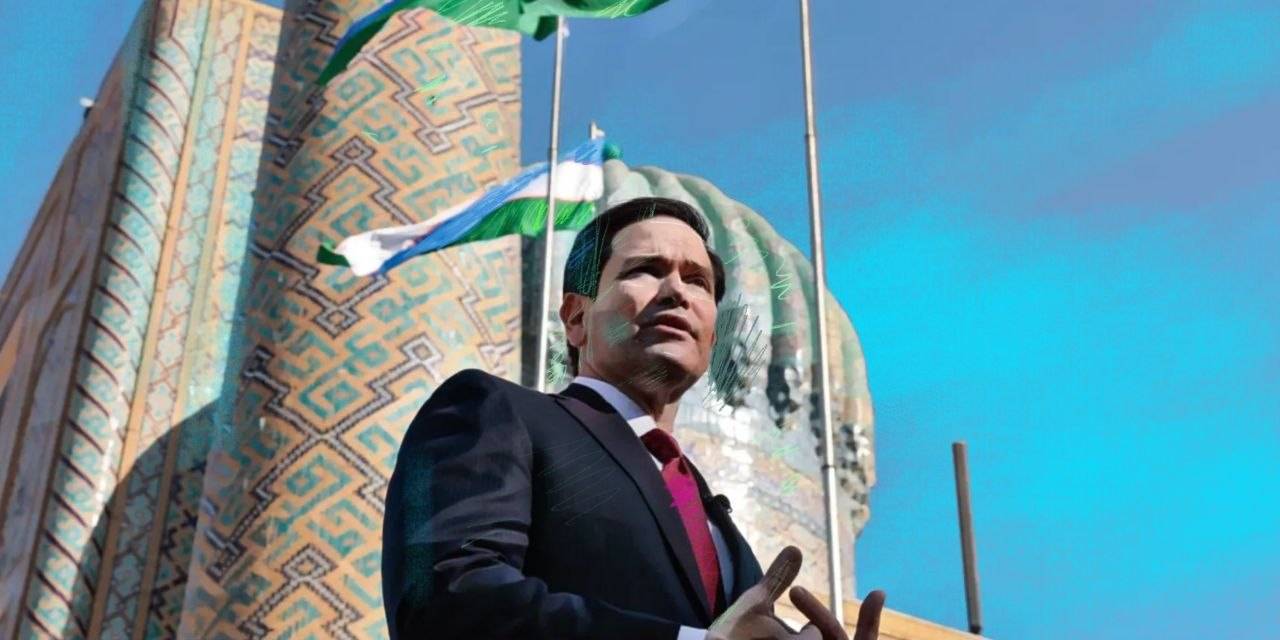
U.S. Secretary of State Marco Rubio has arrived in Uzbekistan with a delegation representing more than 200 American companies. He is attending a C5+1 ministerial meeting with the foreign ministers of Kazakhstan, Kyrgyzstan, Tajikistan, Turkmenistan, and Uzbekistan. The agenda includes regional connectivity, energy security, trade, private investment, and economic modernization.
The visit brings the format back to its birthplace. The first C5+1 ministerial meeting was held in Samarkand on November 1, 2015, with then-Secretary of State John Kerry.
The November 6, 2025, summit in Washington gave the relationship a substantial commercial dimension. Uzbekistan and the United States announced economic agreements and trade contracts worth approximately $34.5 billion. President Donald Trump also said Uzbekistan intended to purchase and invest more than $100 billion in the United States over the following decade.
Samarkand is now hosting a ministerial meeting accompanied by a large business delegation. The immediate question is how much of the previously announced portfolio has moved toward financing and implementation. In late September, Uzbekistan’s Minister of Investment, Industry, and Trade, Laziz Kudratov, valued the project portfolio with the United States at $35 billion, with approximately $7 billion already completed. On that accounting, about $28 billion remains.
In my assessment, the strongest overlap between American and Uzbek interests lies in processing critical minerals inside Uzbekistan, using American financing and technology to serve international supply chains. Washington wants alternative sources of strategic materials. Tashkent wants investment in industrial production rather than simply exporting raw materials.
Their positions are less closely aligned on technology and relations with Iran. Uzbekistan seeks access to American artificial intelligence infrastructure while maintaining cooperation with China. It also regards Iran as an important transit partner. Washington’s approach to sensitive technologies and sanctions could complicate both ambitions.
Another Uzbek priority is ending the application of the Jackson–Vanik Amendment to Uzbekistan, a U.S. trade-law provision dating from 1974 that continues to affect the legal framework for bilateral commerce. Rubio can support its repeal, but Congress must make the decision.
Investment Deals
The C5+1 format has become more commercially focused. At the Washington summit, the U.S. Department of Commerce organized a dedicated venue for business agreements and announced more than $25 billion in commercial deals involving the five Central Asian countries.
Since the Washington summit, Uzbekistan has developed additional channels for economic cooperation with the United States. A bilateral Business and Investment Council has brought together officials and business representatives. Cooperation has also expanded into critical minerals, energy, infrastructure, and advanced manufacturing.
In June 2026, Uzbekistan’s Ministry of Investment, Industry, and Trade, its Fund for Reconstruction and Development, the U.S. International Development Finance Corporation (DFC), and the Export-Import Bank of the United States (EXIM) announced a joint investment platform.
Uzbekistan has also adopted a critical minerals development program for 2026–2030, covering 120 projects valued at $4.2 billion. The first stage includes 12 projects worth $166 million, with plans to produce high-purity selenium, tellurium, and rhenium.
These plans reflect Tashkent’s industrial priorities. Uzbekistan wants foreign partners to help build processing facilities and develop technological expertise, not merely purchase mineral concentrates.
The scale of American economic involvement still needs perspective. Bilateral trade exceeded $1 billion in 2025, while Uzbekistan’s total foreign trade turnover reached $81.2 billion. China remains a much larger trading partner for the region. The United States matters to Uzbekistan primarily as a potential source of long-term capital, advanced technology, and access to Western markets.
Critical Minerals, Transport, and the Middle Corridor
The agenda in Samarkand can be divided into six areas: critical minerals, transport, energy, trade rules, technology, and security.
Critical minerals are likely to attract particular attention. The February memorandum on cooperation in the sector and the June investment platform provide a basis for negotiations, but project financing and processing arrangements remain decisive.
Kazakhstan offers an example of the type of transaction Washington is pursuing. U.S.-based Cove Capital is involved in a tungsten project, and EXIM has issued a nonbinding letter of interest for financing of up to $900 million.
Transport is another regional priority. The Middle Corridor connects Central Asia to Europe through the Caspian Sea and South Caucasus. Washington has also supported the development of the Trump Route for International Peace and Prosperity (TRIPP), a proposed transport connection through Armenia.
These routes offer the United States alternatives to transit through Russia and Iran. For Central Asian countries, the practical concern is access to ports, railways, and markets through several directions.
Energy cooperation could cover electricity grids, renewable power, and nuclear regulation. Trade discussions are likely to include Uzbekistan’s accession to the World Trade Organization (WTO) and the future of the Jackson–Vanik Amendment.
Technology presents a more difficult set of questions. Uzbekistan wants access to American chips, cloud infrastructure, and AI models while also benefiting from lower-cost Chinese technology. Its interest in the U.S.-led Pax Silica initiative must be understood against that broader policy.
Security discussions may involve Afghanistan and sanctions compliance. Iran could also arise in bilateral talks, particularly because Uzbek transport planners see Iranian territory as a route to southern ports.
What Washington Wants from Central Asia
For the United States, critical minerals are an immediate strategic concern. Washington is seeking to diversify supply chains in sectors where China plays a dominant role, especially processing. Central Asia has substantial deposits of uranium, tungsten, antimony, and other strategic materials. Uzbekistan’s copper and uranium resources make it a potential partner.
American companies are also interested in aviation, industrial equipment, services, and finance. During the November 2025 summit, Uzbekistan Airways increased its firm Boeing 787 order to 22 aircraft, illustrating how commercial transactions have become part of the administration’s diplomacy toward the region.
Washington’s technological interests extend beyond mineral extraction. Advanced semiconductors, cloud services, and sensitive digital infrastructure have become areas of competition with China. Uzbekistan’s effort to work with both countries may require careful negotiation over technology access and restrictions.
Nuclear energy deserves attention as well. Uzbekistan is pursuing a nuclear power project involving Russia while also expanding regulatory contacts with the United States. Cooperation on nuclear safety does not, by itself, indicate a change in the project’s principal partners.
Nor has Washington publicly demanded that Central Asian states withdraw from the Shanghai Cooperation Organization, abandon cooperation with the Eurasian Economic Union, or cancel existing Russian nuclear projects.
American diplomacy toward Uzbekistan also relies on personal relationships. The bilateral Business and Investment Council has established a channel involving senior Uzbek officials and U.S. representatives, including Sergio Gor. Such contacts may accelerate negotiations, but major financing decisions still depend on the relevant institutions, while changes to U.S. trade law require congressional approval.
What Tashkent Wants in Return
For Uzbekistan, the central objective is to secure investment on terms that support domestic industrial development. American government financing could help attract private investors to projects that would otherwise be difficult to fund.
Technology is equally important. Uzbek officials have expressed interest in both American computing infrastructure and Chinese open-source AI models. The country’s ambitions in artificial intelligence depend on access to computing capacity, reliable electricity, and skilled personnel.
Local processing is the third priority. Under Uzbekistan’s minerals program, new investment is intended to increase the value of products manufactured domestically. Whether American participation supports that objective will depend on the ownership structure, technology transfer, and processing requirements of individual projects.
The fourth priority is trade-law reform.
The Jackson–Vanik Amendment continues to create uncertainty in Uzbekistan’s commercial relationship with the United States. Rubio described it as an obstacle during a Senate appearance in June 2026 and expressed support for lifting the restrictions. But legislative proposals have repeatedly failed to become law.
Uzbekistan’s WTO accession adds urgency to the issue. Bilateral market-access negotiations with the United States were completed in December 2024. Tashkent wants a stable trade relationship backed by legislation rather than arrangements that require periodic renewal.
The two countries also have different priorities regarding Iran. Washington is concerned about sanctions compliance, while Uzbekistan considers Iranian routes important for reaching southern ports. This issue may become more prominent if American financing is tied to transport projects designed to bypass Iran.
What Samarkand Could Deliver
Five possible outcomes would give the Samarkand meeting practical significance.
The first would be financing decisions under the DFC–EXIM platform, identifying specific projects, amounts, and implementation schedules.
The second would be agreements on critical minerals that include processing in Uzbekistan and clear provisions for technology transfer.
The third would be a more specific American commitment to pursuing the removal of Jackson–Vanik restrictions on Uzbekistan. The fourth would be clarification of the conditions under which Uzbekistan could participate in Pax Silica. The fifth would be Uzbek participation in financing mechanisms supporting the Middle Corridor.
None of these outcomes is guaranteed. Nor is it realistic to expect Congress to lift the restrictions during the ministerial meeting or to assume that every newly announced memorandum will become an investment.
For Uzbekistan, the more revealing figures will be the amount of financing secured, the number of projects with implementation schedules, and the share of mineral production intended for processing inside the country.
A joint C5+1 statement and additional bilateral memoranda are plausible outcomes. Their significance will depend on whether the participants identify financing sources and deadlines rather than announce another aggregate value for future transactions.
Uzbekistan’s Regional Ambitions and Competition with Kazakhstan
Samarkand also gives Uzbekistan an opportunity to strengthen its position within Central Asia. Since 2017, Tashkent has promoted closer regional cooperation, including proposals for more formal institutions.
The United States is increasingly engaging the five countries as a group. That creates opportunities for regional infrastructure, but it also exposes competition among them for American investment.
Kazakhstan has already secured substantial American interest in its mineral sector and has moved ahead on certain technology initiatives. Uzbekistan has developed its own investment portfolio and bilateral institutions. The two countries are pursuing overlapping but not identical approaches.
Tashkent could distinguish itself by proposing regional mineral-processing projects that combine resources from neighboring countries with Uzbek industrial facilities. Cross-border electricity networks offer another area where several countries could benefit from a common approach.
Turkmenistan’s participation is particularly important for any transport or energy project crossing the Caspian region.
My baseline expectation is that the Samarkand meeting will produce a joint C5+1 statement, bilateral agreements, and new business memoranda. The more ambitious outcome would be financing commitments for specific industrial projects, clearer technology arrangements, and a regional initiative on mineral processing.
The principal risk is that disagreements over Iran or sensitive technologies overshadow economic negotiations.
I would assign roughly a two-thirds probability to the baseline scenario. The difference between that outcome and a more ambitious one will depend heavily on how well Uzbekistan has prepared projects for financing.
Rubio has arrived in Samarkand with American companies looking for business. Uzbekistan’s challenge is to ensure that the negotiations produce factories, technology, and financing rather than another large total assembled from preliminary agreements.
The views expressed in this article are those of the author and do not necessarily reflect the official policy or position of the publication, its affiliates, or any other organizations mentioned.