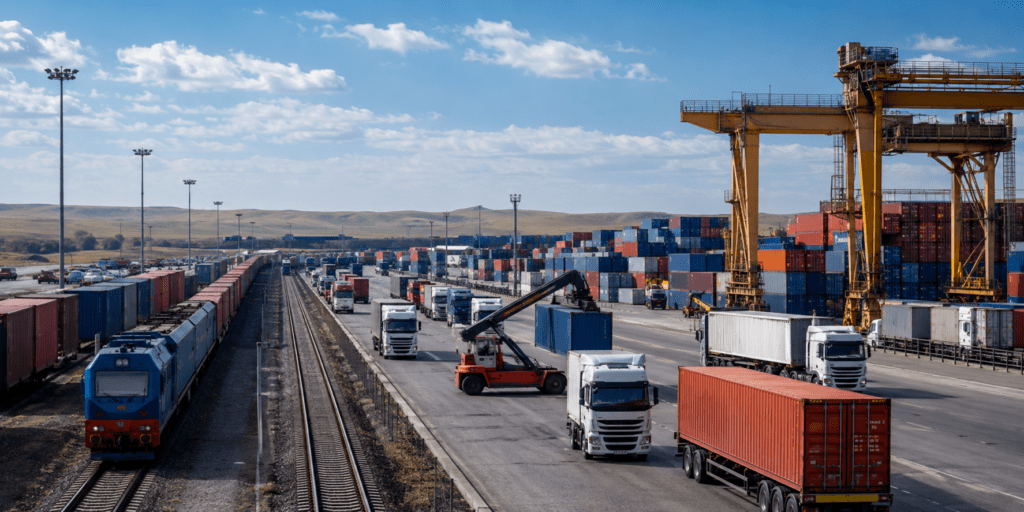
Kyrgyzstan’s exports have begun to recover after a sharp decline in 2025, when the value of its gold exports plunged by nearly three-quarters. In the first eight months of 2026, exports rose by nearly 20%. Even so, for every dollar earned from selling goods overseas, Kyrgyzstan spent more than four dollars on imports.
According to a report by the National Statistical Committee of the Kyrgyz Republic, exports fell by 41.2% in 2025 to $3 billion. Imports, meanwhile, continued to grow, reaching $13.7 billion. As a result, the country spent $10.6 billion more on foreign goods than it earned from selling its own products abroad. A year earlier, the gap stood at $7.3 billion.
The main reason for the decline was a sharp drop in overseas sales of gold, one of Kyrgyzstan’s principal sources of export revenue. Their value fell from approximately $2.5 billion in 2024 to $683 million in 2025. Exports of other goods also fell 11.2%.
Trade was also affected by weaker demand from Russia and Kazakhstan, two major markets for Kyrgyz producers, as well as temporary restrictions on exports of certain goods, including scrap metal and livestock.
Kyrgyzstan’s trade is closely tied to neighboring countries. It belongs to the Eurasian Economic Union, alongside Russia, Kazakhstan, Belarus, and Armenia. Members trade with one another without standard customs duties on most goods. Russia and Kazakhstan remain the largest buyers of Kyrgyz products and, together with China, supply most imports.
The imbalance is particularly pronounced in trade with China. Chinese goods account for more than a third of Kyrgyzstan’s total imports, while China receives only around 5% of its exports. Uzbekistan also remains an important market for Kyrgyz products. Outside the region, Switzerland and the United Kingdom are significant destinations.
The downturn continued in the first half of 2026, when exports fell another 11.1% compared with the same period a year earlier.
By the end of August, however, the picture had changed. Figures for the first eight months showed exports rising 19.5% to $2.3 billion. Gold exports also rebounded sharply, reaching $770.6 million, more than in the whole of 2025. Over half of that amount was exported in August alone. Imports also increased, reaching $9.7 billion. The recovery in overseas sales has therefore not yet significantly narrowed the gap between exports and imports.
A trade deficit does not mean Kyrgyzstan is losing the equivalent amount from its government budget. It measures the difference between the value of goods imported into the country and those sold abroad. Imports are paid for by businesses and consumers, with funds coming from various sources, including remittances from migrant workers and investment.
Services have become one of the fastest-growing areas of Kyrgyzstan’s international trade, providing another source of funds for imports. According to preliminary figures, in 2025 the country earned $3.55 billion from services exports, up 20% from the previous year. Revenue from foreign visitors rose 36.9% to $1.19 billion. In international statistics, this category includes travelers’ spending on accommodation, food, shopping, and other services during their stay.
Revenue from financial services also increased, while earnings from transport and information technology services declined. Unlike its trade in goods, Kyrgyzstan exported more services than it imported, recording a services trade surplus of approximately $430 million in 2025.
Export growth in 2026 has interrupted a sharp downturn in overseas sales, but the overall picture remains largely unchanged. Kyrgyzstan continues to import large volumes of Chinese and Russian goods, while its exports remain heavily dependent on gold and demand from neighboring countries.
Kyrgyzstan’s government is developing measures to support exporters, including reducing transport costs and expanding businesses’ access to financing.