China has extended a suspension of restrictions on critical mineral exports to the U.S., while European governments are preparing to stockpile strategic metals and support alternative suppliers. For Central Asian mining companies, the initiatives could open new markets and help finance projects that would otherwise struggle to compete with Chinese producers.
On November 24, China’s Ministry of Commerce confirmed that its suspension of tighter controls on U.S.-bound shipments would continue until January 27, 2027. The suspension was originally due to expire on November 27. The measures affect gallium, germanium, antimony, and certain graphite products. Beijing imposed an effective ban on U.S.-bound shipments of the first three metals in December 2024 following American restrictions on China’s semiconductor industry. General export licensing requirements remain in place.
Meanwhile, France has announced plans to establish strategic reserves of rare earths and other critical minerals as early as 2027. The government will consider price guarantees for producers and encourage manufacturers to sign long-term purchasing contracts.
Italy and the Netherlands are also developing a European stockpiling network centered on Rotterdam and Porto Marghera in Venice. The €14 million EU-backed pilot project identifies rare earths and tungsten as potential materials for storage, processing, and distribution.
The Economics of Mineral Security
The antimony market illustrates the commercial risks facing prospective suppliers. A November 10 report by the U.S. Geological Survey (USGS) found that average U.S. antimony prices more than doubled from approximately $10 per pound in 2024 to $24 in 2025. Following Beijing’s suspension of its ban in November 2025, spot prices fell to around $12 per pound by the end of April 2026.
Price guarantees and long-term purchasing contracts could help producers withstand such fluctuations. The International Energy Agency (IEA) found that global investment in critical minerals fell by 9% in 2025 despite rising demand. Public financing commitments in advanced economies, meanwhile, reached approximately $65 billion, more than four times their level in 2023.
IEA Executive Director Fatih Birol described the additional cost of diversifying supplies as “a form of economic insurance against major supply risks.”
Central Asian countries have an opportunity to supply some of the materials most exposed to disruption. Their established mining and metallurgical industries also provide a foundation for expanding domestic refining.
Tajikistan’s Established European Market
During his visit to Dushanbe on November 18, U.S. Deputy Secretary of State Christopher Landau discussed mining cooperation and investment opportunities with Tajik President Emomali Rahmon.
Tajikistan accounted for approximately 20% of the antimony mined worldwide in 2025, ranking third behind China and Russia. American investment in the sector is already well established. U.S.-based Comsup Commodities operates the Jijikrut antimony-mercury mine in Tajikistan’s Sughd region through its subsidiary Anzob.
While China received all of Tajikistan’s antimony ore and concentrate exports in 2024, the destinations of its processed products tell a different story.
France received 48% of Tajikistan’s unwrought antimony powder exports that year, with Belgium accounting for another 44%, USGS data show. The U.S. received just 0.8%. France’s stockpiling initiative comes against the backdrop of an established commercial relationship with Tajikistan’s metallurgical industry.
Domestic processing capacity is expanding. On July 7, Rahmon inaugurated an antimony metallurgical plant operated by TALCO Gold in the Ayni district, with a stated annual capacity of up to 5,000 metric tons. A Japanese group including the state-backed Japan Organization for Metals and Energy Security has also discussed establishing antimony trioxide production in Tajikistan.
Neighboring Kyrgyzstan has substantial antimony reserves and accounted for an estimated 0.6% of global production in 2024. It exported antimony ores and concentrates to China, while its antimony oxides went to China and Uzbekistan.
Kazakhstan and Uzbekistan Target Processing
An October 29 report by the Organisation for Economic Co-operation and Development (OECD) identified opportunities to recover germanium, gallium, indium, and rare earth elements from existing Central Asian mining operations and industrial waste.
Kazakhstan already produces or processes around 20 of the 34 materials on the EU’s critical raw materials list. Its established zinc, copper, and lead industries offer opportunities to recover additional metals during refining.
In October, Kazakhstan invited Belgian companies to participate in domestic mineral processing projects. “We are ready to discuss phased models under which processing is gradually transferred to Kazakhstan along with the necessary technologies and expertise,” said Vice Minister of Industry and Construction Olzhas Saparbekov.
The European Bank for Reconstruction and Development (EBRD) has also increased its stake in Australia’s Sarytogan Graphite Limited to 18.4%. Its latest investment will help fund a feasibility study and development work at a major graphite deposit in central Kazakhstan.
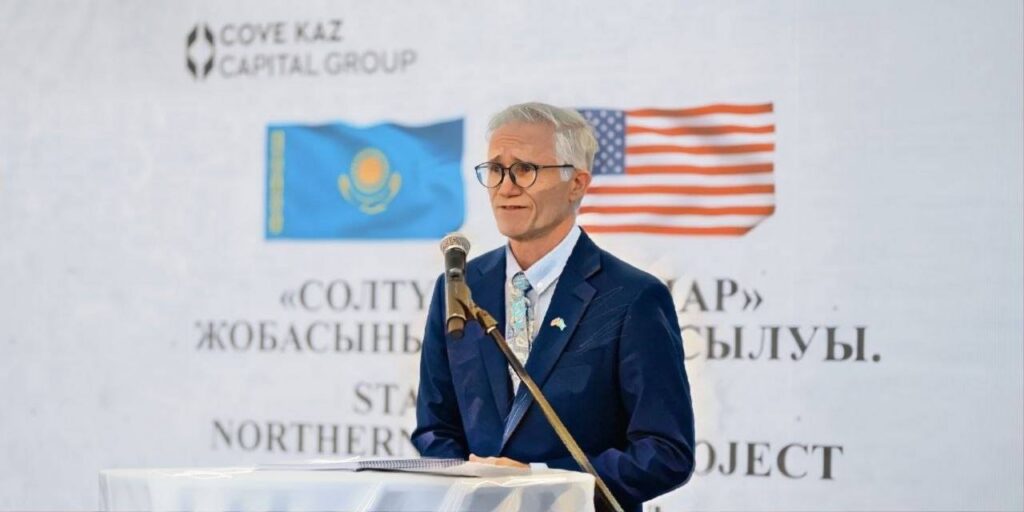
American investment in Kazakhstan’s tungsten sector illustrates the financing challenges facing larger projects. U.S.-based Cove Kaz Capital Group is developing the Northern Katpar and Upper Kairakty deposits, with plans for domestic refining. However, two U.S. government lenders that previously expressed an interest in providing up to $1.6 billion are not currently pursuing the transaction. Cove says its development work remains funded and plans to pursue construction financing after completing its feasibility study in 2027.
Tungsten prices increased sixfold through early 2026, the IEA’s Global Critical Minerals Outlook found. European stockpiling and long-term supply contracts could create additional outlets for Kazakhstan’s planned production.
Meanwhile, Uzbekistan is pursuing cooperation with American companies to develop advanced refining technologies. On October 19, American Resources Corporation and ReElement Technologies signed an agreement with the Uzbekistan Technological Metals Complex (UzTMK) and the country’s Fund for Reconstruction and Development.
ReElement says it has successfully processed Uzbek tungsten into high-purity oxide. The next phase involves commercial demonstration at its U.S. facilities and engineering studies for potential refining operations in Uzbekistan.
“Our objective is not simply to move raw materials from one country to another, but to deploy technology that creates higher-value products for both countries,” said Mark Jensen, CEO of American Resources and ReElement.
Getting Minerals to Market
The EU has established critical raw materials partnerships with Kazakhstan and Uzbekistan. Its regional DATA4CRM initiative, backed by €7.5 million in EU and Finnish funding, aims to improve geological information across all five Central Asian republics.
Even Turkmenistan, whose mining industry remains relatively undeveloped outside hydrocarbons, already supplies European buyers with industrial materials. Its iodine exports increased by 51% in 2024 to 813 metric tons, with the UK receiving almost 30%, USGS figures show.
However, transport remains a significant obstacle. At an EU-backed industry workshop in Tashkent on November 5, preliminary OECD findings showed that most surveyed Uzbek exporters still relied on the Northern Corridor through Russia to reach EU mineral markets. Higher costs, longer transit times, and unpredictable schedules have discouraged greater use of the Trans-Caspian Transport Corridor.
UzTMK representative Timur Khikmatullayev also identified predictable energy and water costs and reliable supplies of raw materials as priorities for expanding Uzbekistan’s metallurgical industry. Improving transport across the Caspian and securing long-term purchasing commitments from European manufacturers could help Central Asian producers finance more of the processing plants their governments want to establish at home.