
Kazakhstani startup Pulsar.ai is exploring the Chinese market for data from its SmartRail vehicle scanner. The device uses AI to identify signs of damage and wear in seconds. Potential customers include automakers, insurance companies, banks, and online car marketplaces.
The company says it collected around 150,000 images to train its AI models during a pilot project with Astana Motors, a Kazakh automotive group.
Pulsar.ai is Kazakh entrepreneur Baglan Olzhabayev’s second venture in automotive technology. He previously launched Beep, a kind of Uber for auto mechanics, which expanded into the United States. Olzhabayev completed a program at Draper University in 2023 and has also taken part in accelerator programs with Google for Startups and MOST Ventures.
He chose to build his new business in Kazakhstan with co-founder Zhanara Galymzhan, who has experience in banking innovation, fintech, marketing, and entrepreneurship development.
In an interview with The Times of Central Asia, Olzhabayev explained why Kazakhstan’s roads and climate could give the startup a competitive advantage abroad. He also discussed what makes China an attractive market and how realistic it is to build a billion-dollar technology company in Central Asia.
TCA: Can you explain how SmartRail inspects a vehicle and what kinds of problems it can detect?
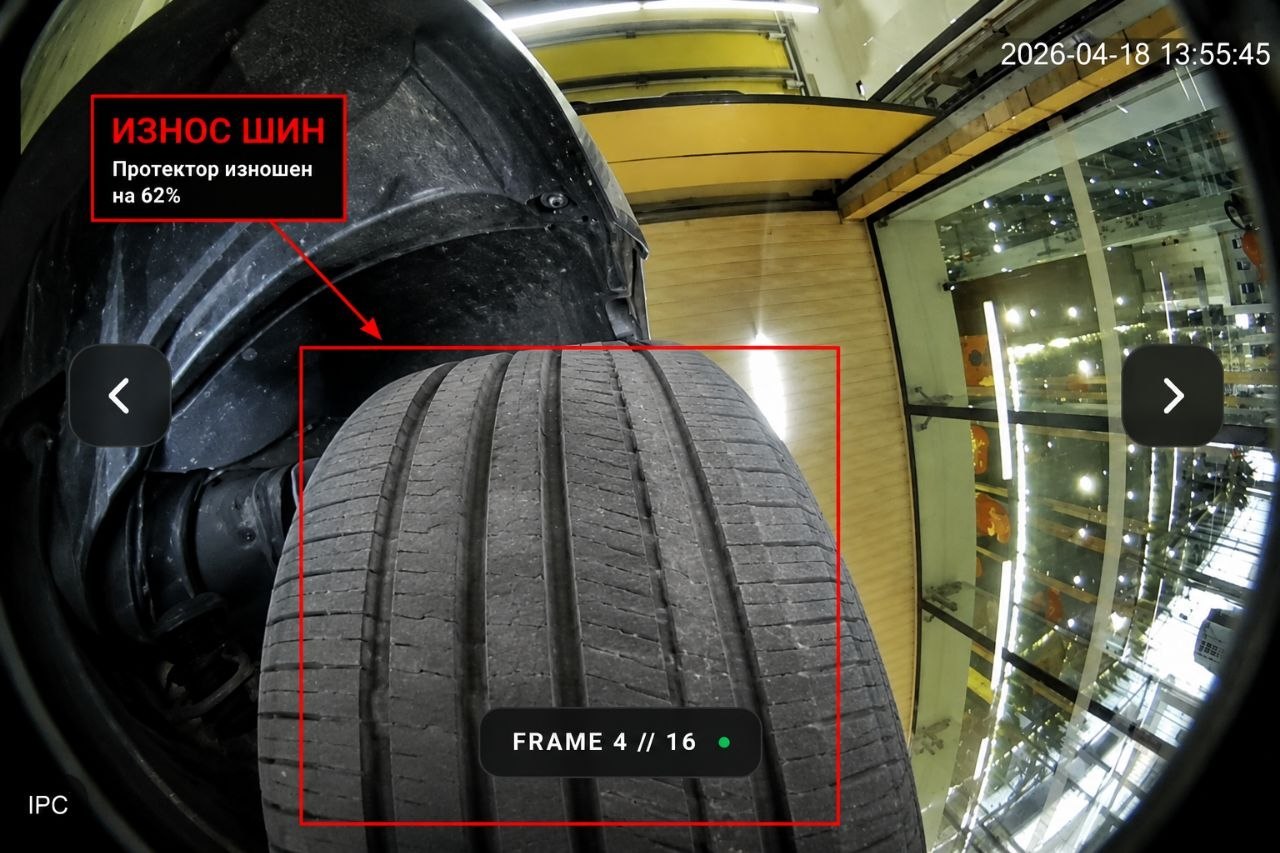
Baglan Olzhabayev: Yes, we are a hardware startup, meaning a startup that uses physical equipment. In our case, it is the SmartRail scanner, which is integrated into a speed bump, with the data it collects processed using AI. The driver does not need to do anything other than drive over it. Within seconds, the scanner examines the vehicle’s underbody and tires, while cameras mounted on stands on either side scan the body, detecting scratches, dents, and rust.
When scanning the underbody, we identify corrosion, surface rust, oil and other fluid leaks, uneven tire wear, and signs of impact damage. For example, we distinguish between surface rust and corrosion because, in the former case, treating the metal is sufficient, whereas if the metal has begun to deteriorate, the component needs to be replaced. The system can also distinguish oil from water.
TCA: Can the scanner make mistakes?
Baglan: It can. Although we are constantly improving our AI models using new data, no technology can yet deliver 100% accuracy. It depends on the type of defect. For some categories, accuracy is 80%, but when detecting corrosion, it reaches 90% or higher.
We have tested the scanner in different weather conditions, and it performs well both outdoors and in clean indoor inspection bays. Vehicles can drive over it continuously without stopping. The system scans each vehicle and uses its license plate to determine which vehicle the images belong to.
Even at a regular auto repair shop, our technology saves mechanics time. They have a starting point for their inspection. They receive a preliminary assessment and can get to work more quickly.

TCA: How do you plan to generate revenue: by selling equipment, software, or the information you collect?
Baglan: Our main focus is not selling equipment, although there are certainly customers who want to buy it. But no, we do not sell hardware; we sell answers. These include reports, analytics, and a vehicle’s usage history. There are numerous ways to make money from the information collected about a single vehicle.
Anyone can build the hardware. The most valuable asset is the data.
TCA: But your competitors can collect this data too, can’t they?
Baglan: In business, there is a concept known as a moat, a competitive barrier that protects a business from its rivals. Imagine you are my competitor. You have the technology and artificial intelligence, and so do I. But I started collecting data the day before yesterday, while you started today. Naturally, I already have more data than you do.
TCA: As far as I know, Chinese automakers have expressed interest in your technology?
Baglan: Yes, our team is currently in China. They spent the first week in Hong Kong, are now in Shenzhen, and will then travel to Shanghai. They will remain in China until December 20. If we can find common ground with potential partners there, we will be able to attract substantial investment and expand the business.
TCA: China is one of the world leaders in automotive manufacturing and technology. Surely, there are already products similar to SmartRail. What might make your product attractive to Chinese companies?
Baglan: Of course, there is equipment similar to ours in China, but not all of it uses artificial intelligence. Many systems still require a person to analyze the images. We can collect data on a large scale and build a digital history of a vehicle’s condition.
There is no point in selling our equipment to the Chinese. They can develop and install similar devices themselves. The real value for them lies in understanding how their vehicles are used in our market. That information is of interest to any automaker.

TCA: What specific information can you provide to automakers?
Baglan: Take, for example, vehicles exported from China to Kazakhstan and other Central Asian countries. A vehicle leaves the factory in one condition, but dents and scratches can appear during transportation. We scan the vehicle again when it is unloaded and show the manufacturer the difference.
Second, based on the data we collect, we provide analysis on how these vehicles are used in Central Asia, how climatic conditions, road quality, and driving patterns affect their condition, and which components are subject to wear.
We do not provide manufacturers with raw data because they have neither the time nor the resources to examine hundreds of thousands of photographs of their vehicles. We provide them with an analytical report.
TCA: Kazakhstan’s automotive market is relatively small. Why should information about how vehicles are used here be particularly valuable to major Chinese manufacturers?
Baglan: Selling a vehicle is one thing, but manufacturers also make money from spare parts, on which they have high profit margins. You can buy a car once and drive it for ten years. During that time, it may break down several times, and the manufacturer will make money selling spare parts.
That is why it is important for manufacturers to understand which parts are most in demand in a particular market, which components can be improved, and which spare parts they need to stock in advance.
TCA: There is similar technology in the United States, isn’t there?
Baglan: Yes, an Israeli startup called UVeye operates in the U.S. market and is valued at an estimated $841 million. It is described as an “MRI for cars.” Its scanning installations are quite large and require substantial investment. A vehicle rolls off the assembly line, arrives here, and we record the changes that occurred during transportation. The vehicle then goes into use, and we continue collecting data on its condition and providing analytics to the manufacturer.
TCA: What advantages does developing and testing the product in Kazakhstan give Pulsar.ai?
Baglan: The data we collect in Kazakhstan is used to train our artificial intelligence. Figuratively speaking, it feeds on that data. At the same time, our vehicles and their components are the same as those in America, Africa, or China.
We also have four distinct seasons, and vehicles are used in completely different weather conditions. We do not collect perfect, clean data obtained under laboratory conditions. We collect what you might call dirty data, directly from the streets, in the rain and snow. If artificial intelligence learns to recognize and distinguish defects under these conditions, it will be able to work anywhere, even in Antarctica.
TCA: Does Kazakhstan give you an advantage over American competitors in terms of product development speed and costs?
Baglan: Our market is more flexible. During the first two weeks of the pilot project, we collected 150,000 photographs of vehicles. To date, tens of thousands of scans have been carried out. One in four vehicles we examined had critical defects. The cost of manual data annotation in the U.S. can reach one dollar per annotation.
You see, launching hardware startups in America is very difficult. We can collect large volumes of data more quickly and at a lower cost. We can already enter the U.S. market with proven use cases and say, “Guys, my AI works. Let me show you how.” A car drives over the scanner, and the magic happens right before their eyes.
TCA: Is the product’s Kazakh origin an advantage or a barrier when entering international markets? How do foreign investors react?
Baglan: When American investors put money into a Kazakh startup, the first thing they want to see is traction, measurable results demonstrating the progress of your technology in the U.S. market. They say, “It doesn’t matter how many millions or billions you have made in your own market. Make money here and show us results here.” For them, broadly speaking, the world is divided into America and everywhere else.
Of course, being from Kazakhstan sometimes prompts a degree of skepticism. But investors also understand perfectly well that a good idea, a good product, and a good team can come from anywhere, even Mars. We have the example of Higgsfield, which is now valued at more than $5 billion. A team from Kazakhstan created and launched that startup and demonstrated that they could build a world-class product.
In August 2026, Higgsfield, which specializes in AI-generated video, raised $400 million at a valuation of $5.4 billion.
TCA: You have already launched an automotive startup in the United States. How realistic is it for a Kazakh technology company to break into the American market?
Baglan: It is entirely realistic. I know this market very well. I lived there and launched Beep with my partners, a service for quickly finding auto mechanics that reached a valuation of $3 million. I understand how American mechanics work, how drivers behave, and how they use their vehicles.
You can break into this market, but it requires substantial funding. As many investors say, you can easily make $5 million in America, but you can spend it even faster.
TCA: How did Beep work?
Baglan: It was a fairly average startup, but it was a good experience for me. I was still very inexperienced when I launched it. I did not even know that what I was doing was called a startup. The project was subsequently rebranded in America as AutoCare One. There were around 15,000–20,000 American auto mechanics on the platform. Essentially, it was the Uber model, except that instead of requesting a driver, you requested a mechanic. It would have been innovative a decade ago. But today we have entered the age of artificial intelligence, and we need to move forward.
TCA: What is your strategy for entering international markets?
Baglan: Opportunities are opening up for us in many different markets, including the Caucasus, Turkey, China, Kazakhstan, and even America. For now, we are weighing our options.
Of course, the ultimate goal of virtually any startup founder is to enter the American market and realize their American dream. But we were born in Kazakhstan, launched our product here, and are developing it here. For us, it is a testing ground where we want to put our artificial intelligence through its paces and improve it.
If we manage to enter the Chinese market, that will also be a very good result. What happens next depends on the opportunities that open up for us. We may not even need to enter the American market.
TCA: What stage is your startup at now? As I understand it, you received $85,000 from a Hyundai dealership?
Baglan: Yes. Initially, we had to turn down several investment offers because we were not satisfied with the proposed company valuation or the amount of investment. As for the $85,000, that was a commercial arrangement, not venture capital investment. We accepted the money to refine the technology, purchase and install equipment, and start generating data for our customer.
If everything develops as we currently plan, we expect to raise $2 million at a company valuation of just over $12 million. That takes into account the prospects for operating in Central Asian and Chinese markets.
TCA: Where are your scanners currently operating?
Baglan: At the Aport shopping mall in Almaty, where we are demonstrating SmartRail’s effectiveness. Within a month, we plan to equip the entire shopping center, installing 10–12 scanners at the entrances to its parking areas.
The second area is toll roads and vehicle inspections. We have a letter from Kazakhstan’s Ministry of Transport expressing interest in incorporating our technology into the vehicle inspection system. We have not yet been given the go-ahead to install the equipment. As you can imagine, doing business with the government takes time. We still have many stages to complete, including a cybersecurity audit.
TCA: What objectives have you set for the next six months?
Baglan: First and foremost, we plan to install equipment at several shopping centers in Kazakhstan. If everything goes well, we may introduce our technology into the vehicle inspection system and install scanners on toll roads. Just imagine: Kazakhstan’s toll roads recorded 74 million vehicle journeys in 2025. That is 74 million potential vehicle scans.
TCA: You are accumulating an enormous volume of information about vehicles. How are you addressing personal data protection?
Baglan: When we first launched the startup, we examined this issue very carefully. First, when someone enters private property, such as a shopping center parking lot, or uses a toll road, they accept the terms of a publicly available service agreement. In our case, those terms provide for scanning the vehicle’s underbody.
Second, we do not share vehicle license plate numbers, images of drivers’ faces, or other personal information. Our database might contain, for example, 10,000 Hyundai Elantras that have been used in completely different ways. Each has its own history of damage, dents, scratches, and signs of wear. That is the information we are interested in.
Pulsar.ai’s published terms and conditions state that drivers must actively consent to the processing of restricted personal data. Separate consent is required for sharing data with commercial partners and for using anonymized data to train AI models.
TCA: Is Kazakhstan’s infrastructure ready to store and process such large volumes of information? How will you address this issue when entering international markets?
Baglan: Our data is currently stored in the cloud within Kazakhstan. Following a startup competition held at Digital Bridge, Yandex awarded us a grant of 10 million tenge ($21,800) in computing resources on its cloud servers in Kazakhstan. We also have supercomputers and Alem.Cloud, and Timur Turlov is opening a data center in Karaganda.
We will store Chinese data in China, where Alibaba Cloud and other cloud services are available. In America, we will use Amazon’s services. Each country will store its own data. The data itself will not be transferred outside the country, but the artificial intelligence trained on all these datasets will be able to operate effectively anywhere in the world.
TCA: Will automakers be your main customers in international markets?
Baglan: Not exclusively. We see considerable potential in these relationships. But we are useful not just to manufacturers, but also to banks, insurance companies, automotive marketplaces, logistics companies, and others. Anyone interested in objective information about a vehicle’s condition. It is a limitless market.
TCA: Do you see Pulsar.ai as a niche product or as a technology capable of becoming the foundation of a multibillion-dollar business?
Baglan: Everyone who launches a startup believes in a bright future where a unicorn is waiting for them to ride. I cannot predict the future, but I can say with confidence that this data will be worth a great deal of money. The company can monetize it in many different ways.
In large markets with substantial numbers of vehicles, our company could potentially become a unicorn [a privately held company valued at $1 billion or more]. China, for example, has 366 million vehicles, America has 280 million, and Kazakhstan has only 6 million.
A Kazakh company can reach a Series A funding round while operating exclusively in the domestic market, but its valuation will generally not exceed $20–30 million. We have a small market, and we need to acknowledge that.
According to the U.S. Federal Highway Administration, the United States had 298 million registered motor vehicles in 2024.