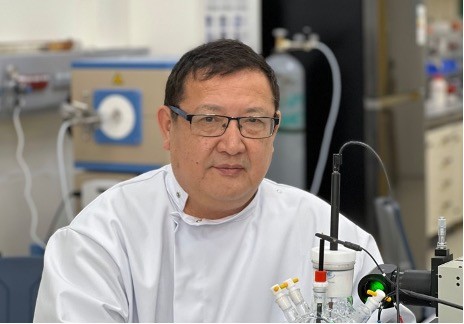
Nurxat Nuraje is a Kazakh scientist who is now well known in the global scientific community. He has spent more than two decades studying and conducting research in the United States.
Drawn to science from an early age, he earned his PhD in chemistry from the City University of New York in 2008, successfully launching his research career.
His main field of research is nanotechnology and its applications. At a time when nanoscience was still emerging, his bold approach to the subject quickly gained recognition. His first major publication was in the Journal of the American Chemical Society – one of the world’s leading chemistry journals.
The paper introduced innovative ideas about nanocircuit fabrication, methods and challenges in their development, computational power, and potential applications. This paper was considered a major contribution to the field at the time.
Soon after, he joined the Massachusetts Institute of Technology (MIT), one of the world’s foremost technology universities, as a postdoctoral researcher. There, he succeeded in finding ways to increase computer storage capacity, which is a crucial question for modern computing. His research on the development and application of specific nanoparticles was published in Advanced Materials, once again establishing his name in global science.
His work was later awarded a silver medal at the International Materials Research Society conference in San Francisco.
“Science doesn’t deliver results overnight. It evolves gradually,” says Nuraje. “The true mission of a scientist is to reshape the world’s thinking through discovery. In the future, we must move from oil to hydrogen energy. That is the energy of tomorrow.”
Since 2013, Nuraje has worked as a research scientist at MIT. He is also credited with developing conductive polymer nanoparticles, which are now widely used.
Together with his students, he continues to design and create practical, everyday-use technologies. In 2015 he received the Joseph Award for his outstanding contribution to nanotechnology. He became the first Kazakh scientist to win this American honor.
Why did MIT invite him to join their team? The answer lies in his PhD dissertation, which was recognized by experts as one of the best in the field. Harvard University, the University of California, and MIT each offered him postdoctoral positions.
One of Nuraje’s remarkable achievements was the development of anti-fogging materials – the kind used on smartphone screens today. Working with MIT professor Angela Belcher, he co-created a new type of photocatalytic material through genetic engineering of the M13 virus. This groundbreaking work was published in Advanced Materials in 2012 and resulted in five international patents. This is a true testament to the Kazakh proverb: “Knowledge conquers all.”
In 2015, he joined Texas Tech University as a professor of chemical engineering, where he established his own research laboratory, The Nurxat Nuraje Lab. There, his team developed solar-powered water-splitting technology to produce hydrogen. His breakthroughs in conductive polymers earned him the American Chemical Society’s Petroleum Research Award in 2016.
In the following years, he was named “Most Distinguished Scientist” at Texas Tech University, and in 2018, the Journal of Materials Chemistry A listed him among the world’s top researchers.
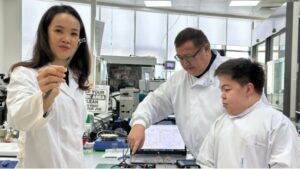
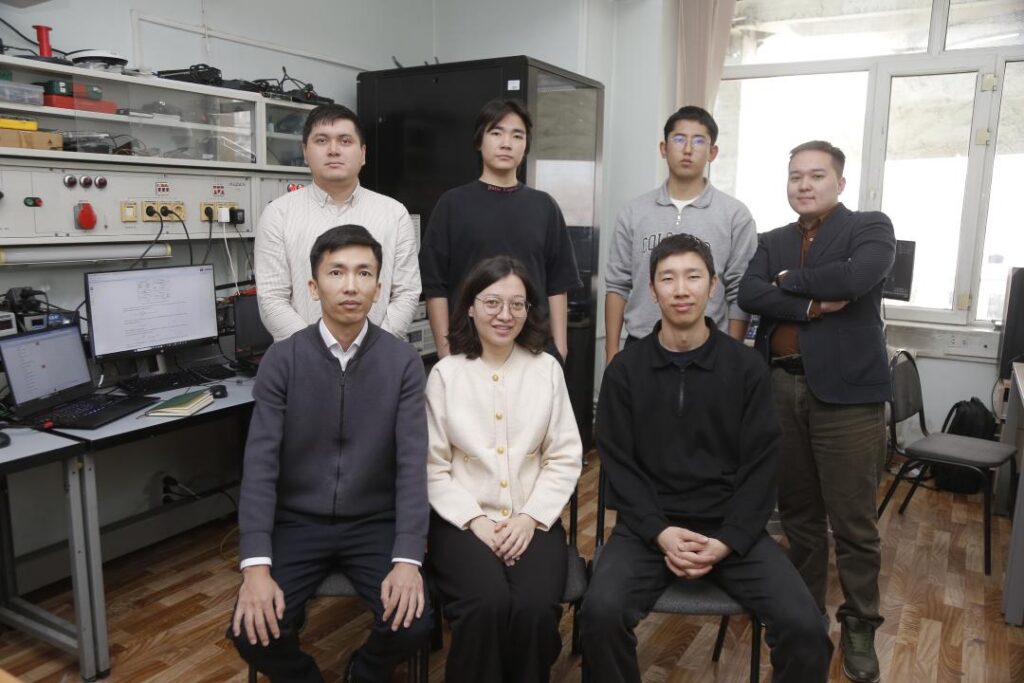
Nurxat Nuraje with his students
In 2019, he returned to Kazakhstan to continue his scientific work at Nazarbayev University. Within three years, he founded four major research laboratories focusing on membranes, conductive plastics, solar hydrogen production, and biomass. These labs now employ over forty young Kazakh researchers.
When we asked Nuraje about the innovations that his team has achieved, he replied: “We’ve developed flexible, conductive rubber materials that can stretch and conduct electricity without breaking, unlike metal. They can be used for sensors, bacterial testing, even TV screens. That’s a major success, and our findings have been published in a high-impact scientific journal.”
Nuraje believes that science must be trusted and valued before it can truly flourish. Together with his students, he continues to promote Kazakhstan’s scientific achievements globally. Recently, his team developed a hydrogen detection sensor. This is a clear example of how passion and dedication to science can yield tangible progress.