Tokayev Flags Nuclear Proliferation Risk in the Iran Conflict

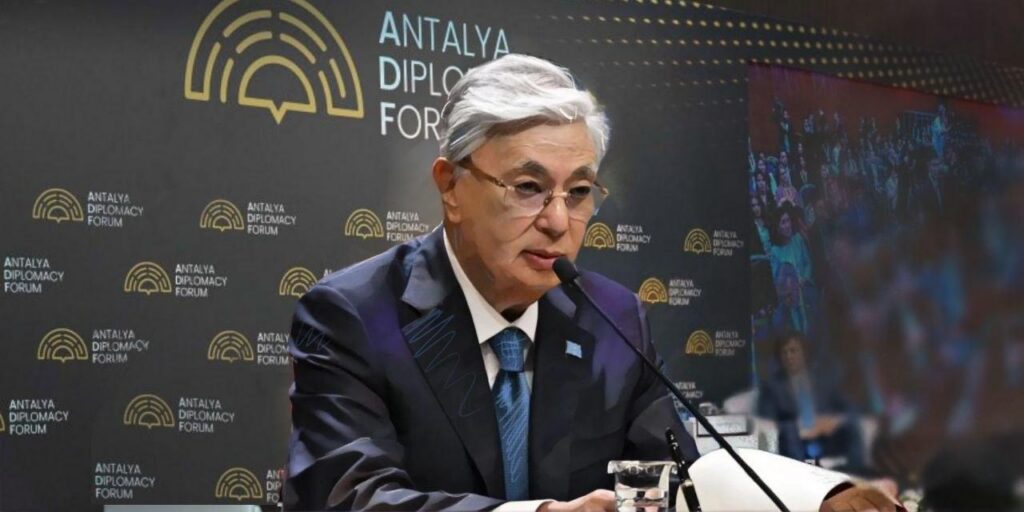
On April 17 at the Antalya Diplomacy Forum, Kazakhstan President Kassym-Jomart Tokayev said that in the Iran conflict, the deeper issue is not freedom of navigation through the Strait of Hormuz but the spread of nuclear technologies and arms. That, he said, is the issue that should stand at the center of negotiations over the crisis
Astana has long treated its anti-nuclear stance as a core state principle. Tokayev has said explicitly in the past that a nuclear-weapon-free world is a policy priority of his government. That aspiration has become part of Kazakhstan’s national identity. At Antalya, he did not produce a new line. He applied an established one to a new crisis.
Kazakhstan’s sensitivity on the issue lies at Semey, formerly Semipalatinsk, in eastern Kazakhstan, where the Soviet Union built one of its principal nuclear test grounds, a site covering about 18,500 square kilometers. Between 1949 and 1989, the USSR conducted 456 nuclear tests there, including 116 atmospheric tests and 340 underground ones. The first Soviet atomic bomb was detonated there on August 29, 1949. For Kazakhstan, Semey is not only a chapter in Soviet strategic history; it is a prolonged experience of severe human and environmental exposure, environmental damage, and official secrecy borne on Kazakh territory.
That record helps explain why Tokayev’s public language has, on two recent occasions, echoed Donald Trump’s. On April 8, Tokayev said that the Middle East ceasefire “was made possible through the goodwill and wisdom of U.S. President Donald Trump, Iran’s leadership, and other countries involved in the conflict,” explicitly crediting Trump’s role in making de-escalation possible. At Antalya on April 17, Tokayev said Trump had raised the UN’s dysfunction “very eloquently” at the previous September’s UN General Assembly session, adding, “I fully agree with him.” The convergence is notable. Tokayev’s emphasis on non-proliferation, restraint, and negotiated crisis management aligns with Trump’s support for the truce and his criticism of a UN-centered system that Tokayev likewise sees as increasingly unable to resolve major crises.
At independence, Kazakhstan inherited 1,410 nuclear warheads deployed on Soviet strategic systems, including intercontinental missiles and heavy bombers. It acceded to the Nuclear Non-Proliferation Treaty in 1994 and transferred its last nuclear warhead to Russia in April 1995. This history gives Kazakhstan a place in non-proliferation diplomacy that few states can claim. It absorbed the consequences of nuclear testing and then renounced a major inherited nuclear arsenal.
This history has never receded into symbolism; its human consequences endure. Populations near the test site and in downwind settlements were exposed to fallout over decades, and the medical afterlife remains an active field of research. The International Agency for Research on Cancer, part of the World Health Organization, established a prospective cohort study near the Semipalatinsk test site, known as the SEMI-NUC project, to track long-term outcomes among residents exposed to chronic low and moderate doses of radiation.
Registry-based research has found that exposed populations are subject to elevated cardiovascular mortality risks, while other studies have examined thyroid disease, cancer, reproductive effects, and other lasting health consequences. According to some estimates, low-dose radiation from the Semipalatinsk program affected more than a million people over time. Entire communities lived with repeated exposure under Soviet secrecy before the scale of contamination was finally publicly acknowledged. For Kazakhstan, this is not a single closed historical episode but a dispersed health burden carried across decades.
These events and phenomena entered politics through public mobilization as well as state action. In 1989, the Nevada-Semipalatinsk movement emerged as a mass mobilization against continued testing. It linked Kazakhstani and American anti-nuclear activists, drawing in writers, scientists, workers, and ordinary citizens. Tied by name to the better-known Nevada test site in the United States, it became a major force in the campaign to shut the site down. What had long been regarded in Moscow as a remote regional burden turned into a nationwide political question. The permanent closure of the test ground on August 29, 1991, was not only an act of republican authority but also a turning point for society at large. Anti-nuclear politics in Kazakhstan were never only official doctrine; they were also a broad social cause.
It is therefore not surprising that nuclear questions still carry unusual moral and political weight in the country. A survey conducted by the Kazakhstan Institute for Strategic Studies in August 2024 found that 53.1% of respondents supported building nuclear power plants, 32.5% opposed the idea, and 14.4% were undecided. Among opponents, the main concerns were the risk of accidents and environmental damage. The survey covered 1,200 respondents across Kazakhstan’s 17 regions and the three largest cities, so the results were not merely a local reflex around the former test site. In Kazakhstan, nuclear policy still passes through memories of bodily risk, contamination, and distrust carried forward from Semey.
The October 2024 referendum clarified the distinction. Official results showed that 71.12% of participating voters supported the construction of a nuclear power plant, with turnout above 63%. The legacy of Semipalatinsk no longer operates as a simple veto on civilian nuclear development. But that is precisely why Tokayev’s Antalya remarks carry weight. Civilian nuclear power, domestic energy policy, and the spread of nuclear arms are different questions, and public debate in Kazakhstan increasingly distinguishes among them. The referendum did not erase Semey’s historical weight. It made clearer the distinction between peaceful nuclear use under safeguards and the older fear attached to uncontrolled nuclear danger.
There is also a practical diplomatic continuity behind Tokayev’s words on Iran. Kazakhstan welcomed the 2015 Joint Comprehensive Plan of Action, said that its implementation would strengthen non-proliferation and regional security, and pointed to its own contribution through two rounds of talks in Almaty. It also agreed to host the IAEA Low Enriched Uranium Bank at the Ulba Metallurgical Plant in Oskemen, giving Kazakhstan an operational place inside the institutions of non-proliferation. The Almaty negotiations made Kazakhstan a venue for negotiation rather than a distant observer, while the LEU Bank placed part of the non-proliferation system on Kazakh territory. Tokayev’s remarks in Antalya are deeply embedded both in Kazakhstan’s historical experience and in its diplomatic practice.
Tokayev’s intervention was more than a comment on a passing crisis. It came from a state on whose territory the Soviet Union detonated its first atomic bomb and whose citizens lived with the fallout: a state whose post-Soviet identity was shaped by closing the test site and voluntarily renouncing inherited warheads, and whose diplomacy has consistently sought to transform that history into international norms and institutions. In Antalya, Tokayev drew on Kazakhstan’s own historical experience of the strategically more consequential danger of nuclear proliferation to argue that the Iran crisis should not be reduced to maritime throughput or commercial disruption in the Gulf.