• KGS/USD = 0.01144 0%
  • KZT/USD = 0.00196 -0%
  • TJS/USD = 0.10899 -0%
  • UZS/USD = 0.00008 -0%
  • TMT/USD = 0.28490 0%
  • KGS/USD = 0.01144 0%
  • KZT/USD = 0.00196 -0%
  • TJS/USD = 0.10899 -0%
  • UZS/USD = 0.00008 -0%
  • TMT/USD = 0.28490 0%
  • KGS/USD = 0.01144 0%
  • KZT/USD = 0.00196 -0%
  • TJS/USD = 0.10899 -0%
  • UZS/USD = 0.00008 -0%
  • TMT/USD = 0.28490 0%
  • KGS/USD = 0.01144 0%
  • KZT/USD = 0.00196 -0%
  • TJS/USD = 0.10899 -0%
  • UZS/USD = 0.00008 -0%
  • TMT/USD = 0.28490 0%
  • KGS/USD = 0.01144 0%
  • KZT/USD = 0.00196 -0%
  • TJS/USD = 0.10899 -0%
  • UZS/USD = 0.00008 -0%
  • TMT/USD = 0.28490 0%
  • KGS/USD = 0.01144 0%
  • KZT/USD = 0.00196 -0%
  • TJS/USD = 0.10899 -0%
  • UZS/USD = 0.00008 -0%
  • TMT/USD = 0.28490 0%
  • KGS/USD = 0.01144 0%
  • KZT/USD = 0.00196 -0%
  • TJS/USD = 0.10899 -0%
  • UZS/USD = 0.00008 -0%
  • TMT/USD = 0.28490 0%
  • KGS/USD = 0.01144 0%
  • KZT/USD = 0.00196 -0%
  • TJS/USD = 0.10899 -0%
  • UZS/USD = 0.00008 -0%
  • TMT/USD = 0.28490 0%
08 December 2025

Tajikistan Launches Export Support Program for Small Producers and Farmers

Tajikistan has launched a wide-reaching initiative aimed at strengthening the country’s export potential, with a particular focus on supporting small producers and farmers. According to Khurshed Zuhurzoda, First Deputy Director of the Export Agency, export support centers and export schools are being established across the regions to provide both infrastructure and education to help local products reach international markets.

Empowering Farmers and Small Businesses

The program, supported by the World Bank, targets small-scale farms of which there are over 200,000 nationwide, that often lack the logistical, financial, and regulatory resources necessary to export their goods.

“This project is especially important for small-scale producers who do not have sufficient resources and knowledge to organize the export of their products,” Zuhurzoda said.

Education, Consulting, and Promotion

The initiative is grounded in the newly approved Concept for the Development of Export Support Centers and Export Schools. These institutions will offer comprehensive support to prospective exporters, including:

  • Training in the fundamentals of international trade;
  • Consulting on certification, customs procedures, and legal compliance;
  • Assistance in identifying foreign partners and market entry strategies;
  • Participation in international exhibitions and forums;
  • Promotion of the Made in Tajikistan brand through digital and traditional media.

The program aims to enhance the global visibility of Tajik products and reinforce the presence of local producers in competitive international markets.

A grant from the World Bank is also funding the construction and outfitting of the first regional export centers, scheduled to open in the Gorno-Badakhshan Autonomous Region and Khatlon region by the end of 2025.

Rising Trade Validates Strategic Direction

Zuhurzoda noted that the program’s rollout coincides with an uptick in foreign trade. In the first half of 2025, Tajikistan’s foreign trade turnover reached $4.7 million, a 7.2% increase compared to the same period in 2024.

Officials view this as confirmation that their strategy of diversifying the economy, strengthening small and medium-sized enterprises, and boosting the international competitiveness of Tajik goods is gaining traction.

Amid intensifying global competition and regional shifts in trade logistics, this initiative may play a pivotal role in building a resilient and export-oriented economy in Tajikistan.

Kazakhstan and Turkey Tighten Ties Amid Shifting Caspian Dynamics

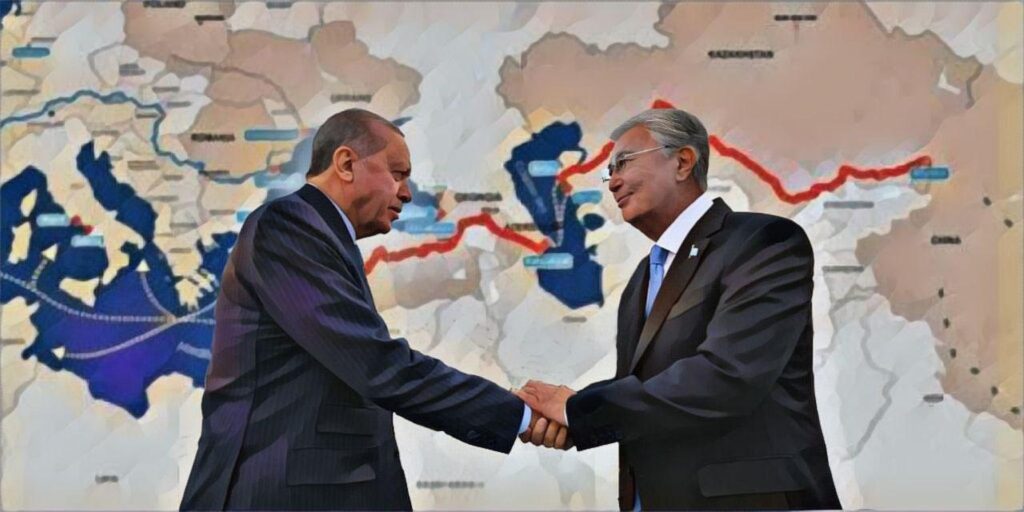
Kazakhstan’s President Kassym-Jomart Tokayev arrived in Turkey on an official visit late on Monday, where he held talks with President Recep Tayyip Erdoğan. The two leaders went on to co-chair the fifth meeting of the Kazakhstan–Turkey High-Level Strategic Cooperation Council. Coming amid heightened tensions in the Caspian region, particularly between Russia and Azerbaijan, the trip appears aimed at recalibrating regional dynamics, though analysts say its full implications remain unclear.

Tokayev’s visit ended on a ceremonial high, as Erdoğan bestowed upon him the Devlet Nişanı, Turkey’s highest state honor. Accepting the award, Tokayev — who noted he had previously declined both domestic and foreign distinctions — thanked the Turkish president and people, highlighting Kazakhstan’s political and economic achievements. Erdoğan, in turn, praised Kazakhstan as the “center of peace and stability in its region.” Yet with Kazakhstan straddling both Central Asia and the Caspian basin — each a strategic priority for Ankara — it remains unclear which “region” Erdoğan had in mind.

Much of the visit, however, played out behind closed doors. The official press release offered only general statements and few specifics. But the images released were polished and plentiful.

Ahead of the summit, Tokayev met with prominent Turkish business leaders already active in Kazakhstan or planning future investments in the country’s economy.

Political analyst Adil Kaukenov, a China specialist, weighed in on Tokayev’s business meetings via his Telegram channel, stating that the main topics were processing and logistics. His colleague Daniyar Ashimbayev, meanwhile, interpreted the visit as evidence that Astana is pursuing the foreign policy course it deems necessary.

“I have already written about the logistical and geopolitical rivalry between Central Asia, the South Caucasus, and Asia Minor,” Ashimbayev observed. “A strange situation even arose when Kazakhstan signed one agreement on the Trans-Afghan Highway with Kabul, and Tashkent signed another. Or the constant discussion between Tashkent and Baku on the development of the Trans-Caspian corridor without the participation of Ashgabat and Astana. Tensions have risen in relations between Baku and Moscow, which could jeopardize Caspian logistics. Against this backdrop, the Kazakh authorities are methodically pushing through their agenda.”

Ashimbayev also recalled Kazakhstan’s recent diplomatic successes, such as securing EU sanctions exemptions for agricultural and coal exports.

“In this regard, Tokayev’s trip to Ankara was intended to resolve possible contradictions and misunderstandings in bilateral relations,” Ashimbayev concluded.

While official sources emphasized economic and cultural-humanitarian cooperation as the main themes of the visit, Ashimbayev hinted that more sensitive topics may have been discussed privately.

“The Turkish release mentions that the parties discussed defense issues, while the Kazakh release says they talked about IT,” he noted. “But by and large, the meaning of the talks is that both leaders calmly sorted out mutual issues, with no one acting as a supplicant or ‘vassal’ (as is sometimes the case at similar meetings). Kazakhstan methodically focused on the issues of interest to it and correctly discussed the issues raised by the host of the summit.”

A closer analysis of publications on Akorda, the Kazakh presidential website, offers subtle clues about the meeting’s agenda. One statement from the Strategic Cooperation Council notes that the two sides discussed “prospects for increasing exports via the Baku-Tbilisi-Ceyhan oil pipeline.” Tokayev also “invited Turkish companies to participate in projects aimed at reducing the electricity deficit,” and expressed confidence in the partnership between KazMunayGas and Turkiye Petroleum.

The BTC pipeline is often floated as an alternative to Russian export routes, though it tends to re-emerge during times of political tension as a form of leverage. Moscow remains unenthusiastic about Ankara’s growing role as a logistics hub in the region.

During a media briefing, Tokayev said: “Currently, 1.4 million tons of Kazakh oil are transported annually to Turkey via the Baku-Tbilisi-Ceyhan pipeline. We discussed increasing supply volumes and welcome Turkiye Petroleum’s intention to work in the Kazakh market. We are also interested in utilizing the investment opportunities of Turkish companies and their experience in diversifying energy sources and building power plants. We are ready to jointly implement large-scale projects.”

But even more significant was Tokayev’s public and official invitation for Turkey to increase its presence in the Caspian region.

“The development of the Trans-Caspian international transport route, known as the Middle Corridor, is of great importance. This initiative is in the interests of both countries. Kazakhstan is modernizing its railways, building highways, and upgrading infrastructure to boost shipping on the Caspian Sea. We invite Turkish investors to actively participate in these projects. Our government is ready to provide special incentives to Turkish entrepreneurs,” Tokayev stated.

The Caspian Sea, once largely dominated by Russia, requires substantial investment to increase its logistical capacity. This includes not only the BTC pipeline, which relies on barge transport from Aktau, but other east-west cargo routes such as Chinese goods en route to Europe. The limited depth of the sea restricts large vessels, reducing the economic appeal of the Middle Corridor. Turkey, with an interest in both the BTC and the broader corridor, is a logical partner.

From a geopolitical perspective, Ankara, as a NATO member, could serve as a counterweight to Russia and Iran in the region.

Viewed through that lens, Tokayev’s outreach to Erdoğan looks like a calculated and strategic move, and Erdoğan appeared to be acknowledging this by presenting Kazakhstan’s president with Turkey’s highest award.

The question now is, how will Moscow respond?

EU–Kazakhstan Relations: Strategic Cooperation Amid Geopolitical Shifts

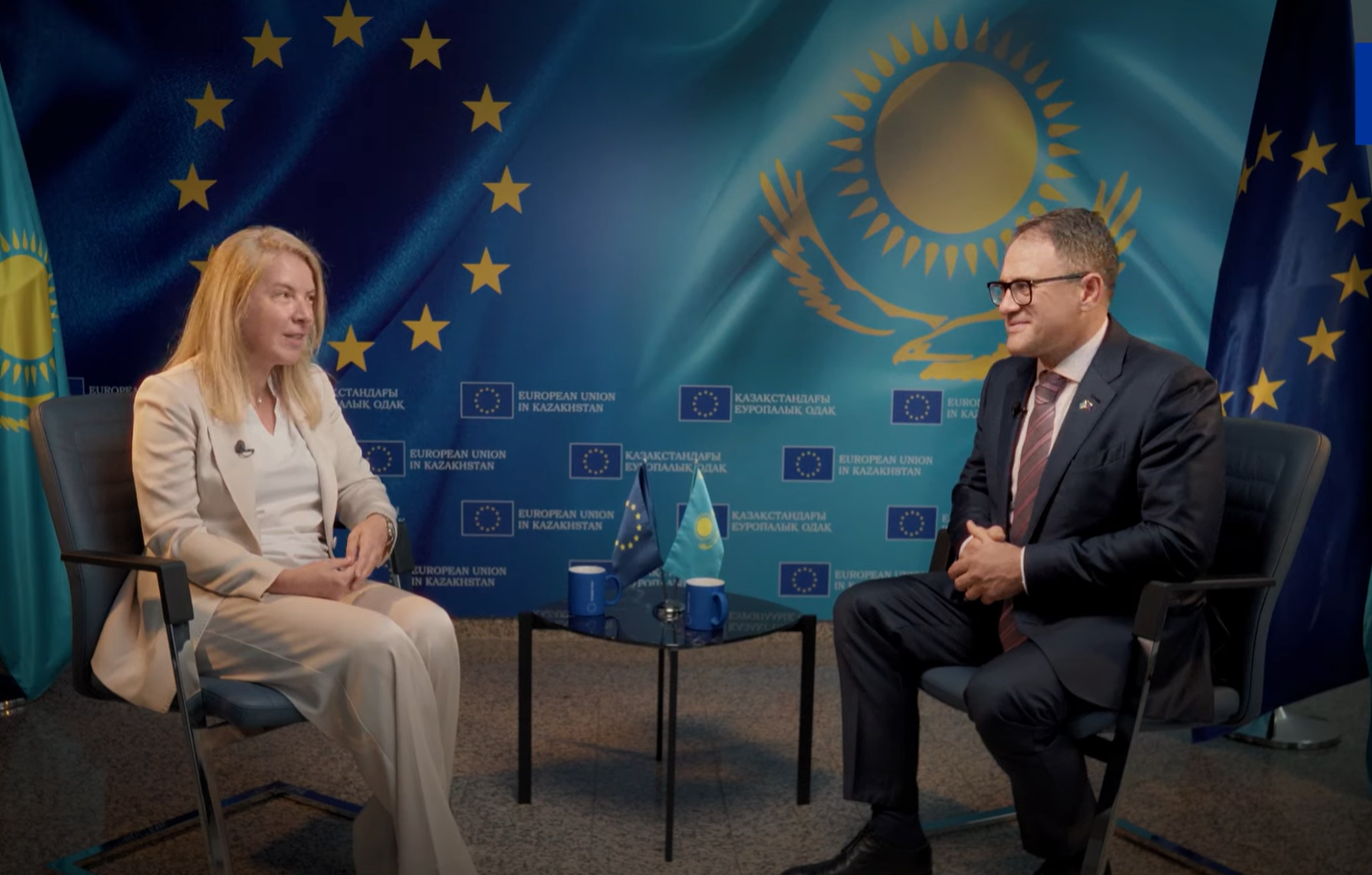
In a recent podcast discussion, EU Ambassador to Kazakhstan Aleška Simkić and Kazakhstan’s Ambassador to the EU and NATO, Roman Vassilenko, discussed the evolving relationship between the European Union and Kazakhstan and broader Central Asia. Their exchange offered insight into the shared strategic interests driving EU–Kazakhstan cooperation across trade, energy, critical raw materials, connectivity, and mobility.

Trade and Investment: A Stable Foundation
Trade and investment continue to underpin the relationship; the European Union remains Kazakhstan’s largest trading partner and top foreign investor. Bilateral trade reached $49.7 billion in 2024, with the majority comprising energy exports from Kazakhstan, highlighting its role as a key supplier to European markets. The EU collectively accounts for a significant share of Kazakhstan’s FDI, equal to €54.8 billion in 2022, representing approximately 50–55% of Kazakhstan’s total FDI.

The Enhanced Partnership and Cooperation Agreement (EPCA), in effect since 2020, underpins the EU–Kazakhstan bilateral relationship, providing a legal framework for cooperation across 29 sectors. As noted by both ambassadors, it enables structured dialogue on trade, energy, governance, and sustainability. While political engagement has increased, both sides acknowledge that deeper implementation is needed to fully leverage the EPCA in line with the EU’s broader strategy for Central Asia.

Roman Vassilenko acknowledged the recent momentum: “I think the relationship between Kazakhstan and the EU has strengthened tremendously over the past three and a half years. With a relatively new Commission in place in Brussels, and with the President of Kazakhstan committed to strengthening ties with the European Union as part of our balanced and pragmatic foreign policy, we are at a moment where we can truly advance, deepen, and strengthen our relations in many ways.”

EU Ambassador to Kazakhstan, Aleška Simkić (left) with Kazakhstan’s Ambassador to the EU and NATO, Roman Vassilenko (right); Image: EU Delegation to Kazakhstan.

Energy and Raw Materials: Strategic Realignment
While energy has long anchored EU–Kazakhstan ties, both ambassadors emphasized a shift toward broader, forward-looking cooperation. Ambassador Vassilenko identified critical raw materials and green hydrogen as emerging areas of strategic importance, offering Kazakhstan opportunities to diversify its economy while supporting the EU’s green transition.

Kazakhstan, with its mineral wealth and renewable energy potential, is well-positioned to contribute to Europe’s supply chain resilience in clean technologies. The country’s abundant reserves of critical minerals—such as rare earths, copper, lithium, and cobalt—align with Europe’s need to diversify sources for its green transition. Coupled with growing investment in renewable energy and deepening cooperation with European partners, Kazakhstan stands out as a strategic supplier for clean-tech industries.

Both envoys stressed the importance of moving from basic resource exports toward long-term industrial partnerships — including local processing, infrastructure development, and regulatory alignment — as a means of ensuring mutual benefit.

Connectivity: The Middle Corridor and Infrastructure Links
Connectivity also features prominently. The Trans-Caspian International Transport Route, or “Middle Corridor,” is increasingly viewed as a viable overland route connecting China to Europe via Kazakhstan. Cargo volumes have risen, and both the EU and regional stakeholders are investing in capacity upgrades. The EU’s Global Gateway strategy includes a €12 billion commitment to infrastructure in Central Asia, covering transport, energy, and digital initiatives.

Connectivity was identified by both ambassadors as a strategic priority, with Vassilenko emphasizing the growing importance of the Middle Corridor and describing it as a key area for advancing regional integration and EU-Kazakhstan cooperation. Indeed, the EU–Kazakhstan collaboration now includes a dedicated Coordination Platform for the corridor’s development, aimed at strengthening transport links and infrastructure across the region.

As the ambassadors stressed, connectivity is not just logistical — it’s geopolitical. The Middle Corridor is becoming a central pillar of Kazakhstan’s role as a bridge between Asia and Europe.

Mobility: Negotiating Easier Access
Mobility remains a point of interest, particularly in light of Kazakhstan’s interest in visa facilitation with the EU. Negotiations are expected to begin in the fall of 2025 though outcomes will depend on alignment with EU visa policies and migration standards. Both ambassadors described greater people-to-people contact as a long-term investment in bilateral relations.

Strategic Context and Outlook
The EU’s broader engagement with Central Asia has gained urgency amid geopolitical tensions and supply chain disruptions. At the inaugural EU–Central Asia Summit in Samarkand in April 2025, leaders adopted the Samarkand Declaration, elevating relations to a strategic partnership and reaffirming respect for sovereignty and territorial integrity. The EU reaffirmed its “commitment to deeper cooperation in an evolving global and regional geopolitical landscape [and] upgrade relations between the European Union and Central Asia to a strategic partnership.”

As EU Ambassador Aleška Simkić noted in the recent dialogue: “We must continue to engage with geopolitics constructively. Both the EU and Kazakhstan share a commitment to the UN Charter and a peace-oriented agenda. I also see potential in regional integration. While the EU has its internal challenges, Central Asia is moving closer together. Kazakhstan plays a key role in that. Continued progress in regional cooperation offers significant opportunities.”

However, challenges remain. EU investment, while increasing, is still competing with a substantial Chinese and Russian economic presence. Additionally, practical barriers — ranging from infrastructure bottlenecks to regulatory fragmentation — could slow progress.

Nonetheless, there is cautious optimism. As the EU seeks to diversify its supply chains and develop more resilient partnerships, Kazakhstan has positioned itself as a relevant player. Whether that translates into durable, balanced cooperation will depend on sustained policy alignment, transparency, and mutual accountability.

Kazakhstan Faces Turbulence as External Pressures Mount

Kazakhstan, Central Asia’s largest economy, is facing a convergence of pressures, from currency depreciation and geopolitical turmoil to volatile oil markets and contentious fiscal reforms, that are testing its economic resilience.

Geopolitical Pressures Escalate

By mid-2025, it had become increasingly apparent that Kazakhstan has limited capacity to influence global geopolitical dynamics. Like many “middle powers,” the country must adapt to the actions of larger states, whose unpredictable decisions continue to exert downward pressure on the tenge and fuel inflation.

On July 28, U.S. President Donald Trump shortened a previously issued 50-day ultimatum to Russian President Vladimir Putin, giving him just 10-12 days to agree to a peace deal with Ukraine. This development added to the mounting uncertainty already impacting Kazakhstan’s economy.

As previously reported by The Times of Central Asia, analysts warn that Trump’s secondary sanctions, 100% tariffs targeting Russia’s trading partners, could potentially be extended to Kazakhstan and other Central Asian economies. Though Kazakhstan is not among Russia’s largest trading partners, its economic links to Moscow are still substantial. The country relies heavily on imports from Russia, including electricity, gasoline, food, and medicine.

Adding to the pressure, on July 7, Trump announced a 25% tariff on Kazakhstani goods, effective August 1, 2025. While $1.8 billion of Kazakhstan’s $2 billion in exports to the U.S. (mostly oil, metals, and rare earth elements) are exempt, the move has nonetheless rattled Kazakhstan’s already fragile industrial sector and spooked investors.

Oil price instability, largely driven by Western efforts to curtail Russian exports, also poses a major risk. Oil revenues make up the bulk of Kazakhstan’s export income and are a key source of budget financing.

Further complicating matters, new Russian restrictions require foreign tankers to obtain Federal Security Service (FSB) approval before accessing key Black Sea ports. This affects the Caspian Pipeline Consortium (CPC), which handles more than 80% of Kazakhstan’s oil exports and is partly owned by U.S. firms Chevron and ExxonMobil. Reuters estimates the new rules could disrupt over 2% of global oil supply.

Tenge Hits Historic Low

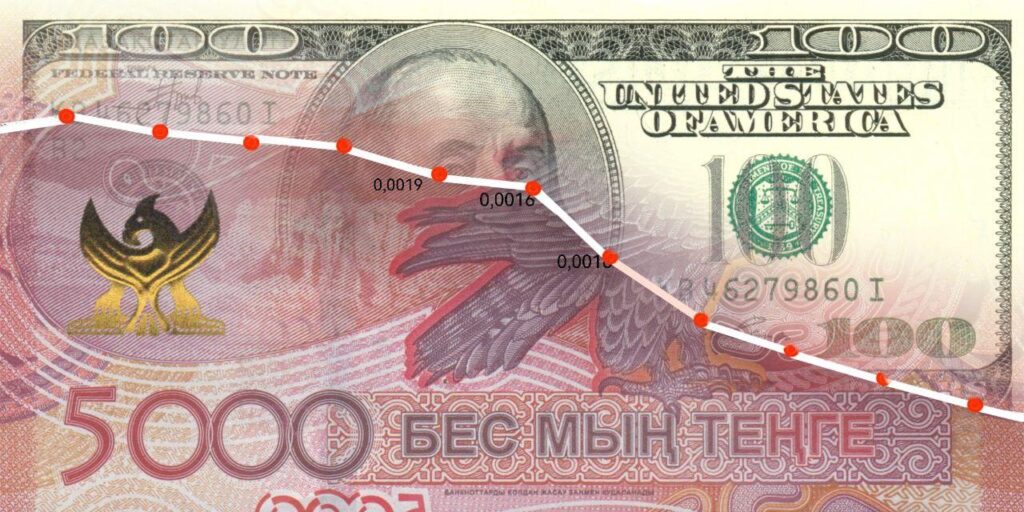
As of July 28, the tenge dropped to a record low of 544.87 per U.S. dollar. The depreciation is driving up the cost of imports, an acute problem in an import-dependent economy, pushing more families to spend over half their income on food.

Companies with debt obligations in U.S. dollars are also seeing their liabilities grow, worsening the investment climate and prompting firms to scale back on planned expansions.

Central Bank Warns Against Intervention

National Bank Chairman Timur Suleimenov cautioned against government intervention in currency markets, stating that past administrative controls led to abrupt and damaging devaluations.

Suleimenov blamed rising fiscal injections and an 18% increase in money supply for the tenge’s vulnerability. He warned that unless GDP and industrial output keep pace with monetary growth, currency pressure will persist. Although Kazakhstan has $52.2 billion in reserves to mitigate speculative shocks, the governor insisted that intervention should be reserved for market distortions, not fundamental shifts.

Structural Trade Imbalances Deepen

Economist Yernar Serik noted via his Telegram channel, Tradereport, that growing imports of foreign equipment, driven by industrial modernization, are compounding exchange rate pressures. In June 2025 alone, domestic firms spent 652 billion KZT ($1.2 billion) on machinery, a 47% increase from May and 35% higher year-on-year.

Serik also highlighted a deteriorating trade surplus: from $9.5 billion in January-May 2024 to just $6 billion in the same period of 2025. While exports fell 9% to $29.8 billion, imports rose to $23.7 billion. “This trade pattern means Kazakhstan now earns less foreign currency while spending more of it,” Serik said. “The weakening of the tenge isn’t a conspiracy; it reflects the laws of supply and demand.”

Fiscal Reforms Spark Backlash

In a bid to stabilize the economy, President Kassym-Jomart Tokayev signed a new Tax Code on July 18, introducing a 16% standard VAT rate and setting reduced rates for medicine and healthcare services from 2026.

The reforms have triggered strong resistance from the business community. Industry associations and entrepreneurs argue that the changes will stifle business activity, increase administrative burdens, and raise the risk of corruption.

“Due to the increased tax burden, businesses will raise prices, rents will climb, and consumer demand will fall,” warned Berik Zairov, chair of the Union of Independent Businesses of Kazakhstan. Experts also forecast a further drop in small business numbers and a negative impact on wages and investment.

Economic Crossroads: Kazakhstan Faces Prolonged Volatility

As Kazakhstan navigates this storm of external shocks and domestic challenges, the coming months will test the government’s ability to balance fiscal discipline with economic support. While officials are betting on cautious monetary policy, structural reforms, and resilient oil exports to prevent a deeper crisis, the country’s dependence on external markets leaves it exposed to forces beyond its control. Without a decisive shift in trade dynamics or geopolitical relief, Central Asia’s largest economy may face a prolonged period of volatility that reshapes its growth trajectory.

Turkmenistan’s Strategic Reentry into Gas Diplomacy

Turkmenistan holds the world’s fourth-largest proven gas reserves. And yet, its energy diplomacy has until quite recently remained inert. The paradox is systemic: it possesses more gas than infrastructural escape routes; yet as demand for non-Russian energy rises across Eurasia’s westward axis, Ashgabat’s relevance grows, not so much because it radically evolves but because the system around it does.

Historically, 80–90% of Turkmen gas has flowed east through the Central Asia–China pipeline, sometimes called the Turkmenistan–China corridor. The dependency is acute, and the pricing asymmetrical. Previous efforts to increase flows in other directions — across Iran, via Azerbaijan, southward to South Asia, or across the Caspian Sea — have been dashed on the rocks of logistics and geopolitics. The early 2000s were especially pivotal, when Turkmenistan’s delay in engaging with the EU’s Southern Gas Corridor initiative shaped a decade of missed leverage. What we are seeing now is not a late start but a late modulation of the country’s energy vectors across weakly emerging paths.

Geoeconomic Constraints as Strategic Catalysts

Dependency on China as a monopsonist (sole purchaser) implies not just limited diversification but two deeper vulnerabilities. First, price-setting mechanisms remain inscrutably opaque. Second, the lack of alternative outlets structurally reinforces the asymmetry. Attempts to broaden options through Iran or Azerbaijan, though nominally ongoing, rely more on swaps than corridors, and even these are uneven.

The Dauletabad–Sarakhs–Khangiran pipeline, completed in 2010, should have represented a minor second axis. However, it operates at a trickle, if at all, due to Iran’s past failure to pay contracted sums in a timely fashion, requiring international arbitration. Another example is the Turkmenistan–Afghanistan–Pakistan–India (TAPI) pipeline, discussed since the 1990s, and in which India lost interest two decades ago. TAPI remains on hold, hampered by Afghanistan’s security volatility and a practical lack of commercial prospects that produce financing shortfalls.

The Trans-Caspian Gas Pipeline (TCGP) was long stalled by legal uncertainties over Caspian Sea seabed rights and opposition from Russia and Iran. Even since the sea’s status under international law was settled by the Caspian Convention, signed in 2018, planning for this pipeline remains somnolent, despite its removal of many legal barriers to TCGP construction.

Swap agreements are usually regarded as workaround tools, but for Turkmenistan, they have become more permanent structural mechanisms, allowing Ashgabat to insert itself into third‑party supply chains without transit risk. Iran’s infrastructure is unreliable but offers compression and metering; Azerbaijan’s network enables reverse flows and flexibility.

A modest but symbolically important addition is the Dostluk field, a previously disputed offshore deposit between Azerbaijan and Turkmenistan in the Caspian Sea. A 2021 Memorandum of Understanding resolved maritime delimitation and designated the field for joint development.

Even when summed all together, these vectors remain mainly null. Once seen as “backup” export routes, they have failed structurally. Turkmenistan, infrastructurally entangled yet geopolitically uncommitted, still lacks true backup and instead manages redundancy, maintaining multiple provisional export channels simultaneously. It must still respond adaptively to shifting constraints while balancing fragile options.

Turkmenistan’s Attempts to Rewire Its Client Network

Since 2023, Ashgabat’s behavior has shifted. Bilateral agendas have softened, and regulatory murmurings hinted at pragmatic change. In February 2025, Turkmenistan finalized a gas swap with Ankara whereby Turkmenistan would deliver up to 2 bcm/y to Iran while Türkiye received an equivalent volume via its northern pipeline grid. Flows began on March 1 this year, with Türkiye’s offtake volume by year’s end projected at 1.3 bcm. For a country that consumes 50 bcm annually, it’s marginal. For Turkmenistan, it’s a crossing.

Though small relative to Türkiye’s 50 bcm/y consumption, the swap symbolizes its diversification beyond Russia and Iran, even as Turkey develops domestic offshore production in the Sakarya gas field. A similar framing applies to Iraq. In 2024, an MOU was signed with Turkmenistan for five years of supply. Implementation, however, has stalled due to U.S. sanctions on Iran complicating Iraqi payments. Nonetheless, the architecture is important: Turkmen gas would help shore up Iraq’s north‑central grid amid Iranian shortages.

The EU remains marginal but attentive. Since 2023, high-level EU delegations have resumed consultations in Ashgabat. Hungary has lobbied for deeper engagement within the Turkic States format; Romania and Bulgaria have signaled quiet interest in Caspian–EU tie-ins via Georgian connectors. These include not only the Bulgaria–Romania–Hungary–Austria (BRUA) pipeline, but also the reverse-flow, which has just begun through the Trans-Balkan Pipeline (TBP) to Ukraine, from where larger volumes could eventually reach Europe itself.

Brussels’s 2024 update to its Central Asia Strategy emphasized energy interdependence, if cautiously. Meanwhile, companies like Eni and OMV have renewed dormant feasibility studies in Turkmenistan’s western fields. These engagements operate as symbolic client activation that expresses Ashgabat’s readiness to pre-structure possible corridors.

Changing Systemic Significance of Turkmenistan’s Neutrality

Turkmenistan’s long-standing rhetoric of “positive neutrality” is now less of an ideological posture and more of a practical mode of functioning. The attempt to implement it through the country’s gas diplomacy illustrates this shift, exhibiting three systemic properties. First, Ashgabat is trying to distribute its leverage. No longer really counting on one breakthrough pipeline (such as TAPI or TCGP), Turkmenistan is implementing a series of smaller, incremental linkages. Second, this strategy, where multiple channels operate in parallel, creates the principle of redundancy and optionality, reducing reliance on any one route and allowing for adaptive shifts. Third, swap diplomacy can adjust faster than large-scale infrastructure projects, also permitting swift diplomatic signaling.

Turkmenistan’s neutrality is ceasing to be an absence of alliances and becoming an ongoing reconfiguration of possibilities. The several corridors do not destabilize the overall field of geoeconomic constraints. Ashgabat cooperates with partners without aligning itself, not yet hedging but seeking strategic leverage. In this connection, it is very significant that Ashgabat has also increased its engagement in what may be called technical multilateralism: OSCE energy working groups, Turkic States logistics forums, and EU–Central Asia energy roundtables.

Turkmenistan’s Significance for the Evolving Caspian Sea System

Turkmenistan’s gas diplomacy in 2024–2025 continues to seek to rebalance its geoeconomic system. The economy is still trying to avoid betting on a single pipeline by investing in multiple, contextual, contingent connections. From Türkiye via Iran, to nascent Iraqi flows, to pipelines through Azerbaijan, Ashgabat is reframing its historic neutrality as flexibility.

Constrained by overreliance on China and stalled corridor projects like TAPI and TCGP, Ashgabat is now adopting a modular, multi-vector posture: leveraging swap arrangements, logistical intermediaries, and symbolic client activation across Türkiye, Iraq, and the EU. Turkmenistan’s “positive neutrality” has evolved into a method for modulating infrastructural connections in an attempt to manage constraints. In the Caspian system-of-systems, Turkmenistan emerges as an “interstitial” node mediating the network by redistributing its shifting tensions.

A mid-July 2025 meeting between the Chair of the Turkmenistan People’s Council, Gurbanguly Berdimuhamedov, and Azerbaijani President Ilham Aliyev in Baku gains significance in this context: it is emblematic not because of final deliverables, but because of its focus on corridor-building dynamics. Turkmenistan appears to be learning to live within system constraints, using gas diplomacy as a principal interface with its geopolitical environment.

Within the systems logic set out above, the Baku meeting marks a point of coupling between Turkmenistan’s flows and the Azerbaijani-Turkish node. Azerbaijan has also deepened institutional coordination outside the energy sector, as container traffic along the Turkmenbashi-Baku route has risen sharply, increasing bilateral logistical interdependence. Not a high-profile summit, the meeting marks routine energy planning, with the routine itself signaling the operation and standardization of a modular multi-vectorism by Ashgabat.

This approach confirmed a phase shift in Turkmenistan’s practice of neutrality from rigid nonalignment to selective entanglement. Ashgabat’s strategy is neither an abrupt realignment nor an overt turn to the West, but rather an adjustment in diplomatic posture whereby gas transit animates a dynamic system of geoeconomic extension within the broader configuration of policy issue-areas.

The meeting and its results underscore the general argument offered here, about how the Caspian Sea basin is becoming a “system-of-systems”: trade corridors, pipeline paths, financial architectures, and diplomatic cooperation within and beyond the region; these phenomena include Kazakhstan’s oil swaps through Azerbaijan, Georgia’s infrastructural dependability, and Russia’s tolerance of swaps but resistance to TCGP. Turkmenistan’s relevance lies not in its scale of activity or level of integration, but in how it modulates friction among larger actors by utilizing its gas resources as an instrument of differential connectivity.

EU Grants Kazakhstan Exemption to Transit Coal Through Sanctioned Russian Ports

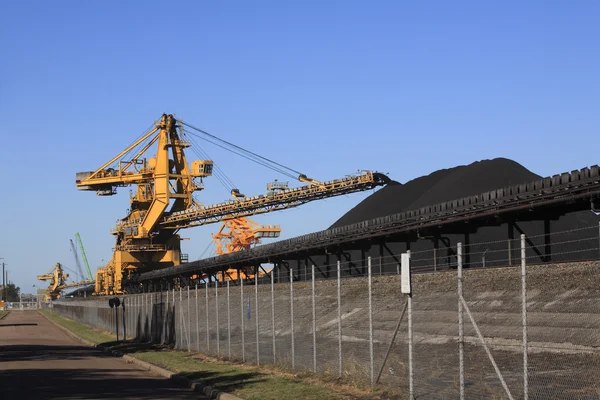
The European Union has granted Kazakhstan an exemption permitting the transit of Kazakh coal through select Russian ports previously restricted under EU sanctions. The decision, included in the EU’s 18th package of sanctions, aims to secure Kazakhstan’s coal exports to Europe.

The exemption follows months of negotiations led by the Ministry of Trade and Integration, the Ministry of Foreign Affairs, and Kazakhstan’s Permanent Mission to the EU. The talks were prompted by sanctions introduced in February 2024 under the 16th EU sanctions package, which included a ban on transactions with Ust-Luga port, one of the main routes for Kazakh coal shipments to the EU.

“To resolve the situation, work was carried out at various levels and an official request was sent to the European Commission asking for changes to the sanctions regime,” the ministry stated. “As a result, the 18th package of EU sanctions contains amendments allowing transactions with a number of Russian ports for the transit of coal of Kazakh origin.”

Conditions of the Exemption

The exemption is conditional and tightly regulated:

  • Only coal of Kazakh origin may be transited;
  • Ownership of the cargo must not involve entities from countries under EU sanctions, including Russia and Belarus;
  • The designated Russian ports may be used solely for transit purposes, specifically loading and dispatch, without any procurement or production activities on site.

Trade Impact

Kazakhstan remains a key coal supplier to the European market. In 2022, it exported 4.4 million tons of coal to the EU, generating $419.2 million, representing 45% of total coal exports. Although volume increased to 6.1 million tons in 2023 (54.3%), falling global prices reduced revenue to $382 million. In 2024, exports declined to 5.2 million tons worth $312.5 million (51.8%).

During the first five months of 2025, Kazakhstan exported 1.6 million tons to the EU, generating $82.9 million and accounting for 38.5% of total coal exports over that period.

“Despite the temporary decline in indicators, the measures taken are creating conditions for the restoration of export flows and increased stability of logistics routes,” the ministry said. “Kazakhstan will continue to work to protect trade interests, support national exports, and strengthen economic ties with key partners.”

As previously reported by The Times of Central Asia, domestic coal consumption in Kazakhstan is expected to decrease due to government plans to phase out pilot coal-fired power plants in favor of renewable energy and low-carbon technologies, including gas.