• KGS/USD = 0.01144 0%
  • KZT/USD = 0.00192 -0%
  • TJS/USD = 0.10849 0%
  • UZS/USD = 0.00008 0%
  • TMT/USD = 0.28571 0%
  • KGS/USD = 0.01144 0%
  • KZT/USD = 0.00192 -0%
  • TJS/USD = 0.10849 0%
  • UZS/USD = 0.00008 0%
  • TMT/USD = 0.28571 0%
  • KGS/USD = 0.01144 0%
  • KZT/USD = 0.00192 -0%
  • TJS/USD = 0.10849 0%
  • UZS/USD = 0.00008 0%
  • TMT/USD = 0.28571 0%
  • KGS/USD = 0.01144 0%
  • KZT/USD = 0.00192 -0%
  • TJS/USD = 0.10849 0%
  • UZS/USD = 0.00008 0%
  • TMT/USD = 0.28571 0%
  • KGS/USD = 0.01144 0%
  • KZT/USD = 0.00192 -0%
  • TJS/USD = 0.10849 0%
  • UZS/USD = 0.00008 0%
  • TMT/USD = 0.28571 0%
  • KGS/USD = 0.01144 0%
  • KZT/USD = 0.00192 -0%
  • TJS/USD = 0.10849 0%
  • UZS/USD = 0.00008 0%
  • TMT/USD = 0.28571 0%
  • KGS/USD = 0.01144 0%
  • KZT/USD = 0.00192 -0%
  • TJS/USD = 0.10849 0%
  • UZS/USD = 0.00008 0%
  • TMT/USD = 0.28571 0%
  • KGS/USD = 0.01144 0%
  • KZT/USD = 0.00192 -0%
  • TJS/USD = 0.10849 0%
  • UZS/USD = 0.00008 0%
  • TMT/USD = 0.28571 0%
12 December 2025

Kazakhstan’s Nuclear Diplomacy – With China Set to Build Second, Who Will Construct Third Nuclear Power Plant?

Kazakhstan’s famed hospitality, long enshrined in its national proverbs, has also become a guiding principle in its foreign policy. One recent example is the Kazakh government’s diplomatic maneuvering in the selection of partners for its nuclear power program.

Leader of the Race

Initially, Kazakhstan planned to build a single nuclear power plant by 2035 to address potential electricity shortages. However, following the October 6, 2024, referendum, where 71.12% of voters approved a plant in the Almaty Region, President Kassym-Jomart Tokayev instructed the government to explore the construction of at least two additional facilities. This directive, as it turns out, was both timely and strategic.

In March 2025, the newly formed Atomic Energy Agency, reporting directly to the president, was tasked with overseeing the selection of international consortium leaders. On June 14, the agency announced that Russia’s state-owned Rosatom would lead the consortium to build Kazakhstan’s first nuclear power plant.

Rosatom CEO Alexey Likhachev welcomed the decision, stating that the VVER-1200 Generation 3+ reactors, already operating in Russia and Belarus and selected by partners in Hungary, Egypt, Turkey, Bangladesh, and China, would be used. These reactors, he emphasized, meet international safety standards and integrate both active and passive safety systems.

Tricks Up Their Sleeves

Behind the scenes, the selection process revealed a quiet tug-of-war between Chinese and Russian interests. Ultimately, Rosatom prevailed, thanks, in part, to two strategic moves.

First, Rosatom’s supporters enlisted Assystem, an ostensibly independent nuclear engineering consultancy, to assist Kazakhstan Atomic Power Plants LLP in the evaluation process. The firm’s analysis favored Rosatom.

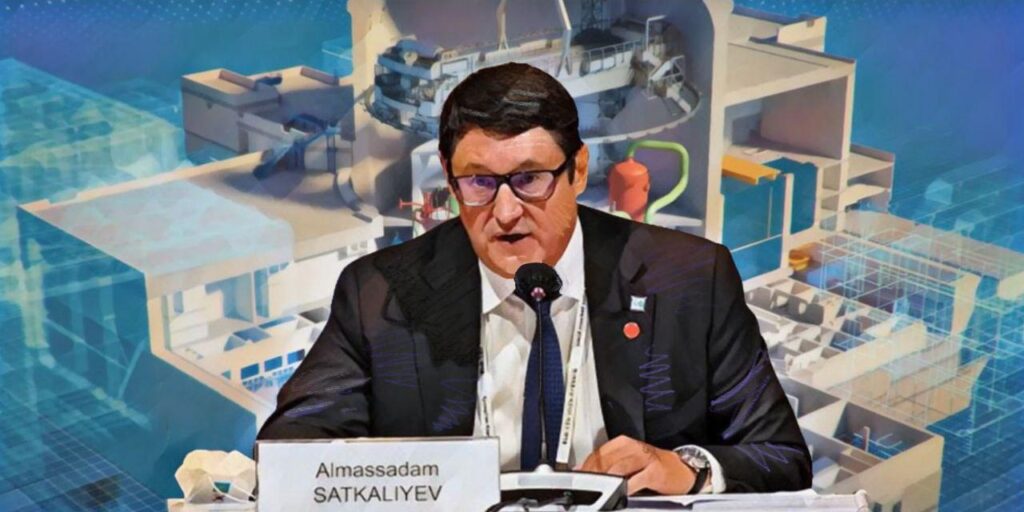
Second, to pre-empt concerns about Western sanctions, the Kazakh authorities emphasized that Kazakhstan would be the sole owner and operator of the facility. Atomic Energy Agency head Almasadam Satkaliev stated that Kazakhstan would control the entire production cycle from uranium mining to fuel processing and plant maintenance, thereby limiting direct Russian involvement post-construction.

This arrangement may allow the creation of a Kazakh legal entity immune to Western sanctions, as it would be wholly state-owned. Whether this could offer Rosatom a loophole for acquiring restricted components remains an open question but one that few may press given the global interest in nuclear safety.

Another Contender Emerges

Just hours after Rosatom’s contract was announced, Satkaliev made a second, equally strategic statement: China National Nuclear Corporation (CNNC) would lead the construction of Kazakhstan’s second nuclear power plant. Satkaliev cited CNNC’s “strongest proposals” and revealed plans for a broader agreement on nuclear cooperation with China.

“Objectively, few countries can master the entire nuclear cycle. China is one of them,” Satkaliev noted.

Back in February, prior to the agency’s creation, Kazakhstan’s Ministry of Energy, then also led by Satkaliev, had identified Kurchatov and Aktau as potential sites for future nuclear facilities. Kurchatov lies near the former Semipalatinsk nuclear test site, while Aktau once hosted the Soviet-era BN-350 fast neutron reactor.

The timing of Satkaliev’s announcement is no coincidence. Chinese President Xi Jinping is scheduled to visit Kazakhstan on June 16 for the second China-Central Asia Summit. For a nation that prides itself on hospitality, delivering news of a Chinese loss in a strategic bidding war just ahead of a state visit would be diplomatically tone-deaf, especially given China’s role as Kazakhstan’s leading investor.

Tokayev’s foresight in authorizing plans for three nuclear plants and establishing a presidentially controlled agency gave Kazakhstan the flexibility to diplomatically appease both Moscow and Beijing within hours.

Who Will Build the Third Plant?

In addition to Rosatom and CNNC, the shortlist of vendors for the third plant includes South Korea’s KHNP and France’s EDF. It now appears likely that one of these Western companies will be tapped to construct the third nuclear power plant, offering Kazakhstan the geopolitical balance it seeks in an increasingly multipolar energy landscape.


Kazakhstan Launches Construction of Strategic Center-West Highway Corridor

Kazakhstan has officially commenced construction of the long-anticipated Center-West highway corridor, a strategic infrastructure project designed to enhance national connectivity and boost the country’s transit capacity. The groundbreaking ceremony took place in the Kostanay region on June 14, marking a major milestone in the implementation of Kazakhstan’s national transport development strategy.

According to the Ministry of Transport, the new highway will stretch 865 kilometers along the route Astana-Zhanteke-Egindikol-Arkalyk-Torgai-Irgiz. Once completed, the corridor will directly link the central and western regions of Kazakhstan and integrate into the Trans-Caspian International Transport Route (TITR), a critical freight corridor connecting China and Europe via Kazakh territory.

One of the most significant logistical benefits of the project is a 573-kilometer reduction in travel distance between Astana and Irgiz, which is expected to substantially cut transit times and enhance freight movement efficiency.

Construction began simultaneously in two directions: one from the town of Arkalyk toward Astana, and the other from the village of Torgai toward Irgiz. This dual-front approach is intended to accelerate the project timeline and streamline construction efforts across Kazakhstan’s expansive steppe terrain.

Speaking at the launch event, Deputy Minister of Transport Satzhan Ablaliyev emphasized the strategic importance of the initiative. He noted that the corridor would not only improve national transport infrastructure and transit capabilities but also enhance regional interconnectivity and accessibility.

Beyond its national scope, the project is expected to deliver substantial local benefits by boosting economic activity in adjacent areas. Increased mobility, expanded trade routes, and job creation, both during construction and in the long term, are among the anticipated outcomes.

The Center-West highway corridor forms a key component of Kazakhstan’s broader strategy to modernize its transport network and solidify its role as a pivotal transit hub between East and West.

Kyrgyzstan Sees Notable Drop in Poverty Rate

Kyrgyzstan’s national poverty rate dropped to 25.7% in 2024, marking a 4.1% decrease from the previous year, according to new data released by the National Statistical Committee of the Kyrgyz Republic.

In 2023, approximately 1.871 million people in the country lived below the poverty line, with nearly 62% residing in rural areas. For 2024, the poverty threshold was set at 65,417 Kyrgyz soms (around USD 748) per capita annually. The extreme poverty line was defined at 41,349 soms (approximately USD 472).

As of January 2025, Kyrgyzstan’s population stood at 7.3 million.

Many Kyrgyz households, particularly in rural communities, depend on remittances from family members working abroad, primarily in Russia. According to The Times of Central Asia, around 600,000 Kyrgyz nationals currently live outside the country, with Russia remaining the primary destination. By the end of 2024, over 379,000 Kyrgyz citizens were registered with Russia’s migration authorities.

A recent World Bank report on migration trends in Europe and Central Asia highlighted the significant economic impact of these remittances. In 2024, remittances accounted for approximately 24% of Kyrgyzstan’s GDP. The report also found that the poverty rate among households with a family member working abroad was under 10% but would exceed 50% without these external income flows.

In a related development, China pledged USD 3.7 billion in assistance to Central Asian countries, including Kyrgyzstan, to support poverty alleviation initiatives. The commitment was announced by Chinese President Xi Jinping at the inaugural China-Central Asia Summit, held in May 2023 in the city of Xi’an.

Xi stated that China would develop a plan for scientific and technological cooperation with Central Asia in the area of poverty reduction and encourage Chinese companies operating in the region to generate more employment opportunities.

Tashkent Turns to Beijing: Uzbekistan’s Military Realignment Reflects Regional Shifts

Uzbekistan is reportedly preparing to acquire fifth-generation fighter jets from China, a move that signals a significant shift in the country’s military strategy, according to the Tashkent Times. Historically dependent on Russian arms, Tashkent is now actively diversifying its defense partnerships, prompting analysts to see this as part of a broader regional realignment in Central Asia’s security architecture.

Experts from Uzbekistan and Kazakhstan told Exclusive.kz that the transition has been years in the making. Zakir Usmanov, a defense analyst at Uzbekistan’s National Scientific Research Center “Bilim Karvoni,” noted that dissatisfaction with Russia’s performance in the Collective Security Treaty Organization (CSTO) was a turning point. “It became clear that Russia was no longer fulfilling its obligations under the CSTO,” he said. In response, Uzbekistan withdrew from the bloc and began upgrading its military with Chinese-made systems, affordable, functional, and supported by flexible financial and logistical arrangements.

“The example of Turkey shows that military modernization can be achieved relatively quickly,” Usmanov explained. “Uzbekistan’s decision to acquire Chinese aircraft is deliberate, they’re cost-effective and come with training and maintenance packages.”

Kazakhstan, by contrast, is taking a more cautious approach. Military expert Daulet Zhumabekov acknowledged similarities in both countries’ efforts to diversify military procurement but emphasized Kazakhstan’s deeper institutional ties to Russia through the CSTO, open borders, and economic integration within the Eurasian Economic Union (EAEU).

“For Kazakhstan, strategic balance is essential,” said Zhumabekov. “Turning completely away from Russia would be impractical, but relying solely on Moscow is also a strategic liability.”

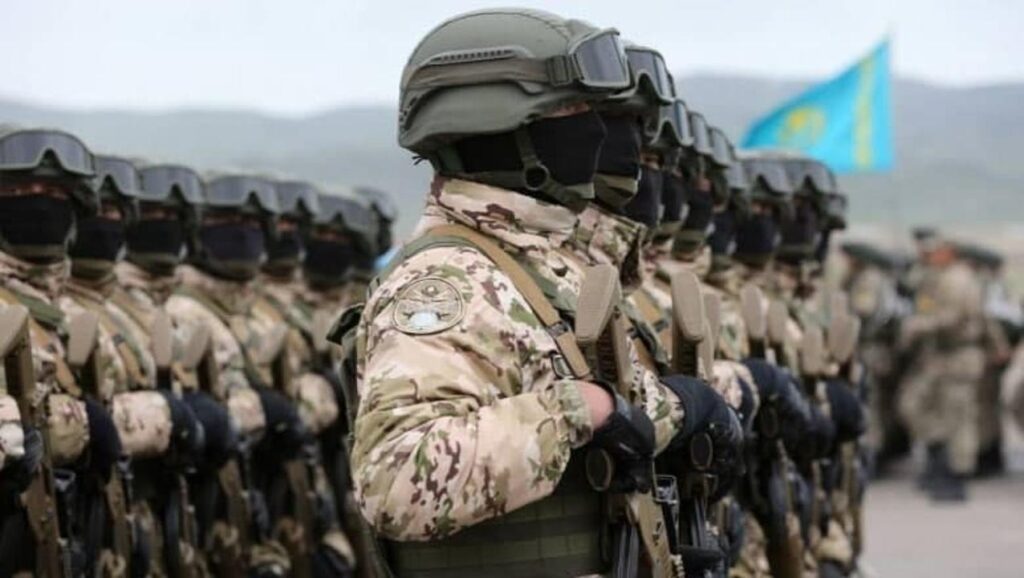
Nevertheless, Kazakhstan has made incremental moves toward diversification, including the purchase of Turkish drones and Airbus transport aircraft, mainly for logistics and peacekeeping rather than combat roles. Zhumabekov pointed out that around 80% of Kazakhstan’s arms and ammunition still come from Russia, which he views as a significant vulnerability.

Kuat Dombay, director of the C5+ Central Asia Studies Center in Kazakhstan, noted that Uzbekistan has moved more decisively. “China’s willingness to share military technology makes it an attractive partner,” he said. He cited Pakistan’s jointly developed JF-17 fighter jet as evidence of Beijing’s growing capabilities. Uzbekistan has already begun pilot training on Chinese platforms, indicating that this is more than a procurement deal, it represents strategic integration.

Dombay also emphasized that defense cooperation with China and Turkey tends to be less politically provocative than with Western nations. “Deals with the U.S. or Europe can provoke backlash from Moscow,” he said. “But agreements with Beijing or Ankara are seen as more neutral.”

China’s ambitions in Central Asia are expanding. A recently released White Paper from Beijing positions China as a potential guarantor of regional security, a role long associated with Russia. With relations with the West under strain, China seeks stability along its borders, particularly in regions critical to its energy and infrastructure initiatives.

Dombay highlighted symbolic diplomacy, such as President Xi Jinping’s first post-pandemic state visits to Kazakhstan and Uzbekistan, during which he explicitly affirmed support for Kazakhstan’s sovereignty, an unusual gesture widely interpreted as a message to Moscow.

“Central Asia can benefit from balancing competing powers,” Dombay suggested. “It’s like Nepal maintaining autonomy between India and China, we can do the same.”

Looking forward, experts believe that real security will require more than diversified procurement. Regional cooperation, including joint defense production and potentially a regional military alliance, is seen as a long-term goal. While both Kazakhstan and Uzbekistan manufacture armored vehicles, production remains duplicative. Dombay argues that a more rational division of labor, modeled on European defense coordination, would benefit all.

Still, political constraints remain. Zhumabekov expressed skepticism that Kazakhstan could lead such an initiative while it remains politically tethered to Moscow. “We’re not yet a fully independent strategic actor,” he said. “Until we can make autonomous decisions, true regional defense cooperation will remain out of reach.”

Nonetheless, the trajectory is clear. With Russia increasingly isolated due to its war in Ukraine and mounting international sanctions, Central Asian countries are quietly seeking alternatives. For now, China appears ready to fill the vacuum.

Bishkek’s Tender to Convert Trolleybuses into Electric Buses Fails, Again

For the second time, a municipal tender in Bishkek aimed at converting trolleybuses into electric buses has ended in failure. According to the Kyrgyz public procurement portal, no bids were submitted for the project, which offered 4.5 million KGS (approximately USD 51,500) per unit.

Following the unsuccessful tender, local media reported that city authorities approached an unnamed Chinese company directly to initiate a pilot conversion of one trolleybus. However, transport industry experts are skeptical, noting that retrofitting Belarusian models designed for overhead power may prove technically complex and economically unjustifiable.

The initiative stems from a controversial municipal decision to transition trolleybuses to battery power rather than restoring the city’s overhead network, which was dismantled between 2023 and 2024 under the “Clean Sky” program. The plan has been heavily criticized by both residents and experts since its inception.

Environmental group #BishkekSmog argued that the cost of converting the city’s remaining 50 trolleybuses could exceed USD 2.5 million.

“Why invest additional millions when the existing trolleybuses are already capable of operating on the overhead contact network?” the group stated. “Moreover, the name of the supposed contractor, a private Chinese company, has not been disclosed, raising concerns about transparency and the quality of any potential work.”

Meanwhile, legal proceedings continue over the municipality’s decision to decommission the trolleybus network. The next hearing is scheduled for June 25 at the Bishkek Administrative Court. Activists and legal advocates argue that the dismantling violated international loan agreements and undermined the long-term sustainability of the city’s public transport system.

The Asian Development Bank has distanced itself from the city’s current strategy, stating that it does not support the conversion initiative and had no involvement in the project.

Kazakhstan’s Automotive Industry to Produce Nearly 150,000 Vehicles in 2025

Kazakhstan’s automotive industry is projected to manufacture approximately 149,000 vehicles in 2025, according to government forecasts. This figure represents a 5% increase over 2024, when the country produced 134,000 vehicles.

“This year, the automotive industry is expected to increase domestic car production to 149,000 units, or 5% more than in 2024,” the government stated. The growth is being driven by several new car assembly projects initiated in 2025, including the construction of the Astana Motors Manufacturing Kazakhstan multi-brand plant in Almaty.

Located in Kazakhstan’s largest city, the Almaty facility will begin assembling Chinese automotive brands such as Chery, Haval, and Changan. The project has attracted investments totaling KZT 202 billion (approximately USD 397.3 million) and is expected to produce up to 120,000 cars annually while creating more than 3,600 jobs. The development is also expected to stimulate related industries, particularly in auto parts manufacturing.

Meanwhile, in Kostanay, the construction of a new KIA Kazakhstan plant is underway. With a projected capacity of 70,000 vehicles per year, the project has received KZT 90 billion (USD 177 million) in investment and will employ around 1,500 workers.

According to the Kazakhstan Automobile Union, 33,100 new vehicles were produced nationwide in the first quarter of 2025. Of these, 18,000 were assembled in Kostanay, 12,900 in Almaty, and the remainder in Semey, the Karaganda Region, Kokshetau, and other locations.

In a sign of the sector’s vertical development, the Almaty Autoparts Production enterprise has commenced operations in the city’s industrial zone. It will manufacture up to 100,000 car seat sets annually for Hyundai vehicles.

The government’s report underscores the role of state policy in advancing Kazakhstan’s machine-building industry, particularly through the formation of investment clusters. “Of the 17 major projects that form the industrial backbone of the economy, nine are overseen by the Ministry of Industry and Construction,” the report noted.

The government’s focus on investment and localization is bearing fruit. In 2023, KZT 115 billion (USD 226 million) was invested in machine building, a figure that more than doubled in 2024 to KZT 282 billion (USD 554 million).

Currently, over 4,000 enterprises are active in Kazakhstan’s machine-building sector. These include 66 large companies, 105 medium-sized firms, and 3,998 small businesses. As previously reported by The Times of Central Asia, the country set a new record for new car sales in 2024.