A pale Milanese dawn draped the city in shifting greys, as visitors crossed the threshold into the space of Fondazione Elpis, a foundation created to promote dialogue with emerging geographies and young artists.
This time, it was Central Asian artists who were in the spotlight, claiming a shared history fractured by Soviet rule and global currents. The show YOU ARE HERE: Central Asia redraws a regional map, allowing artists to redraw the borders of their belonging beyond nation-states. At the same time, it invites each visitor to relate to the works by locating its place within these stitched, erased, and reconfigured narratives.
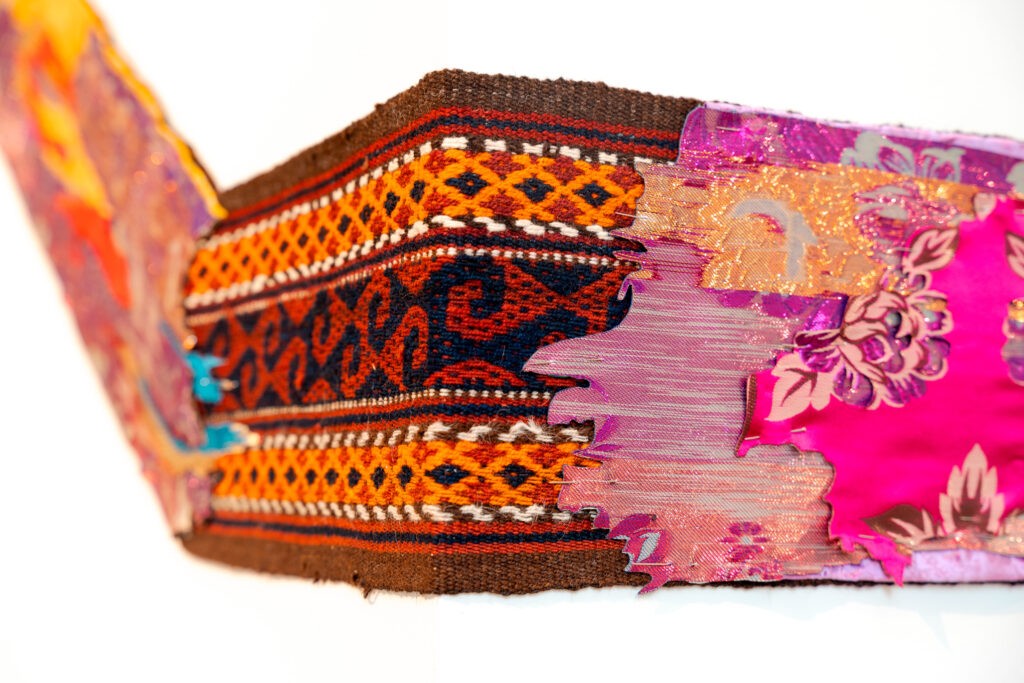
Curators Dilda Ramazan and Aida Sulova orchestrated twenty-seven artists into a living constellation: from Munara Abdukakharova’s rolled patchwork, its golden hammer-and-sickle motifs softened by the hand-stitched curves of Kyrgyz kurak korpe, to Vyacheslav Akhunov’s furious erasures of scraped notes, the show reassembled in unexpected patterns stories of resilience, resistance, and reimagined belonging.
YOU ARE HERE not only reframed Central Asia for a European audience but asserted that the region’s histories are neither static nor singular, they are stitched, erased, reconfigured, and claimed anew by the very people who live them.
The Times of Central Asia spoke with Kazakh curator, Dilda Ramazan.

“YOU ARE HERE. Central Asia”, installation view, primo piano, Fondazione Elpis, Milano © Fabrizio Vatieri Studio
TCA: Can you tell us about the genesis of the show?
The show emerged after the invitation of the Fondazione Elpis, whose founder, Marina Nissim, became interested in the region and its artists after seeing one of the Central Asian pavilions at the Venice Biennale.
By presenting the complex Central Asian landscape to a European public who might not know it very well, we wanted to give artists the platform for free expression without framing the region from the stereotypical perspective, as is often the case in the Western context. We wanted the artists to reflect on the idea of space and belonging through the idea of locating oneself.
TCA: Do you feel there is a growing awareness of Central Asia in Europe?
Yes, I can feel and see it, but it is a natural process one should expect within the logic of globalization. The exhibition addressed the impact of Soviet and post-Soviet transitions on the cultural identities of Central Asian nations by showcasing artists of several generations. Some of them had a direct experience of living under the Soviet regime, so again the artists spoke for themselves and the region’s past through their works.

Emil Tilekov, Traces and Shadows, 2024 © Fabrizio Vatieri Studio
TCA: How is the theme of migration explored in the exhibition, particularly concerning its economic and emotional implications for Central Asian communities?
Migration was one of the key aspects evoked in the show because it is still an experience lived by the artists and/or their relatives and families. Two Kyrgyz artists, for example, raised this issue in their projects.
This was the case in the video by Chingiz Aidarov, who worked as a migrant in Moscow, and a performative piece by Jazgul Madazimova, who produced a new artwork specifically for the show at Fondazione Elpis, reminiscing about her mother’s labor migration to Russia.
Alexei Rumyantsev, a Tajik artist, presented his installation in the shape of a brick wall with ikat, traditional Central Asian fabrics, which also evoked rather poetically the representation of Central Asian migrant labor as a basis for some foundations of other places.

Alexey Rumyantsev, The Wall, 2024 © Fabrizio Vatieri Studio
TCA: How did the exhibition challenge Western-centric perspectives in art by presenting alternative narratives from Central Asia?
I think the exhibition tried to do so by highlighting artist’s experiences without expecting anything from them. All of the selected participants were given carte blanche so that they could talk about whatever they decided was important to share. We, as curators, didn’t have any specific agenda to keep up with; we just followed and trusted the artists.
TCA: How did you choose the artists for the show?
We proceeded via a semi-open call. This means that we addressed a call to a restricted number of artists, not publicly. After, we made our selection from what we received from them as proposals.
TCA: Let’s talk about specific artworks; how does Vyacheslav Akhunov’s technique of erasing texts and images, and Ester Sheynfeld’s collection of the resulting dust in Petri dishes, serve as a metaphor for the deconstruction and preservation of memory?
Vyacheslav Akhunov’s and Ester Sheynfeld’s projects [have a] dialogue with each other. As assistant and teacher, it was important for them to preserve this complementary character of their practices. Akhunov comes to erase his notes, directly and violently, alluding to the process of rewriting history in the region, whereas Sheynfeld is here to preserve and inherit from previous generations. So, despite the loss, which was fabricated and created rather artificially, knowledge could still be saved in Central Asia.

Vyacheslav Akhunov and Ester Sheynfeld, The Disappearance, 2024 / Dust, 2024 © Fabrizio Vatieri Studio
TCA: What is the significance of the materials used in Aika Akhmetova’s Rage Fantasies, and how do they reflect on consumer culture and personal identity?
Aika Akhmetova’s installation was made from materials found in the region. The key element is the Soviet-era blue mailbox, which can still be seen in many of the cities in Central Asia. Part of the architecture of the entrance in any residential building, those mailboxes are rarely in use today since the systems were modernized in Central Asia after the USSR collapsed. But still, they remain, offering the possibility of a different appropriation as a space of communication for teenagers in love or neighbors’ chit-chat. Thus, they become territories of one’s free expression, not really private nor fully public.

Aika Akhmetova, Rage Fantasies (dettaglio), 2023, Installazione site specific © Fabrizio Vatieri Studio
TCA: How does Saodat Ismailova’s Her Five Lives explore the multifaceted experiences of women in Central Asia through its narrative and visual elements?
Saodat Ismailova’s piece centers on female experiences by hijacking the perspective from the male gaze of directors to that of the presence of women who starred in the films. It shows the evolution of heroines, how they were portrayed in the cinema, and how that portrayal evolved under different historical periods.
TCA: What is the conceptual significance of Yerbossyn Meldibekov’s use of aluminum basins in his installation NKVD, and how does it relate to Soviet-era surveillance?
The idea behind using aluminum basins was related to the material’s pliability and plasticity — it easily changes shape under pressure. This was important to provide the installation with a specific visual effect, that of the Central Asian mountain peak that got renamed multiple times under the influence of different political regimes that were present in the region during the last century. Another meaning of using a basin was important for Meldibekov to highlight the object’s initial function. As a washing basin, it showed that history itself could be washed away by those in power.

Yerbossyn Meldibekov, NKVD, 2020-2021, installazione, 4 bacinelle di alluminio, dimensioni variabili © Fabrizio Vatieri Studio
TCA: How does the Qizlar collective’s use of Telegram for video performances challenge traditional notions of artistic space and audience engagement?
Qizlar installation’s idea was to demonstrate that physical location is no longer important in our highly digitalized world of social networks and applications. The artists wanted to make everyone see how they always manage to keep their presence together as a collective even if they are far away from each other. Artistic space, as they show us, is any space produced by artistic gesture. Very much the same applies to Central Asia: it can be anywhere Central Asians are.

Qizlar, In the Circle of My Heart, 2024 © Fabrizio Vatieri Studio
TCA: Finally, can you please tell me about the reception to the show, and how do you hope the show has impacted the knowledge of Central Asia and its contemporary art scene internationally?
I’m happy with how the show went because it was greatly supported by our diaspora in Europe and Central Asians who traveled abroad to see it. I also want to believe that it managed to bring Central Asia closer to Europeans, showing them that we’re not different from them, only that we went through some other experiences in the past. On a very personal level, I learned a lot by doing this project, and I could not be happier to have worked with the amazing team at the Fondazione Elpis.