• KGS/USD = 0.01144 0%
  • KZT/USD = 0.00212 0%
  • TJS/USD = 0.10456 0.19%
  • UZS/USD = 0.00008 0%
  • TMT/USD = 0.28490 0%
  • KGS/USD = 0.01144 0%
  • KZT/USD = 0.00212 0%
  • TJS/USD = 0.10456 0.19%
  • UZS/USD = 0.00008 0%
  • TMT/USD = 0.28490 0%
  • KGS/USD = 0.01144 0%
  • KZT/USD = 0.00212 0%
  • TJS/USD = 0.10456 0.19%
  • UZS/USD = 0.00008 0%
  • TMT/USD = 0.28490 0%
  • KGS/USD = 0.01144 0%
  • KZT/USD = 0.00212 0%
  • TJS/USD = 0.10456 0.19%
  • UZS/USD = 0.00008 0%
  • TMT/USD = 0.28490 0%
  • KGS/USD = 0.01144 0%
  • KZT/USD = 0.00212 0%
  • TJS/USD = 0.10456 0.19%
  • UZS/USD = 0.00008 0%
  • TMT/USD = 0.28490 0%
  • KGS/USD = 0.01144 0%
  • KZT/USD = 0.00212 0%
  • TJS/USD = 0.10456 0.19%
  • UZS/USD = 0.00008 0%
  • TMT/USD = 0.28490 0%
  • KGS/USD = 0.01144 0%
  • KZT/USD = 0.00212 0%
  • TJS/USD = 0.10456 0.19%
  • UZS/USD = 0.00008 0%
  • TMT/USD = 0.28490 0%
  • KGS/USD = 0.01144 0%
  • KZT/USD = 0.00212 0%
  • TJS/USD = 0.10456 0.19%
  • UZS/USD = 0.00008 0%
  • TMT/USD = 0.28490 0%

Kazakhstan and France Join Forces to Save Lake Balkhash

Work has begun in Almaty on the development of a master plan to preserve Lake Balkhash, one of Central Asia’s largest bodies of water. Experts from Kazakhstan and France will collaborate on the project, according to the Ministry of Water Resources and Irrigation of the Republic of Kazakhstan. 

Master Plan for the Balkhash Ecosystem

A two-day seminar has been launched in Almaty, during which a roadmap for the action plan was presented. The document includes an analysis of the water resources in the Ile-Balkhash basin, a study of groundwater reserves, the creation of a digital platform to monitor water levels, and the automation of hydraulic engineering facilities.

Additional measures aim to ensure the more efficient use of the basin’s water resources and involve joint projects with China to protect the Ili River. The French Development Agency (AFD) and the French Geological and Mining Research Bureau (BRGM) are key partners in the project. French experts are currently collecting the necessary data and planning site visits to inspect wells, hydrological stations, and irrigated lands.

The project is overseen by the Ministry of Water Resources and Irrigation of Kazakhstan, with support from Kazakhmys Corporation LLP. The seminar is attended by representatives from Kazakhstani ministries, international organizations, academia, and the Consulate General of France in Almaty.

“For a long time, issues related to Lake Balkhash were addressed on a case-by-case basis, without a unified strategy. To move towards a systematic approach, we are starting to develop a master plan,” said Bolat Bekniyaz, First Deputy Minister of Water Resources and Irrigation.

He emphasized that the plan would consider all aspects of the basin’s sustainability, from ecology and water management to energy, agriculture, and socio-economic development.

Kazakhstan-France Cooperation

The Balkhash preservation initiative builds on earlier agreements between Kazakhstan and France. Last October, it was announced that a memorandum of cooperation and a trilateral agreement, covering groundwater exploration in the Ili-Balkhash basin, were in preparation. 

The French Development Agency (AFD), the French Geological and Mining Research Bureau (BRGM), and the International Water Agency (OiEau) are leading partners in this endeavor.

During a meeting with Kazakhstan’s Minister of Water Resources, Nurzhan Nurzhigitov, French Ambassador Sylvain Guillemot highlighted the growing interest of French companies in constructing and modernizing water facilities, as well as in projects related to leak detection and resource management optimization.

Water Resource Challenges in Balkhash

Separately, on the shores of Lake Balkhash, in the village of Ulken, Kazakhstan plans to build its first nuclear power plant. 

According to unofficial data, since early 2025, approximately 3.8 billion cubic meters of water have been diverted from the Kapshagay Reservoir to Lake Balkhash, a move that has positively impacted the region’s ecological conditions and the Ili River delta. 

Experts have long warned that without a coordinated approach to water resource management, Lake Balkhash risks following the catastrophic path of the Aral Sea. Declining water levels are already impacting biodiversity, climate conditions, and the socio-economic well-being of local communities.

The development of a master plan is viewed as a crucial step in preventing further degradation, promoting sustainable water use, and preserving the ecological balance of the region.

Kazakhstan and Kyrgyzstan Seek to Increase Agricultural Trade

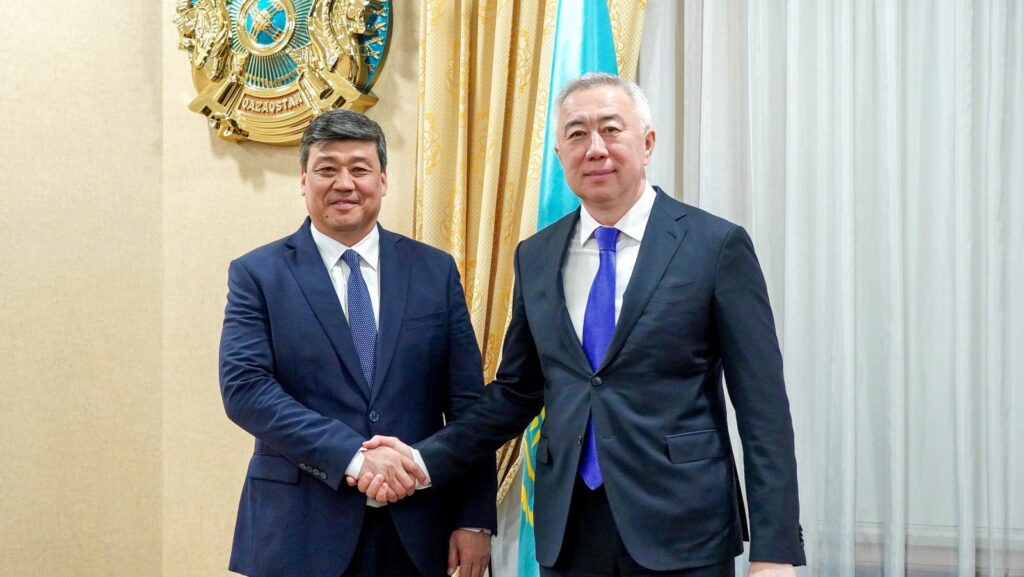
Kazakhstan and Kyrgyzstan have agreed to establish a “green-light corridor” for the export of Kyrgyz agricultural products to Kazakhstan, as well as for the supply of early spring fruits and vegetables from Kyrgyzstan. 

The agreement was discussed during an April 25 meeting in Astana between Kyrgyzstan’s Deputy Chairman of the Cabinet of Ministers and Minister of Water Resources, Agriculture and Processing Industry, Bakyt Torobayev, and Kazakhstan’s Deputy Prime Minister and Minister of National Economy, Serik Zhumangarin.

Kazakh and Kyrgyz officials agreed to jointly determine the list and volumes of agricultural products required by Kazakhstan. Zhumangarin and Torobayev also discussed introducing tariff discounts on rail transportation for Kyrgyz food and agricultural products intended for export and transit through Kazakhstan.

The officials noted the steady growth of Kazakh-Kyrgyz trade, which reached $1.7 billion last year.

Zhumangarin proposed expanding the range of Kazakh goods exported to Kyrgyzstan. 

“We are ready to increase the export of Kazakhstani products across 195 commodity items by more than $260 million,” Zhumangarin stated. He also suggested increasing the export of Kazakh grain and oilseeds to Kyrgyzstan.

Kyrgyzstan Simplifies Process for Obtaining Construction Licenses

The Kyrgyz Ministry of Construction has streamlined the process of issuing licenses to construction companies, eliminating intermediaries and making it possible to obtain a license directly for a fixed fee and within a short time frame. Minister of Construction Nurdan Oruntaev announced the changes via his official Facebook page. 

All documents can now be submitted, and construction licenses obtained, through the Ministry of Construction’s official website. According to the ministry, the number of documents required to obtain a construction license has been reduced significantly, from 23 to just 6.

However, the cost of obtaining a construction license has increased substantially, from 150,000 KGS (approximately $1,700) to 1.5 million KGS (around $17,000).

“Foreign investors, please contact us directly. Do not purchase licenses from unofficial sources. We are ready to issue you a construction license under the simplest conditions: you need only to provide a copy of the relevant license from your country and pay 1.5 million som to the state treasury. No bureaucracy, no queues, just six documents, and the license will be issued within 10 days,” Oruntaev emphasized.

Under the new rules, the procedure for obtaining one-time construction licenses has also been simplified. Companies without a full construction license can now receive a permit for a single project at a specific site.

This reform follows the establishment of the Ministry of Construction earlier in 2025. Previously, licensing and regulatory functions for construction were managed by the Architecture and Construction Agency, which was subordinate to the Ministry of Economy and Commerce.

Kazakhstan to Increase Taxes for High Earners

The Kazakh Ministry of National Economy has submitted a second package of amendments to the tax legislation to parliament, proposing an increase in the individual income tax rate for high earners. The second package was submitted to the Mazhilis (the lower house of the Kazakh parliament) on April 25.

One of the key provisions is the introduction of differentiated individual income tax rates based on employees’ earnings. “Citizens with lower incomes will pay personal income tax at a lower rate than high-paid workers,” the Ministry of National Economy stated. 

The ministry has not specified the exact income levels that will be subject to the higher rate. However, in early April, Minister Serik Zhumangarin indicated to parliamentarians that an increased rate of 15% was being proposed for employees whose annual income exceeds 8,500 monthly calculation indices (MCI).

Currently, one MCI in Kazakhstan is valued at 3,932 KZT ($7.64). By 2026, when the new Tax Code is expected to come into force, it is planned to rise to 4,129 KZT ($8). Based on these figures, the threshold for the increased personal income tax rate would start at 35 million KZT per year (approximately $68,000) or 2.9 million KZT per month ($5,600) in 2026.

Not all of a high earner’s salary would be taxed at the increased 15% rate. Instead, only the portion exceeding the 2.9 million KZT threshold would be taxed at the higher rate; income up to that threshold would continue to be taxed at the standard 10% rate.

Currently, Kazakhstan levies a flat personal income tax rate of 10%. The Ministry of National Economy projects that the introduction of a progressive scale could increase tax revenues by 70 billion KZT per year (approximately $13.5 million).

Additional Tax Code Reforms

The ministry also proposed optimizing deductions for medical, education, and social contributions. A single basic deduction of 30 MCI per month would be introduced, replacing the current deduction of 14 MCI. All additional deductions would be eliminated, aiming to simplify accounting procedures and reduce the administrative burden for individuals and employers.

At present, employees can exempt from taxation a portion of their salary equivalent to 14 MCI, or about 55,000 KZT ($106), upon request. This exemption is available to all working citizens but can be used at only one place of employment. Under the proposed changes, starting in 2026, Kazakhstani citizens would be able to exempt 123,800 KZT ($239) per month from taxation.

The ministry also proposed strengthening liability for violations related to compulsory social and health insurance and the use of special tax regimes. These measures are part of a broader strategy to reinforce tax compliance across the country.

In total, the government has proposed 71 amendments to the draft new Tax Code and related legislation, along with 67 amendments to the current Tax Code.

As previously reported by The Times of Central Asia, the Mazhilis approved the draft of the new Tax Code in its first reading in early April. However, the proposed reforms continue to provoke debate and criticism from deputies, experts, and entrepreneurs. 

Uzbekistan Wins Arbitration Case Against Turkish Textile Company

On October 10, 2024, the International Centre for Settlement of Investment Disputes (ICSID) announced its decision in the case between Turkish company Bursel Tekstil Sanayi ve Dış Ticaret A.Ş. and Uzbekistan. According to Uzbekistan’s Ministry of Justice, the tribunal rejected all claims made by Bursel Tekstil.

The dispute began in July 2017, when Bursel Tekstil accused the Uzbek government of breaching promises related to cotton pricing and tax policies, actions the company claimed had led to its bankruptcy. Bursel Tekstil sought approximately $700 million in compensation. However, the tribunal ruled in favor of Uzbekistan and ordered Bursel Tekstil to cover the country’s legal costs.

Bursel Tekstil had invested in Uzbekistan’s textile industry in the early 2000s, helping to build a textile plant in Tashkent with funding from the OPEC Fund for International Development and the European Bank for Reconstruction and Development. By 2011, the company operated three factories in Uzbekistan.

Uzbekistan was represented in the arbitration by the Ministry of Justice and the American law firm White & Case. Under ICSID rules, the tribunal’s decision is final and binding.

Previously, The Times of Central Asia reported on another ICSID decision in May 2024, ordering the return of four resorts in Kyrgyzstan to Uzbekistan. In that case, Uzbekistan successfully argued that Kyrgyzstan had violated a 1992 agreement among former Soviet Union countries, which stipulates that property belonging to one country but located on the territory of another remains the property of the original owner.

Money Seized from Corrupt Kazakh Officials to Fund Water Pipelines

In Kazakhstan’s Akmola region, water supply systems will be built in the towns of Kosshy and Makinsk using funds seized from corrupt officials. The government of Kazakhstan reported that more than 1 billion KZT (approximately $2 million) from the Special State Fund has been allocated for this purpose.

Water Supply for Kosshy and Makinsk

A total of 476.7 million KZT (about $925,000) has been allocated to complete the construction of a water supply network in Kosshy. The project envisions full centralization of the town’s water supply. Currently, approximately 50 kilometers of pipeline have already been laid, with the total network planned to span 64.1 kilometers. The facility is expected to be operational by the end of this year.

The town’s existing infrastructure is designed for 30,000 residents, while the official population has already surpassed 50,000. According to Kosshy’s General Development Plan, the number of residents could reach 150,000 by 2038.

In Makinsk, the reconstruction of water supply networks is ongoing. The project includes laying 72.7 kilometers of new pipes. To date, 45 kilometers have been completed using previously allocated funds. A new allocation of 606.4 million KZT (around $1.2 million) will enable the full completion of the project, ensuring centralized water supply for the town’s more than 18,000 residents.

Returned Assets Benefit Society

Recovering illegally withdrawn assets has become a key priority of Kazakhstan’s Anti-Corruption Service. This work, based on the principle of “follow the money,” is a major component of the national anti-corruption strategy. Since 2022, over 1.12 trillion KZT ($2.1 billion) has been recovered for the state and quasi-state sector entities. Asset recovery efforts are conducted both domestically and internationally, using cooperation channels such as GlobE, CARIN, and ARIN.

Schools, Medical Centers, and Water Pipelines: How Returned Funds Are Used

The Special State Fund has already financed approximately 280 projects in education, healthcare, social protection, sports, and the modernization of engineering and water networks.

Earlier this year, it was reported that 1.4 billion KZT (around $2.7 million) would be used to build water facilities in 11 villages in the Aktobe region. 

Additionally, in April, 2.5 billion KZT (approximately $4.8 million) was allocated for the reconstruction of the main water pipeline in Turkestan region. These efforts are expected to significantly improve water supply for residents of several rural settlements.

The Ministry of Education also announced that 28 new schools will be built using funds recovered from corrupt officials, providing education to 22,000 children. 

The initiative to use recovered assets for the development of social infrastructure highlights the tangible benefits of anti-corruption efforts, with the projects in Kosshy and Makinsk standing as prime examples of how returned funds can directly improve the lives of citizens.