• KGS/USD = 0.01144 0%
  • KZT/USD = 0.00196 -0%
  • TJS/USD = 0.10899 0%
  • UZS/USD = 0.00008 0%
  • TMT/USD = 0.28490 0%
  • KGS/USD = 0.01144 0%
  • KZT/USD = 0.00196 -0%
  • TJS/USD = 0.10899 0%
  • UZS/USD = 0.00008 0%
  • TMT/USD = 0.28490 0%
  • KGS/USD = 0.01144 0%
  • KZT/USD = 0.00196 -0%
  • TJS/USD = 0.10899 0%
  • UZS/USD = 0.00008 0%
  • TMT/USD = 0.28490 0%
  • KGS/USD = 0.01144 0%
  • KZT/USD = 0.00196 -0%
  • TJS/USD = 0.10899 0%
  • UZS/USD = 0.00008 0%
  • TMT/USD = 0.28490 0%
  • KGS/USD = 0.01144 0%
  • KZT/USD = 0.00196 -0%
  • TJS/USD = 0.10899 0%
  • UZS/USD = 0.00008 0%
  • TMT/USD = 0.28490 0%
  • KGS/USD = 0.01144 0%
  • KZT/USD = 0.00196 -0%
  • TJS/USD = 0.10899 0%
  • UZS/USD = 0.00008 0%
  • TMT/USD = 0.28490 0%
  • KGS/USD = 0.01144 0%
  • KZT/USD = 0.00196 -0%
  • TJS/USD = 0.10899 0%
  • UZS/USD = 0.00008 0%
  • TMT/USD = 0.28490 0%
  • KGS/USD = 0.01144 0%
  • KZT/USD = 0.00196 -0%
  • TJS/USD = 0.10899 0%
  • UZS/USD = 0.00008 0%
  • TMT/USD = 0.28490 0%
08 December 2025

Kazakh Oil Service Providers Urge Government to Curb Chinese Dumping

The Oil and Gas Council of Kazakhstan (PetroCouncil) has appealed to Prime Minister Olzhas Bektenov to address what it describes as unfair pricing practices by Chinese subcontractors in the oil and gas chemical industry.

PetroCouncil, an association representing around 150 Kazakh oil service providers, engineering firms, and manufacturers, published an open letter to the prime minister on its Telegram channel. The letter highlights growing concern over the involvement of foreign companies, particularly from China, in major industrial and oil and gas chemical projects across Kazakhstan.

“By offering services at prices up to 70% below market rates, they are effectively driving out domestic companies,” the council stated. “This creates risks of reduced Kazakhstani content, loss of tax revenue, job cuts, a decline in engineering expertise, and potential threats to quality and industrial safety.”

PetroCouncil argues that the current situation demands systematic government intervention. The organization has proposed several measures aimed at restoring fair competition and supporting domestic industry players.

Among its recommendations is a cap on price dumping in tenders, setting a minimum price threshold no more than 20% below the average market rate. The council also suggests strengthening the weight of the “Kazakh content” criterion when evaluating bids and introducing a “second-best price” principle, favoring local companies when cost differences with foreign bidders are minimal.

Further proposals include stricter oversight of foreign worker permits, enhanced enforcement of labor laws, and the establishment of a national registry of domestic producers involved in oil and gas chemical projects.

As previously reported by The Times of Central Asia, Russian energy giant Lukoil has announced plans to divest its international assets in response to Western sanctions. Kazakh authorities are assessing potential implications for the projects in which Lukoil is currently involved within the country.

Tajikistan’s Government to Introduce AI Browser for Administration

Tajikistan has announced plans to integrate AI into government operations for the first time, aiming to support data-driven decision-making across public administration.

The announcement was made at the AI CONF conference in Dushanbe, one of Central Asia’s largest forums focused on AI. During the event, more than 20 agreements and partnerships were signed, totaling over $117 million.

The headline development was an agreement between Perplexity AI, Epsilon3.ai, and the Ministry of Industry and New Technologies of Tajikistan to launch the Comet AI Browser, described as the world’s first agent-based AI browser tailored specifically for the public sector.

“This collaboration contributes to the formation of a sovereign artificial intelligence ecosystem in the region,” said Epsilon3.ai co-founder Najima Noyoftova. “By combining Perplexity’s cutting-edge technology with our experience in creating government AI systems, we are laying the foundation for self-sufficient digital governance and setting a new standard for responsible AI innovation in Central Asia.”

The Comet browser will replace manual document search and analysis processes, allowing officials to receive real-time analytical reports and policy recommendations. The goal is to accelerate administrative workflows and improve transparency across ministries.

Comet uses natural language processing and deep data analysis to interpret queries, compare sources, and deliver conclusions. It can assist with gathering statistics, drafting regulatory documents, and monitoring procurement activities or economic trends. By automating routine tasks, it is expected to reduce staff workloads and lower the risk of human error.

The project’s pilot phase is scheduled for fall 2025, during which 140 employees at the Ministry of Industry will be trained to use the browser. If successful, the platform will be rolled out to additional government agencies in 2026.

AI Creator Ilona Brazhnik on Kazakh Myths and Creative Freedom

Alena Brazhnikova, better known by her pseudonym Ilona Brazhnik, is in many ways a product of her time. A decade ago, she was transferring art onto skin as a tattoo artist. Today, she creates viral videos powered by artificial intelligence, bringing to life mermaids, Zvezdy, and mythological girls with hooves and wings, symbols of a digital era in which neural networks replace paintbrushes, yet the pursuit of beauty, meaning, and freedom remains unchanged.

TCA: Ilona, did your artistic journey begin with tattooing?

Brazhnik: Yes, it all started rather quickly. When I began, there weren’t many artists in Karaganda, a mining town in central Kazakhstan, offering the style I worked in. At the time, “old school” tattoos with bold, rough lines were popular. But I wanted to explore subtlety, fine lines, and detailed work. Inspired by European artists, I posted an ad online. Within a month, I was fully booked for the next three months. My client base grew on its own because I was offering something different.

TCA: Are there particular tattoo motifs that resonate with you?

Brazhnik: I wouldn’t say I have one favorite. I rotate motifs regularly to avoid burnout. But I do love working with thin lines and soft dot shading, it gives the image depth and detail.

@ilona_brazhnik

TCA: The tattoo trend seems to have quieted. Is that your impression too?

Brazhnik: Absolutely. The hype has passed. There was a time when everyone was getting tattooed just for the sake of it. Now, people are more thoughtful. They take their time, consult with others, and carefully choose their designs. The “everyone’s doing it, so I will too” trend ended around eight years ago.

TCA: You’ve transitioned to AI and now earn money creating videos?

Brazhnik: You could put it that way. There’s definitely demand for AI-generated content. But I didn’t start doing it for the money, I just found it interesting. When people started to respond positively to my work, I thought, why not?

TCA: Your videos are visually striking. How much does a project like that cost?

Brazhnik: It depends on the complexity. Is it a brand advertisement or a fantasy story? Do you need to showcase clothing, jewelry, or a specific location? Will the same character appear throughout? And of course, duration matters. I can only quote a price once I receive the technical brief.

TCA: Are brand commissions more expensive?

Brazhnik: Not necessarily. I never charged tattoo clients more just because they could afford it. It depends on the task. Brand work is usually more technically demanding. AI doesn’t like repetition; it redraws objects each time, so logos, packaging, and inscriptions often need to be added manually. I once made a video where glasses were disassembled into ornaments and then reassembled. When asked to replicate it, it took 20-30 failed attempts. AI just doesn’t do “exactly the same.”

TCA: Did you start making videos to grow your TikTok and monetize content?

Brazhnik: In Kazakhstan, you can’t earn money from views on TikTok. The only monetization is through livestreams, donations, and gifts, and that’s not for me. I can’t even imagine doing it. I’d probably need another pseudonym to go live.

TCA: So, you work under a pseudonym now?

Brazhnik: Yes. My real name is Alena. The pseudonym helped me step into the public eye. I used to have a regular job, didn’t use social media, and didn’t share anything personal. But I wanted to express myself creatively. So, I chose: stay hidden or come forward. Ilona was born. Alena is reserved; Ilona is creative and media-savvy.

@ilona_brazhnik

TCA: Be honest, are you real, or is Ilona a fictional persona created by a team?

Brazhnik: (Laughs.) I’m real. You can check: scroll down my feed, and you’ll see it used to be a personal account with old photos. I never deleted them.

TCA: With the rise of neuro-actresses, are you concerned people might confuse you with them?

Brazhnik: I understand the concern. But neuro-characters are still distinguishable, at least to me. I once did a neuro-photo session using my face. It looked realistic to others, but I could tell it wasn’t me.

TCA: Your videos feature complex lighting and camera angles. Where did you learn that?

Brazhnik: My tattoo work taught me. For ten years, I photographed clients after their sessions. You learn how to light a shot, position the subject, and make the design look appealing.

TCA: Fog is notoriously hard to render in graphics, yet you use fog and underwater scenes. What’s most challenging for AI to generate?

Brazhnik: Water movement. Simple swimming is fine, but realistic motion with splashes is hard. I did a scene for a fitness club, someone swimming beside a dolphin. Nothing looked right. Limbs moved like propellers, and physics broke down. Fast movements are still difficult. Birds flapping their wings look off, though gliding birds are fine. But that’s for videos made from still photos, which is what I work with. Videos generated from scratch might fare better. Interestingly, AI handles animal movement better than humans.

TCA: One of your videos shows a knight in pierced chainmail with a cat on his shoulder, like a short film on loneliness. Have you submitted such works to AI festivals?

Brazhnik: Not yet, but I plan to. I heard about a competition in Dubai. Maybe I’ll enter.

@ilona_brazhnik

TCA: Many AI creators say neural networks struggle with Kazakh ornaments. Yet your work includes many. How do you manage it?

Brazhnik: I often add them manually. Sometimes AI gets close, but usually it’s off. For accurate Kazakh decorations, I use Photoshop, AI assistance, or draw by hand. The issue is the training data; AI has lots of Chinese elements, but very little Kazakh content. We don’t have enough users uploading such images.

TCA: You have a video featuring Tuyaqty Kyz (Tұяқты қыз), a girl with hooves. How did you achieve that effect?

Brazhnik: At first, AI didn’t get it. It showed furry slippers, paws, everything except hooves. Then I found a photo of hoof-shaped shoes in a museum. That helped. I used them as a visual reference and explained, “These are the shoes.” Then the AI understood.

TCA: Does your work get stolen often? Is there any protection?

Brazhnik: It happens a lot. Someone recently downloaded my mermaid video, removed my signature, and posted it as their own. Social media platforms are better now at detecting plagiarism, and exact copies are less likely to spread. I get alerts when someone reposts my work. If they credit me, great, it boosts exposure. But stealing for profit is frustrating. Legally, the only protection is copyright registration.

TCA: You were born in Karaganda, spent your childhood in Almaty, and now live in Astana. Which feels like home?

Brazhnik: Astana. I like its pace; everyone is moving, working, doing something. Almaty is more laid-back; I go there for the mountains. Karaganda is dear to me too. I suppose I’ll always be a Karaganda girl at heart.

TCA: What do you dream of as an artist?

Brazhnik: Freedom. The freedom to express myself, to show people my inner world. To tell my story, to show my soul, and to be understood. That’s what I dream of.

Kyrgyzstan Achieves Self-Sufficiency in Six Staple Food Products

Kyrgyzstan is now fully self-sufficient in six of nine socially important food products: potatoes, milk, meat, vegetables, eggs, and sugar, according to the Ministry of Water Resources, Agriculture, and Processing Industry, which oversees national food security through agricultural production monitoring.

The country achieved full self-sufficiency in sugar in 2024, having previously relied on imports.

Regarding meat, Kyrgyzstan meets its domestic demand for beef and lamb and is close to achieving self-sufficiency in poultry. However, higher meat prices in neighboring Uzbekistan and Tajikistan led Kyrgyz farmers to export meat for greater profits. In response, the government introduced a ban on meat exports and imposed price controls to stabilize domestic markets.

To support local egg producers, the government has banned egg imports amid rising domestic production. Kyrgyzstan now exports chicken eggs; from January to August 2025, the country exported 3.3 million eggs.

The remaining three staple food products, bread (including flour and grain), vegetable oil, and fruit, are still partially dependent on imports.

Kyrgyzstan Introduces Voluntary Loan Ban to Curb Financial Fraud

Starting November 1, Kyrgyzstan will implement a self-restriction mechanism allowing citizens to voluntarily block the issuance of loans and credits in their name, a measure aimed at protecting individuals from financial fraud involving unauthorized loans.

Announcing the initiative at a press conference on October 30, Bektur Aliyev, Deputy Chairman of the National Bank of Kyrgyzstan, said the new regulation comes in response to a rise in cases where fraudsters used fake or stolen passports to secure loans online.

The self-restriction can be activated or revoked remotely at any time via the State Portal of Electronic Services or the Tunduk mobile app. Once submitted, the restriction takes effect immediately, while cancellations require a 12-hour waiting period.

Financial institutions, including banks and microfinance organizations, are legally required to check for any active self-restriction before issuing a loan. If such a restriction is in place, the loan cannot be granted. Should a loan be issued during the restricted period, the contract is deemed legally invalid and the lender has no legal grounds to demand repayment.

According to the National Statistics Committee, microcredit organizations issued over 40 billion soms in loans to more than 567,000 recipients in the first half of 2025. More than 60% of those loans were for consumer purposes, and the volume of microloans increased by 34% compared to the same period last year.

A similar voluntary loan restriction system has been in place in Kazakhstan since 2023.

Kyrgyz Startup Designs ‘Growave’, an E-Commerce Tool to Retain Customers on Shopify

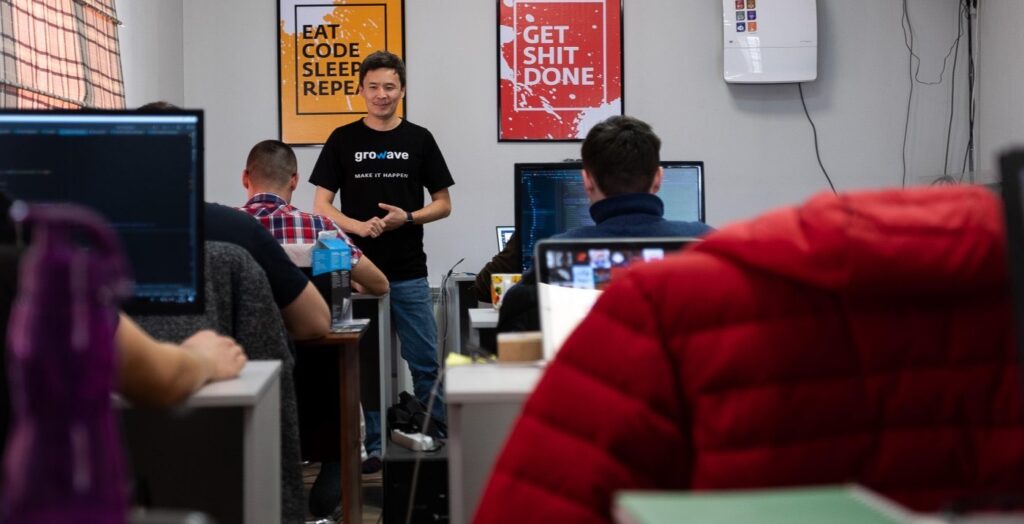
Eldar Galiev is the CEO and Co-Founder of Growave, a Kyrgyz startup that helps companies retain customers on the retail platform Shopify. 

“There were times in my life when I seriously thought about moving abroad. The deciding factor [in staying] was the realisation that many people close to me live in the Kyrgyz Republic. That is something to be cherished. That is why I stayed here”, explained Galiev in 2020.

Success after several failures

Galiev started his career early. During his sophomore year, he started working for the software company Skalfa. Like many talented founders, he left university during his senior year to focus on building his own products.

Growave was not the first company Galiev started. “My first serious project, Hire-Experts, came after three years of working at a product company. At that point, I decided to start my own business and found a startup. The first two attempts failed. The third one, Hire-Experts, turned out to be more or less successful — it later became a company that develops software solutions for online communities,” Galiev said in 2021.

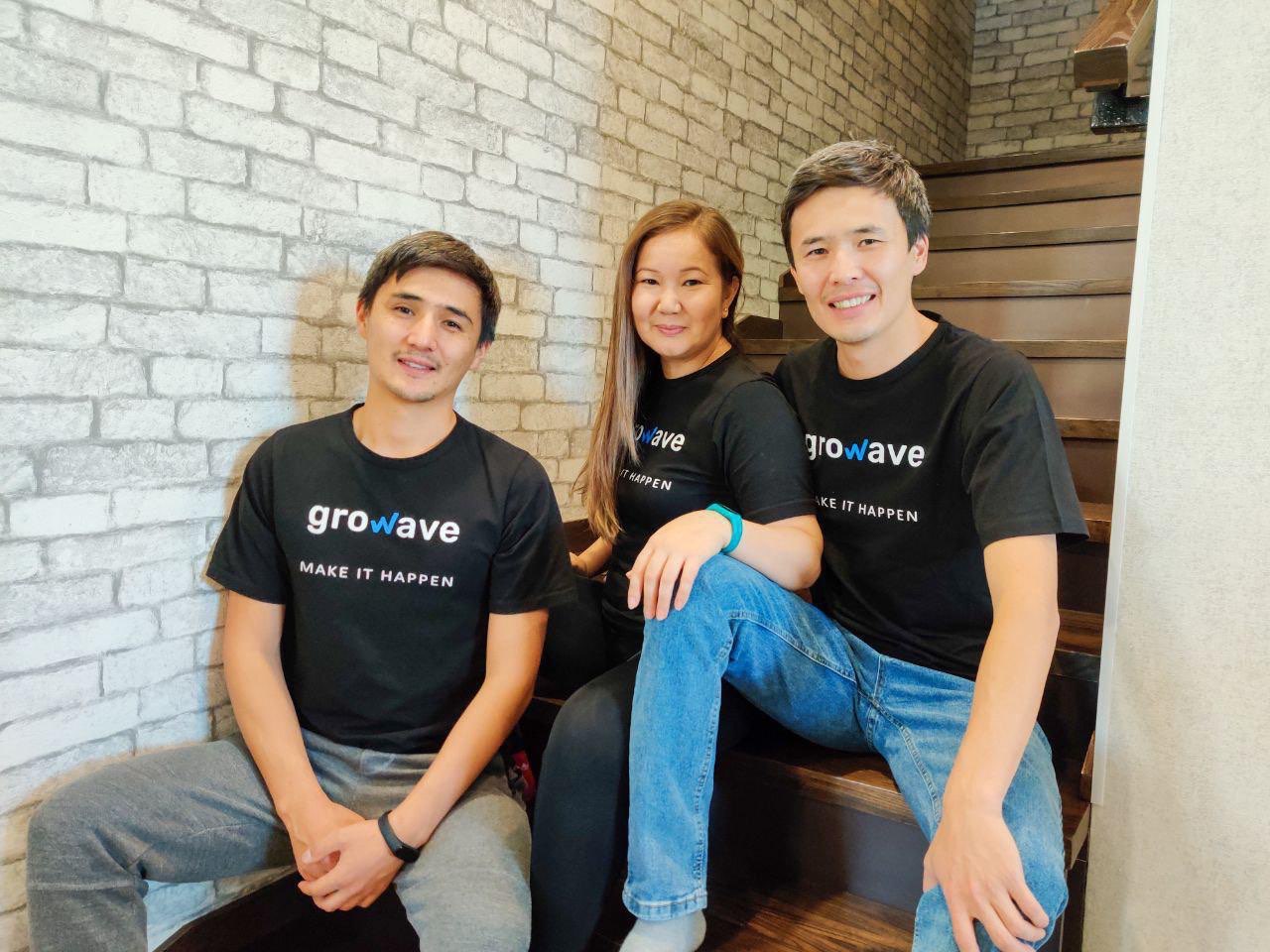
This experience helped Galiev when he decided to build Growave in 2014. Growave is a family startup; Galiev created the company with his wife, Munara, and brother Ermek. Their skillsets complement each other, with Galiev overtaking business development, Munara handling HR and finance, and Ermek leading on the tech side. 

Galiev and his co-founders saw an opportunity when they couldn’t find products focusing on relationships between brands and their customers. Galiev understood that the local markets were too small and went straight to building a global product from scratch. The team did not have experience of being sellers themselves, so the first iterations of the product did not perform very well. 

Soon, they came up with a free plan for customers, which helped them gain their first 500 clients. And with feedback collected from them, they managed to build something that customers actually needed.

Now, Growave is a marketing platform for e-commerce, helping companies to retain their customers with an all-in-one solution including loyalty, referrals, wishlists, reviews, and Instagram UGC. Galiev believes that it is not only advertising that is important, but also building long-term relationships with customers. This, in turn, prompts customers to stay loyal to certain Shopify sellers.

Image: Growave

‘Bootstrapping’ ninjas

Unlike many global startups, Growave has not raised any external funding from VCs to date, making the company an amazing example of bootstrapping — growing a business without external funding. In 2017, three years after its launch, Growave became profitable. Before that, Growave had gone through a turbulent time when the co-founders had to invest their income from other projects. 

This great example of bootstrapping now has 60+ employees. Still, Galiev is talking to VCs to get their feedback about the startup and to pitch Growave as a solution for their portfolio companies.

Now Growave can boast a customer base of over 15,000 companies from more than 150 countries. Over half of their clients are in North America, including large brands like Boeing, Unilever, SONY, and Xiaomi. The company has an ARR (annual recurring revenue) of over $4 million. Few startups operating in Kyrgyzstan can claim such results.

“I have had great ambitions since childhood”, Galiev has said on WE. This is reflected in Growave’s ambitious plans to reach a valuation of $100 million by 2030 and seek exit opportunities through an acquisition by some larger players.

“We have been in the market for over 10 years — during this time, we have built a strong international team, attracted 15,000 customers, and held dozens of events in the US and Europe. But it feels like we are just getting started. We are still trying, learning, making mistakes, and growing — with the same hunger and ambition as on day one. This is what drives us toward our goal of becoming a global leader in eCommerce loyalty programs.” Galiev told The Times of Central Asia.