• KGS/USD = 0.01144 0%
  • KZT/USD = 0.00212 0%
  • TJS/USD = 0.10456 0.19%
  • UZS/USD = 0.00008 0%
  • TMT/USD = 0.28490 0%
  • KGS/USD = 0.01144 0%
  • KZT/USD = 0.00212 0%
  • TJS/USD = 0.10456 0.19%
  • UZS/USD = 0.00008 0%
  • TMT/USD = 0.28490 0%
  • KGS/USD = 0.01144 0%
  • KZT/USD = 0.00212 0%
  • TJS/USD = 0.10456 0.19%
  • UZS/USD = 0.00008 0%
  • TMT/USD = 0.28490 0%
  • KGS/USD = 0.01144 0%
  • KZT/USD = 0.00212 0%
  • TJS/USD = 0.10456 0.19%
  • UZS/USD = 0.00008 0%
  • TMT/USD = 0.28490 0%
  • KGS/USD = 0.01144 0%
  • KZT/USD = 0.00212 0%
  • TJS/USD = 0.10456 0.19%
  • UZS/USD = 0.00008 0%
  • TMT/USD = 0.28490 0%
  • KGS/USD = 0.01144 0%
  • KZT/USD = 0.00212 0%
  • TJS/USD = 0.10456 0.19%
  • UZS/USD = 0.00008 0%
  • TMT/USD = 0.28490 0%
  • KGS/USD = 0.01144 0%
  • KZT/USD = 0.00212 0%
  • TJS/USD = 0.10456 0.19%
  • UZS/USD = 0.00008 0%
  • TMT/USD = 0.28490 0%
  • KGS/USD = 0.01144 0%
  • KZT/USD = 0.00212 0%
  • TJS/USD = 0.10456 0.19%
  • UZS/USD = 0.00008 0%
  • TMT/USD = 0.28490 0%

Underground Smuggling Tunnel Uncovered on Uzbek-Kazakh Border

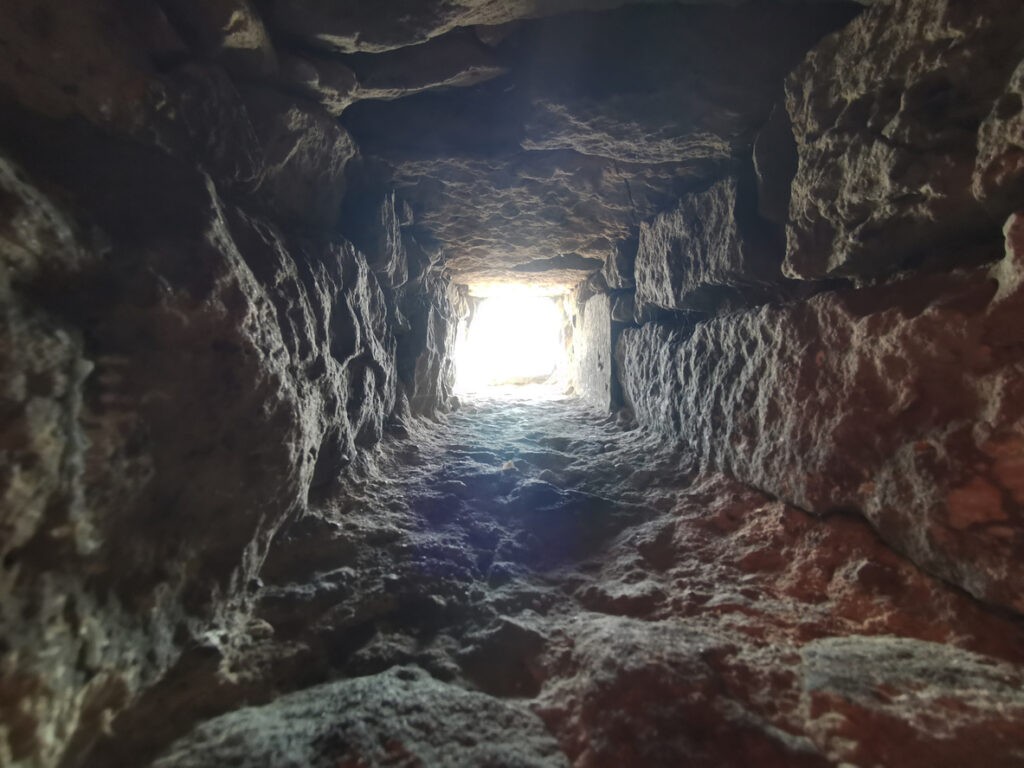
Under the coordination of Kazakhstan’s Turkestan Region Prosecutor’s Office and in cooperation with Uzbek law enforcement, authorities dismantled a criminal group and shut down a tunnel used for smuggling petroleum products.

One tunnel, stretching 450 meters between the two countries, was used to smuggle 5–7 tons of fuel and lubricants daily. The smuggling operation had been active for two months before being brought to an end. Investigations revealed that a well-organized transnational criminal group was behind the tunnel, using it to facilitate the illicit transfer of goods and funds between Kazakhstan and Uzbekistan.

Meanwhile, Uzbekistan’s State Security Service (DXX) uncovered another illegal underground tunnel on the Tashkent-Kazakhstan border. Working in coordination with the Tashkent-Aero customs complex, border troops, and military personnel, the DXX exposed a cross-border smuggling operation involving large quantities of substandard drugs imported from India into Uzbekistan via Kazakhstan.

In a related case, a similar underground passage was discovered in April in Kyrgyzstan’s Jalal-Abad region. This tunnel was being used to smuggle people and contraband goods into Uzbekistan.

Long-Awaited Construction of China-Kyrgyzstan-Uzbekistan Railway Officially Launched

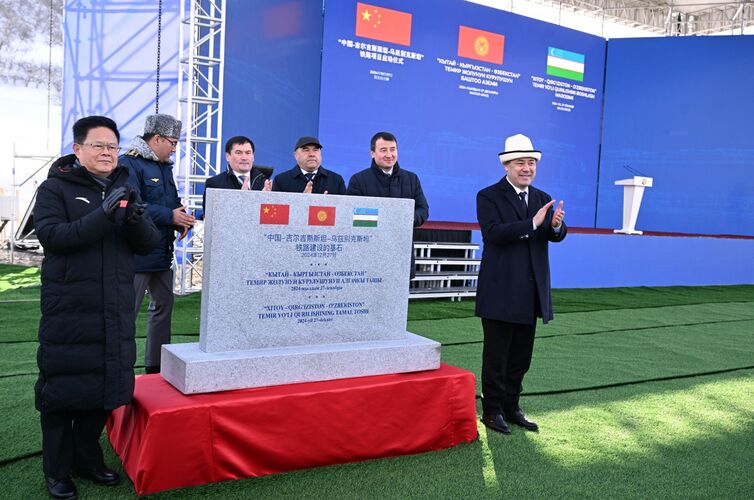
On December 27, Kyrgyzstan’s President Sadyr Japarov, the Chairman of the National Development and Reform Commission of the People’s Republic of China, Zheng Shanjie, and Uzbekistan’s Deputy Prime Minister Jamshid Khodjayev participated in a ceremony to mark the start of construction on the China-Kyrgyzstan-Uzbekistan railway. The event occurred in the village of Tosh-Kutchu in Kyrgyzstan’s Jalal-Abad region, where they laid the first stone for this significant regional transportation project.

Speaking at the ceremony, President Japarov highlighted the importance of the China-Kyrgyzstan-Uzbekistan railway as more than just a transportation route, describing it as a critical strategic bridge linking the East and West. “This route will ensure the delivery of goods from China to Kyrgyzstan, as well as to the countries of Central Asia and the Middle East, including Turkey, and on to the European Union. The project will strengthen interregional ties, help diversify transport routes and increase the competitiveness of the region as an international transport and transit hub, which is in line with the goals of the Central Asian countries,” Japarov said.

Zheng Shanjie delivered a message from Chinese President Xi Jinping, highlighting that the new land corridor connecting Asia and Europe will significantly increase the flow of people and trade among the three countries. According to the message, the project is expected to drive regional prosperity by fostering industrial and resource development, boosting trade, and attracting investment.

Uzbekistan’s President Shavkat Mirziyoyev, in an address read by Deputy Prime Minister Khodjayev, called the launch of railway construction a historic milestone that the three nations had been working toward for nearly 30 years. The Uzbek leader noted that the new transportation artery, which will establish the shortest land route connecting Central Asia and China, will strengthen the strategic partnership between the three nations.

The 523-kilometer railway will traverse Kashgar (China), Torugart, Makmal, Jalal-Abad (Kyrgyzstan), and Andijan (Uzbekistan). Once completed, the railway is expected to handle up to 15 million tons of cargo annually.

Currently, neither Kyrgyzstan nor Uzbekistan has a direct railway connection to China. Central Asia’s rail link to China is limited to a route through Kazakhstan, leaving Kyrgyzstan and Uzbekistan without a direct connection.

Ilham Aliyev: Azerbaijani Plane Crashed In Kazakhstan Due To Russian Ground Fire

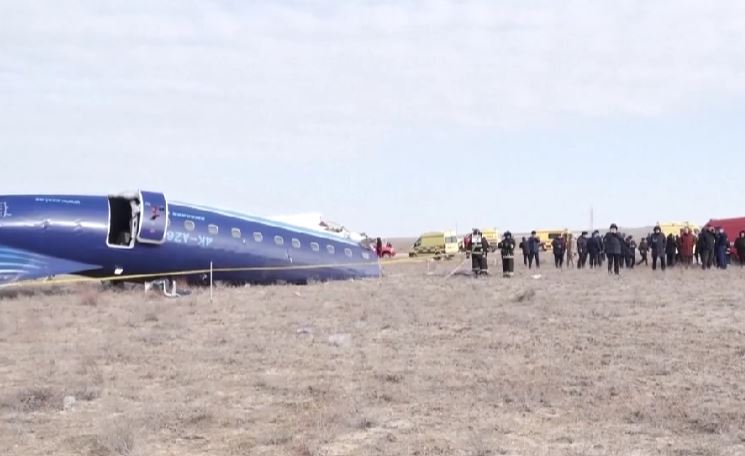
Azerbaijan’s President Ilham Aliyev said on Sunday that the Azerbaijani airliner that crashed in Kazakhstan last week had been hit by Russian ground fire while flying over Russian territory. He also said that there had been efforts by Russia to cover up what had happened by spreading “absurd theories.”

After several days of international speculation and scrutiny, Aliyev spoke in detail with Azerbaijan Television in Baku about the crash of the Azerbaijan Airlines (AZAL) plane on Wednesday that killed 38 people. His remarks came one day after Russian President Vladimir Putin apologized for the crash but did not acknowledge that the aircraft had been accidentally hit by Russian fire.

Kazakhstan is leading the investigation of the crash, which occurred near the Caspian Sea city of Aktau after the plane diverted from its original destination of Grozny in the Russian republic of Chechnya. Officials said 29 people survived.  

“The facts indicate that the Azerbaijani civilian plane was damaged from the outside over Russian territory, near the city of Grozny, and almost lost control. We also know that means of electronic warfare put our plane out of control. This was the first impact on the plane. At the same time, as a result of fire from the ground, the tail of the plane was also severely damaged,” Aliyev said in the interview. 

Aliyev said that fact that “the fuselage is riddled with holes” indicates that initial speculation that birds hit the plane is false, and he criticized “some circles in Russia” for proposing that theory. 

“Another regrettable and surprising moment for us was that official Russian agencies put forward theories about the explosion of a gas cylinder on board the plane. In other words, this clearly showed that the Russian side wanted to cover up the issue, which, of course, is unbecoming of anyone. Of course, our plane was hit by accident. Of course, there can be no talk of a deliberate act of terror here,” the Azerbaijani president said. 

“Therefore, admitting guilt, apologizing in a timely manner to Azerbaijan, which is considered a friendly country, and informing the public about this – these were measures and steps that should have been taken. Unfortunately, for the first three days, we heard nothing from Russia except for some absurd theories.”

Azerbaijan refused Russian suggestions that the Russian-led Interstate Aviation Committee investigate the crash, saying there were concerns about the objectivity of the regional agency. Aliyev said he told Kazakh President Kassym-Jomart Tokayev that he didn’t want the agency involved and that his position was “met with understanding.”

In his apology in a phone conversation with Aliyev on Saturday, Putin said the Azerbaijani plane had been trying to land at a time when Russian air defenses were repelling attacks by Ukrainian drones. But he didn’t say that those air defenses hit the plane. 

Azerbaijan Airlines has suspended flights to 10 Russian cities since the crash. 

Putin Apologizes for Azerbaijan Airlines Plane Crash in Kazakhstan

Russian President Vladimir Putin has apologized for the crash of an Azerbaijan Airlines passenger plane that diverted from its Russian destination to Kazakhstan, the Kremlin said on Saturday, as investigators focused on the possibility that Russian air defenses had mistaken the plane for a Ukrainian drone and fired on it.

Putin made the apology in a telephone conversation with President Ilham Aliyev of Azerbaijan, according to a Kremlin statement.

“During the conversation, it was noted that the Azerbaijani passenger aircraft, which was strictly on schedule, repeatedly attempted to land at the Grozny airport. At that time, Grozny, Mozdok and Vladikavkaz were attacked by Ukrainian combat unmanned aerial vehicles, and Russian air defense systems repelled these attacks,” the statement said.

Putin did not offer further detail about what exactly caused the plane to crash. In an account of the conversation, Aliyev’s office gave more detail to support the contention that Russian air defenses and communications jamming targeted the plane when it tried to land as scheduled in Grozny in Russia-controlled Chechnya, saying the aircraft “was subjected to physical and technical external interference in Russian airspace.”

In the call with Putin, Aliyev “emphasized that the presence of numerous holes in the fuselage of the plane, the injuries of passengers and crew members by foreign particles that penetrated the deck of the plane while still in the air, and in this regard, the statements of the surviving flight attendants and passengers establish the fact of external physical and technical interference,” the Azerbaijani president’s office said.

“During the conversation, the heads of state discussed a serious and thorough investigation of all the details of this tragedy and bringing the perpetrators to justice,” the office said.

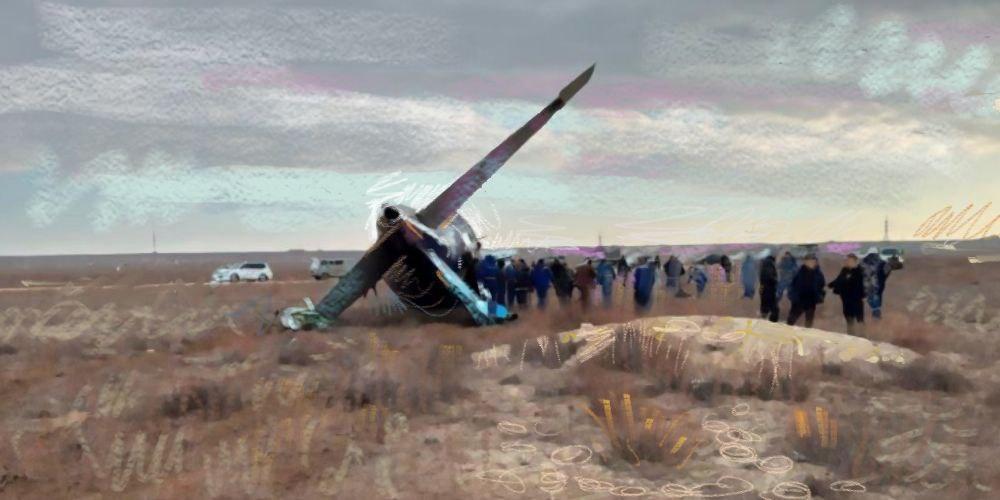
The Embraer 190 plane was flying on the Baku-Grozny route but diverted and crashed near the Caspian Sea city of Aktau, Kazakhstan, on Wednesday killed 38 people, according to Kazakh and Azerbaijani officials. A total of 67 people, including five crewmembers, had been on board.

Kazakhstan is leading the investigation and its prosecutors have opened a criminal case.

The Kremlin said two employees from the office of Azerbaijan’s prosecutor general are in Grozny and are working with Russian counterparts on the investigation.

With Russia Under Scrutiny, Kazakhstan Promises Thorough Investigation into AZAL Crash

The investigation of the fatal crash of an Azerbaijan Airlines plane in Kazakhstan after it diverted from Russia is a major international test for Kazakh authorities, who have promised a full and impartial inquiry even as the theory that Russian air defenses had fired on the aircraft gains traction.

Kazakhstan, which is in charge of the probe of the crash that killed 38 people near the Caspian Sea city of Aktau on Wednesday, has cautioned against a rush to judgment before all the evidence has been assessed. But it must navigate emerging tensions between Azerbaijan and Russia, which have put forth conflicting narratives about what happened, as well as the possible challenge of collecting evidence from the plane’s original destination of Grozny, the capital of Russian Chechnya. 

Azerbaijan and Russia say they are collaborating with the investigation by Kazakhstan, which comes amid geopolitical rifts over Russia’s full-scale invasion of Ukraine and the efforts of countries in Central Asia to balance their interests among major trading partners and rival powers. 

In a sign of the growing international complexity of the crash inquiry, Turkish Transport Minister Abdulkadir Uraloğlu said Friday that his ministry was dispatching an eight-person team to Baku, Azerbaijan’s capital, “to examine all aspects of the incident” at the request of Azerbaijan’s civil aviation authorities. Also, a team from the Brazilian company that produced the Embraer 190 plane has arrived in Kazakhstan to help with the investigation.  

On Friday, Kazakh President Kassym-Jomart Tokayev updated his Azerbaijani counterpart, Ilham Aliyev, on the investigation and and “assured that the Kazakh side will make every effort to ensure a comprehensive and objective clarification of all the circumstances of the air crash,” Tokayev’s office said. The two leaders agreed that their governments will stay in close contact during the investigation. 

Azerbaijan Airlines, meanwhile, said on Friday that preliminary results of the investigation showed that the Brazil-produced Embraer 190 plane on the Baku-Grozny route had crashed because of “physical and technical external interference,” a possible reference to an attack by the city’s air defenses and alleged communications jamming at a time when Russian authorities said there was a threat from Ukrainian military drones. 

The airline, also known by the acronym AZAL, said it had suspended flights from Baku to a total of 10 Russian cities because of concerns about flight safety. 

Also Friday, Dmitry Yadrov, head of Russia’s Federal Air Transport Agency, gave an account of the circumstances surrounding the crash that did not address the airline’s version. 

Yadrov said the plane was unable to land in Grozny because of a restriction requiring all aircraft to leave the area due to alleged Ukrainian attempts to attack civilian infrastructure there, according to Russia’s state-run news agency RIA Novosti. There was dense fog around the airport and the Azerbaijan Airlines plane tried to land twice before deciding to proceed across the Caspian Sea to Aktau, he said. 

Some commentators in Azerbaijan have expressed frustration with varying initial accounts from Russian official sources of what caused the crash, including a collision with birds and an oxygen cylinder explosion inside the cabin. Some aviation and security specialists have said scattered puncture marks on the outside of a piece of the wrecked fuselage are consistent with shrapnel from an air defense strike.  

There were 62 passengers on the flight, including 37 people from Azerbaijan, 16 from Russia, six from Kazakhstan and three from Kyrgyzstan, according to the airline. There were five crewmembers. Of the 67 in total on the plane, 38 died, according to Kazakh officials.

Kyrgyz Journalists Reject Japarov Criticism of Foreign Funding in the Media

Kyrgyzstan’s President Sadyr Japarov has criticized the country’s media for its willingness to accept foreign funding. American diplomats disagree with the government’s “accusations,” while local journalists pointed out that Kyrgyz media operates with the help of advertising and grants.

Speaking at the recent People’s Kurultai (Congress) in Bishkek, Japarov criticized several Kyrgyz media outlets for receiving foreign funding, accusing journalists of spreading false information. According to him, most Kyrgyz publications have foreign sponsors.

Japarov claimed that journalists obey their “masters” and are therefore deprived of freedom of speech. The president also shared data on foreign funding received by some opposition media outlets and NGOs.

“These funds are accounted for in reports only superficially. Their foreign sponsors say, ‘Yes, they are doing a good job.’ But what’s really happening? Here, they spread false information, look for negativity, and undermine the reputation of others. And when lawsuits are filed against them, they immediately claim it’s an attack on freedom of speech,” Japarov said.

The president addressed the leadership of the U.S. State Department, stating that funds should be directed directly to Kyrgyz authorities.

“We will ensure their effective use. Do you want to raise the level of journalism? We can do it. Do you want complete freedom of speech? We guarantee it,” Japarov emphasized.

A few days later, the U.S. Embassy in Bishkek responded to the criticism.

“In the field of journalism, our assistance is aimed at funding fact-checking programs, supporting Kyrgyz-language journalism, and assisting investigative journalists in uncovering violations, including corruption,” the diplomats said in a statement.

The embassy emphasized its belief that independent media, which performs a watchdog role in society, is crucial for any government.

In an interview with The Times of Central Asia, journalist Chynara Sydykova shared that grant support enabled her to implement several socio-cultural projects.

“These projects helped us grow and become independent professionals in directing, producing, and project management. Finally, it allowed us to simply become journalists capable of working honestly, objectively, and professionally, covering topics of public interest,” Sydykova said.

The investigative journalist noted that none of the grant providers interfered with the work process. However, Sydykova admitted that manipulations could occasionally occur.

“Journalists shouldn’t cling to every visible opportunity to get funding. They need to build a reputation so that no one would even think of using them as an agent of influence. Thanks to my television projects, I provided real help to respondents in the areas of health and social injustice,” Sydykova added.

Public figure and journalist Alisher Tashmatov told The Times of Central Asia that he takes a neutral stance on grants. According to him, the most important thing is that grants allocated by foreign institutions should not threaten Kyrgyzstan’s national security.

“In Kyrgyzstan, media survives through advertising and grants. Only a few receive funding from the state. Moreover, even state-owned media occasionally receives financial assistance from foreign institutions and companies,” he noted, adding that criticism of the authorities should be well-founded.