• KGS/USD = 0.01144 0%
  • KZT/USD = 0.00193 -0%
  • TJS/USD = 0.10876 0.55%
  • UZS/USD = 0.00008 0%
  • TMT/USD = 0.28490 0%
  • KGS/USD = 0.01144 0%
  • KZT/USD = 0.00193 -0%
  • TJS/USD = 0.10876 0.55%
  • UZS/USD = 0.00008 0%
  • TMT/USD = 0.28490 0%
  • KGS/USD = 0.01144 0%
  • KZT/USD = 0.00193 -0%
  • TJS/USD = 0.10876 0.55%
  • UZS/USD = 0.00008 0%
  • TMT/USD = 0.28490 0%
  • KGS/USD = 0.01144 0%
  • KZT/USD = 0.00193 -0%
  • TJS/USD = 0.10876 0.55%
  • UZS/USD = 0.00008 0%
  • TMT/USD = 0.28490 0%
  • KGS/USD = 0.01144 0%
  • KZT/USD = 0.00193 -0%
  • TJS/USD = 0.10876 0.55%
  • UZS/USD = 0.00008 0%
  • TMT/USD = 0.28490 0%
  • KGS/USD = 0.01144 0%
  • KZT/USD = 0.00193 -0%
  • TJS/USD = 0.10876 0.55%
  • UZS/USD = 0.00008 0%
  • TMT/USD = 0.28490 0%
  • KGS/USD = 0.01144 0%
  • KZT/USD = 0.00193 -0%
  • TJS/USD = 0.10876 0.55%
  • UZS/USD = 0.00008 0%
  • TMT/USD = 0.28490 0%
  • KGS/USD = 0.01144 0%
  • KZT/USD = 0.00193 -0%
  • TJS/USD = 0.10876 0.55%
  • UZS/USD = 0.00008 0%
  • TMT/USD = 0.28490 0%
11 December 2025

Kyrgyzstan and Russia to Expand Cooperation Across the Board

On July 10, the 25th meeting of the Intergovernmental Kyrgyz-Russian Commission on Trade, Economic, Scientific, Technical and Humanitarian Cooperation, was held in the Russian city of Krasnoyarsk, co-chaired by the Chairman of the Cabinet of Ministers of the Kyrgyz Republic Akylbek Japarov and Deputy Prime Minister of the Russian Federation Alexey Overchuk.

Aimed at strengthening cooperation between Kyrgyzstan and Russia, the agenda focused on developing trade and economic relations, increasing bilateral trade turnover, and creating favourable conditions for investments and joint ventures.

The parties also discussed issues related to developing scientific and technical cooperation, expanding humanitarian ties, including in education, culture, and healthcare, as well as joint projects in tourism and transport.

Referencing the fact stated that in 2023, trade turnover between Kyrgyzstan and Russia reached $3 billion, and in the first four months of 2024, had already exceeded $1 billion, showing an increase of 30%, Akylbek Japarov announced the mutual goal to increase the Kyrgyz-Russian trade to up to $5 billion.

Given the two countries’ intention to increase the share of mutual settlements in national currencies, the head of the Kyrgyz Cabinet invited the largest state-owned banks of Russia, such as Sberbank, VTB, Vnesheconombank, and Gazprombank, to open branches in Kyrgyzstan.

On the same day, Akylbek Japarov also spoke at the meeting of the 11th Kyrgyz-Russian Interregional Conference in Krasnoyarsk.

Regarding Kyrgyz-Russian cultural and humanitarian interaction, Japarov said that the past three years had seen a “breakthrough in the education sector.” In particular, he noted an agreement concluded last year, on Russia’s construction of nine new schools in Kyrgyzstan; one in each of its seven regions and two in the cities.

Further to signing a Decree on the establishment of a branch of the Lomonosov Moscow State University in the Kyrgyz city of Karakol, the president expressed his appreciation of the increase in budget-paid places for Kyrgyzstan citizens studying in Russian universities to 1,000.

EDB to Finance Mountain Resort in Kyrgyzstan

On July 10, the National Investment Agency under the President of the Kyrgyz Republic, Vasta Discovery LLC, and the Eurasian Development Bank (EDB) signed a trilateral Memorandum of Cooperation on the construction of the Baytik mountain resort, an all-season tourism cluster in Kyrgyzstan’s northern Chui region.

The EDB will act as the project’s creditor but the amount of the planned investment has yet to be declared.

Following the signing of the agreement, Sergey Ignatov, EDB’s Senior Managing Director stated, “As a multilateral development bank, the EDB performs its investment activities so as to contribute to the economic growth of its member countries, the expansion of trade and economic ties, and the development of integration processes in the Eurasian space. Apart from its obvious integration potential, the Baytik Mountain Resort project is also expected to contribute to the development of tourism, an important sector of the Kyrgyz economy, which will have a positive impact on related industries and cultural exchange in Eurasia, and will become a significant growth point in this region.”

Talantbek Imanov, Director of the National Investment Agency highlighted the fact that the Baytik Mountain Resort represents the first foray into cooperation in Kyrgyzstan’s  tourism infrastructure and outlining the project, announced: “The future resort includes 15 cable cars, 36 ski slopes exceeding 57 km, 4 tourist villages and a ski complex that meets the requirements of international top class competitions, including the Olympic Games and World Cup alpine skiing and snowboarding events.”

The Baytik Mountain Resort will be constructed and developed by Vasta Discovery, a company with extensive experience in implementing large-scale tourism infrastructure projects. Emphasizing his company’s firm commitment to the project, Sergey Bachin, CEO of Vasta Discovery confirmed, “We are confident that there will be domestic demand for the resort and its services and that it will also become an important attraction for foreign tourists and inspire them to visit Kyrgyzstan.”


Kazakhstan-EU Transport and Logistics Cooperation

Expansion and strengthening of trade, economic and investment cooperation, and joint projects in transport and logistics with a focus on the development of the Trans-Caspian International Transport Route (TITR), were the key issues of the 15th meeting of ‘Kazakhstan-EU’.  Participants in discussions held in Astana on 10 July included Kazakhstan Prime Minister Olzhas Bektenov, head of the Delegation of the European Union to Kazakhstan, Ambassador Kestutis Jankauskas, and heads of diplomatic missions of EU countries in Kazakhstan.

During the meeting it was stated that about 85% of goods exported by China to EU countries are transported through Kazakhstan, and TITR provides the most competitive cargo delivery time of 12-15 days.

Regarding their interest in unlocking the full potential of TITR, also known as the Middle Corridor, participants noted the establishment of the joint venture, Middle Corridor Multimodal, at the Astana International Financial Centre, and the significant role of the European initiative ‘Global Gateway’, which opens new prospects for investment in the transport industry.

To raise their strategic partnership to a new level, all confirmed their commitment to developing and strengthening Kazakhstan-EU trade and economic relations.

According to the Kazakh government, the European Union accounts for over 40% of Kazakhstan’s foreign investments and about 30% of foreign trade.

In 2019-2023, trade turnover between Kazakhstan and EU countries increased by 36.2%, amounting to $41.4 billion. Last year, EU countries invested $10.4 billion in Kazakhstan’s economy, and in the first quarter of 2024 alone, $2.8 billion.


A Rocky Romance in Kyrgyzstan: Boyfriend of President’s Niece is Arrested

The boyfriend of the niece of Kyrgyz President Sadyr Japarov has been arrested on suspicion of manufacturing illegal drugs, two weeks after a controversy over his use of a rented government helicopter to propose marriage. 

“We confirm that the boyfriend of the daughter of President Sadyr Japarov’s younger brother was detained by law enforcement agencies,” presidential spokesman Askat Alagozov said on Facebook on Wednesday. He said there is “every reason to believe” that the man, Aftandil Sabyrbekov, wanted to hide “his illegal activities” by developing relationships with people who could protect him from the law. 

Alagozov stressed that the president won’t hide illegal conduct. The spokesman did not specify the alleged crimes of the fiancé of Lazat Nurkozhoeva “and his accomplices,” but several media organizations in Kyrgyzstan reported that a district court in Bishkek ordered Sabyrbekov to be placed in pretrial detention until Aug. 3. 

Sabyrbekov is suspected of the “Illegal production of narcotic drugs, psychotropic substances and their alternatives for the purpose of sale in large quantities,” the Kloop outlet reported. It said he could face between 12 and 15 years in prison if convicted. 

Last month, Sabyrbekov asked Nurkozhoeva, a former beauty queen, to marry him after the pair traveled by helicopter to the mountains near Bishkek. The helicopter belonged to the Ministry of Emergency Situations, a revelation that prompted scorn on social networks and drew an apology from Japarov, who has campaigned against corruption.

The ministry said the aircraft was “legally leased” and Japarov said the government sometimes rents its helicopters for the benefit of the state’s coffers. But the ostentatious use of the government asset, flaunted in a slick video showing Japarov’s niece in the helicopter, was over the top for some critics. 

It wasn’t true love after all, the presidential spokesman, Alagozov, appeared to suggest. At the end of his Facebook message, he referred to Sabyrbekov as the “ex-boyfriend,” indicating that the romance with the president’s niece was over. 

Almaty’s Aspan Gallery Champions Central Asian Art at Home and Abroad

“It’s difficult to be a point, but it’s easy to be a line, as everything in our world is moving.”

The quote by Soviet avant-garde artist Sergey Kalmykov became the title of a 2020 show by Kazakh artists Almagul Menlibayeva and Yerbossyn Meldibekov, the first exhibition by Almaty-based gallery Aspan to be staged in the UK.

This concept of continuous movement aptly describes the nine-year trajectory of the Aspan Gallery, founded and directed by Meruyert Kaliyeva. Maintaining its focus on contemporary Central Asian art, the gallery is constantly expanding and adapting to the dynamic of the international art world.
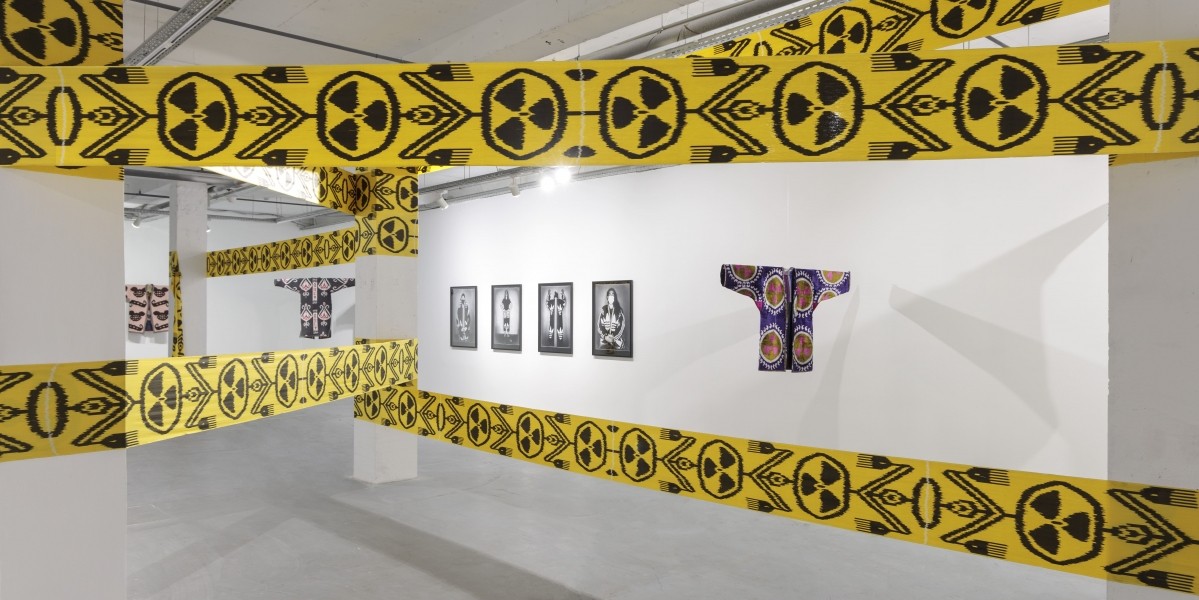
Dilyara Kaipova @Aspan


The story of how the gallery came into being is unconventional.

Meruyert Kaliyeva studied art in the UK, with the intention of practicing as an artist. She soon discovered, however, that the life of an artist was not for her and explained to TCA: “To be an artist, you must sacrifice your social and family life. You must disconnect from it all, and I was not willing to do that.”

At the same time, she noticed that unlike her, many individuals at art school seemed destined to become artists. “Some people don’t have the luxury of choice,” she recalls. “I felt that these people needed to focus solely on creating art, and I realised I could help unburden them from some practical preoccupations.”

After four years and a half working in auction houses in the UK, Kaliyeva finally decided to return to Kazakhstan. Having quickly realised the importance of supporting artists in a region where institutional support for contemporary art is extremely limited, she opened what is now the Aspan Gallery.

Kaliyeva’s mission was  twofold. In tandem with developing the Central Asian art scene locally, through staging important historical exhibitions, publishing books and catalogues, and commissioning artists, she also concentrated on disseminating knowledge of Central Asian art abroad.

A case in point is Aspan’s recent, significant donation to the Stedelijk Museum in Amsterdam. The donation was curated by Robbie Schweiger, based on research conducted in Kazakhstan, Kyrgyzstan, and Uzbekistan, and with input from Kaliyeva, connections were drawn between Central Asian artists and the Stedelijk’s permanent collection.

The Times of Central Asia spoke to Kaliyeva about both the donation and the growth of the Kazakh art scene over the past few years.

TCA: Why did you choose the Stedelijk Museum in Amsterdam for such a significant donation?

MK: We were keen to have some of our artists represented in major institutions and identified three museums as contenders. The first on the list was the Stedelijk, which already held a collection of Central Asian art. The donation comprised 22 works by 13 artists from Kazakhstan, Kyrgyzstan, and Uzbekistan, spanning almost fifty years, from 1974 to 2020.

Works from the 1970s and 1980s, created by artists associated with the underground art scene of the former Soviet republics, were complemented by work made after these republics gained independence in the early 1990s., in which  artists explored national identities while simultaneously attempting to keep abreast with the international art world.

TCA: In addition to museums, are collections of Central Asian art being developed in the private sector?

MK: For a long time, the main collectors of Central Asian art were foreign institutions and individuals, but things are rapidly changing. Kazakhstan is developing a solid collector base. Half of our sold-out show by Gulnur Mukazhanova in 2021, for example, was bought by local collectors. More and more Kazakh collectors are travelling to international art fairs and in the last few years, have accounted for some 30 percent of our sales.

Central Asia’s first contemporary art museum will open next year in Almaty. Funded by Kazakh collector and philanthropist Nurlan Smagulov, the Almaty Museum of Arts has been actively buying works by Central Asian contemporary artists alongside that by international ‘stars’. Another private museum, due to open in Caucasus in a few years’ time, is also building a very strong collection of Central Asian art. It is very encouraging to see such growing interest in our artists’ work not only from local collectors, but also from collectors from further afield who provide very important links.

Almagul Menlibayeva @ Aspan


TCA: You returned to Kazakhstan after living in London for many years. How had the art scene changed?

MK: What surprised me the most, was the number of Central Asian artists represented by galleries in Milan, London, Brussels, Hong Kong, New York, but despite being included in biennales and museum collections, their work was not shown anywhere in Central Asia. Artists such as Vyacheslav Akhunov, Said Atabekov, Yerbossyn Meldibekov, Almagul Menlibayeva, Yelena and Viktor Vorobyev, Gulnara Kasmalieva and Muratbek Djumaliev, Sergey Maslov, Rustam Khalfin and so on, I call “Astral Nomads,” because they are like isolated stars.

Working in their own studios, they only met up at international exhibitions and in the absence of local exhibitions of contemporary art, all these artists were disconnected from each other.

I started by showing artists already fairly established on the contemporary art scene and then gradually began to include younger artists. In 2021, we hosted four solo shows of young female artists – Saodat Ismailova, Dilyara Kaipova, Gulnur Mukazhanova and Bakhyt Bubikanova. Their works are now held in many museum collections and have been exhibited at documenta, the Venice Biennale, the Gwangju Biennale, the Sharjah Biennale etc.

Gulnara Kasmalieva @Aspan


TCA: How has the gallery evolved and how do you select your artists?

MK: I founded the gallery in 2015 and at first, staged pop-up exhibitions, including two midcareer retrospectives of Yerbossyn Meldibekov and Yelena and Viktor Vorobyev, curated by Viktor Misiano at the Kasteev Museum of Arts in Almaty. The gallery’s focus has always been Central Asian contemporary art and as I was pretty much the only gallery showing contemporary art, I was basically able to approach any artists I wanted to work with.

We have recently started to curate more historical exhibitions such as a non-selling show of Lidiya Blinova, who was instrumental in the development of the contemporary art scene in Kazakhstan but died prematurely in 1996, leaving almost no physical works behind her.

We restaged some of her most important installations and by accident found a hitherto unknown body of drawings and sketches that we exhibited for the first time. Two years ago, we staged a retrospective of Sergey Maslov and managed to secure loans from museums in northern Kazakhstan, which together with the reconstruction of Maslov’s rocket-yurt installation, made the show very special.

Gulnur Mukazhanova @Aspan


TCA: In terms of market demand, is there a growing interest in artists from Central Asia?

MK: There is a definite growing interest among museums and collectors towards our artists, but it is quite rare for them to regard  Central Asia as a geographical region. I would say that while museums and collectors look at certain artists, who happen to be from Central Asia, there aren’t many creating a ‘Central Asian collection’, in the same manner as collections of ‘African art’ or ‘Chinese art’.

M HKA and Stedelijk Museum, both with collections of Central Asian art, are exceptions. I find it quite positive that artists escape being labelled by the region they come from, even though they all work within a local context in a very deep and meaningful way.

TCA: 

MK: Over the last ten years, there have been a lot of changes  in Kazakhstan’s art scene. The way people consume news has totally changed with the advance of digital media platforms; attention span has been shrinking and we have fewer and fewer lengthy pieces on art.

The rise of social media has produced a new way of consuming art, and I think we should embrace it. Social media is attracting more people outside the art world to exhibitions, regardless of whether they just turn up for an opening or come by later and post something on Instagram.

I feel that just like people who go on hikes to portray themselves as outdoorsy types, people visit galleries and museums to convey their interest in culture. For me, it doesn’t matter if they come to a show simply because our paintings provide a beautiful background for a selfie. They might initially come for that reason but in the process, they become accustomed to art. And maybe, next time, they’ll be interested to stay longer, or come back with a friend. It all boils down to slowly getting people through the door, and I’m confident it will grow from there.

Why Is Bishkek Getting Rid of Trolleybuses?

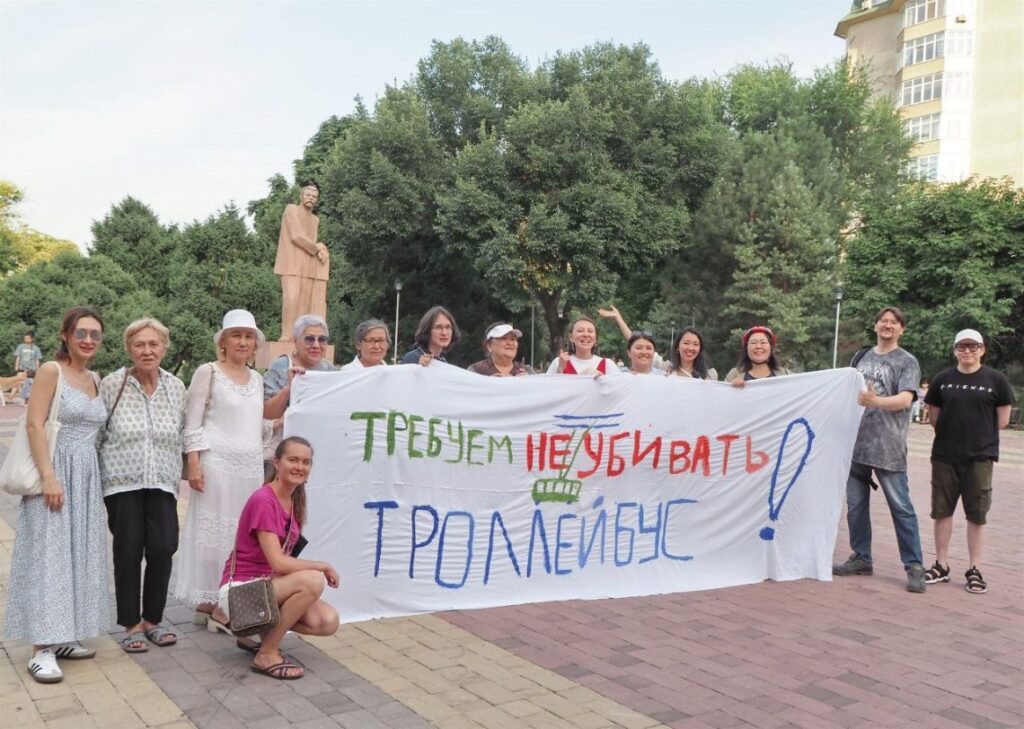
Bishkek City Hall intends to “clean” the city of trolleybuses. According to city officials, the environmentally friendly mode of transportation has become unprofitable; however, residents are against such a decision — citizens claim their opinion is not considered in the municipality.

Almost all trolleybus routes will be removed from Bishkek’s roads, and electric buses ordered from China will replace them. The entire electric infrastructure — wires for trolleybuses — has been dismantled.

In an interview with the state agency Kabar, mayor Aibek Junushaliyev said that the unpopular decision would create more comfortable living conditions for citizens.

“Trolleybuses can only ride on one route, and we cannot temporarily redirect them to other streets. That is, they can only travel on their lines, and during some road closures, it is impossible to change their route. Electric buses and other public transportation are more mobile, and their route can be changed to solve problems with traffic jams in the city. With trolleybuses, such a solution is impossible,” Junushaliyev said.

The mayor explained his decision to remove trolleybuses due to the unprofitability of electric transportation. Allegedly, trolleybus passenger traffic is decreasing year by year. In 2023, trolleybuses moved 8 million people; this year, they moved 3 million fewer.

“Also, trolleybus maintenance is costly. We subsidize more than 200m KGS ($2.3m) for trolleybuses,” Junushaliyev stated.

The Bishkek mayor’s office said it is launching the Open Skies project, which will remove all trolleybus lines in the city because they have reached the end of their useful life.

Interestingly, in 2022, the Bishkek Trolleybus Department signed a contract with the Chinese company Ankai Automobile Co. to bring 120 battery-powered trolleybuses and the entire charging infrastructure to Kyrgyzstan.

Bishkek residents are outraged by the city authorities’ unilateral initiative. In the past few weeks alone, government agencies have received more than three hundred appeals from citizens to stop the destruction of an ecological mode of transportation.

Activist Darya Nesterova told The Times of Central Asia that the city government deliberately underestimates the number of passengers traveling on trolleybuses.

“City Hall is violating the law. We have regulations according to which such projects must be submitted for public discussion. The townspeople should comment that the mayor’s office has behaved very willfully. They did not listen to the opinion of city deputies or the people; they immediately started cutting trolleybus wires, although they had no legal right to do so,” Nesterova said.

According to her, the destruction of one of the modes of public transportation is sabotage.

“Bishkek City Hall in 2018 took a loan from the European Bank for Reconstruction and Development to upgrade the trolleybus network. This loan the city will repay for another five years. In addition, the bank’s money was used to purchase 50 new trolleybuses capable of serving the city. Therefore, all the talk about the outdated electric fleet is illogical,” Nesterova isaid.

The public doesn’t understand how the capital’s authorities will explain themselves to the creditors—the EBRD gave a loan to reconstruct trolleybus lines in Bishkek. Bishkek wants to transfer the trolleybuses to the city of Osh, but this contradicts the bank’s credit terms.

In the meantime, concerned Bishkek citizens have written a letter to Kyrgyz President Sadyr Japarov asking him to save Bishkek’s trolleybuses, which have been an integral part of the capital for 73 years.