• KGS/USD = 0.01144 0%
  • KZT/USD = 0.00216 0%
  • TJS/USD = 0.10616 -0.19%
  • UZS/USD = 0.00008 0%
  • TMT/USD = 0.28530 0%
  • KGS/USD = 0.01144 0%
  • KZT/USD = 0.00216 0%
  • TJS/USD = 0.10616 -0.19%
  • UZS/USD = 0.00008 0%
  • TMT/USD = 0.28530 0%
  • KGS/USD = 0.01144 0%
  • KZT/USD = 0.00216 0%
  • TJS/USD = 0.10616 -0.19%
  • UZS/USD = 0.00008 0%
  • TMT/USD = 0.28530 0%
  • KGS/USD = 0.01144 0%
  • KZT/USD = 0.00216 0%
  • TJS/USD = 0.10616 -0.19%
  • UZS/USD = 0.00008 0%
  • TMT/USD = 0.28530 0%
  • KGS/USD = 0.01144 0%
  • KZT/USD = 0.00216 0%
  • TJS/USD = 0.10616 -0.19%
  • UZS/USD = 0.00008 0%
  • TMT/USD = 0.28530 0%
  • KGS/USD = 0.01144 0%
  • KZT/USD = 0.00216 0%
  • TJS/USD = 0.10616 -0.19%
  • UZS/USD = 0.00008 0%
  • TMT/USD = 0.28530 0%
  • KGS/USD = 0.01144 0%
  • KZT/USD = 0.00216 0%
  • TJS/USD = 0.10616 -0.19%
  • UZS/USD = 0.00008 0%
  • TMT/USD = 0.28530 0%
  • KGS/USD = 0.01144 0%
  • KZT/USD = 0.00216 0%
  • TJS/USD = 0.10616 -0.19%
  • UZS/USD = 0.00008 0%
  • TMT/USD = 0.28530 0%

Kazakhstan Aims to Boost IT Services Exports to $5 Billion by 2030

Kazakhstan plans to increase its IT services exports nearly fivefold, to $5 billion by 2030, officials and industry participants said at a roundtable focused on positioning the country as a regional hub for international tech talent and digital nomads.

According to official data, Kazakhstan exported IT services worth $471 million to 95 countries in the first nine months of 2025. In the final quarter of the year, that figure more than doubled, reaching $1.142 billion as of January 1, 2026.

Export revenues also exceeded spending on imported digital solutions by more than 2.6 times, with imports totaling $429 million.

The new export target is expected to be supported by workforce expansion and talent attraction initiatives. Representatives of Astana Hub said the country plans to train 10,000 specialists in AI by 2030. At the same time, Kazakhstan is promoting its Digital Nomad Residency program, launched in January 2025, aimed at attracting foreign IT professionals.

To date, more than 700 applications from 30 countries have been submitted under the program, with over 120 specialists granted residency status.

“Human capital development is the foundation on which Kazakhstan’s growth as a digital hub is built,” said Deputy Prime Minister and Minister for Artificial Intelligence and Digital Development Zhaslan Madiyev. “We aim to make the Digital Nomad process fully digital, transparent, fast, and convenient. The arrival of highly qualified professionals is not just a statistic, it brings international experience, new competencies, and links to global markets. Our goal is to create conditions where talented IT professionals can realize their potential here and contribute to Kazakhstan’s economy.”

Participants at the roundtable, including engineers and analysts from international companies, also shared their relocation experiences and proposed improvements to digital services.

Following the meeting, stakeholders agreed to continue work through a permanent working group to better adapt the program to the needs of the IT community.

As previously reported by The Times of Central Asia, President Kassym-Jomart Tokayev proposed establishing a regional center for cooperation with Japan in digital transformation and artificial intelligence in Astana.

Rybakina Wins on Clay in Stuttgart, in Run-up to Roland Garros

World number two Elena Rybakina defeated Karolina Muchova to win the WTA title in Stuttgart, Germany on Sunday, elevating her to the top spot in the points race to qualify for the season-ending championship in Riyadh, Saudi Arabia in November.

Rybakina’s 7-5, 6-1 victory over Muchova was the Kazakhstani player’s 13th title – and the first repeat title of her career after winning 12 titles in 12 different tournaments. She won in Stuttgart in 2024.

In the Stuttgart quarterfinals this year, Rybakina saved two match points against Leylah Fernandez in a three-hour battle.

The title on clay in Stuttgart gives the Russia-born player momentum ahead of the French Open, which begins next month. Rybakina won the Australian Open this year and is also the 2022 Wimbledon champion.

Kazakhstan Central Bank Chief Eyes Deeper U.S. Investment Links

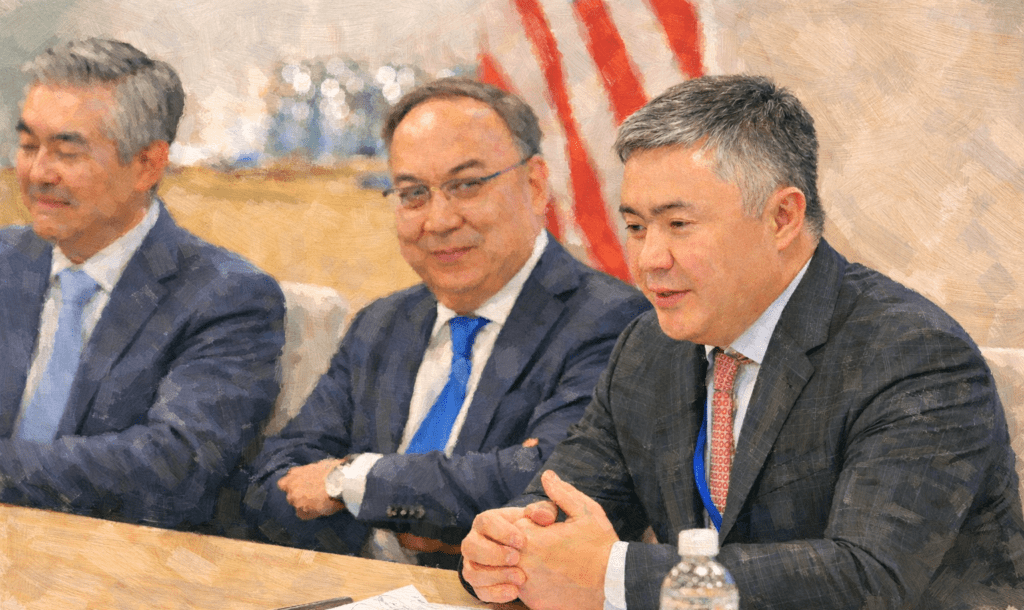
Addressing senior executives from more than a dozen Fortune 100 companies active in Kazakhstan at a U.S. Chamber of Commerce-hosted event in Washington, D.C., on April 14, Timur Suleimenov, Governor of the National Bank of Kazakhstan, laid out the country’s economic outlook and later spoke with The Times of Central Asia on a range of related issues. He was accompanied by Erzhan Kazykhan, President Kassym-Jomart Tokayev’s Special Representative for Negotiations with the United States, Deputy Foreign Minister Alibek Kuantyrov, and Kazakhstan’s Ambassador to the United States, Magzhan Ilyassov.

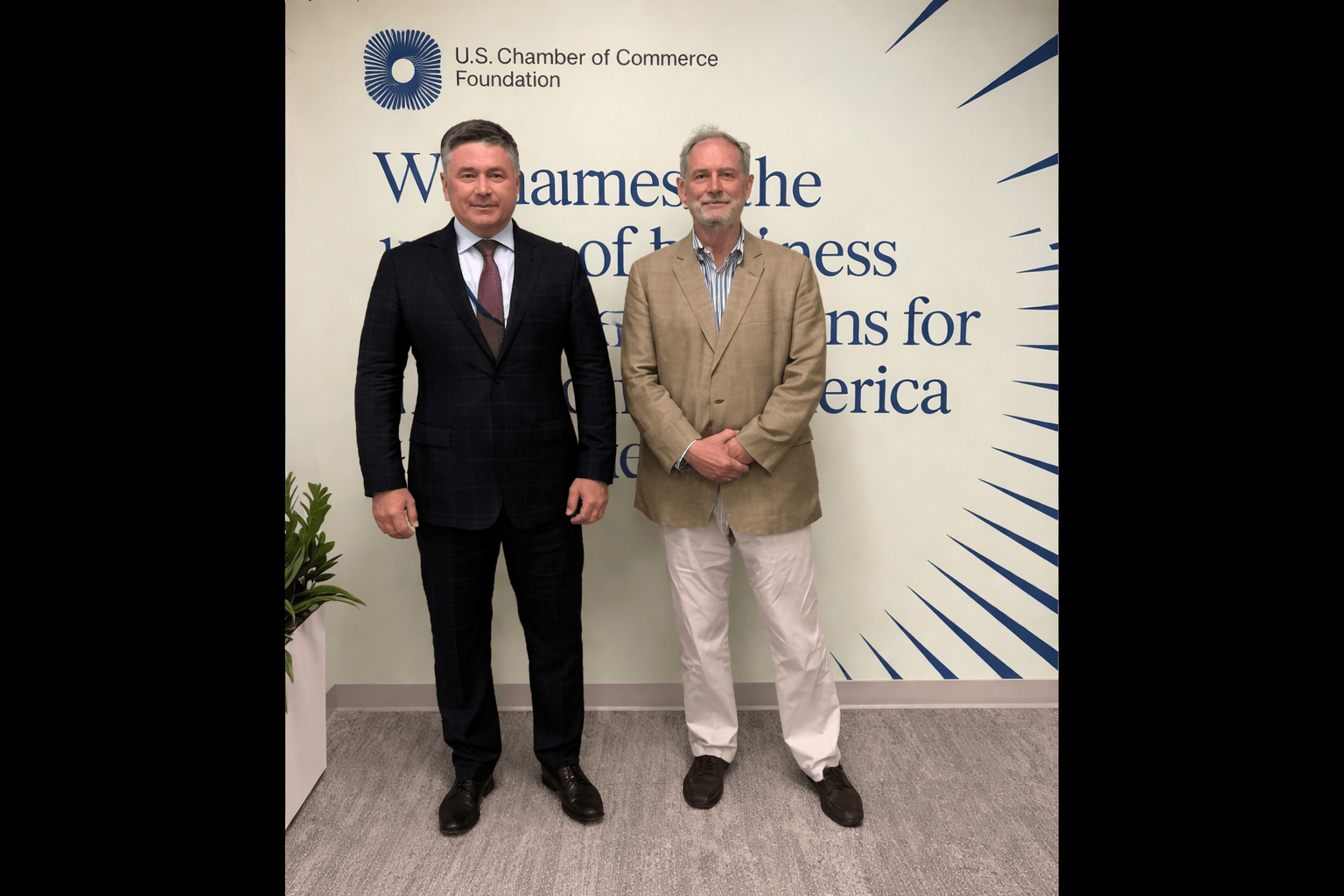
Timur Suleimenov, Governor of the National Bank of Kazakhstan, with Javier Piedra

Kazakhstan’s U.S. Financial Stakes Amid Growth and Inflation

Suleimenov offered a compelling case for Kazakhstan’s economy, citing steady growth, higher investment flows, and a deepening consumer market. Kazakhstan’s economy expanded 6.5% in 2025, marking a third straight year of growth above 5%. GDP per capita surpassed $15,000 – compared to approximately $3,162 in Uzbekistan and about $2,420 in Kyrgyzstan. Fixed-income investments rose 15% year-on-year, and foreign direct investment climbed to 20.5% (from 14.5%), broadening beyond oil.

Suleimenov emphasized the Central Bank’s strong stewardship, citing a new tax and budget code to enhance fiscal discipline and monetary policy that supports investment, stressing that, “We will deal with inflation pressures and external shocks simultaneously while managing cryptocurrencies and private digital payments systems, which can weaken central bank control over money and policy transmission. The markets suggest that we have been doing an excellent job in a complex environment.”

The government, Suleimenov said, is on track to consolidate the budget, with the deficit projected at 2.5% this year, 1.7% next year, and 0.9% by 2028, adding that this will strengthen fiscal-monetary coordination, and noting Kazakhstan’s debt-to-GDP ratio of 24% remains low compared with countries such as the United States (125%), Japan (230%), Italy (137%).

As inflation declined to 11% in March 2026 from 11.7% the previous month, Suleimenov reassured TCA that officials regard it as transitory, saying that “inflation was driven by resilient domestic demand backed by fiscal and quasi-fiscal stimulation, external price pressures (Russian inflation, global food prices), increasing regulated prices (utilities and fuel), and tax reform (a VAT increase from 12% to 16%), with volatile and elevated inflation expectations. For these reasons, we responded with rate hikes and liquidity tightening, bringing inflation down to about 11%, with a further easing expected to single digits by the end of this year.”

Suleimenov reaffirmed that “the United States is integral to Kazakhstan’s financial system and long-term asset strategy.” He noted that Kazakhstan manages approximately $190 billion in long-term assets, including some $75 billion in National Bank reserves, $60 billion in the National Fund, and $55 billion in the unified pension fund. Around one-third of these assets are invested in U.S. securities, while roughly $50 billion is managed by American firms, underscoring deep financial ties beyond industrial investment.

TCA asked how U.S. sanctions and export controls affect Kazakhstan, a concern that was especially acute in the initial stages of the Russo-Ukrainian War. Suleimenov responded that, “Kazakhstan is more deeply integrated into global financial markets than other Central Asian economies, making its custodial banking relationships and broader access to the international financial system especially important. As we said, Kazakhstan can’t risk severing trade ties with its neighbors given its deep economic integration, especially amid tougher Western sanctions; and yet banks have taken steps to tighten compliance around trade with sanctioned countries.”

Digital Finance and New Infrastructure

Suleimenov told TCA that Kazakhstan is leveraging digitalization to upgrade tax systems and improve oversight of state finances. He pointed to the digital tenge, launched in pilot form in 2023, as now fully operational and central to this effort, emphasizing its traceable, programmable nature for ensuring transparent and efficient public expenditure,  particularly as budgets come under pressure from various sources. It is not designed to compete with private retail payment providers.

Kazakhstan’s President Tokayev signed a bill this year to create a new banking framework. The reforms simplify regulation via a two-tier licensing model— basic and full—with Kazakhstan, Suleimenov said, drawing inspiration from the U.S. for those financial institutions that fall into the lighter oversight category. The tenge, the national currency, was also codified into the constitution – a further step towards underscoring sovereign autonomy.

According to Suleimenov, “Kazakhstan is following the U.S. approach in digital finance— studying the GENIUS Act and moving quickly to complete our digital asset bylaws. By May, a comprehensive framework covering crypto, real-world tokens, and tokenized assets should be in place, ensuring the sector operates within clear regulation rather than in a gray zone.”

Kazakhstan wants to become a fully digitized country within three years, and is backing that goal with large-scale infrastructure plans. The Governor of the Central Bank has highlighted a proposed “Data Centers Valley” initiative in northern Kazakhstan, arguing that the region’s cool climate, existing power base and planned energy modernization make it well-suited for digital infrastructure. “The aim is to convert those advantages into computing capacity that can serve both domestic needs and foreign clients,” he stated, underscoring that Kazakhstan is already in talks with major U.S. firms such as Microsoft and Amazon Web Services, and that planned Trans-Caspian internet links would strengthen the country’s appeal as a regional hub for digital investment.

Alatau City, Suleimenov continued, is a planned special-status hub between Almaty and Konayev, which will serve as a new center of growth for Kazakhstan’s economy. Designed as a digitally driven jurisdiction with independent governance, tax, and regulatory systems—building on the Astana International Financial Center model—it aims to foster innovation and advanced tech, extending those strengths into a new smart city. He noted that early investors would gain a first-mover advantage as the city is still under development.

New investment tools are being introduced to broaden the financial system and address investor fears, such as a national crypto fund and a new alternative portfolio in the unified pension fund.

Balancing Openness and Data Protection

“Kazakhstan is seeking the right balance between an open digital economy and safeguarding personal information,” Suleimenov assured the chamber members, and that’s why partnering with tech giants matters. “In this regard, hyperscalers can state their required safeguards, and Kazakhstan will weigh them against its own interests. Our aim is innovation without losing security or compromising privacy. Kazakhstan already has a dedicated law on personal data protection, and that framework rests on the Constitution’s broader guarantees of personal privacy and individual rights rather than on a blind acceptance of impersonal market forces or a separate data code.”

On whether Kazakhstan would follow stricter European data rules or looser U.S./UK models, he said Astana will keep regulations relatively open. He acknowledged periodic calls for tighter controls over digital platforms but said the framework is still flexible, citing Kaspi Bank’s successful model that has accelerated cashless payments but maintains privacy.

The Next Phase of Kazakhstan’s Investment Story

Taken together, Suleimenov’s message was that Kazakhstan is trying to present itself not simply as a resource economy, but as a more disciplined, digitized, and institutionally ambitious investment destination. From fiscal consolidation and inflation management to banking reform, digital finance, and new infrastructure projects, he cast the country’s agenda as one aimed at widening the appeal to international capital while preserving macroeconomic stability. For U.S. investors in particular, Suleimenov’s pitch is that Kazakhstan is far beyond the start-up phase: “We already maintain strong financial ties with the United States and its capital markets, and are now aiming to deepen them through our ongoing reforms and expanded investment under Kazakhstan’s New Constitution.”

Tajikistan-Based Shohin Airlines Aims to Acquire Four Airbus Aircraft

Shohin Airlines, a new private airline registered in Tajikistan, says it is in the final stage of acquiring four planes from the Airbus A320neo line of aircraft.

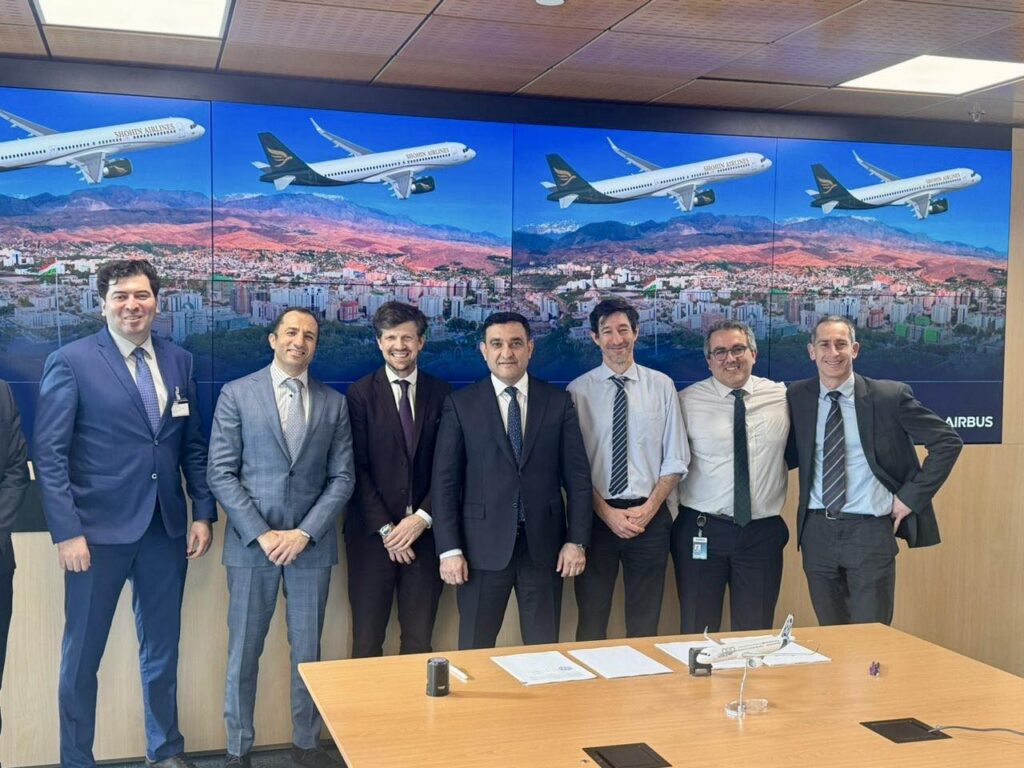
The airline and the European aerospace company met on April 10 to discuss the acquisition of two A320neo and two A321neo aircraft, building on a dialogue that began earlier this year at the Airbus headquarters in Toulouse, France, according to Shohin Airlines.

The discussions with Airbus are showing “steady positive momentum,” and implementation of agreements “will be an important step in developing the airline’s fleet and strengthening its position in the air transport market,” the airline said in a statement on Friday.

Currently, Shohin Airlines operates helicopters for specialized flights. The negotiations with Airbus reflect its plans for significant expansion into commercial passenger traffic.

Last month, the airline announced a $200 million investment from a European investment fund.

Tajikistan Says Two Afghan Smugglers Killed After Crossing Border

Security forces in Tajikistan killed two alleged drug smugglers from Afghanistan who crossed the border overnight, the Tajik government said on Friday.

The incursion happened around 1 a.m. in the Farkhor district of the Khatlon region, and border guards and other national security troops disrupted the attempt to smuggle 25 kilograms of hashish, Tajikistan’s State Committee for National Security said.

“The smugglers disobeyed the border patrol’s lawful demands to surrender and offered armed resistance,” the committee said, according to state news agency Khovar. It said two of the smugglers were killed during “the combat operation” and that a third suspect escaped in the darkness.

The committee described the situation at the border with Afghanistan as “under control.”

On April 8, delegates from border agencies of some countries belonging to the Commonwealth of Independent States, a regional group linked by past Soviet ties, assessed the Afghanistan situation during a meeting in Tajikistan.

“There is general agreement that the unstable military-political and economic situation in Afghanistan will have a destructive impact on border security in the Central Asian region in the medium term,” the agencies said.

Last year, a number of Chinese workers in Tajikistan were killed in cross-border attacks from Afghanistan, prompting the Chinese government to urge the Tajik government to take more robust steps to protect Chinese citizens and businesses.

At the time, Tajik President Emomali Rahmon and senior security officials discussed ways to strengthen the southern border with Afghanistan, whose ruling Taliban movement promised to help find the attackers. The border between the two countries is rugged and mountainous in many places and is about 1,370 kilometers long, making it difficult to monitor.

From From Global Streaming to International Productions: Kazakhstan Filmmakers Go International

Makpal Kursabayeva is a sound engineer whose work has increasingly extended beyond Kazakhstan’s local film industry. Over the years, she has contributed to projects with international teams, from working alongside The Matrix cinematographer Bill Pope to taking part in series produced for global streaming platforms. Her career highlights the expanding role of Kazakhstani professionals in international production and shows that local crews can compete with their Western counterparts. Her work includes on-set recording, post-production, and sound capture in environments ranging from military airbases and nighttime steppes to urban locations.

In an interview with The Times of Central Asia, she discusses how the industry works and why crews from Kazakhstan are competitive in international productions.

TCA: You are a highly experienced sound engineer, but most of your work has been on local projects. Do you think Kazakhstani specialists are competitive in the global market?

Makpal: I have no doubt about it, however confident that may sound. Recently, we worked on an international series filmed in Kazakhstan by Turkish filmmakers. Many department heads were Turkish, but I led the sound department. We worked and communicated seamlessly; there were no barriers at all. And that’s always the case.

I also worked on a commercial project for Chevron, where the cinematographer was Bill Pope, who shot the legendary film The Matrix, the Ant-Man films, Shang-Chi, and more.

TCA: Was the entire crew international as well?

Makpal: The second director was American. Playback equipment was brought from Moscow. It was a mix, bringing together the best. The Russian team even said that such sound equipment isn’t available in Moscow. Technically, we are not lagging behind at all. We also have plenty of talented and highly skilled professionals.

TCA: Were they at all arrogant?

Makpal: Not at all. Bill Pope was great to work with. He’s like a rock star, very open, loves music. We talked about ethnic music; I let him listen to the band Turan. He even asked me to play the dombra. I was a bit nervous because the executive producer was very strict, and I thought she might say I was disrupting the workflow. But he went to her himself and asked, and then she was the one chasing me to make it happen, so the question isn’t whether we can work at a Western level; we already do.

TCA: You’ve also worked with German teams on Emir Baigazin’s films, and with French teams on projects by Yermek Shinarbayev and Akan Satayev’s epic Myn Bala: Warriors of the Steppe?

Makpal: Yes. There was an interesting experience with one Western specialist, I won’t say from which country. I thought they had a different school and that I could learn from him. But while he was good on set, he wasn’t very strong in post-production. It even got to the point where I was teaching him, explaining how to properly edit sound and the technology behind it. Sometimes I would suggest something, and the next day those ideas would be presented as his own. But that didn’t matter much to me, the important thing was that the work was done correctly. I think it’s because we are more versatile specialists, we can work on set and actively participate in post-production. It seems they don’t always have that breadth.

TCA: What is most important to you in working with sound, and which part of the process do you enjoy most?

Makpal: I love the entire process: recording clean sound on set, capturing atmospheres and sync sounds, editing, and sitting in on the final mix. I adore dubbing, it’s about interacting with actors, finding the right intonation, when an actor delivers a line exactly as you imagined it, or even better. That’s pure joy.

TCA: Your projects range from dramas to blockbusters. Which one stands out the most?

Makpal: Every shoot is special, something interesting always happens. For example, on Time of Patriots, we recorded real fighter jets. We were on an airbase, setting up multiple microphones in the field and recording flyovers. It’s an incredibly powerful sound; you have to capture it perfectly.

On another commercial project involving cars, we had to record a vehicle driving at high speed. We placed microphones all over the track, and I got into the car with the driver, directing how to drive to get the right sound. It was quite extreme but very exciting.

TCA: In Yermek Tursunov’s Shal, you even worked with wolves?

Makpal: They were actually wolf-dog hybrids. They were brought from Russia and were very friendly, even wagging their tails, which annoyed the director because it didn’t look wolf-like. Sometimes I even walked three wolves on leashes.

It was a very unusual process. We were in a canyon, without the film crew. My colleague and I set up microphones, and I started howling, and the wolves responded. That’s how you capture the sound. We were on the same wavelength. I remember that shoot very fondly. I also had to record the sound of a snowmobile, and they gave me rides on it, one of those rare moments where work and enjoyment align perfectly.

TCA: Have you experienced extreme conditions on set?

Makpal: Every time, especially due to the weather. Once, during a shoot, a young cameraman asked me to film a message for his mother, saying, “Mom, everything is fine, I’m warm.” Then we had a 20-hour shoot in freezing conditions. Emergency services announced school closures due to a snowstorm, we were still filming. At least we could occasionally warm up at a checkpoint. But that cameraman didn’t step inside once in 20 hours. I think he was traumatized after that.

TCA: You must be constantly freezing, most filming is outdoors, right?

Makpal: We do freeze, even with the warmest gear, special boots, heated insoles powered by power banks. Once I got so cold I thought, “Can I please never work in winter again?” Somehow, that wish came true, I didn’t work winters for a while. Of course, if I’m called, I’ll go but I’d rather avoid the discomfort.

TCA: Your whole life seems to take place on set. Do you ever feel like life is passing you by?

Makpal: Yes. As long as I can remember, I’ve been on set. I feel like I’ve missed important moments in my life. When Seven Days of May premiered, I came home and discovered my 75-year-old father was seriously ill. Two weeks later, he passed away, I learned about it on set, at the end of the workday. It was painful, but I didn’t allow myself to grieve and returned to work on the third day.

When my grandmother passed away, I was in the middle of a 30-hour editing session on a critical project. The entire studio was working. I didn’t even attend the funeral, and I regret that.

TCA: Was that a kind of defense mechanism?

Makpal: Probably. It was hard to process. But I wasn’t only on set during difficult moments, I missed celebrations too. For example, I didn’t celebrate my graduation.

I graduated with honors. My thesis project was Prokofiev’s cantata Alexander Nevsky, a large-scale work with a symphony orchestra and double choir. We recorded and mixed it, and I used it as the basis of my thesis, adding a theoretical part which I actually wrote on set during The Sky of My Childhood.

I came in for one day to defend it. My supervisor, Sergey Lobanov, was on the committee, and right after that he asked me to work on post-production materials with Gérard Depardieu. Everyone was celebrating, and I was editing until late at night.

I always felt everything depended on me, that I had to do it perfectly, that no one else could do it.

TCA: What has changed in the industry over the years?

Makpal: Everything. The biggest change is that we now achieve 100% clean sound. The first time I managed that was on Kempir by Yermek Tursunov. The cast was exceptional: Gaziza Abdinabieva, Kadyrbek Demessinov, Isbek Abilmazhinov, Murat Nurasylov, and legends like Asanali Ashimov and Meruert Utekesheva. It would have been a shame to dub them.

At the time, the producer kept asking me what percentage of clean sound we would get. I said, “I don’t know, I’m not Nostradamus.” In the end, we didn’t dub anything, the entire film used original sound. That was a shock, because it had rarely been done before.

TCA: Has the industry become more technological?

Makpal: Yes, but there are still many nuances that technology can’t replace. For example, it’s now very hard to find quiet locations. We sometimes worked from 2 a.m. to 5 a.m. just to capture silence. Once, we had only one night to record all background sounds before a lockdown began. If we hadn’t made it in time, it wouldn’t have been possible at all.

TCA: How sensitive are directors to sound?

Makpal: It varies. Some are very sensitive, others less so. Some like to sit through dubbing and relive everything, the shoot, the edit. Others get tired of their own material and don’t attend at all.

TCA: But you ensure everything sounds right?

Makpal: It depends. The director is responsible for acting if a line is delivered insincerely or incorrectly. Editors and script supervisors handle dialogue continuity. My role is to ensure the technical quality and clarity of sound, it has to be clean, rich, and expressive. If a plane flies overhead or a phone rings, I ask for another take. Sometimes we decide to fix it in post-production. I always explain what can be cleaned later and what cannot, then the team decides how much they are willing to adjust for sound quality.

TCA: What most often interferes with good sound on set?

Makpal: Location is key. The main issue isn’t phones — they’re usually switched off — but the environment itself: city noise, machinery, random sounds. Technology has advanced a lot, and we can clean many things in post-production but not everything. That’s why the main task is to capture sound correctly from the start.

TCA: Do you have a dream project or director you’d like to work with?

Makpal: Recently, I realized that all my professional dreams are already coming true. I’m working with the people I always wanted to work with.