• KGS/USD = 0.01144 0%
  • KZT/USD = 0.00212 0%
  • TJS/USD = 0.10456 0.19%
  • UZS/USD = 0.00008 0%
  • TMT/USD = 0.28490 0%
  • KGS/USD = 0.01144 0%
  • KZT/USD = 0.00212 0%
  • TJS/USD = 0.10456 0.19%
  • UZS/USD = 0.00008 0%
  • TMT/USD = 0.28490 0%
  • KGS/USD = 0.01144 0%
  • KZT/USD = 0.00212 0%
  • TJS/USD = 0.10456 0.19%
  • UZS/USD = 0.00008 0%
  • TMT/USD = 0.28490 0%
  • KGS/USD = 0.01144 0%
  • KZT/USD = 0.00212 0%
  • TJS/USD = 0.10456 0.19%
  • UZS/USD = 0.00008 0%
  • TMT/USD = 0.28490 0%
  • KGS/USD = 0.01144 0%
  • KZT/USD = 0.00212 0%
  • TJS/USD = 0.10456 0.19%
  • UZS/USD = 0.00008 0%
  • TMT/USD = 0.28490 0%
  • KGS/USD = 0.01144 0%
  • KZT/USD = 0.00212 0%
  • TJS/USD = 0.10456 0.19%
  • UZS/USD = 0.00008 0%
  • TMT/USD = 0.28490 0%
  • KGS/USD = 0.01144 0%
  • KZT/USD = 0.00212 0%
  • TJS/USD = 0.10456 0.19%
  • UZS/USD = 0.00008 0%
  • TMT/USD = 0.28490 0%
  • KGS/USD = 0.01144 0%
  • KZT/USD = 0.00212 0%
  • TJS/USD = 0.10456 0.19%
  • UZS/USD = 0.00008 0%
  • TMT/USD = 0.28490 0%

Kazakhstan to Build New Power Generation Facilities

To ensure Kazakhstan’s energy security and increase its export potential, the Ministry of Energy has adopted a development plan for the country’s electrical power industry.

On March 5th, the Minister of Energy, Almasadam Satkaliev reported that under the new plan, scheduled to run until 2035, existing power generating facilities are to be modernized alongside the commission of new facilities with a total capacity of 26 GW.

In the southern regions of Kazakhstan, gas, and steam generation projects with an installed capacity of about 2.3 GW are due for completion in 2025-2026. The projects comprise combined cycle gas turbines in Turkestan and Kyzylorda with a capacity of 926.5 MW and 240 MW, as well as combined cycle power generation units at two heating plants in Almaty with a capacity of 544 MW and 557 MW.
Another combined cycle power plant with a capacity of 1.1 GW will be constructed in the Kyzylorda region.

The plans also include new gas and coal-fired power generation projects in Kazakhstan with a total capacity of 6.7 GW and the conclusion of an agreement with Russia for the construction of coal-fired thermal power plants in the cities of Kokshetau, Semey, and Ust-Kamenogorsk.

To achieve a 15% share of electricity generation by renewable energy sources by 2030, annual auctions will be held for a total capacity of over 6 GW (1,270 MW in 2024). Renewable energy projects with a total capacity of 3 GW are currently progressing in collaboration with Total Energies (France), Acwa Power (Saudi Arabia), and Masdar (UAE).

Eleven renewable energy facilities with a total capacity of 259 MW are to be commissioned this year.

Last month, Energy Minister Satkaliev reported that in 2023, Kazakhstan consumed 115 billion kWh of electrical energy, compared with 112.9 billion kWh in 2022, and produced 112.8 billion kWh, the same amount as in 2022. Last year Kazakhstan imported 3.4 billion kWh, and exported 1.4 billion kWh. In 2024, the country plans to generate 115 billion kWh.

Last year, the volume of electricity generated by renewable energy facilities amounted to 6.675 billion kWh, including 3.8 billion kWh from wind power plants, 1.8 billion kWh from solar plants, and 993.8 million kWh from hydropower plants. The generation of electricity from renewable sources in 2023 thus amounted to just 5.9% of the country’s total.

Looking to a greener future, Kazakhstan’s new goal is to achieve a 15% share of renewable energy sources in power generation by 2030, and a 50% share by 2050.

Kazakhstan Opens Al-Farabi Innovation Hub in Riyadh

A joint project between Kazakhstan and Saudi Arabia, the Al-Farabi Innovation Hub has newly opened in Riyadh.

As reported on March 5th by the Kazakh Ministry of Digital Development, Innovation and Aerospace Industry, the role of the Hub is to attract talented entrepreneurs and innovative start-ups from Kazakhstan to Saudi Arabia and support their relocation and growth in the region by providing seed investment from the Tumar Venture Fund as well as incubation and acceleration programs.

“Kazakhstan already has experience in growing start-ups,” explained Kazakh minister Bagdat Musin. “Five years ago, we launched the Astana Hub, which has become one of the leading technology parks in Central Asia. We have also engaged global partners such as Google, Draper University, StartX, Microsoft, and the World Bank, to provide access to the best cutting-edge solutions. I believe that the opening of the Hub will allow Kazakhstan and Saudi Arabia to strengthen ties and make a qualitative contribution to economic development.”

The Hub’s General Director Aslan Sultanov went on to state, “The Al-Farabi Innovation Hub will complement the infrastructure of the venture industry in Kazakhstan, giving start-ups from Central Asia and the Caucasus the opportunity to expand into Middle East and North Africa (MENA) markets, which comprise almost 493 million people.”

The new Hub follows the launch on March 1st, of the Qaz Steppe Innovation Hub in Dubai to promote Kazakh IT services to international markets.

Centre for Environmental Diagnostics of Vehicles Opens in Tashkent

On March 5th, Uzbekistan’s President Shavkat Mirziyoyev visited a new centre for environmental diagnostics of motor vehicles in Tashkent.

Environmental issues have become a major concern in Uzbek’s capital city, especially air pollution caused by harmful emissions from traffic.

In a measure to stall the sharp increase in air pollution, the centre first assesses the level of harmful substances emitted by motor vehicles and depending on results, attaches color-coded stickers with chips to vehicles’ windshields.

Plans are in place to divide the city’s territory into several ecological zones. Entry will be limited in accordance with the level of pollutants emitted by vehicles, identified by their red, yellow, or green stickers. Drivers of vehicles that violate the rules will be automatically fined and the resulting revenue, invested in incentives to further improve the environment.

The government plans to expand the initiative by installing some 100 automatic air monitoring stations and creating 84 registration and diagnostic centres for vehicles across the country.

In a move towards tackling air pollution, the government will also encourage the purchase of greener, electric vehicles by reducing the fee for state license plates.

UNDP Gives Boost to Fish Farming in Uzbekistan

The European Union delegation to Uzbekistan, along with the United Nations Development Program (UNDP), has delivered equipment to Uzbekistan’s Scientific Research Institute of Fish Farming to support more sustainable fish-farming methods. The new equipment will help to save water and improve water quality.

Wim Riepma, head of cooperation for the EU delegation to Uzbekistan, commented “healthy fish means healthy food and healthy people. Filters also help to improve the environment, as the fish farm will emit fewer pollutants. In addition, the use of solar water heaters, which will greatly improve fish growth in the early stages of development, contribute to energy savings.”

Uzbekistan, with its fish consumption of 3.5-4 kg per person per year, is far below the World Health Organization’s (WHO) recommended norm of 16 kg. The reason for this is the country’s lack of access to the sea — and its outdated, river-based fish-farming methods. However, the country is trying to remedy the situation. This year, as part of a program called Every Family is an Entrepreneur, Uzbek entrepreneurs can access unsecured loans of up to $4,000 for fish-farming projects.

The equipment donated by the EU — under its Innovation in Agriculture (EU-AGRIN) project — will contribute to the development of scientific research, and improve the work of the Fisheries Research Institute and the affiliated vocational school in Fergana province. In addition to the practical benefits of an increase in fish production, the project will also contribute to creating jobs in rural areas.

The project, amounting to 4.15m ($4.5m), is financed by the EU and will last for four years. EU-AGRIN is a UNDP project aimed at promoting innovative solutions and cooperation in agriculture. So far the project has established partnerships with 18 different innovation groups.

At the end of 2023, Uzbekistan had 5,775 fish farms where 24 species of fish are cultivated for human consumption. Last year the aquaculture industry supported 2,500 jobs in the country.

Kazakhstan Transfers Pension-Fund Assets Worth $5 Billion to Foreign Managers

The National Bank of Kazakhstan has announced that pension savings amounting to $5.18bn have been gradually transferred abroad to be managed by 10 foreign companies. According to representatives of the bank, this amount is only 14.1% of the Unified National Pension Fund’s (EPPF) total assets.

Last month $2.3m from the fund was transferred to the American investment company PIMCO — short for Pacific Investment Management Company.

The National Bank held a tender process in 2023 to select the foreign companies PIMCO and TCW as external managers for the global emerging-market bonds mandate, and JP Morgan was selected as the standby manager. Currently, agreements on investment management of pension assets of the EPPF are being developed with these companies.

At present, foreign asset managers continue to be attractive resources for EPPF in terms of investing its currency portfolio of assets under the mandates termed global shares, global emerging-market bonds, and global investment-grade corporate bonds.

Plastic Bags, Utensils to Be Met With Fines in Kyrgyzstan’s Issyk-Kul Basin

A law imposing fines on the import and sale of plastic bags and utensils is aimed at reducing the harmful effects of polymeric materials on health and the environment in the Kyrgyz Republic, according to the press service of the Ministry of Natural Resources, Ecology and Technical Supervision of Kyrgyzstan.

The ban will take effect in the resort and recreational area of Issyk-Kul, as well as in reserves and natural parks of Kyrgyzstan. The ban was signed by President Japarov last year, since when deputies and the Ministry of Natural Resources of have been working on finalizing its details. One sticking point is that the authorities still can’t decide whether to ban all plastic or to make an exception for some products.

Shashlyk vendor, Issyk-Kul; Photo: TCA

“The list of plastic products banned for circulation includes all kinds of disposable plastic utensils, disposable plastic packaging for food, plastic bottles, disposable plastic packaging for eggs, plastic coffee capsules, [and plastic] bags for food,” the law states. But, as the Ministry of Natural Resources notes, the law is still being amended and there is a lack of clarity.

Meanwhile, food vendors in the Issyk-Kul region say that not all citizens are ready to give up plastic bags and bottles. Therefore, while large stores in Issyk-Kul have stopped selling disposable tableware and replaced them with paper products and Tetra Pak substitutes, the law is poorly enforced in markets and smaller outlets.

Lake Issyk-Kul; Photo: TCA

According to the Ministry of Natural Resources, Ecology and Technical Supervision, the Supervision Service has not imposed a single fine so far, with only warnings being issued. However, they say that as soon as all of the controversial issues have considered, sellers and producers will be fined. So far, the law applies only to sellers and manufacturers of plastic products. Private individuals can use bags, bottles and disposable tableware.

In January of this year, the Issyk-Kul Region became the first in the country where a ban on the circulation of plastic was introduced. From 2027, the law will be expanded to ban the use of plastic containers throughout the country.

Businesses are not satisfied, however, complaining that their opinion was not taken into account in drafting the law. In their opinion, it would have been better to prescribe economic incentives for businesses. Currently, they argue, all soft drinks and vegetable oils are bottled in plastic bottles, and it’s difficult to find replacements for them. In addition, Kyrgyzstan does not yet have large production facilities for alternative containers such as paperboard-and-foil Tetra Paks or glass bottles. Most plastic goods are imported into Kyrgyzstan from abroad, mainly from countries which are not planning to give up disposable plastic containers and are only increasing their production.

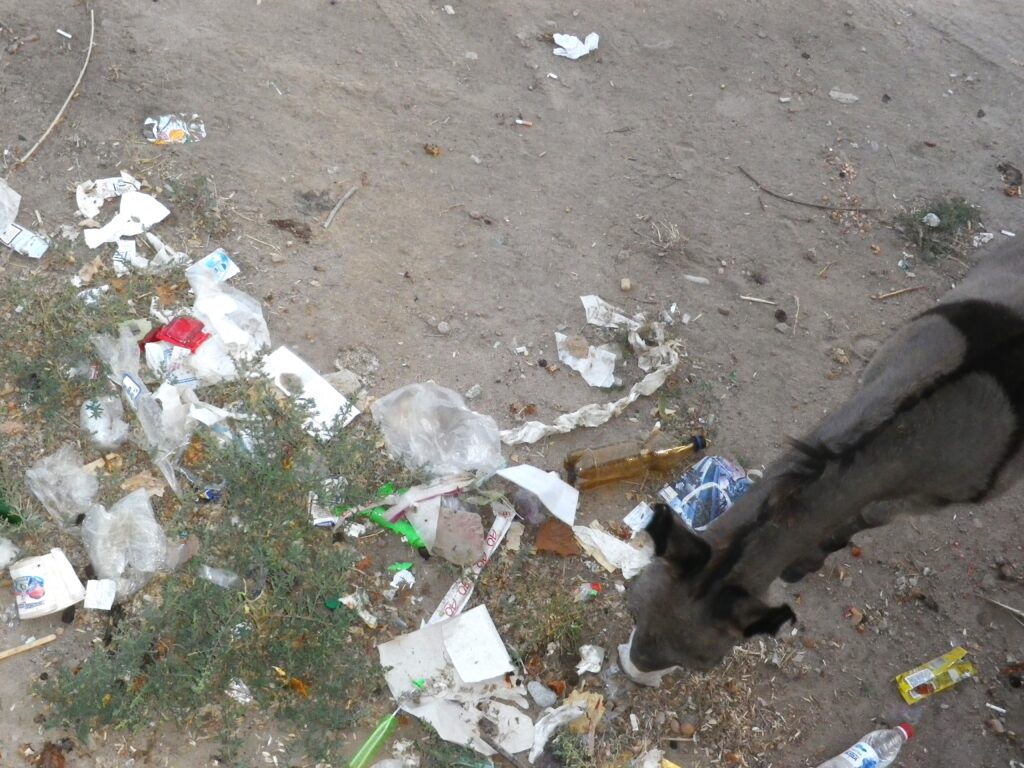
Meanwhile, Kyrgyzstan’s environmentalists have long been sounding the alarm. The biggest danger to the country’s ecology is plastic bottles and cellophane bags, which can be scattered by the wind over a large area. For example, the problem of toxic plastic pollution is particularly acute in Issyk-Kul. Many tourists leave plastic bags and bottles on the shore of the lake, and as a result, at the end of the tourist season the Ministry of Emergency Situations retrieves tons of plastic products from the lake. In addition to disposable containers and bags, they also found poachers’ fishing nets made of synthetic materials, which had accumulated over time and polluted the lake.

Kyrgyzstan does not have a waste processing plant, nor does it have a separate waste collection system. As a result, most disposable bags and bottles are left in landfills. To date, only some private enterprises recycle plastic, but they are wholly insufficient to solve this persistent problem.