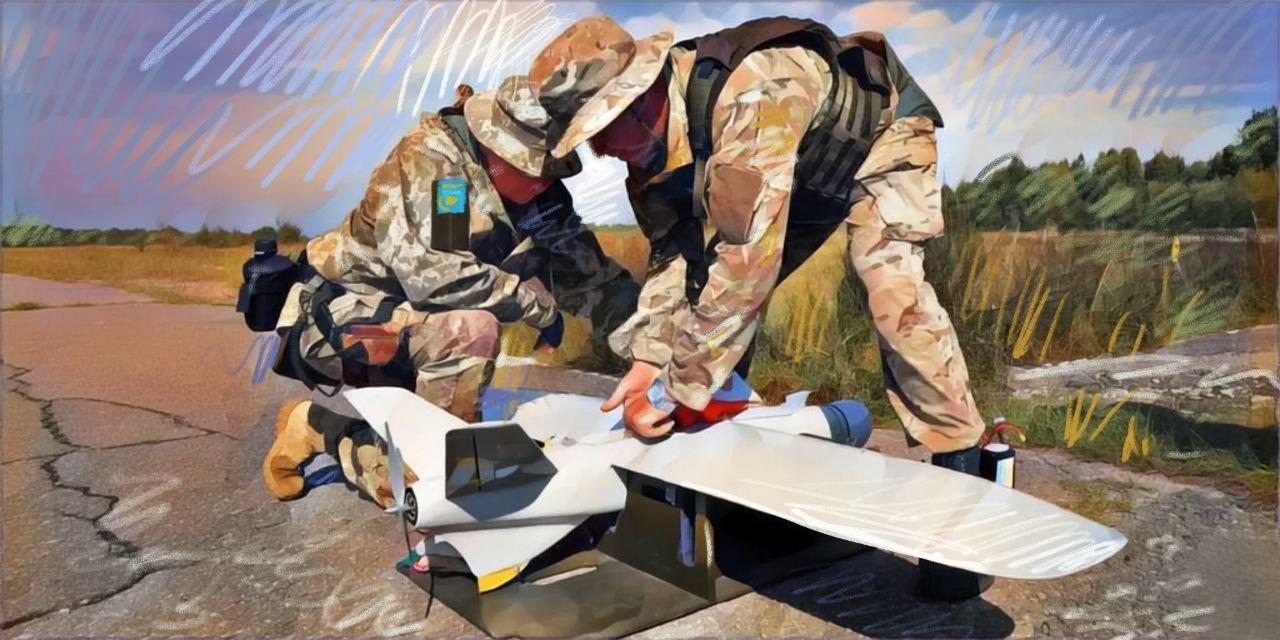
A new drone-related incident in western Kazakhstan has reinforced a pattern that is becoming harder to dismiss. Police in West Kazakhstan Region confirmed that an object resembling an unmanned aerial vehicle was found in the Akzhayik district near the village of Karaulytobe. Images circulating locally appeared to show a largely intact fixed-wing drone. No casualties or damage were reported.
“The object was discovered outside a populated area. All circumstances of the incident are being investigated,” the department said. Reports and images of the object initially circulated on messaging apps before being confirmed by regional authorities.
This latest discovery fits a sequence of similar incidents across the same region over the past year. As previously reported by The Times of Central Asia, on March 18, 2025, a drone about three meters long was found near Atameken village in Taskala district, around 60 kilometers from the district center.
That case followed another discovery on February 18, 2025, in the Bokeyorda district, where a smaller unidentified object was recovered in a remote area. Within days, further debris was found near the Russian border in Zhanibek district, marking the third such case in a single month.
The pattern continued later in the year. On October 23, 2025, a drone of unknown origin exploded near Kyzyltal village in the Burlin district. Residents reported an explosion that damaged rooftops and left a crater near the village, although no casualties were recorded. Authorities opened a criminal case, with the military prosecutor’s office involved alongside police and emergency services.
Similar findings have appeared beyond the West Kazakhstan Region. On June 19, 2025, fragments resembling a UAV were found in Mangistau Region near the Bolashak border station. The debris was located in an uninhabited area, and no damage was reported.
Taken together, these incidents form a clear geographic cluster along Kazakhstan’s western frontier. Most occurred near the Russian border and in sparsely populated areas. The objects were typically discovered after impact, with no confirmed flight paths or official attribution.
Investigations into earlier cases have linked several incidents to areas used for Russian military testing. Western Kazakhstan includes zones connected to long-standing Russian defense activity under bilateral agreements, and parts of the region remain associated with testing operations.
This context explains the cautious official response. None of the incidents have been described as attacks, and none have been attributed to a foreign state. At the same time, the repeated discoveries point to a growing exposure that goes beyond routine testing.
The wider regional environment has shifted rapidly. The war in Ukraine has driven a sharp expansion in drone use across Eurasia. Both Russia and Ukraine deploy long-range UAVs for reconnaissance and strikes, often over extended distances.
Drone activity has already affected infrastructure linked to Kazakhstan’s economy. On February 17, 2025, a drone attack targeted the Caspian Pipeline Consortium’s Kropotkinskaya pumping station in Russia’s Krasnodar region, part of a key export route for Kazakh oil. Further attacks on offshore loading facilities and terminals continued later in the year, with additional incidents in early 2026. This string of incidents disrupted operations and highlighted Kazakhstan’s indirect exposure to drone warfare beyond its borders. Even when incidents occur outside the country, they can affect the infrastructure that underpins its economy.
The repeated discoveries inside Kazakhstan show a different form of exposure. They do not involve confirmed strikes or deliberate targeting but reflect spillover from expanding drone activity across shared airspace. Western Kazakhstan’s proximity to Russian military activity increases the risk of unintended incursions. The terrain is flat and sparsely populated, allowing UAVs to travel long distances without detection, while navigation failures or signal loss can push them off course.
As drone use expands, such incidents are becoming more likely. More systems are operating over longer ranges, increasing the risk of cross-border drift. Countries near testing zones or conflict-adjacent regions face growing exposure, even without direct involvement.
Kazakhstan has begun to respond. Following the Burlin district explosion, the Ministry of Defense introduced additional measures to strengthen airspace monitoring and prevent unauthorized aerial crossings.
The incidents in western Kazakhstan show how this challenge is developing. The country is not a battlefield, but it lies close to areas where military activity continues at scale. Repeated drone discoveries now show that Central Asia is no longer insulated from the technological and military changes reshaping nearby regions.